

Brexit reset sterling into a permanently higher-volatility regime with a persistent downside bias, and it stretched the time between invoice and payment on cross-border trade. The immediate priority for any UK treasury team is a fresh exposure map: know what you owe and are owed, in which currency, over what horizon, then recalibrate hedge ratios against that map rather than against pre-2016 assumptions. Watch realized volatility, risk reversals, and your invoice-currency mix as the tripwires that tell you when policy needs to move again.
TL;DR:
- Sterling now exhibits higher volatility and a persistent downside bias, requiring continuous monitoring of realized volatility, risk reversals, and forward points.
- Political risk, trade friction, and market structure shifts have amplified sterling's sensitivity to headlines, trade delays, and liquidity thinness.
- UK exporters have increasingly invoiced in dollars, transferring currency risk but not eliminating it, while overall exposure has grown in absolute terms since 2016.
- Hedge ratios should be recalibrated using post-2016 volatility data, with horizons matching actual payment delays, and active management rather than reactive hedging.
- Implementing real-time exposure tracking, scenario stress tests, and compliance with evolving UK regulations is essential for effective FX risk management post-Brexit.
Table of Contents
- How Sterling Changed After the Brexit Vote
- Why Brexit Moved Sterling: Politics, Trade Friction, and Market Structure
- How Corporate FX Exposure Changed at the Firm Level
- Recalibrating Hedge Ratios, Horizons, and Budgets
- Choosing the Right Hedging Instrument for Each Exposure Type
- Running an FX Exposure Audit: A Step-by-Step Playbook
- How CorpHedge Approaches Post-Brexit Currency Risk
- What Post-Brexit Regulatory Change Means for FX Risk Practices
- Real-World Lessons From UK Companies Managing Sterling Risk
- Stress Testing Sterling: Building Scenarios That Actually Hold Up
- A Prioritized Checklist for CFOs Managing Brexit Currency Risk
- Get Started: CorpHedge for UK Treasuries Managing Sterling Risk
- Sources
- FAQ
How Sterling Changed After the Brexit Vote
Sterling didn't just fall after the June 2016 referendum. It fell, then settled into a wider, choppier trading band that has never fully calmed down. The pound lost a significant amount against the US dollar in the weeks following the vote, a move driven largely by a spike in political risk premium rather than any change in economic fundamentals overnight, as City academic research on Brexit and the pound documents. That was the first shock. It wasn't the last.
By early 2021, sterling remained notably weaker against the euro than it had been immediately before the referendum, according to The Economics Observatory's analysis of sterling's value. Five years of political noise, negotiation deadlines, and a general election over a hung Parliament kept repricing the currency lower, in fits and starts rather than a single clean drop.
Statistic Callout: Sterling traded markedly weaker against the euro at the start of 2021 than immediately before the June 2016 referendum, and it lost a significant amount against the dollar in the weeks right after the vote. Two separate 15% moves, against two different currencies, at two different points. That's the scale of repricing treasuries are working against.
What matters more for a treasury desk than the headline depreciation is what happened to volatility itself. Pre-2016, sterling traded like a G10 currency with a reasonably stable range against the euro and dollar. Post-2016, it started behaving more like a risk asset, according to Convera's analysis of Brexit's impact on GBP, meaning it sells off harder in risk-off environments and carries a structural downside bias baked into option pricing. That downside bias shows up as skewed risk reversals, where put options on sterling cost more than equivalent calls. It's a quiet, persistent tax on anyone hedging GBP exposure.
Three metrics deserve a permanent spot on your treasury dashboard:
- 30/90/180-day realized volatility on GBP/EUR and GBP/USD, tracked against the pre-2016 baseline, not just year-over-year.
- Risk reversals on your key pairs, which reveal whether the market is still pricing a persistent downside skew into sterling.
- Forward points, which tell you how much interest-rate differentials are adding to (or subtracting from) your hedging cost on any given tenor.
None of these figures require a Bloomberg terminal to track anymore. A platform built for treasury use can pull live implied vol and forward curves automatically. If your team is still eyeballing spot rates once a week and calling that risk management, you're flying without instruments in a storm that started ten years ago and hasn't fully cleared. Our own breakdown of FX volatility metrics walks through how to build that dashboard properly.
Why Brexit Moved Sterling: Politics, Trade Friction, and Market Structure
Three separate channels drive sterling's post-Brexit behavior, and each one demands a different kind of policy response.
The political-risk channel is the most visible. Every time a new negotiation deadline, leadership contest, or trade-deal headline hits, sterling moves before the underlying economic data does. This isn't irrational. Currency markets price probability distributions of future outcomes, and Brexit kept handing traders new, wide distributions to price. A referendum result nobody expected taught the market that UK political risk had to be priced at a premium going forward, and that premium has never fully unwound. It resurfaces around fiscal events, elections, and any hint of constitutional friction (Scottish independence chatter is a recurring trigger).
The trade-friction channel is less visible but arguably more important for corporate treasuries specifically. Customs declarations, rules-of-origin checks, and new VAT mechanics on UK-EU trade didn't just add cost. They added time. Shipments that used to clear in a day now sit in customs queues, and payment terms that used to run 30 days now often stretch to 60 or 90 to account for the friction, as Cambridge Currencies' review of post-Brexit FX conditions for UK businesses points out. Every extra week between invoice and settlement is a week of open FX exposure that didn't exist in 2015. That's a duration problem, not just a price problem, and it means your hedging horizon needs to stretch to match your new payment terms, not the other way around.
The market-structure channel is the one most finance teams underrate. Reduced foreign holdings of UK assets, changes to euroclear and settlement infrastructure, and a broader shift toward dominant-currency invoicing (more on that below) have thinned liquidity in certain sterling crosses at certain times of day. Thinner liquidity means bigger moves on the same order size, particularly around UK data releases or European market close. A block trade that would have passed through GBP/EUR without a ripple in 2015 can now move the rate several pips.
Put these three channels together and you get a currency that:
- Reacts more sharply to UK-specific political headlines than most G10 peers.
- Carries longer effective exposure windows because of trade friction, not because companies chose to hedge further out.
- Trades with less depth at the margin, amplifying moves that used to be absorbed quietly.
None of this means sterling is doomed to keep falling. It means the shape of the risk changed. Volatility clusters differently now, and the events that used to be non-events (a leadership reshuffle, a fisheries dispute, a Northern Ireland protocol update) can now move your hedging P&L. Corphedge built its live position tracking specifically because manual monitoring can't keep pace with a currency that reacts to headline risk this fast. For more on how these volatility drivers interact with corporate exposure generally, our piece on corporate FX risk and volatility is worth a read.
How Corporate FX Exposure Changed at the Firm Level
The most consequential shift in UK corporate FX exposure since 2016 has nothing to do with the exchange rate itself. It's about which currency the invoice is written in.
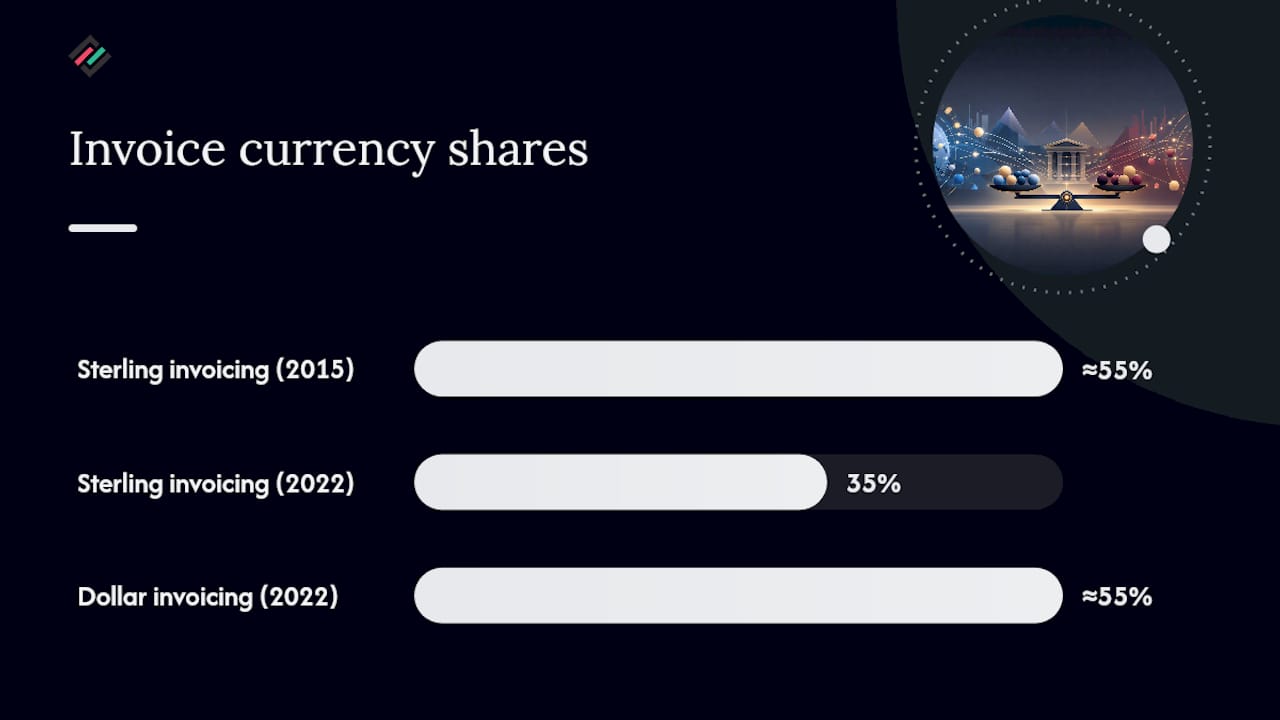
UK exporters, faced with a weaker, choppier pound, moved a striking share of their invoicing away from sterling and into US dollars. The share of non-EU UK exports invoiced in pounds fell significantly over the period from 2015 to 2022, while dollar invoicing rose substantially over the same period, according to CEPR/VoxEU's research on currency mismatches and dollarisation. That's not a marginal adjustment. It's a wholesale change in how a large chunk of UK trade prices itself.
Statistic Callout: Sterling invoicing on non-EU UK exports dropped from roughly 55% to 35% between 2015 and 2022, with dollar invoicing rising to nearly 55% over the same stretch. Most exporters who made that switch did it to escape sterling volatility, but it swapped one exposure for another.
Here's the catch that gets missed in most boardroom discussions: dollarising your export invoicing doesn't remove currency risk. It relocates it. A UK manufacturer that used to invoice in pounds and absorb GBP volatility now invoices in dollars and absorbs USD/GBP translation risk on the way home instead. Export demand for these firms now reacts more directly to dollar moves than it used to, a dynamic CEPR's analysis of UK export dollarisation flags as a genuine structural shift in sensitivity, not a cosmetic one.
Meanwhile, firm-level exposure itself simply grew. Panel research on FTSE 100 companies found that exchange rate exposures increased significantly in absolute terms after the 2016 referendum, according to City's working paper on exchange rate exposure and Brexit. Bigger swings in the currency mean bigger swings in reported earnings for firms with meaningful overseas revenue or costs, whether or not those firms did anything differently operationally.
Three distinct exposure types are worth separating clearly, because they get muddled constantly in corporate risk registers:
- Transaction exposure: the risk on a confirmed invoice or purchase order denominated in a foreign currency, settling on a known future date.
- Translation exposure: the accounting impact of converting a foreign subsidiary's balance sheet back into sterling at each reporting date, even when no cash actually moves.
- Economic exposure: the longer-run competitive impact of currency moves on pricing power and demand, the kind that shows up in margin erosion rather than a single P&L line.
Importers feel the depreciation side hardest. A UK retailer buying stock priced in dollars or euros faces higher landed costs every time sterling weakens, with no natural offset unless it also exports in the currency that's strengthening. Exporters who dollarised get some natural protection against sterling weakness specifically, but they've traded that for direct sensitivity to dollar strength against every other currency in their supply chain. Neither position is automatically safer. Both need active management.
Recalibrating Hedge Ratios, Horizons, and Budgets
Most UK treasuries built their hedging policy before 2016, using historical volatility that no longer describes the market they're operating in. That gap is the single most common failure point Corphedge sees when reviewing a new client's existing FX policy.
Here's a practical sequence for bringing hedge ratios back in line with the post-Brexit reality:
- Rebuild your volatility benchmark using post-2016 data only. If your policy still references pre-referendum standard deviations to size hedges, you're underhedging by design. Recalculate realized volatility over rolling 3 and 5-year windows that exclude the pre-Brexit period as a baseline.
- Raise your hedge ratio on the exposures most exposed to political-risk spikes. There's no single universal number, but many treasury advisors now recommend moving core hedge ratios up by 10 to 20 percentage points versus pre-2016 policy on GBP/EUR and GBP/USD confirmed exposures, reflecting the higher realized vol.
- Match your hedging horizon to your actual payment terms, not your old policy tenor. If customs friction pushed settlement from 30 days to 60 or 90, your hedge book needs tenor buckets that reach that far, or you're leaving the back half of every transaction unhedged.
- Build tenor buckets with explicit percent-hedged targets per bucket. A common structure: 90 to 100% hedged for the 0 to 3 month bucket, 60 to 80% for 3 to 6 months, tapering to 30 to 50% for 6 to 12 months as forecast confidence declines.
- Price the cost of the new policy before you present it, not after. Forward points reflect the interest-rate differential between sterling and the counter-currency, so a higher-rate environment on one side changes your carry cost mechanically. Option premia move with implied volatility, so a wider vol regime means every collar or vanilla option costs more than it would have in 2015.
That last point is where a lot of hedging proposals die in committee. A finance director who approved a hedging budget in 2014 and hasn't revisited the assumptions is going to balk at today's premium levels, unless the numbers are framed clearly against the cost of not hedging. MillTech's guidance on FX hedging for UK corporates notes that while hedging costs have risen with higher option premia and wider forward point spreads, the core toolkit, forwards, options, and swaps, remains fully available through FCA-regulated counterparties. The instruments haven't changed. Their price has.
Pro Tip: Present your hedge ratio recalibration alongside a "cost of inaction" scenario, showing what a 10% adverse move would have done to last year's unhedged margin. Committees approve budget increases far faster when the alternative is quantified, not implied.
Practitioners increasingly push UK corporates away from intermittent, reactive hedging (buying cover only when a big payment is looming) toward structured programmes with regular exposure audits and pre-set rules for when hedge ratios adjust, a shift MHA's treasury advisory team has been recommending consistently since the referendum. Our guide to building a structured currency risk management strategy covers how to move from ad hoc cover to a rules-based program step by step.
Choosing the Right Hedging Instrument for Each Exposure Type
Not every exposure needs the same tool, and treating them identically is one of the more expensive mistakes treasury teams make.
Forwards fit confirmed flows. If you have a signed contract for a known amount settling on a known date, a forward contract locks the rate with no premium cost, just the forward points reflecting the rate differential. This is the cleanest instrument for the transaction exposure sitting in your 0 to 6 month buckets, where the cash flow is certain and the only variable is the exchange rate.
Vanilla options and collars suit contingent exposures. When you're bidding on a contract, budgeting for a forecast sale that might not materialize, or hedging a translation exposure you can't perfectly predict, a forward can leave you worse off if the deal falls through and the rate moved against the hedge. Options give you the right, not the obligation, to exchange at a set rate, which costs a premium but protects optionality. Collars, buying a protective option and selling an offsetting one, reduce that premium cost by giving up some upside, which makes them a popular middle ground for budget-sensitive teams.
Cross-currency swaps handle funding and longer translation exposure. If a UK group has debt or intercompany funding denominated in euros or dollars, a cross-currency swap manages both the interest and principal exchange over a multi-year horizon, something a rolling series of forwards handles clumsily and expensively by comparison.
A few structural trade-offs worth knowing before you pick:
- Zero-cost collars eliminate upfront premium by setting the strike levels so the cost of the bought option and the credit from the sold option offset each other, useful when cash flow for premium payment is tight.
- Uncollateralised structures can work for smaller or lower-credit-risk counterparties but usually come with tighter credit lines from your bank, worth checking before you build a program around them.
- Understanding the sensitivities behind option pricing (delta, vega, theta) matters more once implied volatility is structurally higher, since premium costs move faster with market conditions than they did pre-2016; a solid primer like Evibe's guide to options Greeks is a useful reference for treasury staff newer to derivatives.
Pro Tip: Before locking in a hedge accounting designation under IFRS 9, document your hedge effectiveness testing method upfront. Retrospective testing after a hedge has already moved against you is the single most common reason UK finance teams lose hedge accounting treatment and get hit with P&L volatility they thought they'd eliminated.
IFRS 9 gives more flexibility than the old IAS 39 rules did around what qualifies for hedge accounting, including some previously excluded risk components. But that flexibility only helps if the documentation, the risk management objective, the hedged item, the hedging instrument, and the effectiveness assessment method, is in place before the hedge is executed, not reconstructed afterward. Get this wrong and a perfectly good economic hedge still creates P&L noise, which defeats the entire purpose. Our deeper walkthrough on FX hedging strategies and instrument selection covers the accounting mechanics in more detail.
Running an FX Exposure Audit: A Step-by-Step Playbook
Every policy recalibration above depends on one thing: an accurate, current exposure audit. Skip this step and the rest is guesswork dressed up as strategy.
- Separate confirmed flows from forecast flows. A signed purchase order is a transaction exposure with a known amount and date. A sales forecast for next quarter is a contingent exposure that needs probability-weighted treatment, not the same hedge ratio as a confirmed invoice.
- Map every counterparty's invoice currency. Given how much UK trade has shifted toward dollar invoicing since 2016, don't assume your exposure is still primarily GBP/EUR just because your counterparties are in the EU. Check the actual invoice currency on each contract.
- Log actual payment terms, not contractual ones. If customs delays routinely push a "30-day" invoice to an 80-day actual settlement, your hedge horizon should reflect the 80 days, not the paperwork.
- Consolidate exposure across the group, not just at the entity level. A multinational with offsetting exposures in different subsidiaries may be naturally hedged at the group level even if each entity looks exposed individually. Netting before hedging saves real money.
- Rebuild the audit on a rolling basis, not annually. Given how fast invoice-currency mix and payment terms have shifted since the referendum, an audit that's a year old is describing a company that may no longer exist in FX terms.
Once the audit is built, the systems question follows naturally. Your platform needs real-time position tracking that updates as new invoices land, not a spreadsheet refreshed weekly by someone with twelve other jobs. It needs to integrate with your ERP and payments infrastructure so exposure data flows in automatically rather than getting keyed in by hand, and it needs Value at Risk backtesting so you can validate that your hedge ratios are actually performing the way the models predicted.
If you're evaluating vendors for this, a short checklist keeps the conversation grounded: confirm FCA authorization for any counterparty facilitating trades, check that the platform offers genuine API integration rather than manual file uploads, verify it produces audit-ready reporting templates your board and auditors will accept, and make sure it runs VaR-capable simulations against live market data rather than static end-of-day snapshots.
How CorpHedge Approaches Post-Brexit Currency Risk
Corphedge builds its hedging recommendations around Value at Risk modeling rather than fixed, one-size-fits-all rules, because a static hedge ratio set in 2015 has no business surviving contact with 2026's volatility regime. The platform runs strategy simulations that let a treasury team test how different hedge ratios and tenor buckets would have performed against historical sterling moves, including the post-2016 volatility spikes, before committing real budget to a structure.

That matters because the biggest gap most UK companies face isn't a lack of hedging instruments. It's a lack of visibility into exposure as it happens. Corphedge's real-time position tracking pulls exposure data continuously rather than at month-end, so a finance director can see the group's net GBP/EUR or GBP/USD position on any given day, not three weeks after it mattered.
The platform also integrates directly with payment and treasury infrastructure, including Corpay, so exposure data doesn't have to be manually reconciled across systems before anyone can act on it. Automated notifications flag when exposure crosses a pre-set threshold or when volatility metrics move outside historical ranges, which turns a monthly review meeting into a live control system instead.
Security and cost-efficiency sit underneath all of this deliberately. A treasury tool that isn't affordable enough to justify against a modest hedging budget doesn't get adopted, and one that isn't secure enough to trust with live position data doesn't get used properly even if it's adopted on paper.
Corphedge was recognized as one of the leading risk management platforms in its category in 2023, a distinction that reflects the same practical focus: fewer manual spreadsheets, more real-time control, and a hedging methodology grounded in Value at Risk rather than gut feel.
What Post-Brexit Regulatory Change Means for FX Risk Practices
Brexit didn't just move exchange rates. It also pulled the UK out of the EU's harmonized derivatives and reporting framework, and that shift has real consequences for how UK treasuries document and report currency hedges.
UK-based corporates now operate under UK EMIR and UK MiFIR rather than the EU versions, and while the two frameworks started out closely aligned, they've begun to diverge on specific details, reporting thresholds, and technical standards as each jurisdiction updates its own rules independently. A treasury team hedging exposure with both UK and EU counterparties now needs to track two overlapping but no longer identical rulebooks, rather than the single EU-wide framework that applied before 2021.
This adds a compliance layer that didn't exist a decade ago: confirming which regulatory regime governs a given hedge, checking that trade reporting obligations are met on the correct side of the Channel, and making sure documentation for hedge accounting under IFRS 9 stands up to scrutiny from both UK and, where relevant, EU-based auditors. None of this is insurmountable, but it's an operational cost that pre-2016 treasury policies never had to budget for.
The practical response most treasury advisors recommend is treating regulatory tracking as a standing item in the exposure audit, not a once-a-year compliance check. A hedging program built on structured, well-documented processes tends to absorb regulatory divergence far more smoothly than one still running on ad hoc, deal-by-deal decisions.
Real-World Lessons From UK Companies Managing Sterling Risk
The UK companies that have handled post-Brexit currency risk most effectively share a common trait: they stopped treating hedging as a reaction to a big invoice and started treating it as a continuous discipline.
That distinction, switching currency and hedging the new exposure, versus switching currency and stopping there, tends to separate the companies that improved their risk position from those that just relocated it.
Importers facing higher landed costs after sterling's post-2016 depreciation had more success when they renegotiated payment terms alongside their hedging policy, rather than hedging in isolation. Shortening the window between order and payment, even by a few weeks, reduces the exposure a hedge has to cover in the first place, which is often cheaper than hedging a longer window with a bigger instrument.
Manufacturing groups with subsidiaries across the UK and EU have generally benefited most from consolidating exposure at the group level before hedging, catching natural offsets between a UK entity's EUR payables and a European subsidiary's EUR receivables that would otherwise have been hedged separately, and redundantly, by two different finance teams unaware of each other's positions.
Stress Testing Sterling: Building Scenarios That Actually Hold Up
A hedging policy that only gets tested against smooth, gradual currency moves will fail exactly when it matters most, during the sharp, headline-driven spikes that have defined sterling since 2016.
A useful stress-testing framework for UK treasuries starts with three scenario types rather than one generic "adverse move" assumption. First, a political-shock scenario, modeling a rapid single-day move of the scale sterling experienced immediately after the referendum, to test whether current hedge ratios and margin/collateral arrangements would hold up under a fast, disorderly repricing. Third, a liquidity-stress scenario, testing what happens to hedge execution costs and bid/ask spreads if a political event coincides with thinner market liquidity, since the two tend to arrive together rather than separately.
Running these scenarios quarterly, not annually, matters given how quickly UK political and regulatory developments have moved since 2016. A stress test built on last year's volatility assumptions is testing a currency regime that may have already shifted again by the time the results reach the board.
A Prioritized Checklist for CFOs Managing Brexit Currency Risk
If you take one thing from this article, make it this: sterling's post-Brexit behavior rewards structure and punishes improvisation. The companies getting this right aren't the ones with the cleverest hedges. They're the ones with the most current exposure data.
Three priorities matter more than any specific instrument choice. First, map exposure continuously, not quarterly, because invoice-currency mix and payment terms have both shifted materially since 2016 and keep drifting. Second, recalibrate policy against post-2016 volatility, not pre-referendum assumptions that quietly underhedge every position built on top of them. Third, integrate your systems so exposure data flows automatically, because manual reconciliation is where accurate audits go to die.
The most common mistakes I see aren't exotic. They're ad hoc hedging triggered only by a looming large payment, invoice-currency drift that goes unnoticed until margin already eroded, and IFRS 9 documentation treated as paperwork to backfill rather than a design decision made before the hedge is placed. Hand a CFO one paragraph and it should be this: audit exposure this month, recalibrate hedge ratios against current volatility, match hedge horizons to actual payment terms, and get the accounting documentation right before the trade, not after.
— Bartas
Get Started: CorpHedge for UK Treasuries Managing Sterling Risk
If your team is still hedging reactively, waiting for a big invoice before calling the bank for a forward quote, Corphedge replaces that with a live, VaR-driven view of exactly what's exposed, when, and by how much. The core advantage over ad hoc hedging isn't a fancier instrument. It's knowing your position before a headline moves it, not after.

Treasury teams at mid-sized and larger UK corporates with regular EUR or USD exposure tend to benefit most, particularly groups with multiple subsidiaries where exposure needs consolidating before it's hedged. Onboarding typically follows three steps: an exposure audit to map current positions and invoice-currency mix, a pilot period running Corphedge's simulations against your existing hedge book to compare outcomes, then full integration with your payments and ERP systems once the pilot validates the approach.
The Value at Risk hedging methodology underlying the platform is worth reviewing before a demo, alongside the full feature set for FX exposure management covering live tracking, reporting, and integrations. Corphedge is also expanding into the Poland and Sweden markets, extending the same VaR-based approach to treasury teams managing zloty and krona exposure alongside sterling. Take the product tour to see the platform live, or if your team wants to build internal FX expertise first, the FX hedging course walks through the same methodology step by step. Request a pilot to see your own exposure data running through it before you commit to anything further.
Sources
- How has Brexit affected the value of sterling? — The Economics Observatory
- Selling England no longer pound? Currency mismatches and dollarisation of UK exports — CEPR/VoxEU
FAQ
How much money has the UK lost because of Brexit?
Sterling's depreciation has raised import costs and hedging expenses across UK businesses since 2016, with the pound remaining roughly 15% weaker against the euro in early 2021 than before the referendum, though total economic cost estimates vary by methodology and aren't reducible to one figure.
Has the UK economy got worse since Brexit?
UK trade patterns and currency exposure have both changed materially since 2016, with exporters shifting heavily toward dollar invoicing and firms facing higher, more volatile FX costs, though broader GDP effects involve many factors beyond currency alone.
Will the pound be devalued further?
No one can forecast future currency moves with certainty, but sterling has carried a persistent downside bias and higher volatility since 2016, meaning further swings, in either direction, remain more likely than in the pre-Brexit trading regime.
Is the EU worse off without the UK?
The research reviewed here focuses on sterling's behavior and UK corporate exposure specifically; it doesn't quantify comparative EU economic outcomes, so that question falls outside what this evidence can answer.
What is the biggest currency risk UK companies face post-Brexit?
Longer exposure windows from trade friction, combined with a structural volatility premium in sterling pairs, mean confirmed and forecast exposures now sit open longer and swing harder than they did before 2016.