

TL;DR:
- Strategic hedging involves proactive, governance-backed use of financial instruments to manage currency risk across multiple years. It prioritizes deliberate risk planning over reactive measures, adjusting hedge ratios and techniques based on market conditions and organizational objectives. Effective programs integrate formal policies, scenario analysis, layered approaches, and real-time monitoring to shape financial outcomes reliably.
Most corporate finance teams treat currency hedging as something you do after a bad quarter. That reactive posture is expensive, and in 2026, it is increasingly dangerous. What is strategic hedging, then, if not a damage-control reflex? It is a deliberate, governance-backed financial discipline that protects budgets and stabilizes cash flows across multi-year planning horizons. The difference between tactical hedging and its strategic counterpart is not just timing. It is the difference between reacting to FX moves and designing your financial outcomes in advance. This guide covers the instruments, governance structures, techniques, and real-world applications that define disciplined FX risk management in today's markets.
Table of Contents
- Key Takeaways
- What is strategic hedging in corporate finance
- Market and operational conditions in 2026
- Governance frameworks for hedging programs
- Advanced hedging techniques and examples
- My perspective on hedging as a core treasury function
- How Corphedge supports your hedging program
- FAQ
Key Takeaways
| Point | Details |
|---|---|
| Strategic hedging is proactive | It embeds risk management into financial planning, not as a reaction but as a deliberate policy. |
| Multiple instruments exist | Forwards, swaps, and options each carry distinct cost and flexibility trade-offs that shape hedge design. |
| Hedge ratios are rising | Average FX hedge ratios rose from 49% to 57% in 2026, driven by geopolitical volatility. |
| Governance is non-negotiable | Formal policies, board oversight, and scenario analysis separate effective programs from ad hoc fixes. |
| Layering reduces timing risk | Incremental hedging over time smooths entry costs and preserves flexibility as exposures evolve. |
What is strategic hedging in corporate finance
Strategic hedging is the systematic use of financial instruments to manage identified risk exposures as a planned component of corporate financial strategy. The recognized industry term is "FX risk management" when the focus is currency, but strategic hedging is the broader discipline that encompasses the intent, governance, and execution logic behind any hedging program.
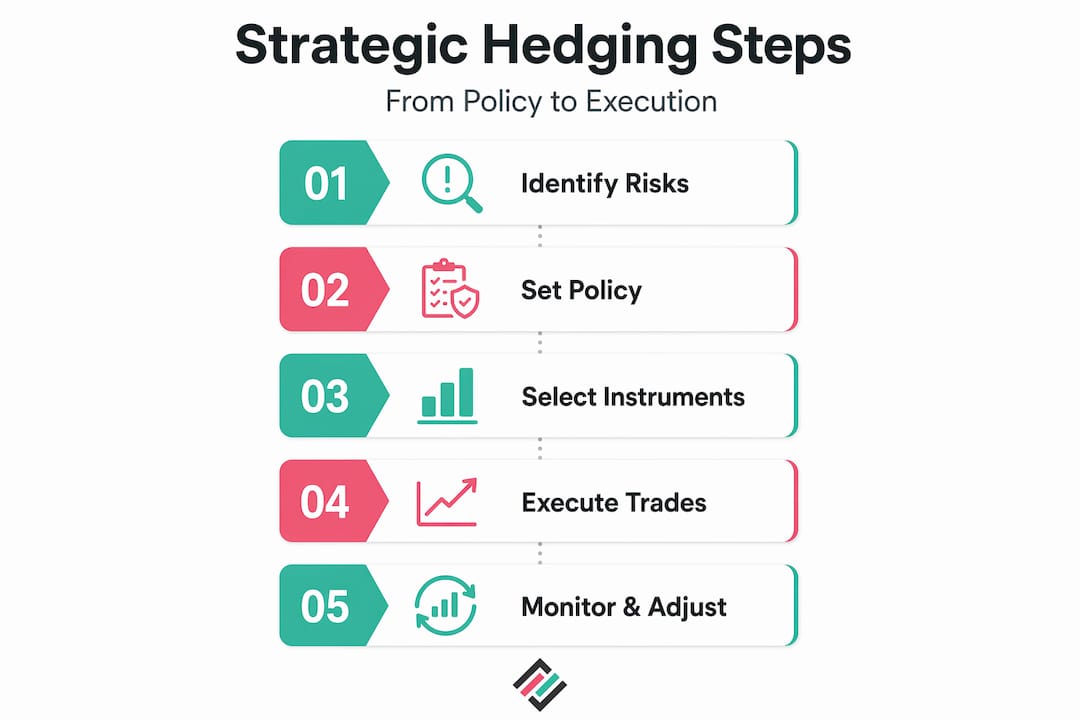
The distinction from tactical hedging matters enormously. Tactical hedging is transactional. A treasurer sees a rate move and covers an upcoming payable. Strategic hedging starts earlier and goes deeper: it defines how much risk the organization is willing to accept, which exposures qualify for coverage, over what time horizon, and what instruments are appropriate. Treasury teams use hedging as a proactive risk management tool, not merely to offset short-term volatility.
The primary instruments for FX strategic hedging are forward contracts, currency swaps, and options. Forwards lock in an exchange rate for a future date, providing certainty but eliminating any benefit from favorable rate moves. Swaps exchange principal and interest in different currencies, useful for longer exposures tied to financing structures. Options and futures are common instruments used to mitigate existing position risks while preserving some upside participation, though they carry premium costs that forwards do not.
Every instrument involves a trade-off. Certainty costs money. Options cost premiums. Forwards forgo gains. The job of strategic hedging is not to eliminate all FX risk at any price. It is to define an acceptable risk-return position that aligns with the organization's planning assumptions and earnings commitments.
Pro Tip: When selecting hedging instruments, match the instrument's flexibility profile to your forecast confidence. High-confidence forecasts suit forwards. Less certain exposures benefit from options structures that preserve flexibility.
Market and operational conditions in 2026
The environment for FX risk management in 2026 is materially more demanding than it was three years ago. Geopolitical shocks, central bank divergence, and persistent inflation in key trade corridors have driven volatility to levels that make unhedged exposures genuinely hazardous for multinational corporates.

The data reflects this shift. A MillTech survey of US and UK corporates found that average hedge ratios rose from 49% to 57% in early 2026, driven by geopolitical-related currency moves. That is not a marginal adjustment. It represents a structural rethinking of FX exposure tolerance across many treasury functions.
Interest rate divergence between the Federal Reserve, the European Central Bank, and the Bank of England has made currency pairs that once behaved predictably into sources of significant earnings variance. Companies with significant EUR/USD or GBP/USD exposures, including those in Polish and Swedish markets where Corphedge is expanding, face a more complex hedging calculus than they did even two years ago.
Operational constraints compound the economic challenge. Hedging programs consume bank credit lines and may trigger collateral requirements, and tightening lending conditions in 2026 have made credit availability a primary external factor shaping hedge feasibility. A treasurer who wants to extend a hedge book to 18 months needs the credit headroom to support it. Many mid-market companies find this constraint limits their hedging ambition more than any strategic preference.
| Condition | Impact on hedging strategy | Recommended response |
|---|---|---|
| Elevated FX volatility | Larger potential losses on unhedged positions | Increase hedge ratios, extend tenor |
| Credit line constraints | Limits volume and tenor of derivatives | Prioritize highest-impact exposures |
| Interest rate divergence | Widens forward points, raises hedge cost | Use options to manage carry cost |
| Geopolitical uncertainty | Forecast reliability declines | Adopt layering and scenario analysis |
Pro Tip: Before finalizing your hedge program for the year, request a credit utilization report from your banking partners. Understanding your available headroom shapes instrument selection before strategy design begins.
Hedge tenors have also shifted. Layering strategies have grown more popular in 2026, with treasurers hedging portions of expected income in increments rather than committing the full exposure in one transaction. This reduces timing risk and smooths the average rate achieved across a program.
Governance frameworks for hedging programs
A hedging policy without governance infrastructure is a document, not a discipline. The companies that extract consistent value from FX risk management share one structural trait: they have embedded oversight into the process, not bolted it on afterward.
Boards and audit committees increasingly expect disciplined risk oversight and clear performance reporting on hedging programs. This expectation has risen sharply as FX losses have appeared in earnings calls at companies that lacked formal programs. The governance infrastructure that prevents those losses includes:
- A written hedging policy that specifies risk appetite, eligible exposures, approved instruments, and minimum and maximum hedge ratios
- Clear roles and responsibilities between treasury, finance, and the board, with defined approval authorities for hedge sizes and tenors
- Regular performance reporting that measures hedge outcomes against pre-specified benchmarks, not spot rates after the fact
- Scenario analysis conducted at least quarterly, with results reviewed by senior leadership
- A policy review calendar tied to the company's annual planning cycle
The policy document is the foundation. It should state not just what the company will hedge but why, with reference to the specific financial metrics it is designed to protect, whether that is earnings per share, operating margin, or cash flow from operations. Formal policies defining risk appetite and eligible exposures are what separate governance-backed programs from ad hoc decisions made under pressure.
Scenario analysis deserves specific attention. Running multiple macro scenarios allows treasury teams to update hedging plans proactively rather than reactively. A well-designed scenario set includes a base case, a stress case (significant adverse FX move), and an opportunity case (favorable move that existing hedges partially foreclose). Each scenario tests whether the current hedge position still serves the policy's objectives. You can also learn more about currency risk management in practical detail to build stronger scenario frameworks.
Advanced hedging techniques and examples
Once a governance structure is in place, the technical design of the hedge program itself becomes the differentiating factor. Three techniques are particularly relevant for corporate treasuries managing meaningful FX exposure in 2026.
Layered hedging involves building the hedge position over time rather than in a single transaction. A company expecting EUR 50 million in revenues over the next 12 months might hedge 20% in month one, add another 20% in month three, and so on. This approach, which has grown sharply more common according to recent treasury surveys, smooths the average rate achieved and avoids the regret risk of a single large hedge placed at an unfavorable moment.
Option-based strategies provide downside protection while preserving some participation in favorable rate moves. A collar strategy, for instance, buys a put option to set a floor on the exchange rate while selling a call option to partially fund that protection. The net premium is lower than a standalone put, and the company retains upside up to the call strike.
Natural hedging deserves attention for companies with bilateral currency exposures. If a company both earns revenue and incurs costs in the same foreign currency, those flows offset each other and reduce the net exposure that requires derivative coverage. Proxy hedging, using a correlated but more liquid currency pair as a substitute when direct hedging is unavailable or costly, serves exposures in less liquid emerging market currencies.
The following comparison illustrates the key trade-offs across three common approaches:
| Technique | Cost | Flexibility | Protection level |
|---|---|---|---|
| Forward contract | Low (embedded in rate) | None | Full at fixed rate |
| Purchased option (put) | High (premium) | High | Full below strike |
| Collar | Medium (net premium) | Partial | Full below floor |
| Natural hedge | Near zero | High | Partial, exposure-dependent |
Knowing which technique fits requires matching the instrument's cost and flexibility profile to the organization's forecast accuracy and risk tolerance. Companies with high forecast confidence and tight margin structures typically favor forwards. Those with less predictable exposures or where upside participation matters to stakeholders often justify the premium cost of option structures.
Pro Tip: For companies entering new markets, including Poland and Sweden where currency exposure is often EUR/PLN or EUR/SEK, proxy hedging through EUR positions can offer a cost-effective interim solution before direct liquidity develops.
Hedging adds strategic control that transforms treasury from a reactive cash steward into a function that shapes financial outcomes. The best programs recalibrate regularly against current market conditions and updated forecasts, rather than locking in a structure annually and hoping for the best.
My perspective on hedging as a core treasury function
I have spent years watching companies treat currency hedging as an afterthought. A rate moves against them, margins compress, the CFO asks why no one hedged, and a reactive program gets stood up in haste. That cycle is painful and avoidable.
What I have come to believe firmly is that corporate treasurers must evolve from reactive hedging to proactive, scenario-driven risk management. The reason most companies fail at this is not technical. It is organizational. Hedging decisions get made by whoever has the bank relationship, without a formal policy, without board visibility, and without defined performance criteria. When that works, it is luck. When it fails, it is a governance problem that looks like a market problem.
The balance between cost and protection is a genuine tension, and I have seen companies err on both sides. Overhedging kills upside in favorable environments and generates internal skepticism about the program's value. Underhedging leaves the business exposed precisely when it cannot absorb the hit. Getting that calibration right requires clear risk appetite statements, not general principles.
My practical advice: start with your most material exposure, define one clear financial metric you are protecting, and build the simplest governance structure that gives you discipline and accountability. You can build sophistication from there. You cannot build credibility after a preventable FX loss.
— Bartas
How Corphedge supports your hedging program
Effective FX risk management requires more than good intentions. It requires real-time visibility into positions, the ability to execute layered hedge structures efficiently, and reporting tools that satisfy board-level governance expectations. Corphedge is built specifically for corporate treasury teams that take these requirements seriously.
The platform supports value-at-risk based hedging that quantifies exactly how much currency exposure your portfolio carries at any confidence level, giving your team a defensible basis for hedge ratio decisions. Position monitoring, policy compliance tracking, and integration with settlement platforms are available through the FX exposure management features that treasury teams in Poland, Sweden, and across Europe already use. If you want to see how the platform fits your specific setup, the Corphedge product tour walks through the full workflow in practical detail.
FAQ
What is the strategic hedging definition in corporate finance?
Strategic hedging is the deliberate use of financial instruments, such as forwards, swaps, and options, to manage identified currency or price exposures as a planned component of corporate financial strategy, not as a reactive response to market moves.
How does strategic hedging work for FX risk?
Companies identify their foreign currency exposures, set a target hedge ratio within a formal policy, and execute derivative contracts over defined time horizons to fix or limit the rate at which those exposures convert, stabilizing cash flows and earnings.
What are the main benefits of strategic hedging?
The core benefits are cash flow predictability, earnings stability, and improved planning certainty. Companies with formal hedging programs can commit to revenue and margin guidance without carrying unquantified currency risk.
What are the most common strategic hedging techniques?
Layered hedging, forward contracts, collar options structures, and natural hedging are the most widely used approaches. Each carries different cost and flexibility trade-offs suited to different forecast confidence levels and risk appetites.
Why is governance important in a strategic hedging program?
Without a written policy, defined roles, and performance reporting, hedging decisions become ad hoc and difficult to defend. Boards and audit committees now expect formal oversight of hedging programs as part of enterprise risk management standards.