

The most effective cash flow hedging programs combine a layered core hedge with dynamic overlays. This structure locks in protection for confirmed exposures while leaving room to adjust as forecasts firm up. If your treasury function does nothing else this quarter, do two things: map every FX exposure by currency pair and settlement date, and set a hard rule to cover confirmed flows landing in the next 30 to 90 days.
That combination isn't theoretical. Structured hedging programs cut cash flow volatility by 23 to 45 percent and improve earnings stability by 30 to 50 percent in practitioner studies. Treasury teams also lean on Value at Risk (VaR) as the program-level metric that ties individual trades back to overall risk tolerance, rather than judging each hedge in isolation.
- Map exposures by currency pair and date before touching a single instrument.
- Set a standing rule: hedge confirmed flows in the 30 to 90 day window, no exceptions.
- Track VaR on open positions monthly, not just at renewal time.
Key Takeaways
Effective cash flow hedging depends on layered program structure and disciplined quarterly review far more than on any single instrument choice.
| Point | Details |
|---|---|
| Structure beats instruments | A layered core hedge plus dynamic overlay reduces rate variation more than simple rolling programs. |
| First 90 days | Map confirmed exposures by currency pair and date, then hedge flows landing within 30 to 90 days. |
| Review cadence | Run weekly operational checks, quarterly program reviews, and annual policy refreshes with tail-risk stress tests. |
| Documentation matters | Attach every trade to its underlying exposure at execution to protect hedge accounting elections and audit trails. |
| Platform advantage | Corphedge automates exposure aggregation and VaR-based simulation, reducing the reconciliation work manual programs require. |
Table of Contents
- What Is Cash Flow Hedging for a CFO?
- Which FX Instruments Fit Which Exposure?
- How Should You Structure a Hedge Ratio and Schedule?
- How Do You Implement and Run the Program Day to Day?
- What Are the Biggest Risks and Costs in a Hedging Program?
- What KPIs Should You Track and How Often?
- How Platforms Like Corphedge Operationalize This
- How Does Hedge Accounting Apply to Cash Flow Hedges?
- What Regulatory and Compliance Rules Apply to Cash Flow Hedging?
- What Are the Tax Implications of Hedging Cash Flows?
- What the Data Actually Tells CFOs to Prioritize
- Get Your Cash Flow Hedging Program Off the Spreadsheet
- Sources
- FAQ
What Is Cash Flow Hedging for a CFO?
Cash flow hedging, in the operational sense treasury teams actually use, means using forwards, options, and swaps to protect forecasted foreign currency receipts or payments so a company's cash position and margins don't swing with the exchange rate. This is distinct from hedge accounting mechanics, which govern how gains and losses get recognized on the books. That's an accounting question for a separate conversation. The treasury question is simpler: will the cash that lands in 90 days buy what you budgeted for?
Most triggers are mundane. A confirmed receivable from an overseas customer. A recurring payroll obligation in a foreign subsidiary. A supplier contract denominated in a currency you don't hold reserves in. Operational guidance consistently points to transaction risk as the priority for most corporates, since forecasted payments and receipts are where FX swings hit liquidity and margins hardest.
Take a $2 million export receivable due in 90 days. That's not a rounding error on most income statements.
- Confirmed receivables and payables with known settlement dates are the cleanest hedging candidates.
- Recurring costs (payroll, lease payments in foreign currency) deserve the same discipline as one-off contracts.
- Forecasting accuracy improves once cash flow volatility drops, which feeds directly into better budget planning.
Which FX Instruments Fit Which Exposure?
Instrument selection comes down to one question: how certain are you about the amount and the date? Forwards work best when both are locked in. You know you're receiving €500,000 on March 15, so you lock the rate now and remove the guesswork entirely. The trade-off is you give up any upside if the currency moves in your favor.
Options make sense when the amount or timing is still fuzzy, or when you want to keep upside exposure while capping downside. A construction firm bidding on a foreign contract that might not close can buy an option instead of committing to a forward for cash flow it may never see. The cost is the premium, which practitioner data puts at 0.5 to 2.5% of notional, well above what a forward typically costs.
Swaps and structured products suit long-term financing arrangements or recurring flows, like a subsidiary that pays a foreign-currency intercompany loan every quarter. Natural hedges, meanwhile, are underused: if you have costs and revenue in the same foreign currency, you may not need a derivative at all.
| Instrument | Best fit | Typical cost driver |
|---|---|---|
| Forward | Known amount and date | Bid-ask spread |
| Option | Uncertain amount, preserve upside | Premium (0.5 to 2.5% of notional) |
| Swap | Recurring flows, long-term financing | Carry/interest differential |
| Natural hedge | Matching currency revenue and costs | Operational, not financial |
Pro Tip: Before pricing a derivative, check whether shifting a supplier contract or invoicing currency could close the gap for free. Natural hedges cost nothing to maintain once set up.
How Should You Structure a Hedge Ratio and Schedule?
Your hedge ratio is simply the percentage of a forecasted exposure you cover with derivatives.
The rolling versus layered decision matters more than most CFOs realize. A rolling program hedges a fixed percentage every period and simply rolls forward, which is simple to run but resets your hedge rate constantly and can amplify volatility if you roll into a bad rate. A layered program builds coverage incrementally over multiple periods, so no single trade determines your effective rate. Practitioner back-testing shows layered structures can cut variation in achieved FX rates by as much as 75% compared to simple rolling approaches.
The hybrid model most mature programs converge on: a static core layer covering high-confidence exposures, topped with a dynamic overlay that adjusts as market conditions or forecasts shift. Recalibrating that overlay at least quarterly outperforms a set-and-forget policy when volatility regimes change.
- Set a default hedge ratio band (for example, 50 to 80%) rather than a single fixed number.
- Layer coverage across multiple trade dates instead of one bulk transaction.
- Review and recalibrate the dynamic overlay every quarter, not annually.
- Reserve 100% coverage only for contractually locked, high-value exposures.
How Do You Implement and Run the Program Day to Day?
Implementation starts with what treasury teams call the exposure ladder: every forecasted FX flow arranged by currency pair and settlement date. This single view is what makes everything downstream possible, from netting to execution to reconciliation.
- Build the exposure ladder across all entities and currency pairs, refreshed at least monthly.
- Run netting, bilateral for two-entity flows, multilateral through an in-house bank or treasury center for high-volume multi-entity corporates, since netting materially reduces the notional you actually need to hedge.
- Execute trades against the netted exposure and document each one, attaching it to the specific underlying item it covers.
- Confirm trades and reconcile hedged notional against actual exposures monthly.
- Run automated effectiveness testing where volume justifies it.
Automating exposure aggregation, netting, execution, and effectiveness testing shortens close cycles and cuts reconciliation errors while producing audit-ready documentation automatically. Treasury owns execution and counterparty relationships; FP&A owns the forecast inputs feeding the exposure ladder; accounting owns the downstream recognition and reconciliation. Weekly check-ins between the three keep the ladder from going stale.
Pro Tip: If your exposure ladder still lives in a spreadsheet updated by hand, that's your biggest operational risk, not the currency market.
What Are the Biggest Risks and Costs in a Hedging Program?
Basis risk tops the list: the derivative you bought doesn't move in perfect lockstep with your actual exposure, especially with cross-currency baskets or thinly traded pairs. Counterparty credit risk is next. A hedge is only as good as the bank standing behind it.

A subtler failure mode is hedging back to the wrong functional currency. This creates a group-level mismatch instead of resolving one, and it happens more often than treasury teams admit, especially at companies with multiple subsidiaries operating in different reporting currencies. Centralized exposure visibility is the fix, not more hedging.
Cost drivers are concrete: bid-ask spreads on forwards run 0.1 to 0.5% of notional, options run higher, and carry differentials on swaps add up over long tenors.
- Diversify counterparties and use credit support annexes (CSAs) to cap bilateral exposure.
- Reconcile hedged notional against actual exposure monthly, not at renewal.
- Never hedge a forecast until it's firm. Speculative pre-hedging is where over-hedging starts.
- Blend forwards for the core exposure with option overlays for tail risk to control cost without giving up protection.
What KPIs Should You Track and How Often?
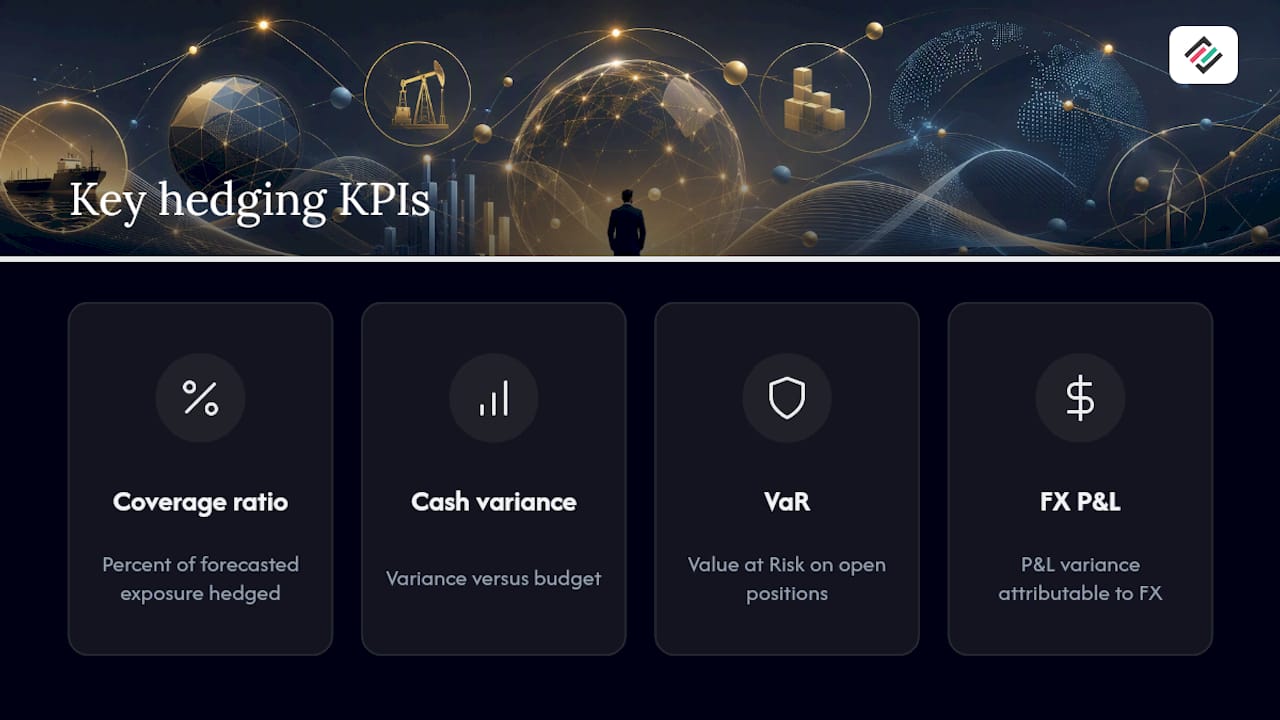
A hedging program without KPIs is just a series of trades hoping to add up to a strategy. Track hedge coverage ratio (percentage of forecasted exposure currently hedged), cash flow variance against budget, VaR on open positions, and P&L variance attributable to FX.
Cadence matters as much as the metrics themselves. Run operational checklists weekly (confirmations, netting runs, exposure ladder updates). Review the program itself quarterly, checking whether hedge ratios and instrument mix still match current forecasts and market conditions. Refresh the written policy annually, or sooner if the business changes materially (new markets, new currency exposure, a shift in revenue mix).
Stress-test the program against tail scenarios, currency moves of 15 to 20%, and feed those results back into hedge-ratio policy rather than treating them as a one-off exercise. This is also where audit and board reporting requirements get satisfied: documented policy, documented effectiveness testing, and a clear record of who approved what.
Treasury owns execution and day-to-day monitoring. FP&A owns forecast accuracy feeding the coverage ratio. Accounting owns the controls around trade documentation and reconciliation. No single function should own all three without the others checking the work.
How Platforms Like Corphedge Operationalize This
Manually running an exposure ladder, netting calculations, and VaR reporting across multiple entities eats treasury bandwidth fast. Platform automation is where the program design above actually becomes repeatable rather than aspirational.
The capabilities that matter most: real-time position aggregation across currency pairs and entities, VaR-based hedging simulation to test hedge ratios before committing capital, execution integrations that connect straight to your bank relationships, and automated attachment of trades to the specific exposures they cover.
Corphedge builds its platform around exactly this workflow, combining live exposure tracking with VaR-driven simulation so treasury teams can model a hedge ratio's impact before executing it. The product tour walks through how position aggregation and automated attachment work together to shorten close cycles and cut reconciliation errors. Corphedge also runs an FX hedging course for treasury teams building this capability internally.
- Real-time exposure aggregation replaces manual spreadsheet consolidation.
- VaR-based simulation lets you test hedge ratios before committing capital.
- Automated trade attachment keeps documentation audit-ready without extra headcount.
| Point | Details |
|---|---|
| Program shape | Layered core hedge plus dynamic overlay reduces rate variation versus simple rolling programs. |
| Priority exposure | Focus hedging on confirmed transaction risk in the 30 to 90 day window first. |
| Platform role | Automation and VaR-based tools like Corphedge cut reconciliation errors and speed close cycles. |
How Does Hedge Accounting Apply to Cash Flow Hedges?
Even though this guide focuses on program design, not accounting mechanics, CFOs still need to know where hedge accounting enters the picture, because it determines how derivative gains and losses hit the financial statements.
Under both IFRS 9 and US GAAP (ASC 815), a company can elect hedge accounting for a forecasted transaction if it meets specific criteria: the hedged item must be a highly probable forecasted transaction, the hedging relationship must be formally designated and documented at inception, and the hedge must be expected to be highly effective at offsetting changes in cash flows attributable to the hedged risk. Get the documentation wrong at inception and you lose the accounting treatment retroactively, even if the trade itself worked perfectly.
When those criteria are met, the effective portion of the gain or loss on the hedging instrument goes to other comprehensive income (OCI) rather than straight to the income statement, then reclassifies to earnings when the forecasted transaction actually affects P&L. Any ineffective portion hits the income statement immediately.
This matters operationally for one reason: documentation discipline. Every hedge relationship needs a formal designation memo, a description of the risk management objective, and a method for assessing effectiveness, prepared before or at the same time as the trade, not after the fact. Treasury teams that build documentation into their execution workflow (rather than treating it as a quarterly scramble for the accounting team) avoid the single most common reason hedge accounting elections get disqualified: late or incomplete documentation. Automated platforms that attach trades to exposures at execution time make this discipline far easier to sustain than manual tracking.
What Regulatory and Compliance Rules Apply to Cash Flow Hedging?
Regulatory obligations around FX hedging vary by jurisdiction and by the size and type of instruments used, but a few themes apply broadly to internationally active companies.
Derivatives trading is subject to reporting and clearing obligations under frameworks like the European Market Infrastructure Regulation (EMIR) for companies operating in or trading with EU counterparties, and equivalent trade reporting regimes apply in other jurisdictions where a company transacts. These rules generally require reporting of derivative trades to a trade repository, and in some cases mandatory clearing through a central counterparty, depending on the instrument and the counterparty classification.
Counterparty due diligence is a compliance requirement in its own right. Banking partners providing FX derivatives are themselves regulated entities, and corporates need documented policies for counterparty selection, credit limits, and exposure concentration. This ties directly back to the counterparty credit risk discussed earlier. A documented hedge policy isn't just good governance; in many jurisdictions, it's the artifact regulators and auditors expect to see when reviewing derivative usage.
Internal controls matter as much as external reporting. Segregation of duties between the person executing trades and the person reconciling them, board-level approval of the hedge policy itself, and periodic internal audit review of hedge program compliance are standard expectations for any company using derivatives at scale. For companies operating across multiple regulatory regimes, keeping a single centralized policy document that gets adapted for local requirements, rather than a patchwork of ad hoc local practices, is the practical way to stay compliant without duplicating effort.
What Are the Tax Implications of Hedging Cash Flows?
Tax treatment of FX hedging gains and losses depends heavily on jurisdiction, the entity structure involved, and whether the hedge qualifies for a specific tax election, so this section covers the general principles rather than any single country's rules.
In most jurisdictions, gains and losses on FX derivatives are taxable or deductible in the period they're recognized, but the timing of that recognition can diverge from the accounting treatment. A hedge that qualifies for hedge accounting and defers its gain or loss to OCI for financial reporting purposes may still be taxed on a different schedule under local tax law, creating a temporary book to tax difference that finance teams need to track separately.
Some tax authorities offer specific hedge identification or matching elections that align the tax timing of a derivative with the timing of the underlying hedged transaction, similar in spirit to hedge accounting but governed by entirely separate rules and separate documentation requirements. Missing the election deadline, which in many regimes falls at or near trade inception, can mean the derivative gain or loss is taxed on a mismatched schedule from the underlying exposure, creating cash tax volatility the hedge was supposed to prevent.
Cross-border intercompany hedging arrangements add another layer: transfer pricing rules in many jurisdictions require that intercompany hedge allocations reflect arm's length terms, which matters for multinational groups running centralized treasury hedging on behalf of subsidiaries. Given how much this varies by jurisdiction and how material the cash tax impact can be, treat tax treatment of hedging instruments as a standing agenda item with your tax advisor, not a detail to resolve after the trade is booked.
The most effective cash flow hedging programs pair a layered core hedge with disciplined quarterly governance rather than one-off trades. The reader should walk away knowing that program structure and operational discipline matter more than any single instrument choice.
| Point | Details |
|---|---|
| Core structure | A layered hedge plus dynamic overlay reduces rate variation more than simple rolling programs. |
| First priority | Map and hedge confirmed transaction exposure in the 30 to 90 day window before anything else. |
| Governance rhythm | Review the program quarterly and stress-test against 15 to 20% currency moves annually. |
| Documentation discipline | Attach trades to exposures at execution to keep hedge accounting elections intact. |
| Platform support | Corphedge automates exposure aggregation, VaR simulation, and trade attachment to cut reconciliation errors. |
What the Data Actually Tells CFOs to Prioritize
Most guidance on this topic still treats hedging as a series of individual trade decisions: forward or option, this month or next. That framing misses the point. The research consistently shows the program structure matters more than any single instrument choice. Layered programs beat rolling programs on volatility reduction, and dynamic overlays beat static policies when regimes shift. Yet plenty of finance teams still run hedging as a reactive, trade-by-trade exercise instead of a governed program with quarterly checkpoints.
The conventional advice to "just hedge your big exposures" undersells the operational work required to make that hedge effective. Exposure mapping, netting, and documentation discipline determine whether a hedge actually protects cash flow or just adds a new administrative burden. Companies expanding into new markets, as Corphedge is now doing in Poland and Sweden, feel this acutely: new currency pairs mean new exposure ladders, and the temptation is to bolt on ad hoc hedges rather than extend the existing program framework.
If you take one thing from this guide, prioritize the exposure ladder and the quarterly review cadence before you spend another hour debating instrument selection. The instruments are the easy part. The discipline is what protects the margin.
— Bartas
Get Your Cash Flow Hedging Program Off the Spreadsheet
Every practice in this guide, exposure ladders, VaR-based hedge ratios, quarterly reviews, effectiveness documentation, becomes dramatically easier when it isn't running through a patchwork of spreadsheets and manual bank confirmations. That's the specific gap Corphedge closes: real-time position aggregation and automated trade attachment replace the manual reconciliation work that eats treasury bandwidth every month.
Corphedge's platform lets you simulate hedge ratios against live VaR data before you commit capital, so the program design choices covered here, layered versus rolling, core plus overlay, become testable decisions instead of guesswork. As Corphedge expands into Poland and Sweden, more internationally active treasury teams in those markets get direct access to the same tools already supporting corporates elsewhere.
If your exposure ladder still lives in a spreadsheet, start with the product tour to see how position aggregation and automated attachment work in practice, or explore the VaR-based hedging approach directly to model your own exposure before your next quarterly review.
Sources
FAQ
What Is Cash Flow Hedging in Simple Terms?
It's using forwards, options, or swaps to lock in or protect the value of future foreign currency payments or receipts, so exchange rate swings don't erode your budgeted cash flow or margins.
What's the Difference Between a Cash Flow Hedge and a Fair Value Hedge?
A cash flow hedge protects a forecasted or uncertain future transaction from rate movement, while a fair value hedge protects the value of an existing asset or liability already on the books, a distinction that matters for accounting treatment but not for the underlying protection strategy.
How Often Should a Hedging Program Be Reviewed?
Run operational checks weekly, review the full program quarterly, and refresh the written hedge policy annually or whenever the business changes materially.
Can Automation Really Reduce Hedging Errors?
Yes. Automating exposure aggregation, netting, and effectiveness testing measurably cuts reconciliation errors and shortens close cycles compared to manual tracking, and platforms like Corphedge build this directly into the execution workflow.