

TL;DR:
- Foreign exchange volatility can unexpectedly erode profits, highlighting the importance of pre-emptive risk management systems. Building operational defenses, accurately modeling exposures, and applying layered hedging strategies protect cash flow and reduce reliance on costly derivatives. Effective governance, clear policies, and natural hedging practices ensure sustainable FX risk mitigation over time.
Foreign exchange volatility doesn't announce itself before it erodes your margins. A single bad quarter of currency moves can wipe out profits that took months to build, and most businesses discover the damage only when reconciling their books. If you want to protect cash flow from forex risk, the solution isn't reacting faster. It's building a system that absorbs currency shocks before they reach your P&L. This guide walks financial professionals and business owners through the complete arc: mapping exposures accurately, selecting the right hedging instruments, deploying operational defenses, and sustaining performance through governance.
Table of Contents
- Key takeaways
- How to protect cash flow from forex with accurate exposure modeling
- Executing hedging strategies for your cash flow profile
- Natural hedging and operational practices
- Monitoring and verifying your FX risk program
- My perspective on what actually works
- How Corphedge helps you safeguard cash flow
- FAQ
Key takeaways
| Point | Details |
|---|---|
| Model currencies separately | Forecast each currency stream independently to expose timing gaps and find natural hedging opportunities. |
| Match instrument to certainty | Use forward contracts for known, dated exposures and FX options when volume or timing is uncertain. |
| Build natural hedges first | Align inflows and outflows in the same currency before layering on financial derivatives to reduce costs. |
| Hedge confirmed exposures first | Lock in rates on dated, confirmed transactions before extending coverage to forecast-based exposures. |
| Govern with a written policy | Define exposure thresholds, hedge ratios, and forecast update cycles to prevent drift and over-hedging. |
How to protect cash flow from forex with accurate exposure modeling
Most businesses aggregate foreign currency revenues and costs into their home currency before analyzing cash flow. That practice destroys exactly the information you need. Multi-currency cash flow modeling means forecasting each principal currency separately, with its own opening balance, inflow schedule, and outflow schedule. When you build it this way, timing gaps become visible immediately.
Consider a U.S. manufacturer that invoices European clients in EUR and pays Asian suppliers in USD. If EUR receivables arrive in 60 days and USD payables are due in 30 days, the net currency position looks comfortable on paper but creates a real liquidity gap in the middle. That gap is exactly where forex cash flow protection breaks down for unprepared businesses.
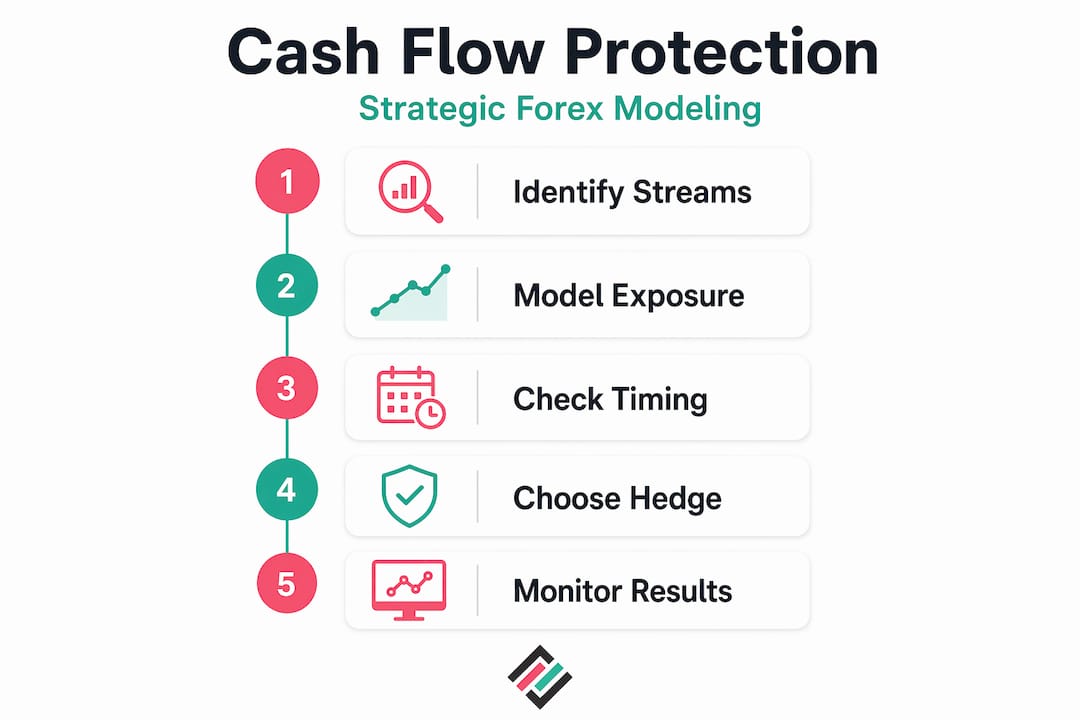
Identifying natural hedges in your cash flows
A natural hedge exists when your EUR inflows and EUR outflows line up closely in amount and timing, so you never actually need to convert currency at all. Before you buy a single derivative, map your flows to find these matches. Many companies are sitting on natural hedges they have never formally recognized, which means they are paying for financial hedges that are already operationally redundant.
One practical step: resist auto-converting foreign currency receipts the moment they arrive. Holding receivables in their original currency preserves your ability to offset them against payables in the same denomination. This is particularly relevant for businesses in Poland and Sweden that are increasingly operating across EUR, PLN, and SEK exposures simultaneously.
Pro Tip: Build a simple three-column table for each major currency: expected inflows by month, expected outflows by month, and the net position. The net column is what you actually need to hedge. Hedging gross flows wastes money.
The table below shows how a basic per-currency cash flow model might look for a mid-size company with EUR and GBP exposure.
| Currency | Monthly inflow | Monthly outflow | Net position |
|---|---|---|---|
| EUR | €800,000 | €600,000 | +€200,000 |
| GBP | £300,000 | £450,000 | -£150,000 |
| SEK | 1,200,000 kr | 900,000 kr | +300,000 kr |
Tracking intra-period buckets matters just as much as the monthly totals. Timing mismatches caused by settlement date differences within a month can create short-term gaps even when the full-month net looks balanced.
Executing hedging strategies for your cash flow profile
Once you know your net currency positions and timing gaps, you are ready to select instruments. The core decision comes down to certainty. If you have a confirmed EUR payable due in 90 days for a fixed amount, FX forward contracts are the right tool. They lock in today's exchange rate for a future transaction, converting an unpredictable cost into a known one. That predictability is the foundation of effective forex cash flow protection.
When volume or timing is uncertain, forwards become risky because you could end up locked into a rate for a transaction that doesn't materialize at the expected size. FX options solve this by giving you the right, but not the obligation, to exchange at a set rate. You pay a premium for that flexibility, but you retain the ability to benefit if rates move in your favor. The shift in market preference is measurable: OTC currency options turnover rose from $303 billion to $634 billion between 2022 and 2025 as forward hedging costs climbed.
Sequencing your hedge execution
Experienced treasury teams follow a clear sequencing rule: cover confirmed, dated exposures first, then extend coverage to forecast-based exposures in layers. This approach, often called hedging the known layer, prevents the most common failure mode in corporate hedging programs, which is locking in rates against transactions that later change in size or timing.
Here is what that sequencing looks like in practice:
- Lock 100% of confirmed purchase orders and dated invoices with forward contracts.
- Cover 50-70% of high-confidence forecast exposures with forwards or collars.
- Use options for the remaining forecast layer where uncertainty is highest.
- Leave purely speculative or early-stage pipeline exposures unhedged.
- Review and rebalance the hedge book every time your forecast is updated.
Pro Tip: Distinguish cash flow hedging from balance sheet hedging before setting your strategy. Cash flow hedging targets future transactions and locks in predictable home-currency values. Balance sheet hedging addresses already-recognized monetary items. Mixing them up leads to accounting mismatches and governance problems.
| Exposure type | Certainty level | Recommended instrument |
|---|---|---|
| Confirmed dated invoice | High | FX forward contract |
| Committed purchase order | High | FX forward contract |
| High-confidence forecast | Medium | Forward or option collar |
| Uncertain forecast volume | Low | FX option |
| Early-stage pipeline | Very low | Unhedged or monitor only |
Natural hedging and operational practices
Effective FX risk management is more than picking a derivative. It starts with restructuring your operations so that fewer conversions are necessary in the first place. This is the principle behind strategies for forex risk management that prioritize operational design over financial engineering.

The most direct operational lever is invoice currency alignment. If your largest costs are denominated in EUR, billing your European clients in EUR eliminates the conversion entirely on that leg of the transaction. This approach requires commercial negotiation, but it dramatically reduces your net FX exposure before any derivative is purchased.
Multi-entity businesses should also look at multilateral netting. Rather than each subsidiary converting its own exposures independently, a central treasury function consolidates all intragroup payables and receivables and settles only the net position. This cash pooling and netting approach reduces the total volume of FX transactions, which lowers both conversion costs and residual risk.
Additional operational practices worth building into your structure:
- Open foreign currency bank accounts to hold receipts in their original denomination until offsetting payments are due.
- Set payment timing policies that align outflows to inflow settlement cycles where possible.
- Write FX risk-sharing clauses into long-term supplier and client contracts to distribute currency risk across both parties.
- For businesses operating in Poland or Sweden, consider maintaining PLN and SEK accounts specifically to manage local cost bases without constant cross-currency conversion.
The goal of all these measures is to reduce the gross exposure your treasury team must hedge with derivatives. Every euro of natural offset is a euro that doesn't require a forward or option premium.
Monitoring and verifying your FX risk program
A hedging strategy that works in theory but drifts in practice is worse than no strategy, because it creates false confidence. Sustainable forex cash flow protection requires a governance structure that keeps execution aligned with policy.
Hedge accounting under IFRS 9 is the accounting framework that ties your derivative gains and losses to the timing of the underlying hedged transaction. Effective portions of cash flow hedge results are recorded in Other Comprehensive Income and reclassified to profit and loss when the hedged item actually affects earnings. Without this alignment, your income statement will show derivative volatility that doesn't correspond to the underlying business performance, creating confusion and governance problems.
Beyond accounting, you need a repeatable written policy. Clear hedge policies with defined exposure thresholds, hedge ratios, and forecast update frequencies are what separate businesses that successfully safeguard cash flow over the long term from those that hedge reactively and expensively.
Follow these four governance steps to keep your program on track:
- Define your hedge policy in writing. Specify minimum exposure thresholds that trigger hedging, target hedge ratios by exposure type, and permitted instruments.
- Tie your hedging schedule to forecast update cycles. Every time your cash flow forecast is revised, review and rebalance your hedge book to match the updated exposure.
- Run a rolling hedging program. Maintain coverage across a defined time horizon (typically 3 to 18 months depending on your business cycle) rather than hedging one transaction at a time.
- Track hedge effectiveness and report it regularly. Measure realized versus forecast rates on completed transactions and present results to senior management quarterly.
Pro Tip: Set variance alerts in your treasury system so that when actual exposures deviate from forecast by more than a defined percentage, your team gets a notification to review hedge coverage. This prevents silent over-hedging or gaps from creeping in between formal review cycles.
My perspective on what actually works
I've seen treasury teams spend significant budget on sophisticated derivative programs while their underlying cash flow models were built in spreadsheets that aggregated everything into one home-currency number. The derivatives looked right on paper, but they were hedging the wrong thing.
What I've learned is that the classification of exposures across timing, transaction type, and certainty level matters more than the specific instruments you choose. Businesses that get this right spend less on hedging and absorb far fewer FX surprises. Those that skip it end up over-hedging forecast exposures that never materialize and under-hedging confirmed ones that do.
My strong conviction is that natural hedging deserves more attention than it typically gets. Most CFOs treat derivatives as the primary tool and operational alignment as a secondary nice-to-have. It should be the opposite. Align your business structure first, then hedge the residual with well-chosen instruments. You will spend less, carry less counterparty risk, and build a program that doesn't collapse when a major contract falls through.
Finally, governance is not bureaucracy. A written hedge policy with regular review cycles is the difference between a program that compounds its effectiveness over time and one that resets every time there's turnover in the treasury function. If the logic for each hedge decision lives only in one person's head, the program is fragile. Write it down, review it quarterly, and let the structure do the work.
— Bartas
How Corphedge helps you safeguard cash flow
Managing multi-currency exposures, sequencing hedges, maintaining IFRS 9 compliance, and running governance reviews is a lot to coordinate across manual tools and spreadsheets. Corphedge was built specifically for this problem.
The platform maps your FX exposures in real time, supports value-at-risk-based hedging strategies, and integrates hedge execution with compliance workflows so your team isn't rebuilding the same analysis every cycle. Whether you are protecting PLN, SEK, EUR, or USD cash flows, Corphedge gives your treasury function the structure to move from reactive hedging to a disciplined, repeatable program. Explore the full platform features to see how your team can implement everything covered in this guide.
FAQ
What is the fastest way to protect cash flow from forex?
The fastest protection comes from identifying your net currency exposure by stream and locking in forward contracts on confirmed, dated payables and receivables immediately. This stops known cash flow uncertainty before it reaches your P&L.
When should I use FX options instead of forward contracts?
Use FX options when your transaction volume or timing is uncertain. Options provide a rate floor while allowing you to benefit from favorable moves, making them better suited to forecast-based or event-driven exposures than rigid forward commitments.
What is natural hedging and why does it come first?
Natural hedging matches currency inflows with outflows in the same denomination, eliminating the need for conversion entirely on that portion of your exposure. It reduces hedging costs and residual risk before any derivative is needed.
How does IFRS 9 affect my hedging program?
IFRS 9 requires that effective cash flow hedge gains and losses be recorded in Other Comprehensive Income and reclassified to profit or loss when the hedged transaction affects earnings. This aligns your derivative results with the underlying business performance and prevents artificial income statement volatility.
How often should I review my FX hedge book?
Review your hedge book every time your cash flow forecast is updated, typically monthly or quarterly. Tie hedge ratios and coverage levels to forecast cycles so that changes in exposure are reflected in your hedging program without delay.