

TL;DR:
- Preparing and organizing accounting records early ensures audit compliance and reduces errors. Proper document control and continuous review help maintain year-round readiness for audits. Failure to verify document versions and timely engagement can significantly prolong audits and trigger regulatory issues.
Accounting records preparation for audits is the process of organizing financial documents, verifying their accuracy, and confirming they meet regulatory and auditor requirements before the audit begins. Finance professionals and business owners in 2026 face stricter compliance rules than ever, including mandatory electronic signature submission requirements and tighter filing deadlines. In Lithuania, for example, companies with assets exceeding 2.5 million EUR or revenue over 4.5 million EUR are subject to mandatory audits. Non-profit organizations face audit requirements when state funding exceeds 0.5 million EUR per year. Getting your records in order before the auditor arrives is not just good practice. It is a legal obligation with real consequences for late or incomplete submissions.
What accounting records do you need to prepare for an audit?
The core documents for any audit include invoices, bank statements, contracts, payroll records, general ledgers, and annual financial statements. Organizing these with proper indexing supports efficient audit verification and reduces back-and-forth with auditors. Beyond the basics, you also need project funding documentation, grant records, and evidence of non-monetary transactions.
Document retention rules in 2026 are specific and non-negotiable. Retention periods range from 10 years for primary accounting documents to permanent retention for annual reports, and up to 75 years for employment records. That means your filing system must handle both current audit cycles and long-term archiving without confusion.
Each document must meet format and content standards. Electronic documents require qualified electronic signatures where mandated. Paper documents must be legible, complete, and stored to preserve integrity. Version control matters too. Auditors need to see the final approved version of every record, not drafts or superseded files.
The table below summarizes the primary document categories and their key requirements:
| Document type | Retention period | Key requirement |
|---|---|---|
| Primary accounting docs | 10 years | Complete, signed, indexed |
| Annual financial reports | Permanent | Qualified electronic signature |
| Employment and payroll records | Up to 75 years | Integrity and availability |
| Project and grant funding records | Per grant terms | Strict cost segregation |
| Contracts and agreements | 10 years minimum | Linked to related transactions |
Non-monetary transactions deserve special attention. Volunteer work and in-kind contributions require a clear valuation methodology supported by consistent documentation. Auditors frequently request clarification when valuation rationale is missing or inconsistent. Defining your methodology before the audit starts saves significant time.
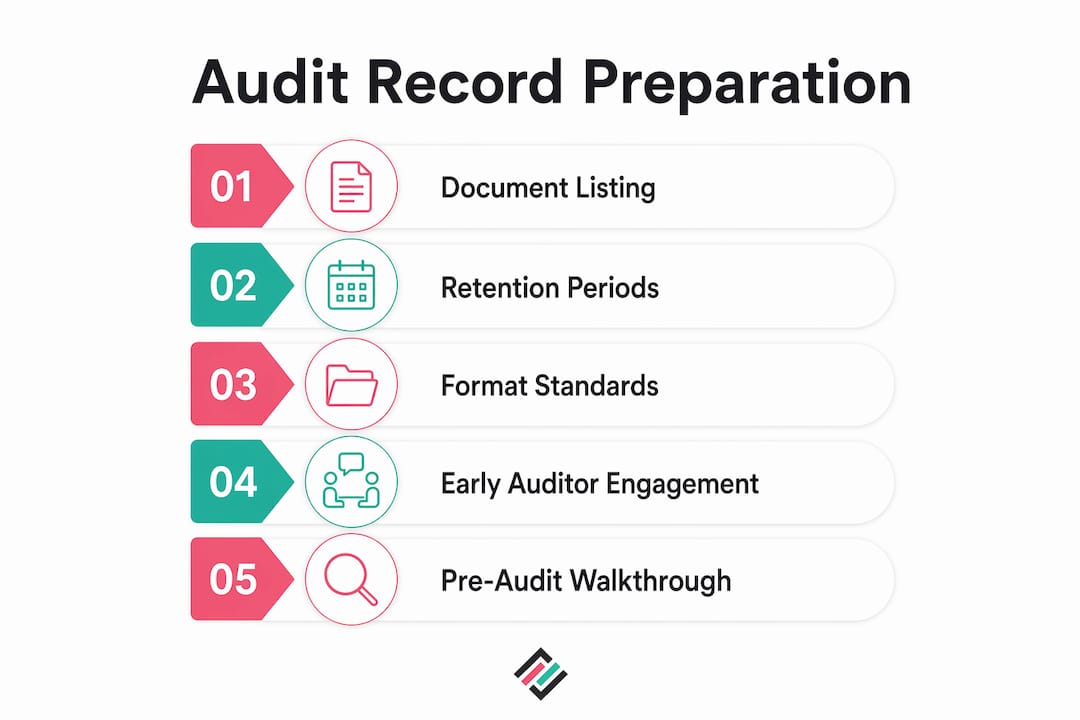
Pro Tip: Create a master document index at the start of each fiscal year. List every required document type, its responsible owner, and its expected location. Update it monthly so nothing falls through the cracks before audit season.
How do you organize accounting records for audit readiness?
Systematic organization is the single biggest factor separating smooth audits from painful ones. Start by building a document management structure that groups records by type and then by chronological order within each category. Digital folders should mirror your chart of accounts so auditors can navigate without a guide.
- Map your document universe. List every record type your business generates and confirm which ones auditors will request.
- Assign document owners. Each record category needs one person responsible for completeness and accuracy.
- Implement version control. Use accounting software or a document management system that logs edits, approvals, and access history.
- Link documents to business processes. Auditors evaluate control cycles comprehensively, seeking evidence that connects transactions to training records, risk assessments, and incident reports.
- Segregate project funds. Strict project cost isolation prevents manual reconstruction during the audit and reduces error risk significantly.
- Reconcile regularly. Monthly bank reconciliations and quarterly ledger reviews catch discrepancies before auditors do.
Engaging your auditor early is one of the most underused tactics in audit preparation. Cooperation agreements that specify responsible persons, timelines, and documentation flows reduce audit queries and help you meet filing deadlines. Ask your auditor for a preliminary document request list at least 4–6 weeks before the audit starts.
Automated document management systems that integrate training records, risk assessments, and corrective actions improve audit readiness and reduce errors. Systems with version control, role-based access, and automated triggers are recognized by auditors and regulators as evidence of strong internal controls. For companies expanding into new markets like Poland and Sweden, a centralized digital system also simplifies cross-border compliance.

Pro Tip: Schedule a pre-audit walkthrough with your auditor. Walk them through your document structure before fieldwork begins. This one meeting typically cuts audit queries by a significant margin.
What common mistakes should you avoid in audit document preparation?
The most costly mistake is engaging your auditor too late. From march 2026 onward, annual reports submitted to Registrų centras without a qualified auditor's electronic signature face automatic rejection. Missing this requirement does not just delay your filing. It can trigger regulatory penalties and reputational damage.
Incomplete or unlinked documentation is the second most common problem. Finance professionals often collect the right documents but fail to connect them to the controls and processes they support. Auditors do not evaluate documents in isolation. They trace a transaction from initiation through approval, recording, and reporting. A missing approval log or an unsigned contract breaks that chain.
Poor document version control is a silent audit risk. When multiple versions of a financial statement or contract exist without clear approval timestamps, auditors cannot confirm which version is authoritative. This triggers additional queries, extends the audit timeline, and signals weak internal controls to regulators.
Non-monetary and grant-funded project records create specific challenges. Organizations that lack a pre-defined valuation methodology for volunteer work or in-kind donations consistently receive auditor requests for clarification. The fix is simple: document your methodology once, apply it consistently, and attach it to every relevant transaction record.
The following mistakes appear most frequently in audit preparation reviews:
- Delaying auditor engagement past the 4–6 week preparation window
- Storing documents without version control or approval timestamps
- Failing to segregate project-specific costs within the accounting system
- Using inconsistent valuation methods for non-monetary contributions
- Submitting financial statements without the required qualified electronic signature
Proactive internal reviews, conducted quarterly rather than annually, catch most of these issues before they become audit findings. Treat each internal review as a dry run for the real thing.
How do you maintain year-round audit readiness?
Year-round audit readiness means building habits that make the annual audit a confirmation of good practice, not a scramble to fill gaps. The foundation is regular self-audits. Conduct a monthly reconciliation of bank accounts and ledgers, a quarterly review of document completeness, and a semi-annual check of retention compliance.
Audit success depends primarily on management's responsibility for accurate accounting policies and maintained financial records. Auditors do not fix deficiencies. They report them. The organization that treats documentation as evidence of its own integrity consistently achieves better audit outcomes than one that treats it as an administrative burden.
Updating document controls when your business changes is equally critical. A new product line, a new funding source, or an expansion into a new market like Sweden or Poland creates new document categories and new compliance obligations. Your document management system must reflect those changes within the same reporting period they occur.
Continuous staff training on documentation standards prevents the gradual drift that undermines even well-designed systems. Assign a compliance owner for each business unit and schedule annual training refreshers. Integrated document management systems that link training records, risk registers, and corrective action logs give auditors a complete picture of your control environment. Understanding how annual report analysis works from an external perspective also helps finance teams anticipate what reviewers prioritize when assessing financial statements.
The audit readiness checklist for year-round maintenance covers these core practices:
- Monthly bank and ledger reconciliations
- Quarterly document completeness reviews
- Semi-annual retention compliance checks
- Annual staff training on documentation standards
- Immediate updates to document controls after any business or regulatory change
Key Takeaways
Proper accounting records preparation for audits requires systematic organization, early auditor engagement, and year-round document discipline to meet 2026 compliance standards.
| Point | Details |
|---|---|
| Start preparation early | Begin collecting audit documents at least 4–6 weeks before the audit start date. |
| Know your retention rules | Primary documents require 10-year retention; annual reports are kept permanently. |
| Link documents to controls | Connect every record to the business process and approval chain it supports. |
| Avoid the electronic signature trap | Missing a qualified auditor's signature triggers automatic rejection at Registrų centras from 2026. |
| Maintain year-round readiness | Monthly reconciliations and quarterly reviews prevent last-minute audit scrambles. |
The part of audit prep most finance teams get wrong
My honest observation after working with finance teams across multiple jurisdictions is this: most audit failures are not caused by missing documents. They are caused by documents that exist but cannot be trusted.
Version control is where I see the most damage. A company will have five versions of a contract in three different folders, none of them clearly marked as final. The auditor asks which one governs the transaction. Nobody knows. That single gap can extend an audit by weeks and signal to regulators that internal controls are weak across the board.
The second pattern I see consistently is treating audit preparation as a finance department task rather than a management responsibility. The accounting team collects the documents, but the approvals, the policy decisions, and the control sign-offs belong to management. When management is not engaged, the documentation trail has holes that no amount of last-minute filing can fix.
The 2026 electronic submission rules have made this worse in one specific way. The qualified electronic signature requirement means the auditor must be engaged early enough to complete their work before the filing deadline. Companies that used to engage auditors in the final weeks of the year now face a hard stop. The system rejects late submissions automatically. That is not a technicality. It is a structural change that rewards organizations with disciplined year-round practices and penalizes those that treat audit prep as a once-a-year event.
My practical advice: treat your document management system as a living record of your organization's integrity, not a filing cabinet you open once a year. The companies that do this consistently spend less time on audits, receive fewer queries, and build the kind of regulatory trust that matters when rules tighten further.
— Bartas
How Corphedge supports financial record organization and compliance
Finance teams managing cross-border operations face a compounding challenge: audit documentation requirements vary by jurisdiction, and currency risk adds another layer of financial complexity to every transaction record.
Corphedge gives finance professionals real-time visibility into currency positions and risk management tools built on Value at Risk methodology. That visibility directly supports audit documentation by ensuring that every hedging transaction, currency exposure, and financial position is recorded, traceable, and audit-ready. For companies expanding into Poland and Sweden, Corphedge provides the compliance infrastructure to manage FX risk while keeping financial records organized for local audit requirements. Explore the full platform capabilities to see how Corphedge fits your audit and risk management workflow.
FAQ
What documents are required for an accounting audit?
The core documents include invoices, bank statements, contracts, payroll records, general ledgers, and annual financial statements. Project funding records and non-monetary transaction documentation are also required where applicable.
How far in advance should you prepare for an audit?
Start collecting and organizing audit documents at least 4–6 weeks before the audit begins. Early engagement with your auditor allows you to clarify scope, assign document owners, and meet filing deadlines.
What happens if you submit financial statements without an electronic signature in 2026?
From march 2026, Registrų centras automatically rejects annual reports that lack a qualified auditor's electronic signature. This makes timely auditor engagement a hard compliance requirement, not an administrative preference.
How long must accounting records be retained?
Primary accounting documents must be retained for 10 years. Annual financial reports require permanent retention. Employment and payroll records must be kept for up to 75 years under current regulations.
What is the biggest risk in audit document preparation?
The biggest risk is poor version control combined with late auditor engagement. Documents that exist in multiple unverified versions cannot be confirmed as authoritative, which extends audit timelines and signals weak internal controls to regulators.