

TL;DR:
- Regulatory accounting support ensures firms meet complex regulatory requirements with audit-ready documentation. It involves specialized workflows, cross-department coordination, and remediation management to reduce compliance risks. Different models like outsourcing or hybrid teams help regulated companies adapt efficiently and maintain high filing accuracy.
Accounting support for regulated companies is defined as specialized financial assistance designed to help firms meet complex regulatory requirements with precision and full documentation. Finance professionals and compliance officers in regulated industries face obligations that go far beyond standard bookkeeping. Bodies like the Prudential Regulation Authority set detailed standards that demand audit-ready infrastructure, traceable records, and cross-functional coordination. The Bank of England's 2025/26 PRA Annual Funding Requirement reached £336.4 million, up £5.1 million from the prior year. That figure signals how seriously regulators treat financial oversight and how costly non-compliance can become.
What accounting support for regulated companies actually covers
Regulatory accounting assistance is the recognized industry term for this discipline. It covers everything from preparing audit-ready financial statements to managing filing deadlines, maintaining documentation trails, and coordinating responses to regulator findings. Standard accounting practices assume stable, predictable reporting cycles. Regulated firms operate under frameworks that change frequently, carry legal consequences for errors, and require evidence packages that hold up under scrutiny.
The scope of compliance accounting services extends well beyond month-end closings. Outsourced accounting teams provide comprehensive reporting, filing coordination, audit trail maintenance, regulatory research, and deadline management across the full regulatory reporting lifecycle. That means your accounting function must be built for regulators, not just for management.
What are the unique accounting challenges faced by regulated companies?
Regulated firms face a category of accounting complexity that generic software and generalist accountants cannot address. Basic accounting software cannot meet regulated companies' needs for audit-ready infrastructure, requiring specialized workflows like automated reconciliation and traceable documentation. Off-the-shelf tools were built for tax filing and financial statements. They were not built to satisfy a regulator demanding a complete evidence trail.
The specific challenges compliance officers encounter include:
- Multi-jurisdictional frameworks. A firm operating across the EU, UK, and US must reconcile IFRS, UK GAAP, and local regulatory requirements simultaneously. Each jurisdiction updates its rules on its own schedule.
- Remediation demands. Most regulated firms' main difficulty lies in remediation of regulator findings, which requires project management and process alignment well beyond normal financial closing processes. A finding from one quarter can generate months of corrective work.
- Audit-ready documentation. Regulators expect traceable, timestamped records for every material transaction. Producing these on demand requires workflows built in advance, not assembled after a request arrives.
- Cross-functional coordination. Effective compliance requires bridging tax, legal, and operations to ensure consistent evidence preparation for regulators. Finance cannot work in isolation.
Pro Tip: Build a remediation log that tracks every regulator finding, its assigned owner, the corrective action taken, and the closure date. Regulators frequently revisit prior findings. A documented log proves you acted and prevents repeat citations.
New Zealand's regulatory cost recovery via prudential levy shifts a $209 million burden to financial entities over four years. That shift illustrates a global trend: regulators are passing compliance costs directly to firms, making efficient accounting support a financial necessity, not just a governance preference.
What accounting support models best serve regulated companies?
Three primary models exist for delivering regulatory accounting assistance to regulated firms. Each carries different cost profiles, flexibility levels, and depth of expertise.
-
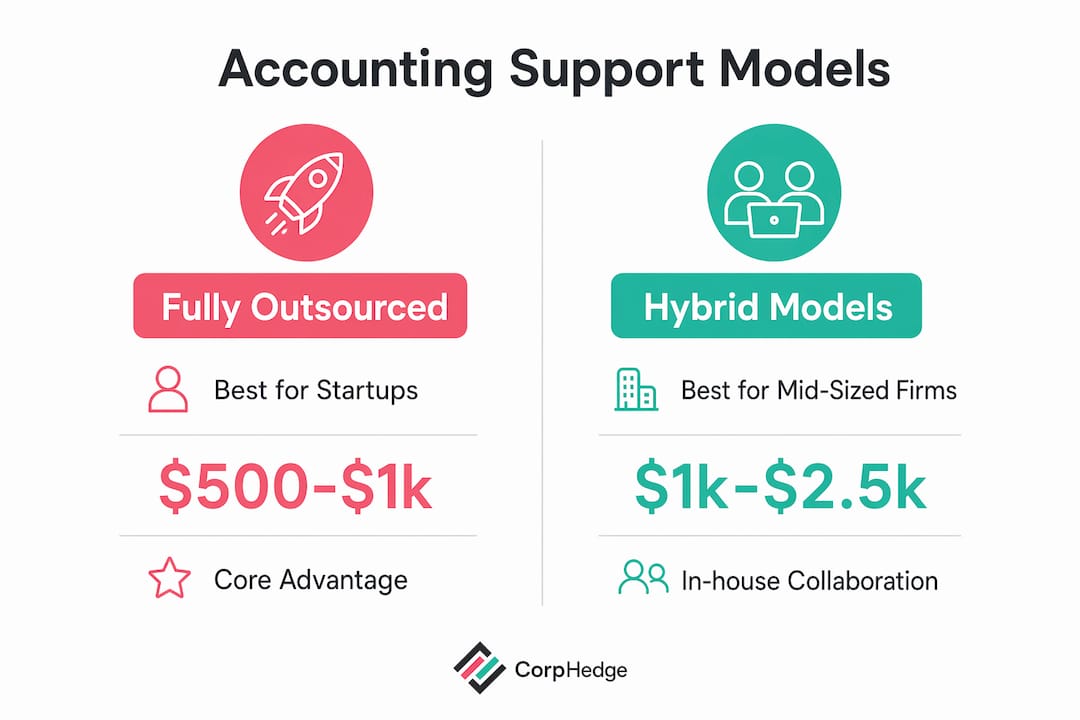
Fully outsourced compliance accounting. A third-party firm takes ownership of all regulatory reporting, filing coordination, and audit preparation. This model works best for firms entering new jurisdictions or those without an established compliance accounting function. Outsourced annual compliance and accounting packages for international entities range from $500 to $2,500 depending on jurisdiction and service volume. That range covers basic filing support at the low end and full managed services at the high end.
-
Fractional compliance specialists. A growing number of firms adopt fractional or outsourced compliance specialists to adapt faster to shifting regulations without full-time hires. A fractional specialist works a defined number of hours per month, covering regulatory updates, filing reviews, and audit preparation. This model suits mid-size regulated firms that have internal accounting staff but lack deep regulatory expertise.
-
Hybrid internal-external teams. Internal finance staff handle day-to-day accounting while an external specialist firm manages regulatory filings, audit support, and remediation projects. This model preserves institutional knowledge internally while adding specialist capacity when regulators require it.
The right model depends on your firm's regulatory footprint, internal headcount, and the frequency of regulatory changes in your sector. The table below summarizes the key differences.
| Model | Best for | Typical cost range | Core advantage |
|---|---|---|---|
| Fully outsourced | New market entrants, lean teams | $500–$2,500 per year | Full coverage, no internal build required |
| Fractional specialist | Mid-size firms with internal staff | Varies by hours | Flexible, cost-controlled expertise |
| Hybrid team | Large regulated firms | Higher, project-based | Internal knowledge plus external depth |
How does specialized accounting support ensure compliance and reduce risks?
Specialized accounting support reduces compliance risk through two mechanisms: automation and expert review working together. Firms using specialized regulatory reporting support achieve up to 99.7% filing accuracy by combining automation with expert review. That accuracy rate matters because a single filing error in a regulated environment can trigger a formal inquiry, a remediation requirement, or a financial penalty.

Automation handles high-volume, repeatable tasks: transaction matching, reconciliation, deadline tracking, and document version control. Expert review catches the exceptions that automation flags but cannot resolve, such as a transaction that crosses two regulatory categories or a disclosure requirement that changed mid-year. Neither layer works as well alone.
The specific risk-reduction benefits of specialized financial reporting for regulated companies include:
- Continuous compliance monitoring. Managed teams track regulatory calendars across jurisdictions and alert finance teams before deadlines, not after.
- Documented governance frameworks. Regulatory reporting support service models maintain documented governance, high-volume repeatability, and contractual accountability for audit-ready reporting. That documentation becomes your defense in a regulatory review.
- Regulatory collaboration. The Bank of England notes that regulatory authorities are collaborating to streamline compliance through alignment of accountability frameworks and simplifying model approval. Firms with structured accounting support are better positioned to benefit from these simplifications.
The 99.7% accuracy figure is not a ceiling. It reflects what structured, managed teams achieve under normal operating conditions. Firms that rely on generalist accountants or unspecialized software consistently fall short of that benchmark.
What practical steps can regulated companies take to integrate accounting support?
Integration of external accounting support fails most often because governance is unclear from the start. Finance teams assume the external provider knows the firm's internal processes. External providers assume the finance team will supply complete, organized data. Neither assumption holds without a written protocol.
The steps that produce reliable integration are:
- Define ownership clearly. Assign a named internal contact for every regulatory filing category. The external provider needs a single point of contact per workstream, not a rotating cast of finance staff.
- Build audit trails from day one. Audit-ready accounting requires workflows including automated reconciliation, digital mapping, and detailed document trails. Set these up before the first filing, not after a regulator requests them.
- Establish a shared regulatory calendar. Map every filing deadline, review cycle, and regulator meeting date into a shared system. Both internal and external teams must work from the same calendar.
- Create a cross-functional communication protocol. Cross-departmental compliance requires accounting support to coordinate tax, legal, and operations to provide cohesive evidence for regulatory audits. A weekly standing call between finance, legal, and the external provider prevents information gaps.
Pro Tip: Request a financial compliance documentation review from your external provider at the start of each quarter. Regulators update guidance between major publication cycles. A quarterly review catches changes before they affect your filings.
Technology selection matters as much as process design. Firms that use platforms with real-time position tracking and integrated reporting reduce the manual reconciliation burden significantly. For regulated companies with foreign currency exposure, connecting accounting workflows to a currency risk management platform eliminates a common source of reporting discrepancy. Corphedge provides real-time currency position data that feeds directly into financial reporting workflows, reducing the gap between treasury and accounting records.
Key takeaways
Specialized regulatory accounting assistance, not generic bookkeeping, is the only reliable path to audit-ready compliance for regulated firms operating under frameworks like those set by the Prudential Regulation Authority.
| Point | Details |
|---|---|
| Accuracy through managed teams | Specialized support achieves up to 99.7% filing accuracy by combining automation with expert review. |
| Model selection drives cost efficiency | Outsourced packages range from $500 to $2,500 annually; choose the model that matches your regulatory footprint. |
| Remediation requires project management | Regulator findings demand structured corrective workflows, not just accounting adjustments. |
| Cross-functional coordination is non-negotiable | Tax, legal, and operations must align with accounting to produce consistent regulatory evidence. |
| Integration starts with governance | Clear ownership, shared calendars, and documented protocols prevent the most common integration failures. |
Why proactive compliance is the only model worth building
The firms I have watched struggle most with regulatory accounting are not the ones with the smallest teams. They are the ones that treat compliance as a reporting exercise rather than an operational discipline. KPMG advises that compliance management requires a transformative approach using methodologies like Lean Six Sigma for proactive compliance. That advice sounds abstract until you watch a firm spend six months in remediation because their accounting function was built to close the books, not to satisfy a regulator.
The shift from reactive to proactive compliance is not about hiring more people. It is about redesigning the accounting function so that audit readiness is a byproduct of normal operations, not a special project triggered by a regulator request. Fractional and outsourced accounting models help firms adapt quickly to shifting regulatory landscapes without expanding internal teams. That flexibility is worth more than it appears on a budget line.
My honest advice: when evaluating an external accounting support provider, ask them to show you a remediation case they managed from finding to closure. Any provider worth hiring has done this before and can walk you through their process. If they cannot, they are selling you reporting support, not compliance support. Those are different products.
— Bartas
How Corphedge supports regulated companies managing financial risk
Regulated companies carry both compliance obligations and financial market exposure. Managing currency risk alongside regulatory reporting requirements is a coordination challenge that most accounting functions handle poorly.
Corphedge is an online platform built for companies managing currency risk in the foreign exchange market. It provides real-time currency position data, hedging based on Value at Risk, and integration capabilities that connect treasury and accounting workflows. For regulated firms in Poland, Sweden, and other markets, Corphedge reduces the gap between treasury positions and the financial records that regulators review. Finance teams can access foreign exchange risk management tools that align with the accuracy standards that compliance accounting demands.
FAQ
What is regulatory accounting assistance?
Regulatory accounting assistance is specialized financial support that helps regulated firms meet filing requirements, maintain audit-ready documentation, and respond to regulator findings. It goes beyond standard bookkeeping to include compliance monitoring, cross-functional coordination, and remediation project management.
How accurate are outsourced regulatory reporting teams?
Firms using specialized regulatory reporting support achieve up to 99.7% filing accuracy by combining automation with expert review. That accuracy level requires documented governance frameworks and contractual accountability, not just software.
What does outsourced compliance accounting cost?
Outsourced annual compliance and accounting packages for international entities range from $500 to $2,500 depending on jurisdiction and service volume. Fractional and hybrid models vary based on hours and project scope.
How do regulated companies prepare for a regulatory audit?
Audit preparation requires automated reconciliation workflows, digital transaction mapping, and complete document trails built into normal operations. Firms that build these workflows before an audit request arrives consistently outperform those that assemble evidence reactively.
Why do regulated firms need cross-functional accounting support?
Regulators expect consistent evidence across tax, legal, and financial records. Cross-functional compliance coordination across departments produces the cohesive evidence packages that regulatory audits require. Accounting support that operates in isolation from legal and operations creates gaps that regulators find quickly.