

TL;DR:
- Financial institution bookkeeping involves daily transaction recording and compliance with regulatory standards.
- Using integrated systems and thorough documentation ensures audit readiness and reduces error risks.
Financial institution bookkeeping is defined as the systematic recording, reconciling, and reporting of all financial transactions within banks, credit unions, and similar regulated organizations. It forms the backbone of trustworthy financial reporting and regulatory adherence. Bodies such as the SEC, FDIC, and NCUA set the compliance standards that shape every bookkeeping decision at these institutions. Accurate banking financial records protect client assets, support risk management, and build the regulatory confidence examiners expect. Without this foundation, audit readiness becomes reactive rather than built into daily operations.
What does financial institution bookkeeping actually require?
Financial institution bookkeeping covers far more ground than standard business accounting. The industry term most professionals use is "institutional accounting," but the bookkeeping layer underneath it is what makes accurate reporting possible. Every loan disbursement, deposit, fee, and expense must be recorded daily, categorized correctly, and tied to a supporting document. Credit union bookkeeping and bank accounting share this core discipline, even when the regulatory frameworks differ slightly.
The scope of daily tasks includes:
- Recording all transactions: loan originations, deposit inflows, wire transfers, and fee income
- Reconciling bank statements against the general ledger every month without exception
- Managing payroll entries and tax withholding records for institution staff
- Producing income statements, balance sheets, and regulatory reports on schedule
- Maintaining supporting documentation for every transaction category
Financial reporting for lenders adds another layer. Loan tracking systems must capture origination dates, payment schedules, interest accruals, and delinquency status. A single misclassified loan entry can distort capital adequacy ratios and trigger examiner scrutiny.
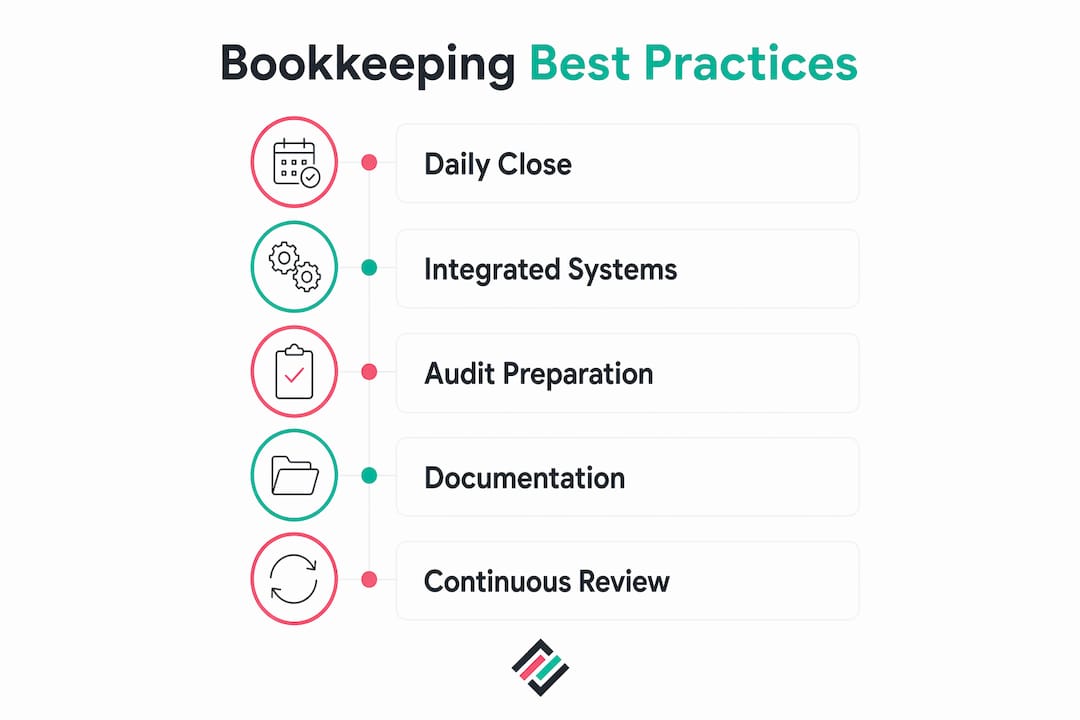
Pro Tip: Set up a daily close checklist that requires sign-off on transaction categorization before the ledger is locked. This prevents end-of-month reconciliation surprises and keeps your audit trail clean from day one.

How do financial institutions ensure audit-ready bookkeeping?
Audit readiness is not a year-end project. Bookkeeping in financial institutions is the frontline defense against regulatory penalties, demanding constant transparency rather than periodic fixes. Examiners do not simply check whether the numbers add up. They assess whether the processes and controls behind those numbers are sound.
The most common audit vulnerabilities fall into a predictable pattern:
- Reliance on spreadsheets with no version control or user access logs
- Missing evidence trails for manual journal entries
- Disconnected data feeds between core banking systems and ancillary platforms
- Incomplete documentation for loan modifications or fee waivers
- Retention gaps where records are purged before the required period ends
Spreadsheet-based bookkeeping lacks the audit trails and version control that examiners require. That absence is a red flag, not a minor deficiency. Regulators treat unverifiable manual changes as a process failure, regardless of whether the final numbers are correct.
The 2026 GENIUS Act introduces a new compliance dimension. Banks involved with digital assets must now maintain triple-entry bookkeeping to provide forensic-level transparency alongside traditional fiat records. This requirement increases complexity for any institution holding or transacting in digital assets, and it demands forensic accounting expertise that many teams have not yet built.
"Regulators assess not only the accuracy of financial statements but also the soundness of underlying bookkeeping processes and controls. A clean balance sheet built on weak processes will not survive a thorough examination."
For document retention, the guidance is clear. Bank statements should be retained for a minimum of 3 years to substantiate tax deductions, with a 7-year retention period recommended for full audit protection. Institutions that purge records at 3 years leave themselves exposed in the event of a complex audit or fraud investigation.
What operational best practices improve bookkeeping accuracy?
The month-end close process reveals the true health of a financial institution's bookkeeping operation. Institutions using integrated general ledger systems synced with core banking processors compress month-end close to 2–3 days, compared to 5–10 business days with manual spreadsheet processes. That difference is not just efficiency. It means faster regulatory reporting, fewer errors carried forward, and more time for staff to review exceptions rather than chase data.
The table below compares the two primary approaches to month-end close management:
| Feature | Spreadsheet-based close | Integrated GL system |
|---|---|---|
| Close timeline | 5–10 business days | 2–3 days |
| Audit trail | Manual, unverifiable | Automated, granular |
| Version control | None | Built-in |
| Data feed errors | High, manual bridging required | Low, native integration |
| Examiner confidence | Low | High |
The integration gap between core banking and secondary systems is the chief source of bookkeeping errors at most institutions. When loan servicing platforms, payment processors, and investment accounting systems do not feed directly into the general ledger, staff must manually bridge the data. That manual step introduces errors and creates the exact kind of unverifiable change history that examiners flag.
Automation helps, but not without human oversight. Human-in-the-loop reconciliation workflows reduce investigation time from six hours to two or three hours compared to fully autonomous AI solutions. The reason is straightforward. Complex financial institution transactions often require judgment calls that automated systems cannot make reliably. Automation handles volume; humans handle exceptions.
Pro Tip: When evaluating a general ledger system, ask the vendor specifically how it handles data feeds from your core banking processor. Native integration is the only acceptable answer. Middleware solutions add a new failure point.
How should financial institutions manage documentation for audit defense?
Documentation is where most institutions underinvest until an audit reveals the gap. Auditors reject summaries without detailed supporting documentation. A bank statement alone does not substantiate a transaction. The supporting layer matters just as much.
The documents that must accompany banking financial records include:
- Original invoices and receipts for all operating expenses
- Loan agreements, modification letters, and payment history logs
- Wire transfer confirmations with stated business purpose
- Board-approved fee schedules and any exceptions granted
- Payroll records including tax withholding calculations and filings
Organizing these records by transaction date and category is the baseline. Retrieval speed matters during an examination. If your team cannot produce a specific loan file or expense receipt within minutes, the examiner's confidence in your overall process drops immediately.
The table below outlines recommended retention periods by document type:
| Document type | Minimum retention | Recommended retention |
|---|---|---|
| Bank statements | 3 years | 7 years |
| Loan agreements | Life of loan + 3 years | Life of loan + 7 years |
| Payroll records | 4 years | 7 years |
| Tax filings and support | 3 years | 7 years |
| Wire transfer records | 5 years (BSA requirement) | 7 years |
Supporting documents beyond bank statements provide the essential evidence for IRS audits and fraud prevention. Detailed recordkeeping is a compliance requirement, not an administrative preference. Institutions expanding into new markets, including Poland and Sweden where Corphedge is currently growing its presence, face additional documentation requirements under local regulatory frameworks that layer on top of existing U.S. standards.
For institutions managing financial asset tracking across multiple asset classes, a centralized document management system with indexed search capability is the most practical solution. Paper-based filing systems cannot meet the retrieval speed that modern examinations demand.
The most common documentation mistake is treating transaction logs as optional detail. Every journal entry should carry a reference to its source document. Without that link, the entry is an assertion, not evidence.
Key Takeaways
Sound financial institution bookkeeping requires integrated systems, disciplined documentation, and daily process controls that hold up under regulatory examination, not just at year-end.
| Point | Details |
|---|---|
| Integrated GL systems cut close time | Synced systems reduce month-end close from 5–10 days to 2–3 days. |
| Spreadsheets fail audit standards | They lack version control and user logs, creating unverifiable change history. |
| Retain records for 7 years | A 7-year retention period provides full protection against complex audits. |
| Documentation beats summaries | Auditors require original invoices, loan files, and transaction logs, not just statements. |
| Human oversight improves reconciliation | Balanced AI-human workflows cut investigation time significantly versus full automation. |
The uncomfortable truth about bookkeeping culture at financial institutions
I have worked with accounting teams at banks and credit unions that ran clean balance sheets for years, then failed examinations not because the numbers were wrong but because the process behind the numbers was invisible. The spreadsheet looked fine. The controls did not exist.
The shift I keep pushing for is treating bookkeeping as a continuous evidence-building process rather than a monthly reconciliation exercise. Every transaction should carry its own proof at the moment it is recorded. Waiting until an audit request arrives to assemble documentation is how institutions end up in consent orders.
The digital asset dimension makes this more urgent. Triple-entry bookkeeping under the 2026 GENIUS Act is not just a compliance checkbox. It represents a fundamental change in how ledger integrity is verified. Institutions that treat it as an IT project rather than an accounting discipline will struggle when examiners start asking forensic-level questions.
My honest recommendation is to audit your own close process before a regulator does. Map every manual data transfer between systems. Count how many journal entries lack a direct source document reference. That number will tell you more about your audit risk than any financial ratio. The financial compliance documentation practices that hold up under scrutiny are built entry by entry, not assembled at year-end.
— Bartas
How Corphedge supports financial institutions with risk-aware reporting
Financial institutions managing currency exposure alongside their bookkeeping obligations face a compounding compliance burden. Corphedge addresses the risk management side of that equation with tools built for institutions that need real-time visibility into currency positions and documented hedging strategies.

Corphedge integrates value at risk hedging with reporting transparency, giving finance teams the documented evidence trail that examiners expect when reviewing foreign exchange positions. For institutions in Poland and Sweden, where Corphedge is actively expanding, the platform supports local regulatory reporting requirements alongside U.S. standards. Explore the product demo tour to see how Corphedge connects risk management with audit-ready financial reporting in a single workflow.
FAQ
What is financial institution bookkeeping?
Financial institution bookkeeping is the systematic daily recording, reconciling, and reporting of all financial transactions within banks, credit unions, and similar regulated organizations. It supports regulatory compliance, audit readiness, and accurate financial reporting.
How long should financial institutions keep bank statements?
Financial institutions should retain bank statements for at least 3 years to substantiate tax deductions, with a 7-year retention period recommended for full audit protection against complex examinations.
Why do spreadsheets fail audit requirements for banks?
Spreadsheets lack user access logs and version control, making manual changes unverifiable. Examiners treat this absence as a process failure, regardless of whether the final figures are accurate.
What is triple-entry bookkeeping and who needs it?
Triple-entry bookkeeping adds a cryptographically verified third record to the traditional debit-credit system, providing forensic-level transparency. The 2026 GENIUS Act requires it for banks involved with digital assets.
How can credit unions reduce month-end close time?
Credit unions that replace spreadsheet-based processes with integrated general ledger systems synced to their core banking processors reduce month-end close from 5–10 business days down to 2–3 days.