

TL;DR:
- Accounting for audit compliance involves adhering to laws, standards, and controls to successfully submit financial statements. From 2026, EU companies exceeding certain size or funding thresholds must undergo audits, or their submissions will be rejected, risking penalties. Continuous internal monitoring and early auditor engagement are essential to maintaining compliance across evolving regulations and international jurisdictions.
Accounting for audit compliance is the process of adhering to laws, standards, and internal controls required to prepare and submit audited financial statements correctly and on time. For international companies operating across EU member states, this process now covers statutory financial audits, sustainability reporting under the Corporate Sustainability Reporting Directive (CSRD), and public tax disclosure under EU Public Country-by-Country Reporting (CbCR). The regulatory environment tightened significantly in 2026, with registries rejecting unaudited submissions and new penalty frameworks taking effect. Compliance officers and accounting professionals who understand the full scope of these obligations avoid costly delays, regulatory sanctions, and reputational damage.
What are the mandatory audit criteria and thresholds for EU companies?
An audit is mandatory in the EU when a company exceeds two of three criteria: assets of at least €2.5 million, net annual revenue of at least €4.5 million, or an average headcount of at least 50 employees at year-end. This "2 out of 3" rule applies to most private companies across EU member states. Crossing two thresholds in a single financial year triggers the obligation for the following reporting period.
Two additional conditions override the size thresholds entirely. Public interest entities, such as listed companies, banks, and insurance firms, face mandatory audits regardless of size. Companies that receive state or municipal funding above €500,000 also trigger an audit obligation, even if they fall below all three financial criteria. This funding threshold catches many mid-sized organizations that assume they are exempt.
| Trigger | Threshold |
|---|---|
| Total assets | ≥ €2.5 million |
| Net annual revenue | ≥ €4.5 million |
| Average headcount | ≥ 50 employees |
| Public interest entity | Any size |
| State or municipal funding | > €500,000 received |
The consequences of missing these thresholds are now more severe. From 2026, registries automatically reject financial statement submissions that lack a qualified auditor's report when an audit is mandatory. A rejection at submission means the company's financial statements are not legally filed, which triggers further regulatory consequences. Accounting teams must confirm audit eligibility before the reporting cycle begins, not after the statements are drafted.
Pro Tip: Build a threshold monitoring worksheet that tracks assets, revenue, and headcount quarterly. Catching a threshold breach mid-year gives you time to engage an auditor before the filing deadline.
Despite EU legislation allowing small companies to be exempt from audits, some member states impose stricter national thresholds. Companies operating in Poland, Sweden, or other EU jurisdictions must verify local requirements separately from the EU baseline. Assuming the EU minimum applies everywhere is a common and costly mistake.
How have new EU directives changed audit compliance requirements?
The Omnibus Directive significantly reshaped the CSRD and the Corporate Sustainability Due Diligence Directive (CSDDD) in 2025 and 2026. The most consequential change for compliance officers is the shift to a risk-based due diligence approach. Companies no longer need to audit every supplier in their value chain. They focus documented effort on the highest-risk relationships instead.
Key changes under the Omnibus Directive include:
- Scope reduction: Fewer companies fall under mandatory CSRD sustainability reporting, with thresholds raised for large undertakings.
- Risk-based due diligence: Companies must identify, prioritize, and document high-risk areas rather than apply uniform procedures across all operations.
- Penalty harmonization: Non-compliance with CSDDD carries penalties capped at 3% of net worldwide turnover, applied consistently across member states.
- Full harmonization: EU member states are prohibited from introducing diverging national rules for core due diligence elements, reducing the patchwork of local variations that previously complicated multinational compliance.
- Timeline adjustments: Reporting obligations for many companies shifted to later fiscal years, but the compliance preparation work must begin now.
The 3% penalty cap sounds like a ceiling, but for a multinational with €1 billion in global turnover, that figure reaches €30 million. That scale makes audit compliance a board-level financial risk, not just an accounting department task.
Pro Tip: Map your value chain and assign a risk tier to each supplier relationship before your next sustainability audit cycle. Auditors will ask for this documentation, and building it retroactively under deadline pressure produces weak results.
Looking further ahead, the 6th Anti-Money Laundering Directive (6AMLD), effective July 2027, raises supervisory expectations around governance and risk-based due diligence beyond simple checklist compliance. Compliance officers should treat 6AMLD preparation as part of their current audit compliance planning cycle, not a separate future project.
What are the EU public country-by-country reporting requirements?
EU Public CbCR requires multinational groups to publicly disclose income tax information on a jurisdiction-by-jurisdiction basis. The scope covers groups with consolidated net turnover above €750 million for two consecutive fiscal years. Groups that fall below this threshold in either year exit the obligation until they meet it again for two consecutive periods.
The required disclosures include:
- Revenue broken down by jurisdiction, including EU member states and listed non-cooperative jurisdictions.
- Profit or loss before income tax for each jurisdiction.
- Income tax accrued and paid per jurisdiction.
- Number of employees per jurisdiction.
- Accumulated earnings at year-end per jurisdiction.
- Tangible assets other than cash or cash equivalents.
The first filing deadline for calendar-year groups is december 31, 2026, covering fiscal years starting on or after january 1, 2025. That deadline is closer than most compliance teams realize, particularly for groups that have not yet mapped their jurisdictional data.
| Requirement | Detail |
|---|---|
| Revenue threshold | > €750 million for two consecutive years |
| Filing deadline | December 31, 2026 (calendar-year groups) |
| Disclosure scope | All EU member states plus listed non-cooperative jurisdictions |
| Auditor role | Scope and publication verification only |
The auditor's role in Public CbCR is narrower than many accounting professionals expect. Auditors verify whether a company falls within scope and confirm that the report was published, but they are not required to assure the accuracy of the report's content. This distinction matters because it places the burden of content accuracy entirely on the company's internal tax and accounting teams.
Where data omissions occur due to commercial sensitivity, companies should discuss those omissions proactively with their statutory auditors before filing. Germany implemented Public CbCR into national law with specific procedural requirements that differ from the baseline EU directive. Groups with German entities must verify local filing mechanics separately. For a broader view of how international banking compliance intersects with these reporting obligations, the international banking compliance guide for 2026 provides useful context on due diligence expectations across jurisdictions.
What are the best practices for financial audit preparation and internal controls?
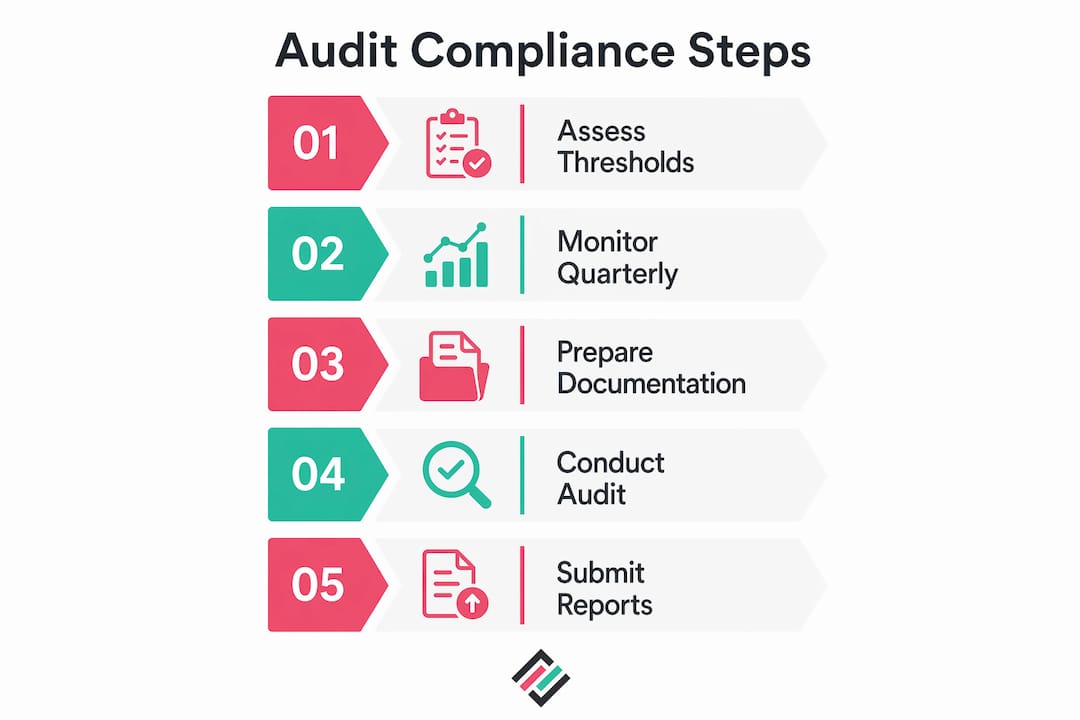
Strong internal audit accounting practices start with documentation architecture. Every material transaction, estimate, and judgment must have a clear audit trail before the auditor arrives. Retroactive documentation is always weaker than contemporaneous records, and auditors can tell the difference.

The most frequently failed area in sustainability audits is the double materiality assessment. Companies often fail sustainability audits because their double materiality assessments are poorly documented, with insufficient evidence of how impacts, risks, and thresholds were identified and evaluated. Sustainability assurance requires auditors to understand reporting processes deeply, perform analytical procedures, and review stakeholder consultation records. If those records do not exist, the audit opinion is at risk.
Practical steps for maintaining audit readiness throughout the year include:
- Establish a compliance calendar: Map every filing deadline, threshold review date, and auditor engagement milestone for the full fiscal year.
- Centralize documentation: Store all supporting records, contracts, and correspondence in a single system with version control and access logs.
- Train staff regularly: Accounting and compliance teams need annual training on updated standards, including CSRD reporting requirements and Public CbCR disclosure rules.
- Use compliance-focused accounting software: Systems that automate threshold monitoring, generate audit trails, and flag anomalies reduce the risk of manual error.
- Engage auditors early: Share draft financial statements and sustainability reports with your auditors before the final submission window. Early engagement surfaces issues while there is still time to correct them.
- Review your accounting compliance checklist quarterly: A static annual checklist misses mid-year threshold breaches and regulatory updates.
Pro Tip: Assign a named owner to every item on your accounting compliance checklist. Shared ownership means no ownership. When an auditor asks who approved a specific disclosure, you need a name and a date.
For companies in Poland and Sweden, where Corphedge is actively expanding its services, local audit exemption thresholds and national implementations of EU directives add another layer of verification. Polish and Swedish accounting professionals should cross-reference EU baseline requirements against national transpositions before finalizing their audit compliance checklist. The financial compliance documentation guide for 2026 covers documentation standards relevant to both markets.
Key Takeaways
Accounting for audit compliance in 2026 requires meeting EU statutory thresholds, adhering to CSRD and CSDDD frameworks, filing Public CbCR reports accurately, and maintaining documented internal controls throughout the year.
| Point | Details |
|---|---|
| Audit threshold triggers | Exceeding 2 of 3 EU criteria (assets, revenue, headcount) or receiving >€500,000 in public funding mandates an audit. |
| Registry rejection risk | From 2026, EU registries reject financial statements without an auditor's report when an audit is mandatory. |
| Public CbCR deadline | Groups above €750 million turnover must file their first Public CbCR report by December 31, 2026. |
| Double materiality documentation | Weak double materiality assessments are the leading cause of failed sustainability audits under CSRD. |
| Harmonized penalties | CSDDD non-compliance carries penalties up to 3% of net global turnover, applied uniformly across EU member states. |
The compliance trap most multinationals walk into
The biggest mistake I see international companies make is treating audit compliance as a year-end exercise. They spend eleven months running the business and then scramble in december to reconstruct documentation that should have been built in real time. That approach fails more often than it succeeds, and the cost of failure is not just a penalty. It is a qualified audit opinion, a delayed filing, and a conversation with regulators that nobody wants to have.
The regulatory environment in 2026 is unforgiving in a specific way. The rules are clearer than they have ever been, which means there is less room to argue ambiguity after the fact. The CSRD double materiality requirement, the Public CbCR disclosure scope, and the CSDDD due diligence framework all have defined criteria. If your documentation does not match those criteria, the auditor cannot sign off. That is not a judgment call. It is a binary outcome.
What actually works is building compliance into the operating rhythm of the finance function. Quarterly threshold reviews, named document owners, and early auditor engagement are not bureaucratic overhead. They are the difference between a clean audit opinion and a restatement. For multinationals expanding into Poland and Sweden, the added complexity of national threshold variations makes this discipline even more critical. The risk reporting checklist for finance executives is a practical starting point for building that rhythm.
The companies that handle audit compliance well share one trait: they treat it as a continuous process, not a deadline. That mindset shift is worth more than any single tool or framework.
— Bartas
How Corphedge supports compliance-ready financial reporting
International companies managing cross-border financial reporting face a compounding challenge: audit compliance standards tighten at the same time that currency volatility adds noise to the financial data auditors review. Corphedge provides FX risk management tools that give accounting and compliance teams accurate, real-time visibility into currency positions and exposure. That accuracy matters when auditors examine the financial statements underlying your Public CbCR disclosures or CSRD sustainability reports. Corphedge's Value at Risk hedging tools help finance teams quantify and manage FX exposure before it distorts the figures your auditors rely on. For companies in Poland and Sweden navigating both local audit requirements and EU-wide reporting obligations, Corphedge offers the financial clarity that compliance-ready reporting demands.
FAQ
What triggers a mandatory audit in the EU?
A mandatory audit is triggered when a company exceeds two of three criteria: assets of at least €2.5 million, net revenue of at least €4.5 million, or an average of 50 employees. Public interest entities and companies receiving over €500,000 in state funding face mandatory audits regardless of size.
What happens if a company submits financial statements without an auditor's report?
From 2026, EU registries automatically reject financial statement submissions that lack a qualified auditor's report when an audit is mandatory. This means the statements are not legally filed, which triggers additional regulatory consequences.
Who must comply with EU Public CbCR?
Multinational groups with consolidated net turnover above €750 million for two consecutive fiscal years must publicly disclose income tax information by jurisdiction. The first filing deadline for calendar-year groups is December 31, 2026.
What is double materiality and why does it matter for audit compliance?
Double materiality requires companies to assess both how sustainability issues affect the business financially and how the business impacts society and the environment. Weak documentation of this assessment is the most common reason companies fail sustainability audits under CSRD.
Do EU audit exemption thresholds apply uniformly across all member states?
No. While the EU sets baseline exemption thresholds, individual member states can impose stricter national thresholds. Companies operating in multiple EU jurisdictions, including Poland and Sweden, must verify local requirements separately from the EU minimum.