

TL;DR:
- Regulatory audit accounting verifies that a company's financial reporting complies with laws and standards. Key standards like PCAOB AS 1000 require detailed documentation, independent testing of estimates, and continuous evidence maintenance. Proper preparation through gap assessments and thorough control documentation helps organizations avoid common regulatory deficiencies.
Regulatory audit accounting is defined as the systematic process of verifying that an organization's financial reporting and internal controls comply with applicable laws, standards, and regulatory requirements. Bodies like the Public Company Accounting Oversight Board (PCAOB), the Financial Reporting Council (FRC), and the Financial Conduct Authority (FCA) set the rules that govern this process. Standards such as PCAOB AS 1000 establish the foundational duties every auditor must meet. For accounting professionals and compliance officers, understanding these requirements is not optional. It is the difference between a clean audit and a regulatory enforcement action.
What are the core standards in regulatory audit accounting?
Regulatory audit accounting rests on a set of codified standards that define what auditors must do and how they must document their work. PCAOB AS 1000 is the modernized foundational standard consolidating auditor duties, including due professional care, professional skepticism, and engagement quality review. It is effective for fiscal years ending on or after December 15, 2024. That means any audit of a calendar-year company completed in 2025 or 2026 must fully conform to AS 1000.
Professional skepticism is not a soft skill under these standards. It is a documented obligation. Auditors must question management representations, corroborate them with independent evidence, and record that process explicitly in the audit file. Engagement quality review adds a second layer: a senior reviewer must independently assess whether the audit conclusions are supported before the report is issued.
Regulators do not accept "we did the work but didn't write it down." Under ISA 230.8 and PCAOB AS 1000, if the reasoning is absent from the audit file, it counts as non-existent. Inspectors apply this standard literally, and firms that fail it face findings regardless of the actual quality of their underlying work.
For FCA-regulated businesses in the UK, the stakes are even higher. FCA-regulated firms generally require a statutory audit regardless of company size, effective for financial years starting April 6, 2025. That removes the size-based exemptions that smaller companies typically rely on. Compliance officers at regulated financial firms must treat audit preparation as a year-round activity, not a year-end scramble.
How do auditors evaluate internal controls and accounting estimates?
Internal control evaluation sits at the center of any regulatory compliance review. Auditors do not simply confirm that a control exists on paper. They verify both its design and its operational effectiveness.

Design effectiveness asks: is this control capable of preventing or detecting a material misstatement? Operational effectiveness asks: did the control actually function as designed during the period under review? Both dimensions require testing, and a control that passes design testing but fails operational testing is treated as a deficiency.
The standard audit procedures used to gather this evidence are:
- Inquiry — asking management and staff how a control works in practice
- Inspection — examining documents, logs, and system records that show the control ran
- Observation — watching the control execute in real time
- Reperformance — independently re-executing the control to verify the outcome
- Confirmation — obtaining direct written responses from third parties
No single procedure is sufficient on its own. Regulators expect a combination, particularly for high-risk areas like revenue recognition and financial instrument valuation.
Accounting estimates present a separate challenge. Under ISA 540, auditors must go beyond reviewing management's methodology. They must independently test assumptions, including stress-testing "close call" scenarios where a different assumption would produce a materially different result. This is where many audit teams fall short. Accepting management's estimate without running an independent model is a recurring inspection finding across PCAOB and FRC reviews.
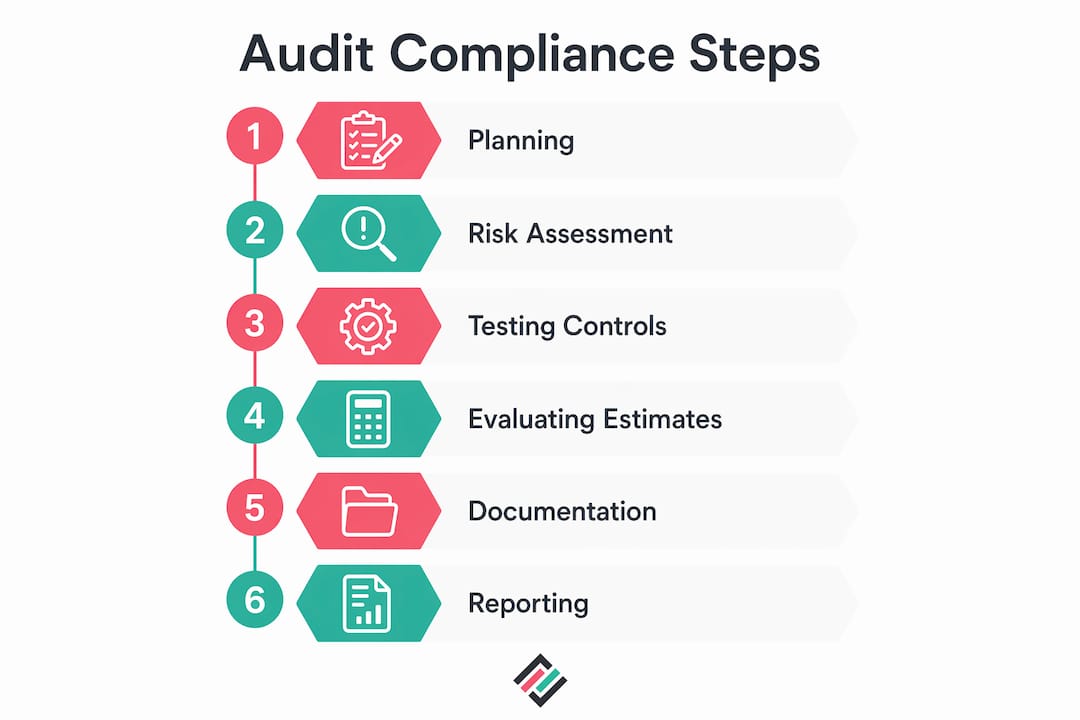
Pro Tip: Build a separate workpaper for each significant accounting estimate. Document your independent assumption range, your stress-test results, and your conclusion. Regulators want to see the auditor's own analysis, not a summary of management's.
Audit trails for internal controls must show clear ownership. Each control should have a named owner, an approval date, and evidence of consistent application. Assigning clear ownership for each control area avoids what compliance experts call the "ownership trap," where no one can demonstrate accountability during an inspection.
Which areas generate the most regulatory audit findings?
Regulatory inspections by the PCAOB and FRC consistently surface the same four gaps. Knowing them in advance lets compliance officers address weaknesses before an inspector does.
- Lack of professional skepticism toward management. Auditors accept explanations without corroborating evidence. Inspectors flag this when the audit file shows no independent challenge to management's positions.
- Inadequate documentation of professional judgment. Under ISA 230.8 documentation standards, every significant judgment must be written down with explicit reasoning. A conclusion without a documented rationale fails inspection.
- Weak going concern assessments. ISA 570.16 requires auditors to evaluate whether management's going concern assumptions are reasonable. Thin workpapers on this topic are a red flag for inspectors.
- Insufficient independent evaluation of accounting estimates. Relying on management's model without running an independent analysis violates ISA 540.13 and is one of the most cited deficiencies globally.
The documentation gap is the most preventable of these four. Audit teams that do the right work but fail to record it face the same regulatory consequence as teams that skip the work entirely. That asymmetry should drive every documentation practice in your firm.
Proactive gap assessments are the most effective mitigation. Internal gap assessments before audits allow organizations to identify and address control weaknesses before a regulator does. Running a mock inspection against your own audit files, using the same criteria an FRC or PCAOB inspector would apply, surfaces problems while you still have time to fix them.
Pro Tip: Schedule a pre-audit file review 60 days before your fiscal year end. Have a senior team member review workpapers using the regulator's published inspection criteria. Findings at that stage cost you revision time. Findings during the actual inspection cost you much more.
What practical steps prepare you for a regulatory audit?
Audit readiness is a process, not an event. The following steps build the foundation for a clean regulatory compliance review.
-
Build a compliance audit checklist. A structured compliance audit checklist maps every control area to the required evidence, the responsible owner, and the applicable standard. Checklists should cover cybersecurity controls, data protection practices, financial reporting governance, and any sector-specific requirements.
-
Assign and document control ownership. Every control on your checklist needs a named owner. That person is responsible for maintaining evidence and demonstrating the control ran consistently throughout the period. Undocumented or shared ownership fails inspection.
-
Maintain continuous evidence upkeep. Audit readiness fails when evidence is outdated or lacks clear approval dates. Regulators reject documentation that cannot demonstrate uniform application across the full audit period. Update evidence on a rolling basis, not just at year end.
-
Align testing schedules with risk. High-risk areas like revenue recognition, financial instrument valuation, and related-party transactions require more frequent testing. Build your internal audit calendar around your risk register, not around administrative convenience.
-
Conduct a pre-audit gap assessment. Walk through your audit file using the regulator's published inspection criteria. For companies operating in regulated sectors, the accounting support for regulated companies framework provides a useful baseline for what inspectors expect to see.
The table below summarizes the key preparation areas and what each one requires:
| Preparation area | What regulators expect to see |
|---|---|
| Control documentation | Named owner, approval date, evidence of consistent operation |
| Accounting estimates | Independent auditor model, stress-test results, documented conclusion |
| Going concern | Management's analysis plus auditor's independent challenge |
| Professional skepticism | Written record of challenges to management and corroborating evidence |
| Audit trail | Complete, dated, and consistently formatted workpapers |
For firms expanding into new markets, such as Poland or Sweden, local regulatory requirements layer on top of international standards. The PCAOB and FRC frameworks provide a strong baseline, but local regulators may impose additional documentation or reporting obligations. Build those requirements into your checklist before the first audit cycle in a new jurisdiction.
Key Takeaways
Effective regulatory audit accounting requires documented professional skepticism, independent evaluation of accounting estimates, and continuous evidence maintenance throughout the audit period.
| Point | Details |
|---|---|
| PCAOB AS 1000 sets the baseline | All audits for fiscal years ending December 15, 2024 and beyond must conform to this standard. |
| Documentation equals compliance | Undocumented reasoning counts as non-existent under ISA 230.8, regardless of actual work done. |
| Test both design and operation | Internal controls must pass both design and operational effectiveness testing to satisfy regulators. |
| Pre-audit gap assessments reduce risk | Running a mock inspection before year end surfaces fixable weaknesses before regulators see them. |
| Ownership prevents the ownership trap | Every control needs a named owner with dated, consistent evidence to survive inspection. |
The uncomfortable truth about audit quality gaps
I have reviewed audit files across multiple sectors, and the pattern is always the same. The work was done. The judgment was sound. But the file does not show it. That is the core failure in most regulatory findings, and it is entirely avoidable.
The shift in regulatory expectations over the past few years is real. PCAOB AS 1000 and the FRC's updated inspection criteria have raised the documentation bar significantly. Auditors who trained under older standards are still writing workpapers the way they always have. Inspectors are reading them the way the new standards require. That gap produces findings that have nothing to do with audit quality and everything to do with presentation.
The other pattern I keep seeing is the treatment of accounting estimates. Teams review management's model, note that it seems reasonable, and move on. That is not independent evaluation. ISA 540 requires auditors to build their own view of the reasonable range, document it, and explain why management's estimate falls within it. The teams that do this consistently are the ones that pass inspection without findings.
My honest recommendation: treat your audit file as the primary product, not the byproduct, of your audit work. If a regulator read only your workpapers and nothing else, they should be able to reconstruct every judgment you made and every piece of evidence you relied on. If they cannot, you have a documentation problem, even if you have no audit quality problem.
— Bartas
How Corphedge supports financial risk and audit compliance
For accounting professionals and compliance officers managing financial risk alongside audit obligations, Corphedge provides tools built for that intersection.
Corphedge is a platform designed to help companies manage foreign exchange risk using value-at-risk-based strategies and real-time currency position monitoring. For organizations operating across multiple jurisdictions, including markets like Poland and Sweden, currency exposure directly affects the financial statement figures that auditors test. Unmanaged FX risk creates volatility in reported results, which in turn draws scrutiny during regulatory audits. Corphedge's value-at-risk hedging tools give finance teams the quantified, documented risk positions that auditors and regulators expect to see. You can also explore Corphedge's full foreign exchange risk management solutions to see how they integrate with your existing compliance framework.
FAQ
What is regulatory auditing in accounting?
Regulatory audit accounting is the process of verifying that an organization's financial statements and internal controls comply with applicable laws and standards. It is governed by bodies such as the PCAOB, FRC, and FCA, and guided by standards including PCAOB AS 1000 and ISA 230.
What does PCAOB AS 1000 require from auditors?
PCAOB AS 1000 requires auditors to apply due professional care, maintain professional skepticism, and complete an engagement quality review. It is effective for fiscal years ending on or after December 15, 2024.
What are the most common regulatory audit findings?
Regulators most frequently cite gaps in professional skepticism, inadequate documentation of judgment under ISA 230.8, weak going concern assessments under ISA 570.16, and insufficient independent evaluation of accounting estimates under ISA 540.13.
How should auditors test internal controls?
Auditors must test both the design and operational effectiveness of each control using procedures such as inquiry, inspection, observation, reperformance, and confirmation. A control that is well-designed but not operating consistently still constitutes a deficiency.
How can compliance officers prepare for a regulatory audit?
Compliance officers should build a structured compliance audit checklist, assign named ownership to every control, maintain current and dated evidence throughout the year, and conduct a pre-audit gap assessment using the regulator's published inspection criteria.