

A zero-cost collar funds a protective put by selling a call at a strike above the current rate, so the two premiums roughly cancel out. You get a defined floor under your exchange rate and a cap on the upside, usually for little or no cash outlay at inception. It fits best when you need protection against a currency shock but don't have room in the budget for an outright option premium, and you're willing to give up some of the gain if the rate moves in your favor.
TL;DR:
- Zero-cost collars are most suitable when the timing or amount of currency exposure is uncertain, rather than when cash flows are locked in and predictable.
- Proper strike selection involves modeling your worst-case tolerable rate first with the put, then finding a call that offsets the premium, considering market skew and volatility.
- The net premium at trade date is zero, but indirect costs such as bid-ask spreads, fees, and collateral requirements can add significantly to the overall hedging expense.
- Collars can limit upside gains if the currency moves favorably beyond the call strike, and empirical evidence shows that puts often expire worthless while calls may be exercised.
- Using modeling platforms like CorpHedge helps compare collar versus forward strategies across multiple currencies and expiries, ensuring risk appetite aligns with operational realities.
Table of Contents
- What Is a Zero-Cost Collar Hedge and How Does It Work?
- When Should You Use a Collar Instead of a Forward or Vanilla Option?
- How to Set Up a Zero-Cost Collar for an FX Receivable or Payable
- What Does a Zero-Cost Collar Actually Cost?
- Governance and Risk Checklist Before You Trade
- Where Collars Actually Belong in a Conservative Hedging Program
- Model and Execute Zero-Cost Collars With CorpHedge
- Sources
- FAQ
What Is a Zero-Cost Collar Hedge and How Does It Work?
A zero-cost collar combines two option legs on the same currency pair with the same expiry: you buy a put to set a floor, and you sell a call to set a ceiling. The premium you receive from selling the call offsets, partly or fully, the premium you pay for the put. When the two amounts roughly match, the structure carries little or no net premium at inception, which is where the "zero cost" label comes from.
The payoff splits into three zones once you understand the strikes:
- Below the put strike: you're protected. If the market rate falls past your floor, the put pays out the difference, so your effective rate never gets worse than the strike you bought.
- Between the two strikes: you participate normally. The company gets whatever the spot market delivers, with no option paying out either way.
- Above the call strike: your upside is capped. If the currency moves in your favor beyond the call strike, the counterparty exercises against you and you settle at the cap rather than at the better market rate.
Strike selection isn't arbitrary. The distance between spot and each strike determines the premium on that leg, and implied volatility and skew (the market's pricing bias toward puts or calls) influence how symmetric your strikes need to be to reach a true zero-cost balance. A steep skew in one direction can force you to widen or narrow one strike just to keep the funding math even.
When Should You Use a Collar Instead of a Forward or Vanilla Option?
The exposure's timing certainty is the first filter. Forwards work best when you know the amount and the date of a cash flow with confidence, an export invoice due in 90 days, for example. Collars earn their place when the timing or amount is uncertain, such as a pending contract award, an M&A transaction that may or may not close, or exposure tied to an event with a binary outcome.
Run through this sequence before choosing:
- Check certainty of amount and date. If both are locked, a forward usually beats a collar on simplicity and cost.
- Check your premium budget. A collar reduces or eliminates upfront cash outlay compared with a standalone put, which matters if your hedging policy caps discretionary spend.
- Check implied volatility and skew. Collars work best when firms want catastrophe protection but have a limited premium budget; if skew is extreme, the zero-cost strikes may sit too far from spot to be useful.
- Check transaction size. Banks generally need a meaningful notional before they'll quote tight, workable strikes. Some providers set explicit minimums, with thresholds around €250,000 not uncommon for a collar structure to make commercial sense.
Pro Tip: Don't force a collar onto a certain, fixed-date exposure just because it's cheaper on paper. If you know exactly when and how much you're receiving, a forward locks the rate without giving up any upside cap.
How to Set Up a Zero-Cost Collar for an FX Receivable or Payable
Start with the floor, not the cap. Decide the worst exchange rate your business can absorb on the exposure and use that as your put strike. Practitioners generally recommend choosing the put strike first based on how much downside the business needs to guard against, then finding the call strike that funds it.
Follow this sequence:
- Set the protection objective. Model the cash-flow impact at a few stress levels (a 5%, 10%, and 15% adverse move is a common set of checkpoints) and pick the floor that keeps the worst case tolerable.
- Price the put, then search for the funding call. Ask your bank or platform for quotes across a range of call strikes until the premium received roughly matches the premium paid. Strikes closer to spot cost more on both legs; moving the call strike further out lowers the premium you collect but raises your cap, so you may need to walk the put strike in to keep things balanced.
- Match expiry to the exposure. The option should expire on or close to the date the receivable or payable settles. Confirm whether the structure settles in cash or requires physical delivery of currency, since that changes what your operations team needs to prepare.
- Submit the request for quote with full details. Specify notional, currency pair, both strikes, expiry, and settlement type. Ambiguity here is a common source of mispriced quotes.
Before execution, confirm the documentation chain: an ISDA agreement or equivalent master agreement should already be in place with the counterparty, along with a trade confirmation that names both option legs individually. Scenario testing at defined stress points, rather than picking strikes as a fixed percentage from spot, tends to produce strikes that actually reflect your risk tolerance instead of a generic rule of thumb.
Settlement instructions need to specify who bears the FX conversion cost on the option cash flows themselves, not just on the underlying exposure. That detail gets missed more often than it should, and it shows up as a reconciliation headache weeks later.
What Does a Zero-Cost Collar Actually Cost?
"Zero cost" refers to the net option premium at trade date. It says nothing about the other costs sitting underneath the structure.
Direct costs to expect, including external cost drivers such as the CBAM default values for U.S. importers, can affect your overall hedging cost and risk exposure.
- Bid-ask spread on both legs. You're pricing two options, not one, so the spread cost compounds even when the premiums net to zero.
- Structuring or documentation fees some banks charge for non-standard strike combinations or bespoke expiries.
- Margin or collateral requirements, depending on your credit line and the counterparty's internal policy.
Indirect costs matter more over time. The capped upside is a real opportunity cost. If the currency moves favorably past your call strike, you settle at the cap and forgo the difference, money you would have kept with a simple forward. There's also a balance-sheet dimension: the option's mark-to-market value moves with spot and volatility between trade date and expiry, which can create earnings volatility under hedge accounting rules even though the structure was designed to reduce risk.
Compare a EUR receivable hedged three ways: a forward locks one rate with no premium and no upside, a standalone put costs cash upfront but leaves the upside open, and a collar sits between the two, no cash premium, a firm floor, and a ceiling. None of these is free. Zero-cost structures can also reduce the ongoing time-decay drag you'd get from continuously buying puts, since the sold call's decay offsets the bought put's decay when strikes sit close to symmetric, which is a real efficiency edge over rolling puts month after month.
Governance and Risk Checklist Before You Trade
A collar is only as reliable as the operational plumbing behind it. Run through this before signing off:
- Counterparty credit review. Confirm the bank or dealer's credit rating and check that your ISDA agreement or equivalent confirmation covers option products specifically, not just forwards or swaps.
- Collateral and margin triggers. Know in advance what market move triggers a margin call and whether your credit facility can absorb it without disrupting other treasury operations.
- Operational risk mapping. Flag early-exercise provisions, settlement date mismatches against the underlying exposure, and whether your chosen expiry falls on an illiquid date that could widen spreads when you need to close or roll the position.
- Approval thresholds and reporting cadence. Set a notional size that requires board or committee sign-off, run the stress scenarios at 5%, 10%, and 15% moves as part of that approval package, and define how often the position gets reported and to whom.
- Roll and close policy. Decide ahead of time what happens if the underlying exposure changes, gets cancelled, or shifts timing. An orphaned collar with no matching exposure behind it is a new speculative position, not a hedge.
Empirical work on realized collar outcomes is a useful gut check here: samples show puts sometimes expire worthless while the sold call gets exercised, meaning the protection you paid for in forgone upside never actually triggers. That's not a reason to avoid collars. It's a reason to size the cap correctly and document the trade-off in your approval memo so nobody is surprised later.
Where Collars Actually Belong in a Conservative Hedging Program
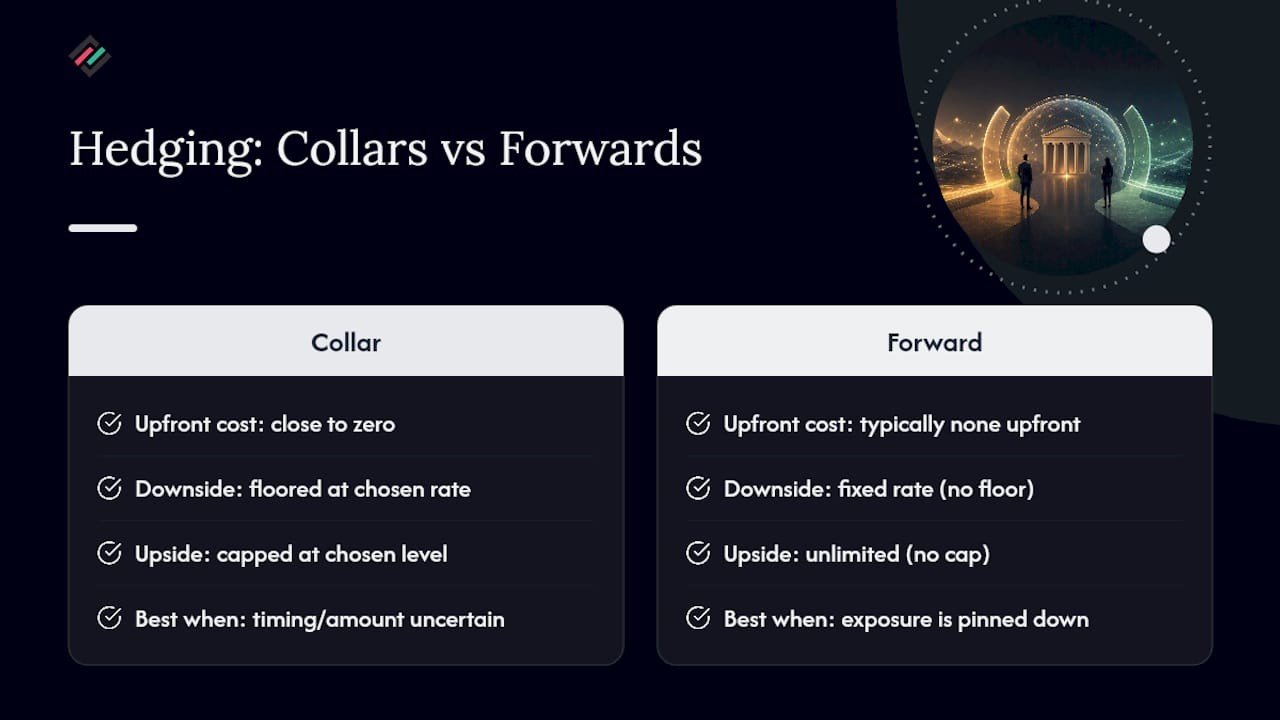
Boards don't push back on collars because the mechanics are complicated. They push back when nobody shows them the scenario table. Frame it plainly: this trade costs close to nothing upfront, floors the downside at a rate we chose deliberately, and caps the upside at a level we also chose deliberately. Put the three outcome zones on one page with real dollar figures, and most approval conversations get shorter.
The rule that keeps this from becoming ad hoc: collars for exposures where timing or amount is uncertain, forwards for exposures you can already pin down. Mixing the two philosophies inside the same hedge program is how policy documents turn into fifty pages nobody follows. Standardized scenario outputs and RFQ processes cut down the hidden operational cost of running collars at any scale, which matters more than most treasury teams expect once you're managing several currency pairs at once.
— Bartas
Model and Execute Zero-Cost Collars With CorpHedge
Building the scenario table by hand for every collar candidate gets old fast, especially once you're comparing strikes across multiple currency pairs and expiries at the same time. Corphedge is built for exactly that comparison: run a VaR-based hedging simulation against your actual exposure book, and see the floor, participation zone, and cap laid out in dollar terms before you call a bank for a quote.

The platform tracks your open positions in real time, so a collar candidate gets evaluated against exposure you actually have, not a spreadsheet snapshot from last week. That matters more as Corphedge expands into the Poland and Sweden markets, where treasury teams are increasingly hedging PLN and SEK exposure alongside EUR and USD books. Scenario outputs export in a format built for board papers, and the same workflow that models the trade helps you track confirmations and settlement afterward. If you want to see how a specific receivable or payable prices out under a collar versus a forward before you commit, take the product tour and run your own exposure through it.
Sources
- Collar Strategy: Zero-Cost Setup & Payoff Diagram | OptionsDecay
- Using options for tail-risk hedges (Equicurious)
- Hedging of Sales by Zero-cost Collar and its Financial Impact (2012)
FAQ
What Makes a Collar "Zero Cost" if Options Aren't Free?
The put premium you pay and the call premium you receive are structured to roughly offset each other, so the net cash outlay at trade date is close to zero. The cost shows up later as capped upside, not as an upfront fee.
Is a Zero-Cost Collar Better Than a Forward Contract?
Neither is universally better. Forwards suit exposures with a known amount and date, while collars suit exposures where timing or size is uncertain and you still want a defined floor without paying cash for a standalone put.
What Strike Should I Choose for the Put Leg?
Base it on the worst exchange rate your business can tolerate, not on a fixed percentage from spot.
Can a Zero-Cost Collar Lose Money for My Company?
The structure itself carries no net premium, but you give up gains above the call strike if the rate moves in your favor. Empirical samples show puts sometimes expire worthless while calls get exercised against you, so the opportunity cost is real.
How Does CorpHedge Help With Collar Structures?
Corphedge models the payoff zones of a proposed collar against your live exposure data, runs the stress scenarios treasury committees expect, and standardizes the reporting used for approval and settlement tracking.