
TL;DR:
- Passive hedging uses a disciplined, rules-based approach to manage currency risk without relying on market predictions. It involves setting predetermined hedge ratios, instruments, and rebalancing schedules to reduce earnings variability and protect cash flows effectively. Consistent monitoring and governance are essential to ensure the program's success over time.
Currency risk has a way of turning strong operating results into disappointing earnings reports. If your company holds significant cross-border receivables, payables, or foreign-currency debt, you already know how quickly an unfavorable FX move can erode margins you spent months building. This passive hedging guide is written specifically for corporate finance and risk management professionals who want a disciplined, rules-based approach to containing that exposure without constantly second-guessing the market. What follows covers everything from foundational policy design to execution mechanics, monitoring protocols, and the most common mistakes that quietly destroy hedging programs.
Table of Contents
- Key Takeaways
- What passive hedging actually means
- Preparing your passive hedging framework
- Executing passive hedging strategies step by step
- Monitoring and adapting your hedges over time
- Common mistakes that undermine passive hedging programs
- My take on passive hedging in 2026
- How Corphedge supports your passive hedging program
- FAQ
Key Takeaways
| Point | Details |
|---|---|
| Passive hedging is rules-based | Define systematic hedge ratios and schedules in advance to remove emotional decision-making. |
| Policy documentation is non-negotiable | A written hedging policy is the single most effective tool for maintaining consistency across market cycles. |
| Instruments matter enormously | Forwards and index puts suit passive programs; volatility products like VXX can lose 50-75% in 12 months due to contango decay. |
| Cost-benefit balance drives outcomes | Overhedging increases costs and erodes returns as much as underhedging increases risk. |
| Passive does not mean static | Tactical, rules-based flexibility increases overall hedging effectiveness when market correlations shift. |
What passive hedging actually means
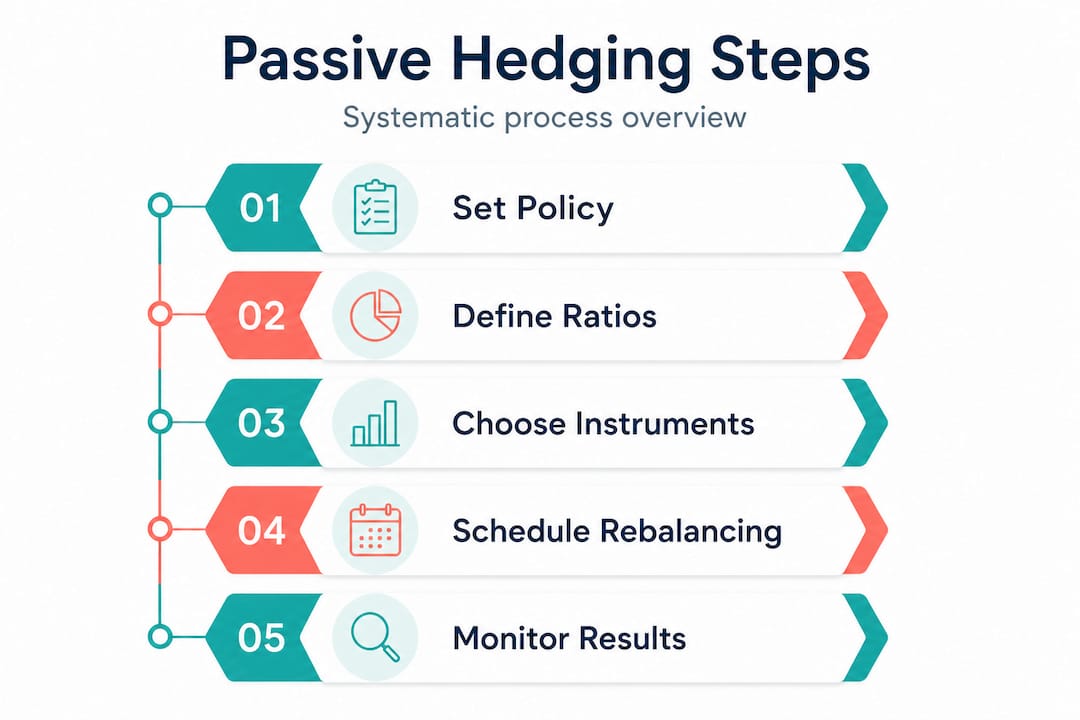
Passive hedging is a systematic, rules-based approach to neutralizing currency exposure according to pre-defined policies rather than discretionary market views. You set the hedge ratio, the instrument, the rebalancing schedule, and the acceptable cost range before a single trade is placed. That structure removes two of the biggest destroyers of hedging programs: emotional decision-making and inconsistent execution.
The contrast with active hedging is meaningful but often misunderstood. Active programs rely on a view about where a currency pair is heading. A portfolio manager running an active hedge might reduce EUR/USD coverage to 30% because she believes the dollar will weaken. Passive programs do not operate that way. The hedge ratio is set by policy, not by forecast. That is not a limitation; it is the point.
Here is what a passive program is actually designed to accomplish:
- Reduce earnings variability within an acceptable range, not eliminate FX risk entirely. The primary goal of passive hedging is variance reduction, not complete risk elimination.
- Protect cash flow predictability so that operating budgets and covenant projections remain reliable.
- Control hedging costs by avoiding unnecessary trades, over-engineering, and reactive positioning.
- Maintain documentation that satisfies audit, governance, and regulatory requirements.
The most important misconception to correct immediately: passive does not mean set-and-forget. Hedges require monitoring, periodic rebalancing, and scheduled policy reviews. A hedge placed 90 days ago and never reviewed is not a passive strategy. It is an abandoned one.
Pro Tip: Write your hedging policy before you execute your first trade. A documented hedging policy protects your team from pressure to deviate during volatile periods and gives auditors a clear governance trail.

Preparing your passive hedging framework
Preparation is where most programs succeed or fail. Skipping the groundwork and jumping straight to instrument selection is the equivalent of building a budget model without first confirming the accounting data is clean.
Follow these steps in sequence before executing any hedges:
- Map your currency exposures. Identify every currency pair your business is exposed to across receivables, payables, intercompany loans, and foreign-currency revenue streams. Separate transactional exposure from translational exposure; they call for different treatment.
- Quantify exposure size and direction. For each currency pair, calculate net notional exposure by month and quarter. Your FX risk management approach should capture both the size of exposure and its timing to align hedging tenors correctly.
- Set your hedge coverage target. This is a policy decision, not a market call. Most corporate programs target between 50% and 80% coverage of forecasted transactional exposure. J.P. Morgan analysis recommends fully hedging foreign currency fixed income while often leaving equity-like exposures unhedged due to cost-benefit and diversification considerations.
- Select your instruments. Forwards are the standard workhorse for passive corporate FX programs: predictable cost, straightforward accounting treatment under ASC 815 or IFRS 9, and no premium outlay. Options add flexibility but carry upfront cost. For portfolio-level tail risk, a common framework allocates 1-2% of portfolio value per quarter to long index puts, 5% out-of-the-money, with 60-90 day expirations.
- Calculate systematic hedge ratios. Hedge ratios should be based on documented risk tolerance, not gut feel. Run a cost-benefit analysis comparing the cost of hedging each currency pair against the potential P&L impact of leaving it unhedged at 1-standard-deviation and 2-standard-deviation move scenarios.
- Confirm regulatory and accounting treatment. Hedge accounting designation under IFRS 9 or ASC 815 requires effectiveness testing and formal documentation before execution. Failing to designate hedges properly can create income statement volatility from MTM swings rather than reducing it.
The table below summarizes typical hedge ratio targets by exposure type, based on established corporate practice:
| Exposure type | Typical hedge ratio | Common instrument | Review frequency |
|---|---|---|---|
| Confirmed purchase orders | 70-90% | Forward contract | Monthly |
| Forecasted revenue (high confidence) | 50-70% | Forward or option | Quarterly |
| Forecasted revenue (lower confidence) | 25-50% | Option | Quarterly |
| Intercompany loans | 90-100% | Cross-currency swap | Semi-annual |
| Translational exposure | 0-30% | Forward or option | Annual |
Executing passive hedging strategies step by step
With your framework in place, execution becomes procedural rather than discretionary. That is exactly the goal.
- Set a rolling hedge schedule. For transactional exposures, a rolling 3-month or 6-month forward program is the most common structure. Each month, you add a new tranche of forwards covering the next period, while the nearest-dated tranche settles against actual cash flows. This creates a smoothing effect on your average rate.
- Execute initial hedge placement. Begin by hedging your most certain, highest-impact exposures first. Do not try to hedge everything at once. Stagger placement across a 2-4 week window to average your entry rate rather than concentrating execution risk on a single day.
- Time tactical purchases before market events. For options-based protection, buying index puts 3-5 days before scheduled market events captures the implied volatility run-up more cost-effectively than buying the day of the event.
- Record every hedge against a specific exposure. Traceability is critical for both hedge accounting and internal governance. Each instrument should link to a specific underlying exposure in your treasury management system.
- Establish threshold-based rebalancing rules. Your policy should define specific triggers for rebalancing, such as: exposure forecast changes by more than 15%, hedge ratio drifts outside a defined band (e.g., +/- 10 percentage points), or a new fiscal period begins. Passive corporate FX hedging at its best uses systematic hedge ratios with frequent rebalancing as markets evolve, rather than waiting for large dislocations.
Key execution principles to keep visible throughout your program:
- Never hedge the same exposure twice. Double-counting is a common treasury error when multiple business units report exposures independently.
- Track all-in hedging costs, including bid-ask spread, counterparty credit risk adjustments, and any option premiums.
- Automate confirmations and settlement tracking through your TMS or banking platform where possible. Manual processes introduce errors that compound over time.
- Document every rebalancing decision, including the trigger that initiated it and the policy section that authorized the action.
Pro Tip: For cost-effective downside protection, periodic out-of-the-money put purchases at regular intervals provide systematic convex protection without requiring market timing, which is exactly what a passive framework demands.
Monitoring and adapting your hedges over time
Ongoing monitoring is what separates a functioning passive program from one that only looks good on paper. This is not micromanagement. It is scheduled, structured verification.
Build monitoring around these core metrics:
- Hedge ratio vs. target. Compare your actual coverage ratio against your policy target monthly. A drift of more than 10 percentage points should trigger a documented review.
- Hedge cost vs. risk reduction. Measure the cost of hedging against the FX volatility it has absorbed. Hedging is a double-edged sword; if your protection cost consistently exceeds your realized FX exposure, you are likely overhedged.
- Realized vs. budget rate. Track the difference between your hedged rate and your internal budget rate each period. This is the clearest measure of whether your program is doing its job.
The table below outlines a recommended monitoring schedule:
| Monitoring activity | Frequency | Responsible party |
|---|---|---|
| Hedge ratio vs. policy target check | Monthly | Treasury analyst |
| Exposure forecast update | Monthly | FP&A and treasury |
| Cost-benefit review | Quarterly | CFO and treasury |
| Stress test against 10% FX move | Quarterly | Risk management |
| Full policy and governance review | Annual | CFO, risk committee |
On the question of tactical deviations: your policy should allow for them, but only within a defined rules-based structure. Tactical deviations are warranted when market correlations shift in ways that undermine your original hedge structure. For example, if USD volatility spikes and your forwards are no longer covering the tail scenarios your stress tests identified, a documented policy deviation to add short-dated options is appropriate. What is not appropriate is reducing hedge ratios because someone in the finance team thinks the dollar is about to weaken.
Technology matters here. Platforms that provide real-time exposure tracking and Value at Risk-based hedging analytics give treasury teams the visibility to catch ratio drift early, rather than discovering it at quarter-end.
Common mistakes that undermine passive hedging programs
Even well-designed programs break down in practice. Here are the failures most worth guarding against.
- Overhedging. The most common pitfall. Overhedging turns a risk management tool into a performance drag. When hedge cost exceeds potential exposure loss, you are paying for protection you do not need.
- Using structurally decaying instruments. Volatility products like VXX are frequently misused as passive hedges. They can lose 4-9% monthly due to contango decay, making them entirely unsuitable for long-term passive programs.
- Ignoring transaction costs. Bid-ask spreads, rolling costs, and option premiums add up. A forward program that looks efficient on a gross basis can become expensive when all-in costs are calculated. Track transaction costs explicitly.
- Poor policy adherence. A documented policy that nobody follows is decorative. Build governance checkpoints into your quarterly close process. Ongoing monitoring of hedge ratios and transaction costs is not optional.
- Failing to update exposure forecasts. A hedge placed against a forecasted exposure that has since changed in size or timing is no longer protecting what you think it is. Forecast accuracy feeds directly into hedge accuracy.
- Ignoring correlation shifts. Currency correlations change, particularly during stress events. A hedge that worked in a low-volatility regime may not hold in a risk-off environment. Review cross-currency correlations as part of your quarterly stress testing.
Pro Tip: Schedule a 30-minute policy adherence review at each quarterly close. Pull your actual hedge ratios against policy targets and document any variances. This single habit catches drift before it becomes a material problem. You can find structured frameworks for this in resources like hedging best practices for 2026.
My take on passive hedging in 2026
I've spent considerable time working through passive hedging frameworks with treasury teams across different industries, and the pattern I keep seeing is this: most programs fail at the governance layer, not the strategy layer. The instrument selection and hedge ratio math are usually fine. What breaks down is the discipline to follow the policy when markets get uncomfortable.
In my experience, the most resilient hedging programs are the ones where the CFO and the risk committee have genuinely internalized why the policy exists, not just signed off on it. When a sharp USD move generates unrealized hedge losses, that is exactly when someone in leadership will pressure the treasury team to reduce coverage. A policy that has been truly internalized holds. One that was just filed with the auditors does not.
What I've also noticed in 2026 is that FX correlations are less stable than they were in the previous decade. The EUR/USD relationship to equity risk-on/risk-off dynamics has shifted meaningfully. That makes the monitoring layer more important than ever. Passive does not mean complacent. The discipline is in how you respond to correlation changes within your policy framework rather than outside it.
I'd also push back on the idea that passive hedging is only for large corporates with dedicated treasury teams. Mid-market companies with even a few million in cross-border exposure benefit enormously from systematic, rules-based programs. The cost of building a simple forward rolling structure is far lower than most finance leaders assume. The cost of not having one shows up eventually in an earnings call nobody enjoys.
— Bartas
How Corphedge supports your passive hedging program
Corphedge is built for exactly this type of systematic, policy-driven FX risk management. The platform provides real-time exposure monitoring, automated hedge ratio tracking, and Value at Risk-based hedging analytics that give treasury teams the visibility they need to maintain policy compliance without manual spreadsheet reconciliation.
Corphedge integrates directly with existing treasury systems and banking platforms, reducing the operational friction that causes passive programs to slip into reactive ones. The platform has recently expanded its coverage to Poland and Sweden, giving corporates operating across Central and Eastern Europe and the Nordics access to localized FX risk management tools built for their market structure. If you want to see how a systematic passive hedging program would look against your actual currency exposure, the Corphedge product tour walks through live scenarios with real data.
FAQ
What is passive hedging in corporate FX management?
Passive hedging is a rules-based approach where hedge ratios, instruments, and rebalancing schedules are set by policy rather than market forecasts. The goal is consistent, cost-controlled reduction of currency exposure variability, not market timing.
What hedge ratio should a corporate program target?
Most corporate programs target 50-90% coverage of transactional exposure depending on confidence in the underlying forecast. J.P. Morgan analysis favors fully hedging fixed income FX exposure while applying lower ratios to more uncertain revenue streams.
How often should passive hedges be rebalanced?
Rebalancing should occur on a scheduled basis, typically monthly for transactional programs, and whenever exposure forecasts change by a threshold defined in your hedging policy. Waiting for large market dislocations to rebalance is a reactive posture, not a passive one.
Are options better than forwards for passive hedging?
Forwards are the standard choice for most corporate passive programs due to predictable cost and straightforward hedge accounting. Options are better suited when exposure timing is uncertain, though premiums add cost that must be factored into the cost-benefit analysis.
What is the biggest mistake in passive hedging programs?
Overhedging. When hedge cost exceeds potential exposure loss, the program creates performance drag without proportional risk reduction. Setting hedge ratios against documented risk tolerance rather than maximum possible coverage prevents this outcome.