

FX volatility measures how frequently and intensely currency exchange rates move over a given period. It is not simply about whether a currency rises or falls — it captures the magnitude and speed of those moves. A currency pair that swings 3% in a single session is far more volatile than one that drifts 0.3% over a week, even if both end up at the same level. For traders and corporate treasury teams, that distinction drives every hedging decision, pricing model, and risk budget they build.
Key attributes of FX volatility:
- Frequency: How often exchange rates shift significantly within a defined window
- Magnitude: The size of each move, typically expressed as annualized standard deviation
- Direction asymmetry: Negative volatility (sharp depreciations) often dominates during stress, especially in emerging and Central European currencies
- Predictability: Volatility clusters — calm periods tend to follow calm, and turbulent periods follow turbulent
Table of Contents
- How is FX volatility actually measured?
- What actually causes currency prices to swing?
- Why FX volatility matters for traders and corporate firms
- Central European currencies: what the volatility data shows
- Which tools help you analyze and monitor FX volatility?
- How Corphedge helps Central European firms manage FX risk
- The risk you cannot fully eliminate
- Key Takeaways
- FAQ
How is FX volatility actually measured?
The most common starting point is historical volatility, calculated as the annualized standard deviation of daily log returns over a rolling window (typically 10, 30, or 90 days). It tells you what happened, not what is coming.
For forward-looking estimates, traders and risk managers rely on GARCH models (Generalized Autoregressive Conditional Heteroskedasticity), which estimate conditional variance — meaning volatility that changes over time based on recent market behavior. GARCH captures the clustering effect that historical averages miss entirely.
Corporate treasury teams add two more layers:
- Value-at-Risk (VaR): The maximum expected loss on an FX position over a defined horizon at a given confidence level (typically 95% or 99%)
- Earnings-at-Risk (EaR): How much reported earnings could shift given a range of exchange rate scenarios
- Implied volatility: Extracted from FX options pricing, this reflects the market's forward expectation of volatility for a specific currency pair and tenor
Pro Tip: Implied volatility from options markets often leads realized volatility during geopolitical stress events — watching the EUR/PLN or EUR/HUF options surface can give you an early warning that historical data will miss.
What actually causes currency prices to swing?
Currency volatility does not come from a single source. It builds from several overlapping forces, and understanding which one is driving a move changes how you respond.

Market sentiment and trader psychology are the fastest-moving drivers. Risk-off episodes trigger capital flows out of higher-yielding or smaller currencies and into perceived safe havens. The ECB has documented that volatility embodies a risk premium linked to investor risk aversion — meaning price swings often reflect fear more than fundamentals.
Geopolitical events and policy uncertainty produce some of the sharpest spikes. When the US administration introduced tariffs on April 2, 2025, global FX markets saw immediate and outsized moves, with the euro appreciating sharply alongside the Swiss franc and yen while the US dollar depreciated — an atypical cross-asset pattern that caught many hedging programs off guard.
Central bank actions set the medium-term volatility backdrop. Rate differentials between the ECB, the Czech National Bank, the National Bank of Poland, and the Magyar Nemzeti Bank create carry trade incentives that unwind violently when sentiment shifts.
Additional drivers specific to Central Europe:
- Global economic releases (US CPI, NFP, Fed decisions) transmit rapidly into CEE currency pairs
- Energy price shocks hit Central European importers disproportionately, widening EUR/CZK and EUR/HUF spreads
- Domestic political uncertainty in Hungary and Poland has historically added idiosyncratic volatility layers on top of global moves
Why FX volatility matters for traders and corporate firms
For a currency trader, volatility is both the risk and the opportunity. Higher volatility widens potential profit ranges on directional positions, but it also blows through stop-losses faster and makes position sizing harder. A trader running EUR/PLN without accounting for the pair's tendency to spike during global stress events is not managing risk — they are ignoring it.

For corporate finance teams, the stakes are different but equally concrete. FX risk breaks into three distinct types: transactional exposure (timing gaps between contract and settlement), translational exposure (converting foreign subsidiary earnings into the reporting currency), and economic exposure (long-term competitive positioning when cost and revenue currencies diverge). Each requires a different management approach.
The margin protection angle is often underappreciated. A Central European manufacturer selling into eurozone markets while paying wages in Polish zloty or Czech koruna faces structural exposure — a move in EUR/PLN can directly compress or expand margins without appearing as an explicit line item in standard financial reports. McKinsey's analysis of currency portfolio and structural risks shows that structural risk — not transaction risk — is where financial distress actually originates for most exporters.
Volatility also shapes investor communications. Companies that disclose the sensitivity of operating earnings to exchange rate scenarios give investors a cleaner picture than those that bury FX impacts in aggregate results.
Central European currencies: what the volatility data shows
Central European currencies — the Polish zloty (PLN), Czech koruna (CZK), and Hungarian forint (HUF) — behave differently from major pairs like EUR/USD. Research covering high-frequency data from 2009 to 2022 on CE currency volatility connectedness found that for all eight endogenously selected global shock events studied, volatility connectedness increased within one business month of the event. Negative volatility dominated during periods of economic distress across the board.
| Currency Pair | Volatility Profile | Key Shock Sensitivity |
|---|---|---|
| EUR/PLN | Moderate-high; spikes sharply during global risk-off | US policy shifts, energy prices, domestic politics |
| EUR/HUF | High; among the most volatile CE pairs | Central bank credibility, inflation differentials |
| EUR/CZK | Lower; CNB's managed approach dampens swings | ECB rate decisions, Czech current account |
| EUR/SEK | Moderate; rising as Sweden integrates into CE corridors | Global risk sentiment, Riksbank policy |
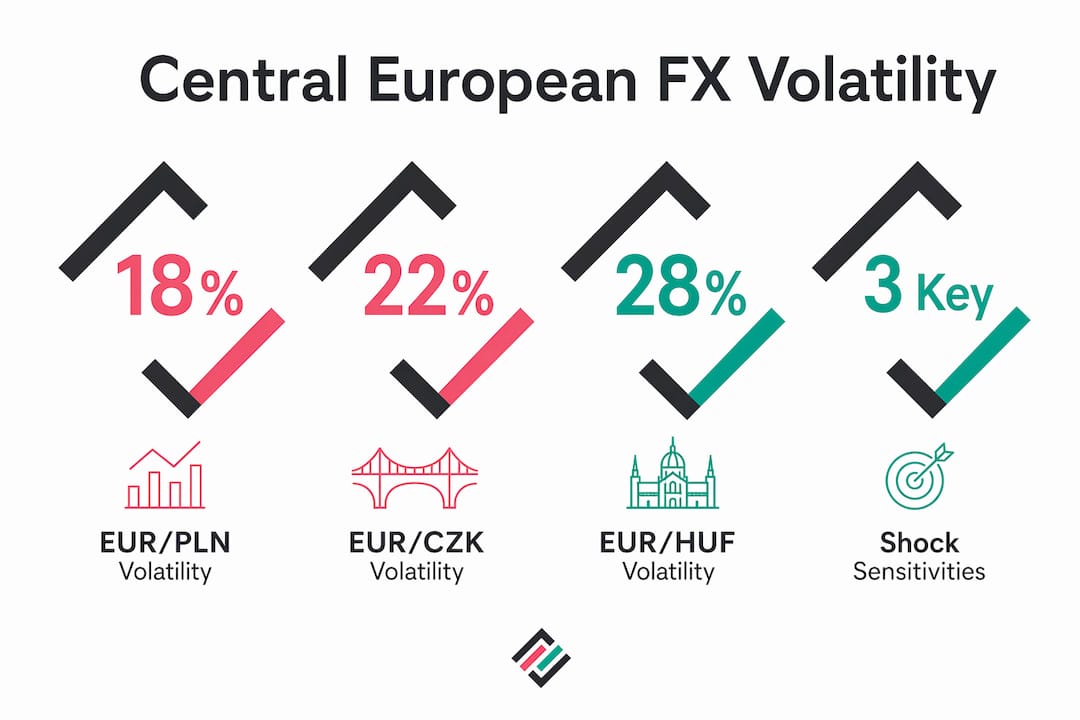
The forint's volatility profile stands out. During the 2022 energy shock, EUR/HUF moved by ranges that would be extraordinary for a G10 pair. The zloty followed a similar pattern, though the National Bank of Poland's more active intervention posture provided partial cushioning. The koruna, by contrast, benefited from the Czech National Bank's historically tighter policy stance and a current account surplus that reduced speculative pressure.
One structural nuance worth noting: intra-euro inflation differentials create FX-like exposure even for firms operating entirely within the eurozone, and derivatives often fail to hedge it adequately. For CE firms with euro revenues and local-currency costs, this adds a layer of exposure that standard forward contracts do not fully capture.
Which tools help you analyze and monitor FX volatility?
The right tool depends on whether you are a trader watching intraday moves or a treasury team managing quarterly hedging programs.
- Bloomberg Terminal and Refinitiv Eikon: Industry-standard platforms for real-time FX volatility surfaces, options pricing, and historical data across CE currency pairs
- GARCH-based calculators: Available through academic and professional platforms; essential for conditional variance modeling beyond simple rolling standard deviation
- VaR engines: Built into most treasury management systems; quantify potential loss at a defined confidence level across multi-currency portfolios
- Scenario modeling tools: Allow stress-testing against defined shock scenarios (e.g., a 10% EUR/PLN depreciation) to see the P&L impact before it happens
- Corphedge platform: Provides real-time FX position tracking, VaR-based hedging strategy execution, and integration with payment platforms for corporate treasury teams in Central Europe
For a broader introduction to market volatility concepts and how they apply across asset classes, dedicated financial education resources can supplement platform-specific tools.
Continuous monitoring matters more than periodic reviews. Volatility regimes shift quickly — a CE treasury team that reviews FX exposure monthly rather than in real time can find itself significantly offside after a single geopolitical headline.
How Corphedge helps Central European firms manage FX risk
Corporate FX risk management in Central Europe has moved well beyond spreadsheets. Managing multi-currency exposures through spreadsheets increases operational risk independently of market volatility — hedge accounting errors, missed exposures, and reporting gaps compound the underlying currency risk rather than reducing it.
Corphedge is built specifically for this problem. The platform gives corporate treasury teams real-time visibility into FX positions, executes hedging strategies anchored to Value-at-Risk calculations, and integrates with platforms like Corpay to reduce settlement friction. For Polish and Swedish firms — markets where Corphedge is actively expanding — this means a purpose-built solution rather than a generic treasury add-on.
Key platform capabilities:
- Real-time position tracking across multiple currency pairs including EUR/PLN, EUR/CZK, and EUR/HUF
- VaR-based hedging execution that ties hedge sizing to quantified risk appetite rather than guesswork
- Scenario modeling for stress events relevant to Central European market conditions
- Integration with Corpay for streamlined cross-border payment and settlement workflows
- Continuous hedge program monitoring to verify that earnings volatility is actually decreasing post-hedge
| Capability | Benefit for CE Firms |
|---|---|
| Real-time position visibility | Eliminates blind spots between reporting cycles |
| VaR-anchored hedging | Ties hedge ratios to measurable risk tolerance |
| Scenario stress testing | Prepares treasury for CE-specific shock events |
| Platform integration | Reduces operational risk from manual data transfer |
Effective FX management must be continuous, not episodic. Corphedge's architecture reflects that — it is designed for treasury teams that need to execute a defined hedging policy consistently, not just react when a currency move has already hit the P&L.
The risk you cannot fully eliminate
No hedging program removes FX volatility entirely. What good risk management does is make the remaining exposure knowable and bounded.
The unpredictability of volatility itself is the deeper problem. Volatility is not constant — it clusters, spikes without warning, and can disconnect from economic fundamentals during acute stress. The ECB has noted that financial market volatility and economic policy uncertainty can temporarily diverge, only to realign sharply during major stress events — exactly when hedges need to perform. A CE firm that hedged EUR/HUF at one volatility regime and then faced the 2022 energy shock discovered that the hedge covered the expected range but not the tail.
Structural risks are the hardest to manage because they do not show up cleanly in transaction data. A Polish exporter whose competitive position erodes when the zloty strengthens faces economic exposure that no forward contract fully addresses. The honest answer is that some FX risk requires operational responses — pricing adjustments, supply chain restructuring, or production relocation — rather than financial instruments alone. Understanding FX hedging strategies means knowing where derivatives help and where they reach their limits.
Corphedge gives Central European treasury teams the tools to quantify what they actually face: real-time position data, VaR-based hedging, and scenario modeling built for CE currency pairs. Explore the full platform capabilities or take a guided demo tour to see how it fits your hedging workflow.
Key Takeaways
FX volatility is the statistical measure of exchange rate fluctuation intensity, and managing it effectively requires continuous monitoring, quantified risk metrics, and hedging strategies matched to each exposure type.
| Point | Details |
|---|---|
| Volatility definition | FX volatility measures the frequency and magnitude of exchange rate moves, not just direction. |
| Measurement tools | GARCH models, VaR, and implied volatility each capture different dimensions of currency risk. |
| CE currency behavior | PLN, HUF, and CZK all showed increased volatility connectedness within one business month of major global shocks. |
| Three exposure types | Transactional, translational, and economic FX exposures each require distinct management strategies. |
| Continuous hedging | Hedge programs only reduce earnings volatility when executed consistently against defined risk metrics. |
FAQ
Is high FX volatility good or bad for traders?
It depends on the strategy. High volatility creates larger profit opportunities for directional traders but increases the risk of stop-loss breaches and requires tighter position sizing. For corporate hedgers, high volatility is almost always a cost driver.
How do you calculate FX volatility?
The standard method is annualized standard deviation of daily log returns over a rolling window (commonly 30 or 90 days). More advanced approaches use GARCH models to estimate time-varying conditional variance, which better captures volatility clustering.
Is trading a volatility index useful for FX risk management?
Volatility indices like the CVIX (currency volatility index) can signal regime shifts and help time hedging decisions, but they are not substitutes for pair-specific VaR analysis or a structured corporate hedging program.
Is volatility inherently good or bad?
Neither. Volatility is a measure of uncertainty. For traders, it is the raw material of profit. For businesses with foreign currency cash flows, unmanaged volatility is a margin risk. The goal is not to eliminate it but to make its impact on earnings predictable and bounded.
Which Central European currencies are most volatile?
The Hungarian forint (HUF) and Polish zloty (PLN) consistently show higher volatility than the Czech koruna (CZK), which benefits from the Czech National Bank's historically tighter policy stance and a current account surplus that limits speculative pressure.