

Integrating a Treasury Management System with your ERP and bank connectivity turns manual FX exposure tracking into a straight-through process. Corphedge and other platforms handling Value at Risk analysis rely on this same principle: connect ERP transaction data to a TMS exposure engine, execute through SWIFT-connected banks, and generate the documentation IFRS 9 demands. The right approach is API-first wherever your banks support it, with SFTP and ISO 20022 messaging as staged fallbacks while you build toward full automation, leveraging foundational insights into how the SWIFT international payments system works.
TL;DR:
- Connecting ERP, TMS, and bank systems via API-first architecture reduces manual intervention and streamlines FX exposure management.
- Multi-protocol connectivity that supports APIs, SFTP, and ISO 20022 offers faster implementation and adaptability across diverse bank relationships.
- Automating exposure capture and hedge documentation within the TMS simplifies IFRS 9 compliance and minimizes manual audit preparation.
- A phased rollout from accounts receivable hedging to full balance-sheet coverage typically takes around six months, with a focus on data accuracy and SLA adherence.
- The primary risks involve underestimating bank protocol differences and poor data mapping, which can delay projects and compromise process integrity.
Table of Contents
- What Is TMS Integration for FX and Why Does It Matter?
- Which Connectivity Standards Actually Work for FX Integration?
- How Data Flows Through TMS, ERP, and Bank Systems
- What Should You Automate First in the FX Workflow?
- What's a Realistic Implementation Timeline?
- What Goes Wrong in TMS-FX Integrations?
- A VaR-Driven Perspective on TMS Integration
- See How Corphedge Fits Your FX Integration Stack
- Sources
- FAQ
What Is TMS Integration for FX and Why Does It Matter?
TMS integration for FX means connecting three systems into one closed loop: your ERP generates the underlying commercial transactions (invoices, purchase orders, forecasted cash flows), your TMS aggregates those into net currency exposure and applies hedging logic, and your banking partners execute the resulting trades. Done properly, this loop runs with minimal manual intervention from exposure capture through settlement.
The payoff shows up in measurable operational terms. Treasury teams report improved visibility into net positions, faster month-end reconciliations, and fewer trade errors once ERP-to-TMS handoffs stop running through spreadsheets. Danone's TMS rollout illustrates the point directly: connecting FX and bank platforms into one workflow delivered end-to-end automation and measurable FX benefits rather than incremental process tweaks.
Three outcomes tend to matter most to finance leaders evaluating this work:
- Reduced P&L volatility from currency swings, because exposures get hedged sooner and more consistently
- Lower operational risk from eliminating manual re-entry between ERP, TMS, and bank portals
- Audit-ready hedge documentation generated as a byproduct of the workflow, not assembled after the fact for IFRS 9 reporting
Which Connectivity Standards Actually Work for FX Integration?
Your connectivity choice determines how fast your exposure data moves and how much implementation effort each bank relationship demands. APIs give you real-time account balances, payment initiation, and status updates, which is why API-driven treasury setups now support hourly cash forecasting instead of the once-daily batch cycle most treasuries grew up with.
File-based methods like SFTP transmitting MT940 statements or ISO 20022 CAMT files remain the pragmatic choice when a bank hasn't built out API coverage for your account structure, or when your ERP's integration budget can't stretch to custom API development this year. SWIFT's gpi network still underpins the messaging layer for a large share of cross-border settlement, even in API-first architectures.
A few practical rules apply regardless of company size:
- Use APIs for any bank relationship handling daily FX execution volume
- Fall back to SFTP/CAMT for legacy banking relationships or lower-frequency currency pairs
- Never build a single-protocol architecture. Multi-protocol connectivity supporting SFTP, ISO 20022, MT940, and APIs reduces total cost of ownership as banks migrate formats over time.
A useful benchmark: platforms built on flexible, multi-protocol connectivity tend to report faster time-to-value than those locked into one messaging standard, since they avoid delays waiting for a single bank's API roadmap.
How Data Flows Through TMS, ERP, and Bank Systems
The FX automation loop follows a predictable sequence once it's built correctly:
- ERP export. Invoices, payment runs, accounts receivable and payable, and rolling cash flow forecasts get pushed into the TMS exposure engine, typically on a daily or intraday schedule.
- Exposure aggregation and strategy application. The TMS nets exposures by currency pair and applies hedging rules, whether policy-based thresholds or a Value at Risk model, then generates trade proposals for approval.
- Execution and confirmation. Approved trades route to the bank or trading platform, confirmations flow back, and settlement instructions execute on value date.
- GL posting. Settled trades post back to the ERP general ledger, closing the loop without a treasury analyst manually re-entering journal entries.
This is where API connectivity earns its keep. Embat's case data shows treasuries running this loop end-to-end with 90% fewer reconciliation errors once account data flows automatically instead of through exported spreadsheets. Reconciliation stops being a monthly fire drill and becomes a daily background check.
What Should You Automate First in the FX Workflow?
Not every step deserves the same automation priority on day one. Start with exposure capture and enrichment, since that's the data foundation everything downstream depends on. Trade suggestion and approval routing come next, followed by execution and settlement reconciliation once you trust the upstream data.
The hedge-accounting piece deserves particular attention here, because IFRS 9 compliance is far easier to build into the workflow than to bolt on afterward. Your system needs to generate:
- Hedge designation documentation at the moment a trade executes, not weeks later
- Effectiveness testing metrics stored alongside each hedge relationship
- An audit trail linking each derivative back to its underlying exposure
Hedge-accounting compliance works best when designation and effectiveness testing are generated by the system itself rather than assembled by an analyst scrambling before year-end audit fieldwork. Banks and market-data vendors, for their part, need clean reference data (correct SWIFT BIC codes, accurate legal entity identifiers) to hit high straight-through processing rates on their end.
Pro Tip: Build your IFRS 9 documentation fields into the TMS data model before you go live, not as a phase-two addition. Retrofitting hedge-accounting evidence into a system that wasn't designed for it usually means months of manual backfilling.
What's a Realistic Implementation Timeline?
Most successful integrations follow three distinct phases rather than a single big-bang cutover.
- Discovery and scoping (weeks 1 to 6). Map every currency exposure source, document existing accounting requirements, and identify which bank connectors you actually need. This is where you decide your API versus file-based mix per banking relationship.
- Connectivity build and pilot (weeks 6 to 16). Build ERP-to-TMS mapping, onboard your first one or two banks, validate data accuracy, and pilot hedging on a single currency flow, often accounts receivable in your largest exposure currency.
- Scale and optimize (months 4 onward). Expand from AR-only hedging to full balance-sheet hedging, add remaining bank connectors, and start tracking STP rates and hedge effectiveness as ongoing metrics rather than one-time validation checks.
A treasurer's guide to automated hedging implementation documents exactly this pattern: a phased rollout that moved from AR-only hedging to full balance-sheet hedging, reducing FX effects as a share of revenue within six months. Our guide to international payment hedging workflow covers the operational detail of that pilot stage in more depth.
What Goes Wrong in TMS-FX Integrations?
The most common failure isn't a technology gap. It's underestimating how much variation exists across bank protocols and waiting too long to bring accounting rules into the design conversation.
Four pitfalls show up repeatedly:
- Bank protocol variety gets underestimated. Teams assume one connectivity method will work across all banking relationships, then discover each bank has its own quirks in file formats or API scope.
- Data mapping stays incomplete. ERP fields don't map cleanly to TMS exposure categories, producing exposure numbers nobody trusts.
- Hedge-accounting rules arrive too late. IFRS 9 documentation gets treated as a reporting afterthought instead of a design requirement.
- Testing stays shallow. Pilots run on clean data and skip edge cases like partial shipments or multi-currency invoices.
Connectivity protocol variation is commonly underestimated, and successful projects treat ISO 20022 adoption as a multi-year program rather than a single migration event. Insist on documented SLAs for every connector, standardize on ISO 20022 where banks support it, and keep your approval and audit trails structured from day one. Our piece on streamlining FX reporting walks through the reconciliation controls that keep STP rates high once you're live.
Pro Tip: Run your pilot on your messiest currency pair, not your cleanest one. If the integration survives your worst data, it will handle everything else without surprises.

A VaR-Driven Perspective on TMS Integration
Corphedge approaches TMS-FX integration from the exposure side first. ERP feeds flow into a Value at Risk engine that quantifies downside risk before any hedge gets proposed, rather than applying a flat percentage-hedged policy regardless of market conditions. That distinction matters because VaR-based sizing adapts hedge ratios to actual volatility, not to a rule set written two budget cycles ago.
The connector question comes up constantly with treasury teams evaluating this space, and the honest answer is that connector maturity varies by bank and by ERP vendor. Our product tour walks through current integration coverage and the VaR methodology in more detail than a single article section can cover.
— Bartas
See How Corphedge Fits Your FX Integration Stack
If you've read this far, you already know the hard part of TMS-FX integration isn't the concept. It's execution: connecting the right banks, building the right exposure logic, and keeping IFRS 9 documentation clean without hiring a compliance team just to manage spreadsheets.
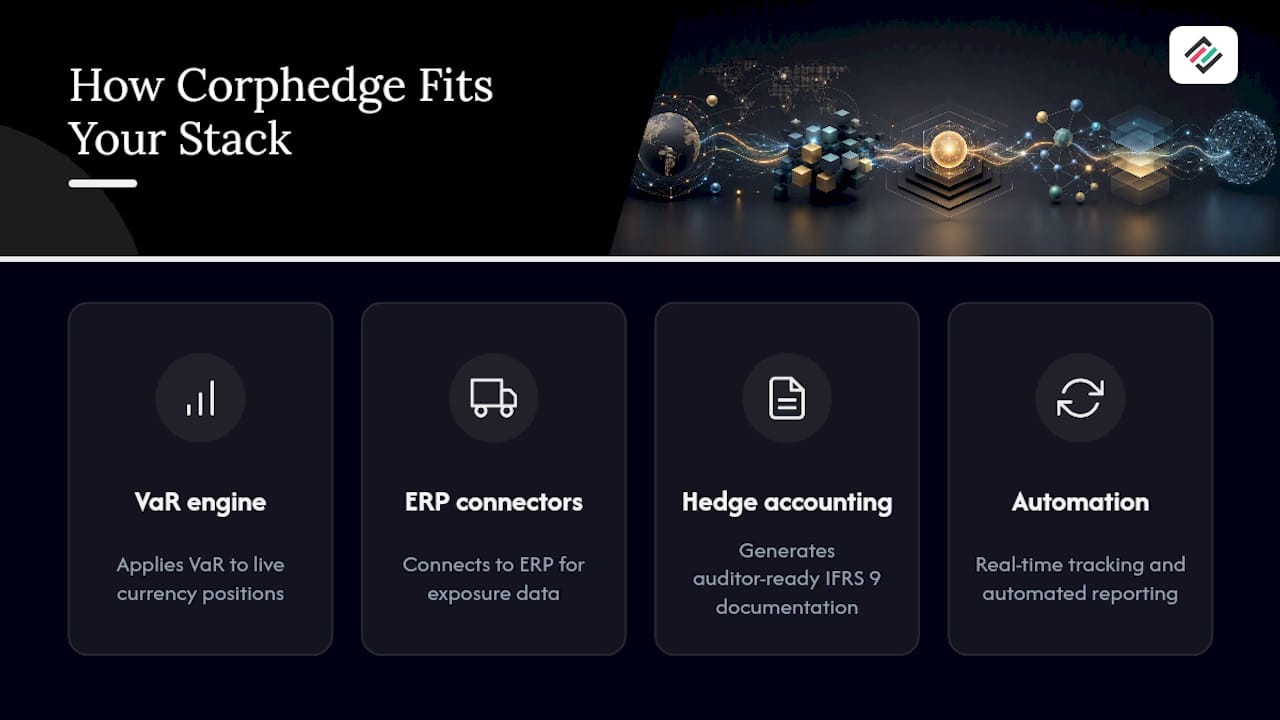
Corphedge is built specifically around that gap. The platform applies Value at Risk analysis to your live currency positions, connects to ERP systems for exposure data, and generates the hedge-accounting documentation your auditors will actually ask for, rather than leaving that work for a finance analyst to reconstruct at quarter-end. As Corphedge expands into the Poland and Sweden markets, that same integrated approach, VaR-based hedging rules, real-time position tracking, and automated reporting, becomes available to treasury teams across a wider footprint of internationally active companies.
Explore the hedging strategies built on Value at Risk to see the methodology behind the trade recommendations, or review real-world scenarios in the corporate FX risk management use cases. If your team needs to build internal hedging expertise before rolling out automation, the FX hedging course covers the theory your analysts will need on day one. Book a walk-through of the product tour to see how the connectors and VaR engine work with your specific ERP setup.
Sources
For deeper technical grounding on the concepts covered here, the Association of Corporate Treasurers' guide to automated hedging implementation documents a real staged rollout. SWIFT's gpi documentation explains the messaging rails underneath most bank connectivity, and the Citi Danone case study shows integration outcomes at enterprise scale. For connectivity architecture specifically, see Salmon Treasury's white paper on flexible connectivity.
- How to implement an automated hedging solution | The Association of Corporate Treasurers
- The Critical Importance of Flexible Connectivity in TMS - Salmon Treasury
- API-Driven Treasury: Integrate TMS with ERPs and Banks
- TMS implementation delivers impressive FX benefits to Danone
FAQ
What Does TMS Stand for in Finance?
TMS stands for Treasury Management System, the software platform corporate treasury teams use to track cash positions, currency exposure, debt, and liquidity across bank accounts and entities.
What Is a TMS in Trading Context?
In an FX trading context, a TMS is the system that aggregates currency exposures from ERP and business data, applies hedging rules, and either generates or executes trade instructions with banking partners.
What Does "TMS Payment" Mean?
"TMS payment" typically refers to a payment instruction or file generated by a Treasury Management System, whether a wire transfer, FX settlement, or intercompany payment routed to a bank via SWIFT, API, or file transfer.
Is API or File-Based Connectivity Better for TMS-FX Integration?
Neither is universally better. APIs give real-time visibility and higher straight-through processing rates, while file-based methods like SFTP and MT940 remain practical fallbacks when a bank hasn't built full API coverage, which is why most mature integrations, including Corphedge's approach, support both.
How Does TMS Integration Support IFRS 9 Hedge Accounting?
A well-designed TMS integration generates hedge designation, documentation, and effectiveness testing automatically as trades execute, rather than requiring analysts to reconstruct that evidence manually before an audit.