

TL;DR:
- Systematic risk in forex is driven by macroeconomic factors like interest rates, inflation, and geopolitical events, affecting all currency pairs simultaneously. It cannot be diversified away and requires layered hedging strategies such as laddered hedges, stress testing, and operational alignment to manage effectively. Measuring this risk through tools like beta, VaR, and EaR helps risk managers protect corporate earnings against market-wide shocks.
Systematic risk in forex is defined as the market-wide component of currency return variability that affects all currency pairs simultaneously and cannot be eliminated through diversification. Unlike company-specific credit events or single-country political shocks, systematic FX risk is driven by economy-wide forces: interest rate cycles, inflation regimes, geopolitical stress, and global liquidity conditions. The Capital Asset Pricing Model (CAPM) formalizes this distinction by compensating investors only for systematic risk, not for risks they could diversify away. For financial professionals and risk managers at multinational corporations, understanding systematic risk in forex explained through both theory and practice is the foundation of any credible hedging program.
What are the primary drivers of systematic risk in forex markets?
Systematic FX risk materializes through macroeconomic forces that move entire currency markets, not just individual pairs. Four drivers account for the majority of market-wide currency volatility.
Interest rate and monetary policy shifts are the most direct transmission channel. When the Federal Reserve, European Central Bank, or Bank of England changes its policy rate, capital flows reprice across all major currency pairs within hours. A single Fed pivot in 2022 drove the U.S. Dollar Index (DXY) up more than 15% over six months, compressing earnings for every multinational reporting in USD.
Inflation trends and purchasing power dynamics alter the real return on currency holdings. Elevated inflation erodes a currency's purchasing power and forces central banks into reactive rate cycles, creating sustained directional pressure across multiple pairs simultaneously. The FX risk premium fluctuates with political risks, inflation, and sovereign uncertainty, driving currency moves well beyond what interest rate differentials alone would predict. This means standard carry-trade models systematically underestimate volatility during inflationary regimes.
Geopolitical events and sovereign risk create abrupt, correlated moves. Russia's 2022 invasion of Ukraine triggered simultaneous EUR weakness, CHF and USD safe-haven flows, and commodity-linked currency spikes in AUD and NOK. No single-pair hedge captured that multi-directional shock.
Market-wide liquidity and funding stress amplify all of the above. During the March 2020 COVID shock, USD funding stress caused virtually every emerging-market currency to sell off in lockstep, regardless of individual country fundamentals.
- Central bank forward guidance shifts
- Coordinated sovereign credit rating downgrades
- Global commodity price shocks affecting resource-linked currencies
- Cross-border capital flow reversals during risk-off episodes
Pro Tip: Monitor the Chicago Board Options Exchange Volatility Index (VIX) and the JPMorgan Emerging Market Currency Index (EMCI) together. A simultaneous spike in both is one of the clearest early signals of rising systematic FX risk across your portfolio.
How does systematic risk differ from specific risk in forex?
Systematic risk is inseparable from global macro factors and cannot be diversified by holding multiple currency pairs. Specific risk, by contrast, is idiosyncratic: a Turkish lira devaluation driven by domestic monetary policy errors, or a South African rand shock from a local mining strike. Adding more currency pairs to a portfolio reduces specific risk but leaves systematic risk fully intact.

The CAPM framework, extended to FX markets, models expected currency returns as a function of systematic risk premiums tied to macroeconomic volatility. Beta in this context measures how sensitive a currency pair is to broad market movements. A high-beta pair like USD/BRL amplifies systematic shocks; a low-beta pair like USD/CHF may partially offset them. Neither eliminates the underlying market-wide exposure.
| Risk type | Source | Diversifiable? | Hedging approach |
|---|---|---|---|
| Systematic (market) risk | Interest rates, inflation, geopolitical shocks | No | Macro hedges, options overlays, policy frameworks |
| Specific (idiosyncratic) risk | Country-specific events, single-issuer credit | Yes | Diversification across uncorrelated pairs |
| Liquidity risk | Market-wide funding stress | Partially | Cleared instruments, tenor laddering |
| Correlation risk | Stress-driven co-movement spikes | No | Stress testing, scenario analysis |
The practical implication for risk managers is direct: diversifying across EUR/USD, GBP/USD, and AUD/USD does not reduce your systematic exposure. All three pairs sold off against the USD during the 2022 rate shock. A genuine currency risk management framework must address systematic and specific risk through separate tools and governance layers.
Pro Tip: When building your FX risk register, tag each exposure as systematic or specific before assigning a hedge instrument. Applying a forward contract to a systematic exposure without an accompanying macro overlay is a common source of residual P&L volatility.
How is systematic risk measured and modeled in forex trading?
Quantifying systematic FX risk requires moving beyond single-pair volatility metrics toward models that capture market-wide co-movements and regime shifts.
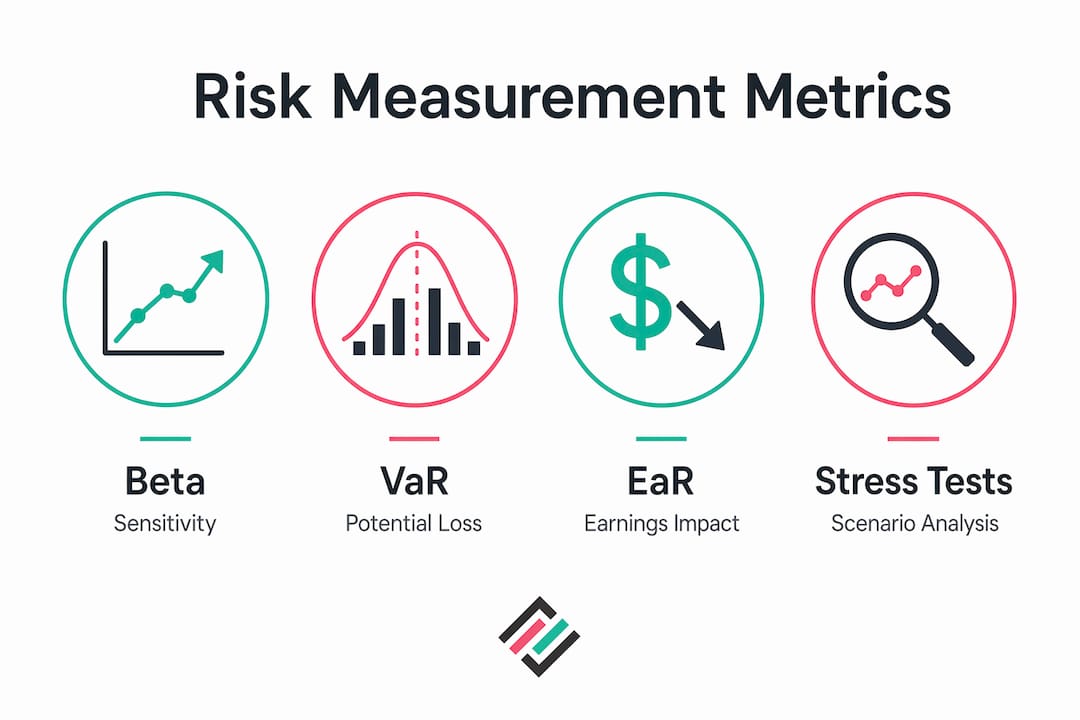
CAPM and beta frameworks provide the conceptual baseline. Beta measures a currency pair's sensitivity to a systematic risk factor, such as a global risk-off index or a G10 rate differential basket. A beta above 1.0 signals that the pair amplifies broad market moves; below 1.0 suggests partial insulation. This framework is most useful for setting relative hedge ratios across a multi-currency portfolio.
Value-at-Risk (VaR) and Earnings-at-Risk (EaR) translate statistical risk into financial terms that boards and CFOs can act on. VaR estimates the maximum loss at a given confidence level over a defined horizon. However, VaR metrics need translation into Earnings-at-Risk for effective corporate board decision-making about FX systematic risk tolerance and hedging policy. EaR connects currency volatility directly to earnings guidance ranges, making risk quantification relevant to financial reporting cycles.
Stress testing and correlation analysis are where systematic risk modeling earns its keep. The Bank of England highlights rising correlations in stress as a primary cause of increased systematic risk and hedging challenges in FX markets. A model calibrated on normal-regime correlations will materially underestimate losses when correlations spike toward 1.0 during a crisis.
Key modeling considerations for risk managers:
- Use conditional correlation matrices calibrated to stress regimes, not just historical averages
- Separate transactional, translational, and economic FX exposures before applying VaR
- Run scenario analysis on simultaneous multi-pair directional moves, not just pair-by-pair shocks
- Validate EaR outputs against actual earnings guidance ranges each quarter
The limitation of all these models is that they are backward-looking. Systematic risk in 2026 increasingly reflects interconnections between FX markets, equity volatility, and sovereign credit spreads that historical data from 2010 to 2020 does not fully capture.
What are effective strategies to mitigate the impact of systematic risk?
Mitigating systematic FX risk requires layered strategies that remain effective even when correlations break down. No single instrument eliminates market-wide exposure, but a structured approach significantly reduces earnings volatility.
Hedge laddering and layering is the most operationally proven technique. Laddered hedging smooths FX exposure by spreading forward contracts or options across multiple forecast horizons rather than locking in a single rate on one date. A company with EUR receivables due over 12 months might hedge 80% of the next three months, 60% of months four through six, and 40% of months seven through twelve. This structure absorbs spot-rate shocks during volatile periods without creating cliff-edge exposure.
Cleared instruments under stressed correlations provide an additional layer of protection. When cross-market correlations rise sharply during stress, bilateral OTC hedges can introduce counterparty risk precisely when you need protection most. Centrally cleared FX derivatives reduce this exposure.
Natural hedges and operational alignment reduce the need for financial hedging by matching revenue and cost currencies at the operational level. A Swedish manufacturer selling into Poland that sources components locally in PLN has a natural hedge against EUR/PLN systematic moves. As Corphedge expands its platform into Poland and Sweden, this operational currency alignment becomes increasingly relevant for mid-market corporates in both markets.
Additional mitigation approaches worth implementing:
- Monitor FX risk premiums actively, not just spot rates, since elevated risk premiums signal rising transaction costs and volatility ahead of spot moves
- Set board-approved hedge ratios tied to EaR thresholds, not arbitrary percentage targets
- Review hedging best practices for advanced overlay strategies when standard forwards fail during correlation spikes
- Stress-test your hedge book quarterly against a scenario where all major pairs move 10% against your base currency simultaneously
Pro Tip: When systematic risk spikes, correlation-based hedges can become directional bets. Build a pre-approved playbook for correlation breakdown scenarios before the stress event occurs, not during it.
How does systematic risk in forex affect company profitability?
Systematic FX risk translates directly into earnings volatility through three exposure channels. Understanding each channel is prerequisite to managing FX exposures at the corporate level.
Transactional exposure hits cash flows immediately. A U.S. company invoicing in EUR faces a direct P&L impact when EUR/USD moves against it between invoice date and settlement. During a systematic risk episode, this impact multiplies across all foreign-currency receivables and payables simultaneously.
Translational exposure affects the balance sheet and reported earnings. Subsidiaries in Poland, Sweden, or any other non-USD jurisdiction see their assets, liabilities, and earnings restated at period-end exchange rates. A 5% strengthening of the USD against PLN and SEK simultaneously reduces reported consolidated revenue without any change in underlying business performance.
Economic exposure is the most strategically significant and the hardest to hedge. Sustained systematic currency moves alter a company's competitive position relative to foreign rivals. A German exporter competing with U.S. manufacturers faces a structural cost disadvantage when EUR strengthens broadly, regardless of any financial hedge in place.
The financial reporting implications are concrete:
- FX headwinds and tailwinds must be quantified separately in earnings guidance using constant-currency growth metrics
- EaR figures should be disclosed to the board alongside standard VaR outputs, since hedge policies should translate modeled risk into board-approved coverage reflecting tolerable earnings volatility
- Analysts and investors increasingly scrutinize FX bridges in earnings calls, making transparent risk communication a governance requirement, not just a finance function task
The challenge for risk managers is converting quantitative risk models into language that drives board-level decisions. A VaR figure expressed in basis points of currency volatility means little to a CFO focused on EPS guidance. Earnings-at-Risk, expressed as a range of potential EPS impact under systematic stress scenarios, closes that communication gap.
Key takeaways
Systematic risk in forex is a permanent, undiversifiable feature of global currency markets that demands dedicated measurement, governance, and layered hedging strategies to protect corporate earnings.
| Point | Details |
|---|---|
| Systematic risk cannot be diversified | Holding multiple currency pairs does not reduce market-wide exposure from macro shocks. |
| CAPM and EaR are the core measurement tools | Beta quantifies sensitivity; Earnings-at-Risk links volatility to financial reporting. |
| Correlations spike during stress | Standard hedges lose effectiveness when pairs move in lockstep; stress testing is mandatory. |
| Laddered hedging reduces earnings volatility | Spreading hedges across time horizons absorbs spot-rate shocks without cliff-edge exposure. |
| Transactional, translational, and economic exposures require separate treatment | Each channel affects P&L differently and demands a distinct risk management response. |
Why most FX risk programs underestimate systematic exposure
After working with corporate treasury teams across multiple market cycles, the pattern I see most consistently is this: risk programs are built for specific risk and then applied to systematic risk without adjustment. A team hedges its EUR/USD receivables with forwards, checks the box, and considers the job done. Then a Fed pivot or a geopolitical shock moves EUR/USD, GBP/USD, and AUD/USD simultaneously, and the hedge book covers only one of three exposures.
The deeper problem is governance. Most boards approve hedge ratios expressed as percentages of forecast exposure, not as EaR thresholds tied to earnings guidance. That disconnect means the risk function is managing to a metric the board never actually uses to make decisions. Translating VaR into EaR is not just a modeling exercise. It is the only way to make systematic risk legible to the people who set risk appetite.
The other underappreciated factor is the dynamic nature of the FX risk premium. Most hedging programs treat the risk premium as static, but it shifts with political risk, inflation expectations, and sovereign credit conditions. A program that monitors risk premium changes in real time, as Corphedge's platform is designed to do, will identify regime shifts weeks before they show up in spot rates. That lead time is where systematic risk management actually creates value.
For risk managers expanding into newer markets like Poland and Sweden, the systematic risk dimension is even more pronounced. PLN and SEK are higher-beta currencies relative to EUR and USD, meaning they amplify global macro shocks more than core G4 pairs. Building your risk framework with that beta differential in mind from day one is far more effective than retrofitting it after the first stress event.
— Bartas
How Corphedge helps you manage systematic FX risk
Corphedge is built specifically for corporate risk managers who need to move beyond spreadsheet-based hedging into a structured, policy-driven FX risk program.

The platform's Value-at-Risk based hedging engine translates statistical risk models directly into board-ready EaR outputs, closing the gap between quantitative analysis and governance decisions. Real-time currency position monitoring lets your team track systematic risk exposure across all pairs as macro conditions shift. For teams managing layered hedge books across multiple forecast horizons, Corphedge's FX risk management platform provides the structure to implement laddering strategies with full auditability. Explore the product tour to see how the tools apply to your specific exposure profile.
FAQ
What is systematic risk in forex?
Systematic risk in forex is the market-wide component of currency volatility driven by macroeconomic factors like interest rates, inflation, and geopolitical events. It affects all currency pairs simultaneously and cannot be eliminated through diversification.
How does systematic risk differ from specific FX risk?
Specific risk is idiosyncratic to a single country or currency and can be reduced by diversifying across pairs. Systematic risk is driven by global macro forces and remains regardless of how many pairs you hold.
What tools measure systematic FX risk most effectively?
Value-at-Risk quantifies potential losses at a statistical confidence level, while Earnings-at-Risk translates that figure into earnings impact terms. CAPM-based beta analysis measures a currency pair's sensitivity to broad market movements.
Why do standard hedges fail during systematic risk events?
During stress, correlations between currency pairs spike, causing pairs that normally move independently to move in lockstep. Hedges calibrated on normal-regime correlations become directional bets rather than offsets.
How can companies mitigate systematic FX risk on earnings?
Laddered hedging across multiple time horizons, natural operational hedges, and board-approved EaR thresholds are the most effective combination. Monitoring FX risk premium shifts in real time provides early warning before systematic stress reaches spot rates.