

TL;DR:
- Financial compliance documentation services organize and verify financial records to ensure organizations remain audit-ready under regulations like SOX and IFRS. Combining automation with expert oversight, these services achieve up to 99.7% accuracy in maintaining evidence and controls, reducing risk and audit costs. They require continuous management, clear frameworks like COSO, and detailed evidence packages to support international operations and regulatory changes.
Financial compliance documentation services are specialized support functions that organize, maintain, and verify the financial records organizations need to satisfy regulatory audits and internal control requirements. Finance professionals and compliance officers at international companies rely on these services to stay audit-ready under frameworks like SOX, COSO, and IFRS. Managed teams combining automated validation with expert oversight now achieve up to 99.7% accuracy in compliance documentation. That benchmark matters because a single documentation gap can trigger regulatory penalties, delay audits, or undermine investor confidence across multiple jurisdictions.
What do financial compliance documentation services actually include?
Compliance documentation services, the recognized industry term for this function, cover every process needed to produce, organize, and maintain audit-ready financial records. The scope is broader than most finance teams expect when they first engage a provider.
Core deliverables typically include:
- Policy and procedure documentation: Written controls mapped to actual operating workflows, not generic templates that fail under auditor scrutiny.
- Audit evidence management: Organized working papers, transaction samples, and supporting schedules that auditors can walk through without friction.
- Version control and document security: Timestamped revisions with access logs so regulators can trace every change to a control document.
- Compliance tracking workflows: Ongoing monitoring of regulatory updates from bodies like the SEC, PCAOB, or FCA, with documentation updated to reflect new requirements.
- SLA-governed managed teams: Outsourced specialists who operate under defined service level agreements, providing continuity when internal staff turn over.
The distinction between a policy on paper and a policy embedded in operations is critical. Frameworks mapped to real operations improve audit defensibility far more than shelf policies that no one follows day to day.
Pro Tip: Before signing with any provider, ask them to show you a sample audit evidence package. If the working papers are not organized by control objective with clear version history, the service will not hold up under a PCAOB or FCA walkthrough.

How do automation and expert oversight combine for accuracy?
Technology alone does not produce defensible compliance documentation. Automated compliance software handles data validation, flags anomalies, and generates structured reports at scale. But regulators and external auditors require human judgment to interpret edge cases, verify regulatory intent, and sign off on control conclusions.
"Effective ICFR requires a risk-based approach augmented by automation, not replaced by it." — KPMG ICFR Handbook, 2025
The COSO framework provides the risk-based structure that makes automation meaningful. COSO defines five components of internal control: control environment, risk assessment, control activities, information and communication, and monitoring. Automated tools execute control activities and monitoring efficiently. Expert audit coordinators handle the risk assessment and control environment layers, which require professional judgment.
The result of combining both is measurable. Managed compliance teams achieve up to 99.7% documentation accuracy by pairing automated validation with regulatory verification by experienced coordinators. That figure reflects early 2026 benchmarks from managed audit documentation operations. Finance teams that rely on automation alone consistently fall short of that standard because software cannot interpret ambiguous regulatory guidance or adapt to jurisdiction-specific nuances.
The role of automation in risk management is best understood as a force multiplier for skilled practitioners, not a replacement for them. International companies operating across Poland, Sweden, the UK, and the US face layered regulatory environments where that distinction becomes operationally significant.
What is the difference between SOX 404(a) and 404(b)?
SOX Section 404 is the most documentation-intensive part of the Sarbanes-Oxley Act for public companies. The two subsections carry very different compliance burdens, and many organizations underestimate the gap between them.
| Requirement | SOX 404(a) | SOX 404(b) |
|---|---|---|
| Who performs it | Management | Independent external auditor |
| Scope | Management's own assessment of ICFR | Auditor attestation of management's assessment |
| Documentation workload | Moderate: control narratives, testing evidence | Doubles: walkthroughs, independent testing, re-performance |
| Primary audience | SEC, internal stakeholders | PCAOB, investors, regulators |
| Typical company size | Accelerated and non-accelerated filers | Large accelerated filers |
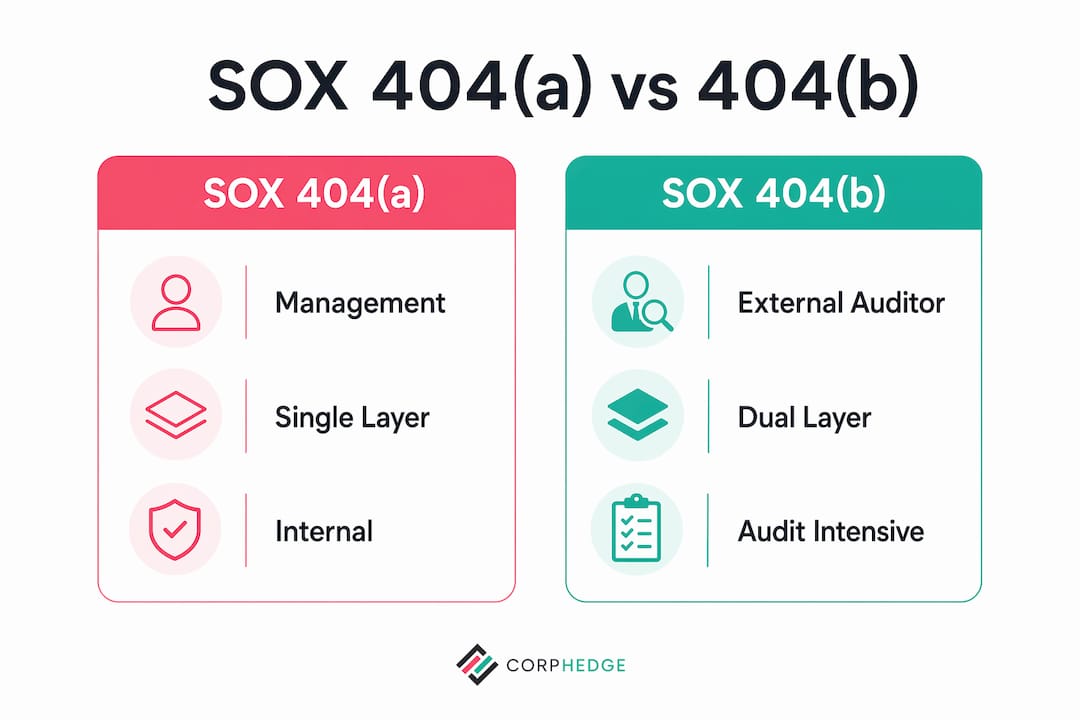
Section 404(b) compliance doubles the documentation workload compared to 404(a). The external auditor must personally walk through major transaction cycles, test controls independently, and form their own opinion. That requires a second layer of traceable evidence that management's 404(a) package alone cannot satisfy.
Managed compliance documentation services address this by building dual-layer evidence packages from the start. Control narratives include both management-facing summaries and auditor-facing walkthrough scripts. Version-controlled working papers carry timestamps that satisfy PCAOB documentation standards.
Pro Tip: If your company is approaching large accelerated filer status, start building 404(b)-grade documentation now. Retrofitting a 404(a) package for external auditor use mid-audit cycle is one of the most expensive mistakes a compliance team can make.
What steps should finance teams follow when working with providers?
Selecting and onboarding a compliance documentation provider requires a structured approach. The following steps reflect current best practice for international finance teams.
-
Conduct an initial assessment. Managed compliance services begin with a consultation to evaluate which tasks are best outsourced, such as transaction monitoring, KYC/CDD, or SAR drafting. A 30-minute scoping call is standard. Use it to map your current documentation gaps against the provider's capabilities.
-
Define the SLA and scope explicitly. Every deliverable, turnaround time, and escalation path belongs in the service level agreement. Vague scopes produce vague documentation. Specify which regulatory frameworks apply: SOX, IFRS 17, MiFID II, or local equivalents in Poland or Sweden.
-
Build clear audit trails from day one. Operational traceability requires that every action is logged and every operator is supervised. Confirm that the provider's platform generates immutable activity logs that external auditors can access directly.
-
Clarify accountability boundaries. Compliance documentation services execute tasks under client supervision but do not remove legal liability from your organization. Your compliance officer remains accountable. Document the supervision structure in writing before work begins.
-
Establish a regulatory change protocol. Regulations change. Your SLA must include a defined process for updating documentation when the SEC, FCA, or a local regulator issues new guidance. Providers who lack this protocol will leave you with stale documentation at the worst possible time.
-
Protect data security and confidentiality. Financial records contain material non-public information. Verify that the provider uses encrypted storage, role-based access controls, and data residency practices that comply with GDPR for European operations.
For a broader view of how outsourcing fits into audit-ready accounting services, finance teams can review current alternatives across the market.
How does strong compliance documentation benefit international operations?
Compliance documentation delivers value well beyond satisfying a regulator's checklist. Finance teams that treat documentation as a strategic asset gain measurable operational advantages.
- Reduced regulatory fines and delays. Firms view documentation as essential for reducing fines, improving credit ratings, and managing operational risk. A well-maintained evidence library cuts audit response time and lowers the cost of regulatory inquiries.
- Stronger investor confidence. Effective ICFR, supported by risk-based frameworks like COSO, signals to investors that financial reporting is reliable. That signal directly affects credit ratings and capital access for international companies.
- Improved internal control environment. Documented controls that map to real workflows create a feedback loop. When a control fails, the documentation shows exactly where the breakdown occurred and who was responsible.
- Lower cost of future audits. Clean, version-controlled working papers reduce the hours external auditors spend reconstructing evidence. That translates directly into lower audit fees over time.
- Operational continuity across jurisdictions. International companies operating in markets like Poland and Sweden face overlapping regulatory requirements. Centralized documentation services create a single source of truth that local teams and global auditors can both access.
A practical financial compliance checklist can help teams identify documentation gaps before they become audit findings.
Key takeaways
Compliance documentation services deliver measurable accuracy, audit defensibility, and long-term risk reduction when they combine automated validation, expert oversight, and frameworks like COSO mapped to actual operations.
| Point | Details |
|---|---|
| Accuracy benchmark | Managed teams combining automation and expert oversight achieve up to 99.7% documentation accuracy. |
| SOX 404(b) workload | Moving from 404(a) to 404(b) doubles documentation scope; build dual-layer evidence packages early. |
| Liability stays internal | Outsourced providers execute tasks under supervision, but legal accountability remains with your compliance officer. |
| Operational embedding | Frameworks mapped to real workflows outperform shelf policies in every audit walkthrough. |
| Strategic value | Strong documentation reduces fines, lowers audit costs, and supports investor confidence across jurisdictions. |
Why compliance documentation is an operating system, not a project
Finance professionals often treat compliance documentation as a project with a finish line. That framing is the single most common reason documentation fails during audits. Compliance is an operating system. It runs continuously, updates with every regulatory change, and degrades the moment you stop maintaining it.
I have seen well-resourced companies enter an external audit with beautifully formatted policy documents that described controls no one had followed for 18 months. The documentation looked complete. The audit trail was empty. The external auditors found the gap in the first walkthrough session. The remediation cost far exceeded what a managed documentation service would have cost for the entire year.
The providers worth working with are not selling you a document library. They are selling you a governance product: logged actions, supervised operators, and a living evidence base that reflects what your organization actually does. That distinction separates providers who help you pass audits from providers who help you build a control environment that does not need to be rescued.
Technology matters, but it is the second decision, not the first. Choose your framework and your accountability structure before you choose your software. COSO gives you the structure. A qualified managed team gives you the execution. Automation gives you the scale. None of the three works without the other two.
For international companies expanding into new markets, the documentation burden compounds with each jurisdiction. Starting with a provider who understands multi-regulatory environments is not a premium option. It is the baseline requirement.
— Bartas
How Corphedge supports financial risk and compliance management
International finance teams managing currency exposure face compliance documentation requirements that intersect directly with financial risk reporting. Corphedge provides foreign exchange risk management tools built for companies operating across multiple regulatory environments, including real-time currency position monitoring, Value at Risk-based hedging strategies, and integration with platforms like Corpay.
Finance professionals who need to align their FX risk documentation with audit and reporting standards can explore Corphedge's capabilities through the product tour. Teams that want to see how the workflow applies to their specific operations can request a demo walkthrough. Corphedge is currently expanding its services to Poland and Sweden, making it a relevant option for European finance teams building out their compliance and risk management infrastructure.
FAQ
What are financial compliance documentation services?
Financial compliance documentation services are specialized support functions that organize, maintain, and verify the financial records needed for regulatory audits and internal control requirements. They combine automated validation, expert oversight, and structured workflows to keep organizations audit-ready.
How accurate can outsourced compliance documentation be?
Managed compliance documentation teams achieve up to 99.7% accuracy by combining automated data validation with expert audit coordination and regulatory verification. That benchmark applies to teams operating under defined SLAs with supervised operators.
Does outsourcing compliance documentation remove my organization's legal liability?
No. Outsourced documentation services execute tasks under client supervision but do not transfer legal accountability. Your compliance officer remains responsible for the accuracy and completeness of all regulatory filings.
What is the difference between SOX 404(a) and 404(b) documentation requirements?
SOX 404(a) requires management to assess and document internal controls over financial reporting. SOX 404(b) requires an independent external auditor to attest to that assessment, which doubles the documentation workload and demands detailed walkthrough evidence for major transaction cycles.
How do I verify that a compliance documentation provider will hold up under audit?
Request a sample audit evidence package before signing. Confirm that working papers are organized by control objective, carry version history with timestamps, and include activity logs that external auditors can access directly. Providers who cannot produce this on request will not perform under PCAOB or FCA scrutiny.