

TL;DR:
- Banking compliance reporting services ensure accurate, timely data submission to regulators across multiple jurisdictions. They combine automation and expert review to achieve over 99.7% accuracy, supporting continuous audit readiness. Effective implementation relies on strong internal oversight and integration into broader risk management processes.
Banking compliance reporting services are defined as specialized managed solutions that collect, validate, and submit regulatory data on behalf of financial institutions to satisfy obligations set by bodies such as the CFTC, CSA, MiFID II, and EMIR. For corporate compliance officers and finance teams at international companies, these services are not optional infrastructure. They are the operational backbone that keeps an institution out of enforcement action. Modern providers combine automated validation with human expert review to achieve accuracy rates of 99.7% or higher across millions of transactions, maintaining audit readiness at every point in the reporting cycle.
What regulatory reporting obligations must banking compliance reporting services address?
Regulatory reporting obligations vary by jurisdiction, but the core expectation is the same everywhere: complete, accurate, and timely data submission with a full audit trail. Compliance officers at international companies face a matrix of overlapping regimes that no single spreadsheet process can handle reliably.
The major reporting frameworks that banking compliance reporting services must support include:
- CFTC and CSA mandates: Both regulators require a 30-day rolling reconciliation cycle as a baseline expectation. Missing this cycle creates filing errors and direct regulatory exposure.
- MiFID II and EMIR: European frameworks demand transaction-level reporting with strict field validation, reference data matching, and rejection management.
- AML and financial crime reporting: Suspicious activity reports and threshold transaction reports must be filed within tight windows, often 24–72 hours.
- Multi-jurisdictional filings: An international company operating in the EU, UK, and North America simultaneously faces three distinct reporting regimes with different schemas, deadlines, and reconciliation rules.
Continuous, data-driven reporting platforms are replacing periodic, spreadsheet-based filings as the new standard for handling these multi-jurisdiction requirements. That shift matters because regulators now expect real-time or near-real-time data visibility, not quarterly batch submissions. Audit trails must be complete, logged, and traceable to satisfy examiner requests at any moment.
How do banking compliance reporting services achieve high accuracy and scalability?

The 99.7% accuracy benchmark is not achieved by technology alone. It requires a deliberate combination of automated validation, forensic data checks, and senior practitioner oversight working in parallel.
Automation combined with expert review
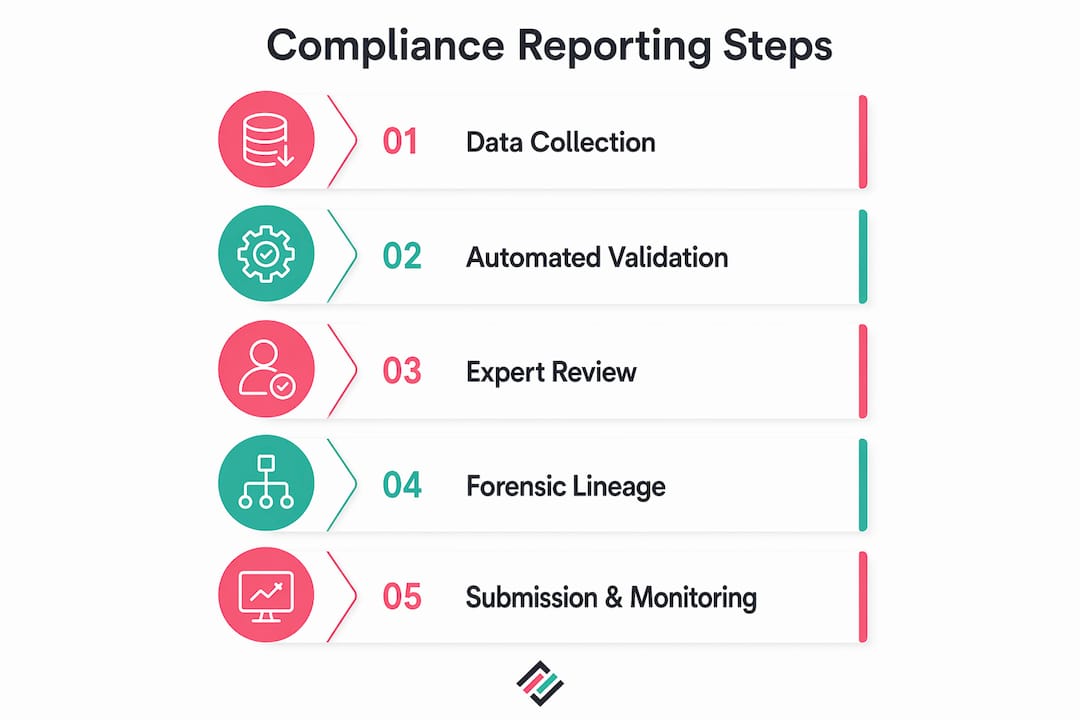
Automated workflows handle the high-volume, repetitive tasks: field population, schema validation, rejection resubmission, and deadline tracking. Human compliance experts then review exception queues, interpret ambiguous regulatory guidance, and make judgment calls that no algorithm can replicate. This division of labor is what separates a reliable service from a software tool that simply moves data.
Forensic validation and data lineage
Treating compliance technology as "set-and-forget" is a mistake. Forensic validation means every data point has a traceable origin, every change is logged, and every submission can be reconstructed for regulatory scrutiny. Data lineage practices create an auditable chain of custody from source system to regulator. Without this, a firm cannot explain a single disputed transaction to an examiner.
Elastic capacity models
Fixed headcount cannot absorb regulatory spikes. Managed services solve this with elastic capacity. One credit union scaled alert volume handling by 4x without increasing fixed headcount, completing compliance remediation within nine months. That model converts a staffing problem into a service-level agreement.
Key technology features that support this architecture include:
- Real-time dashboards showing submission status across all jurisdictions
- Automated alert triage that prioritizes high-risk exceptions
- Workflow routing that assigns exceptions to the right reviewer
- Rejection management with automated resubmission queues
- Change logs that capture every action for audit purposes
Pro Tip: When evaluating a service provider, ask specifically how their platform handles regulatory rejection codes. A provider that manually processes rejections is a bottleneck waiting to happen. Automated rejection resubmission with logged resolution is the correct standard.
What are the key benefits of using managed banking compliance reporting services?
The business case for managed financial compliance services rests on four concrete advantages: cost control, risk reduction, operational efficiency, and regulatory intelligence.
Cost control through elastic pricing. Managed services price like software subscriptions rather than headcount. Finance teams pay for capacity used, not for full-time employees sitting idle between reporting cycles. This model is particularly valuable for international companies expanding into new markets like Poland or Sweden, where local regulatory requirements add reporting complexity without justifying a permanent local compliance hire.
Reduced compliance risk through continuous monitoring. AI-driven automation reduces false positives in AML and financial crime monitoring, which means fewer wasted investigator hours and faster escalation of genuine alerts. Continuous monitoring catches data quality issues before they become regulatory findings, not after.
Improved deadline management. Regulatory deadlines are fixed. A managed service with defined SLAs and automated scheduling removes the human error that causes missed filings. The service owns the deadline, not an individual analyst who might be on leave.
Embedded regulatory intelligence. Regulatory intelligence embedded in service offerings enables real-time interpretation of regulatory changes, reducing manual reconfiguration and maintaining compliance continuity. This is the benefit that most compliance officers undervalue until a rule change breaks their internal process at the worst possible moment.
The combination of these four advantages produces a measurable improvement in audit readiness. Finance teams that previously spent weeks preparing for an examination can produce complete, traceable documentation on demand.
What criteria should compliance officers use to select these services?
Selecting a banking compliance reporting service requires evaluating capability across five dimensions. Technology alone is not sufficient. A provider that sells software without compliance expertise leaves the interpretation gap entirely on your team.
| Evaluation criterion | What to look for |
|---|---|
| Regulatory intelligence | SME-curated knowledge base updated in real time as rules change |
| Multi-jurisdiction coverage | Confirmed support for every regime your firm files under |
| Audit trail capability | Full forensic validation and data lineage from source to submission |
| Elastic capacity | Ability to scale alert volume without renegotiating contracts |
| SLA accountability | Defined penalties or remedies for missed deadlines or accuracy failures |
Strong regulatory intelligence distinguishes providers that anticipate regulatory updates from those that wait for clients to report a problem. The former keeps you compliant. The latter puts you at risk during transition periods.
Technology integration is also non-negotiable. The service must connect to your existing data sources, ERP systems, and treasury platforms without requiring a full data migration. Providers that require proprietary data formats create lock-in and slow down your response to regulatory changes.
Pro Tip: Request a sample audit package from any provider you are evaluating. A credible service can produce a complete, examiner-ready submission history for a sample period within 24 hours. If they cannot, their audit trail is not as complete as they claim.
For a structured view of compliance reporting software options across different capability tiers, the criteria above apply regardless of provider size or market focus.
How to implement banking compliance reporting services effectively?
Effective implementation requires more than a technology deployment. It requires embedding the service into your governance structure so that compliance reporting becomes a controlled, supervised process rather than a delegated task you cannot see.
Practical steps for successful adoption include:
- Assign a senior compliance practitioner as the internal owner. This person maintains visibility over all submissions, reviews exception reports, and serves as the primary contact for the service provider. Outsourcing does not mean losing control.
- Integrate reporting into your broader risk management framework. Compliance reporting data should feed your risk dashboards, not sit in a separate system. Finance teams that connect regulatory data to FX exposure management and treasury risk controls get a more complete picture of their total risk position.
- Establish a regulatory change monitoring protocol. Assign responsibility for tracking rule changes in every jurisdiction you operate in. The service provider should alert you to changes, but your internal team must verify that updates are implemented correctly before the effective date.
- Document everything. Training records, change logs, exception resolutions, and submission confirmations must all be retained in a format that satisfies examiner requests. A financial compliance guide for regulated entities recommends maintaining at least three years of complete submission history as a baseline.
- Run quarterly internal audits. Do not wait for a regulator to find a gap. Internal audit cycles using the same criteria an examiner would apply catch problems early and demonstrate a proactive control environment to regulators.
The risk reporting checklist for finance executives provides a practical framework for verifying that each of these steps is embedded in your annual compliance calendar.
Key takeaways
Effective banking compliance reporting services combine automated validation, forensic data lineage, and elastic capacity to deliver audit-ready regulatory submissions across multiple jurisdictions without fixed headcount costs.
| Point | Details |
|---|---|
| Accuracy benchmark | Managed services achieve 99.7% accuracy by pairing automation with expert review. |
| Regulatory scope | Services must cover CFTC, CSA, MiFID II, EMIR, and AML regimes simultaneously. |
| Elastic capacity | Providers can scale alert handling by 4x without adding permanent staff. |
| Selection priority | Regulatory intelligence and forensic audit trails matter more than technology features alone. |
| Implementation control | Assign an internal senior practitioner to maintain oversight of all outsourced submissions. |
The control environment is the real product
I have spent years watching compliance teams treat regulatory reporting as a back-office task. They buy a platform, configure it once, and assume it runs itself. That assumption is where most enforcement findings originate.
The shift from manual spreadsheets to continuous automated reporting is real and necessary. But automation without a strong control environment is just faster failure. The firms that survive regulatory scrutiny are the ones where every submission is logged, every exception is reviewed, and every change is documented before it goes live.
Elastic compliance models matter for a different reason than most people think. The value is not just cost efficiency during quiet periods. It is operational resilience when a regulator changes a rule mid-year and your alert volume triples overnight. A fixed team cannot absorb that. A managed service with a defined SLA can.
The most undervalued insight I have encountered is this: the control environment should be the primary compliance product, not a byproduct of the reporting process. Regulators do not just want accurate submissions. They want evidence that your organization has a supervised, traceable process that would catch an error before it reached them. That distinction separates firms that pass examinations from firms that spend months in remediation.
For international companies expanding into markets like Poland or Sweden, this is not a future consideration. It is a day-one requirement. Build the control environment before you file the first report, not after the first rejection.
— Bartas
How Corphedge supports your compliance and risk reporting framework

Banking compliance reporting does not exist in isolation. For international companies, regulatory reporting accuracy depends directly on the quality of the underlying financial data, including FX exposure positions, hedging records, and transaction-level risk data. Corphedge provides real-time visibility into currency positions and Value at Risk-based hedging strategies that feed directly into the financial data your compliance team reports on. When your FX risk data is clean, traceable, and continuously updated, your regulatory submissions reflect that quality. Finance teams managing compliance across multiple jurisdictions can explore Corphedge's full FX risk management features to see how exposure controls integrate with broader compliance reporting workflows.
FAQ
What is banking compliance reporting?
Banking compliance reporting is the process of submitting accurate, timely regulatory data to bodies such as the CFTC, EMIR, and MiFID II to satisfy legal obligations. Managed services automate this process while maintaining full audit trails.
How accurate are managed compliance reporting services?
Managed regulatory reporting services achieve sustained accuracy rates of 99.7% or higher across millions of transactions through automated validation combined with expert review.
What is a 30-day rolling reconciliation cycle?
A 30-day rolling reconciliation cycle is a core CFTC and CSA requirement where firms continuously match submitted trade data against internal records to identify and correct discrepancies within a 30-day window.
How do these services handle multi-jurisdiction reporting?
Managed services maintain separate rule sets, schemas, and submission workflows for each regulatory regime, allowing a single provider to handle CFTC, MiFID II, EMIR, and AML filings simultaneously without manual reconfiguration.
What should compliance officers prioritize when selecting a provider?
Compliance officers should prioritize regulatory intelligence, forensic audit trail capability, and elastic capacity over technology features alone. A provider without deep compliance expertise leaves interpretation gaps that increase regulatory risk.