

Pre-trade analytics for corporate FX hedging means running your exposures through a risk model, most often Value at Risk (VaR) or Cash Flow at Risk (CFaR), before you place a single hedge. Done properly, it quantifies how much risk a hedge removes per unit of cost, so a treasurer can compare a 70% hedge ratio against a 90% one in dollars and cents rather than gut feel. Corphedge and similar platforms build this into workflow so the math happens before execution, not after the trade is already booked.
TL;DR:
- Proper pre-trade analytics require detailed exposure mapping that distinguishes between committed flows, forecasts, and balance sheet risks to prevent over-hedging.
- Using quantitative methods like VaR and CFaR helps identify residual risk and tail scenarios, but models must be regularly updated to reflect shifting market conditions.
- Optimal hedge ratios typically involve fully covering committed flows and layering partial coverage on forecasts, with instrument choice aligned to risk objectives.
- Embedding governance, constraints, and live data integration into the platform ensures consistency and reduces manual errors during volatile market conditions.
- Automating exposure tracking and risk modeling within a single system, such as CorpHedge, offers significant savings and more reliable hedge decisions than manual or spreadsheet workflows.
Table of Contents
- What Pre-Trade Analytics Must Produce Before You Hedge
- Core Quantitative Methods: VaR, CFaR, Scenario Analysis, and Monte Carlo
- Turning Analytics Into a Decision: Hedge Ratios and Instrument Choice
- Operational Requirements: Data, Governance, and Embedded Constraints
- A Monthly Checklist and One-Page Pre-Trade Template
- Integrating Pre-Trade Analytics With Live Market Data
- How Macro and Geopolitical Events Move Pre-Trade Numbers
- Software Platforms Commonly Used for Pre-Trade FX Analytics
- Case Studies: Pre-Trade Analytics Working in Practice
- What Actually Breaks Pre-Trade Analytics in Practice
- See Pre-Trade Analytics Working Inside CorpHedge
- Sources
- FAQ
What Pre-Trade Analytics Must Produce Before You Hedge
Every credible pre-trade process starts with an exposure map, not a spreadsheet of guesses. The map separates exposures by certainty and type: committed flows (invoiced receivables, signed contracts) carry near-100% confidence, while forecast flows (next quarter's projected sales in euros) carry lower confidence and should be flagged as such. Balance sheet exposure (translation risk on foreign subsidiaries) behaves differently from cash flow exposure (an invoice due in 60 days), and treating them the same is one of the fastest ways to over-hedge.
Before booking anything, check for natural hedges. A company with euro revenue and euro costs may already be internally offset, and layering a forward contract on top just adds cost without reducing net risk. Xe's treasury workflow guide recommends netting exposures centrally before any derivative gets considered, and prioritizing intercompany offsets, multi-currency accounts, or local borrowing over new hedges.
The data inputs that feed this map include:
- Contracted receivables and payables by currency and settlement date
- Forecast sales and cost volumes, split from price assumptions
- Intercompany loan balances and translation exposure from subsidiaries
- Live spot and forward rates, plus implied volatility for the currency pairs involved
- Historical correlation data between currency pairs in the portfolio
Skipping the granularity step is the single most common reason treasury teams end up over-hedged and paying carry costs they didn't need to, according to research on exposure mapping and hedging outcomes.
Core Quantitative Methods: VaR, CFaR, Scenario Analysis, and Monte Carlo
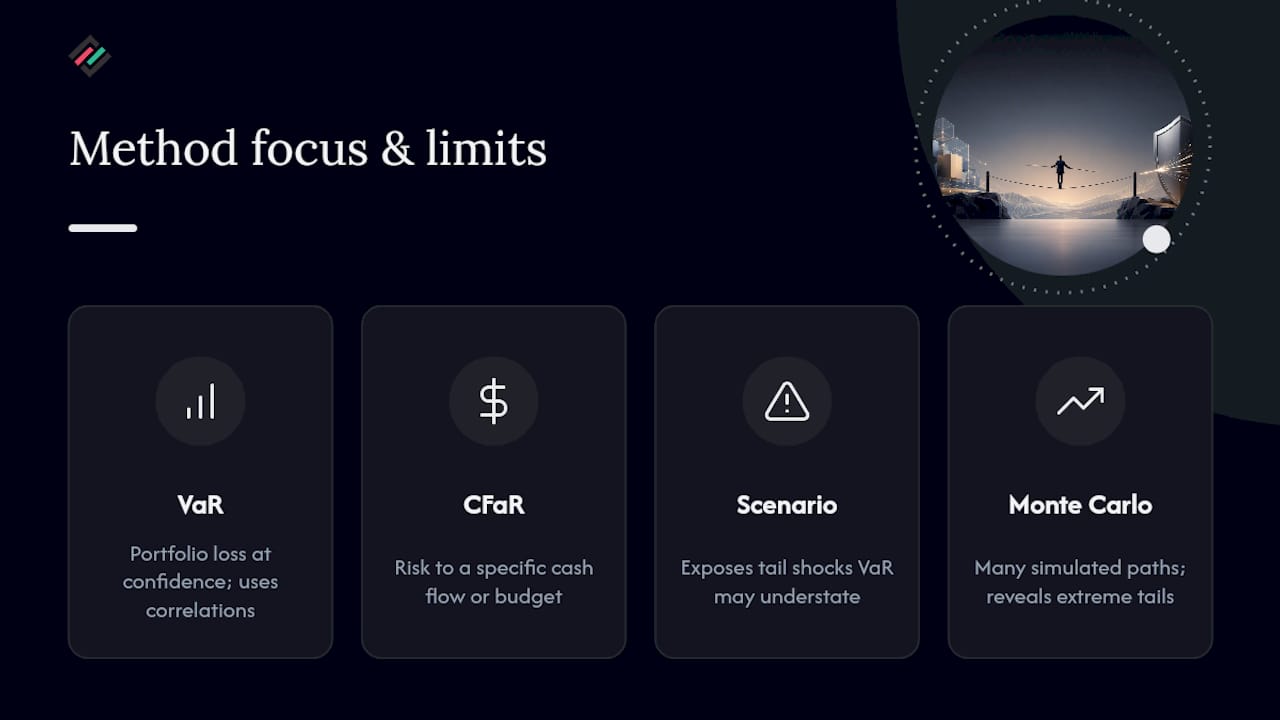
VaR answers a specific question: how much could this FX portfolio lose over a given horizon, at a given confidence level, under normal market conditions? At the portfolio level, VaR accounts for correlations between currency pairs, so a company exposed to both euros and Swiss francs might carry less combined risk than the sum of the two exposures suggests, because the currencies tend to move together. That correlation effect is exactly what lets treasury build an efficient frontier comparing hedge cost against residual VaR, which is the backbone of a defensible hedge-ratio decision.
CFaR asks a different question, and for many operating businesses it's the more useful one. Instead of measuring portfolio value at risk, CFaR measures the risk to a specific cash flow or budget line over a defined period. If your primary hedge objective is protecting next year's EBITDA guidance rather than managing a trading book, CFaR ties more directly to that goal than VaR does.
Scenario analysis and Monte Carlo simulation cover what VaR tends to underweight: tail risk. VaR models built on historical volatility can badly understate losses during a genuine shock, such as a surprise central bank move or a currency peg breaking. Monte Carlo simulation runs thousands of randomized rate paths to show a distribution of outcomes, including the ugly 1-in-100 scenarios that a standard VaR calculation might not capture.
Statistic Callout: After moving to an automated, VaR-led hedging approach with embedded constraints, Avery Dennison reported roughly $1 million in annualized savings alongside more consistent, repeatable hedge decisions.
Every model runs on assumptions, and every assumption ages. Volatility regimes shift, correlations break down during crises, and a model calibrated on 2023 data can misfire badly in 2026 conditions. Update assumptions on a fixed schedule, not just when something goes wrong.
Turning Analytics Into a Decision: Hedge Ratios and Instrument Choice
The efficient-frontier concept is the practical bridge between a risk number and an actual trade. Plot VaR reduction against hedging cost across a range of hedge ratios, and you'll typically see diminishing returns: moving from 50% to 70% hedged might cut VaR sharply, while moving from 90% to 100% barely moves the needle but keeps adding premium or forward-point cost. That inflection point is usually where the optimal hedge ratio sits.
A workable set of rules, in order of how most treasury teams apply them:
- Committed flows get the highest coverage, often 80 to 100%, since the cash flow is contractually certain.
- Forecast flows get partial, layered coverage, hedging in tranches as the forecast firms up over time rather than committing the full amount at once.
- Low-confidence or speculative exposures get monitored, not hedged, until they convert into firmer forecasts.
- Instrument selection follows the objective: forwards lock in a rate for certain flows, options preserve upside for exposures where you want protection without giving up favorable moves, and limit orders help time execution on flows with flexible timing.
Recordkeeping matters as much as the model output. For every trade, store the exposure it hedges, the confidence level at the time, the VaR reduction achieved, the cost, and who approved it. Treasury commentary on documenting hedge rationale consistently points to this as the difference between a defensible hedging program and one that can't survive an audit or a board question.
Pro Tip: Report hedging performance against VaR change, not against a spot-rate comparison. A hedge that "lost money" versus the spot rate at expiry may have done exactly its job by cutting portfolio VaR when it mattered.
Operational Requirements: Data, Governance, and Embedded Constraints
None of this works without an owner. Every exposure line in the register needs a named owner, a data source, and a refresh cadence, feeding into pricing and reconciliation systems automatically rather than through a monthly manual export. CorpHedge's guide to moving off spreadsheet tracking covers why manual exposure updates are one of the most common points of failure in otherwise sound analytics programs.
Governance doesn't need to be complicated, but it does need to exist in writing. A short policy should specify:
- Who can propose a hedge and who approves it (an approval matrix, not a single signature)
- Segregation of duties between the person proposing a trade and the person executing it
- Escalation thresholds: at what VaR level or exposure size does a decision go up a level
- Approved instruments and counterparties, agreed in advance rather than negotiated trade by trade
The AFP's foreign currency and risk policy guidance lays out this kind of structure in detail, and it's worth building your policy against a framework like it rather than starting from a blank page.
Embedding hard constraints into the execution platform itself, rather than relying on people to remember them, is what separates a policy that holds under stress from one that quietly gets overridden. Exposure caps and minimum savings thresholds coded into the system mean a trader can't accidentally exceed a limit during a busy week. Validate the model on a fixed schedule: back-test against realized outcomes, stress-test against black-swan scenarios like a currency peg break, and bring in external review periodically rather than trusting an in-house model indefinitely. Corphedge's coverage of governance and approval workflows walks through what that documentation should look like in practice.
A Monthly Checklist and One-Page Pre-Trade Template
Run this cycle monthly, tighter during volatile periods:
- Refresh the exposure register: update committed and forecast flows, confirm confidence levels.
- Run VaR and CFaR on the updated portfolio, checking against the prior period's numbers.
- Generate two or three candidate hedge portfolios along the efficient frontier.
- Route the proposal through approval, then execute and log the trade.
A one-page template per proposal should capture: owner, currency pair, amount, confidence level, proposed hedge ratio, instrument, expected cost, and the KPI it's measured against. Attach the relevant back-test or stress-scenario note to each proposal so approvers see the model's track record, not just its output.
Integrating Pre-Trade Analytics With Live Market Data
A VaR figure calculated on yesterday's closing rates is already stale by the time a treasurer reads it. Currency markets move on central bank statements, employment data, and geopolitical headlines within minutes, and a pre-trade model that isn't wired to live feeds is working from an outdated picture of risk.
Practical integration means the exposure register pulls spot rates, forward points, and implied volatility from a market data feed continuously, so the VaR or CFaR number on screen reflects current conditions rather than a batch update from the night before. This matters most in the hours around major data releases, when volatility can spike and a stale model understates the risk a treasurer is about to hedge against.
Real-time data integration also closes the gap between analysis and execution. If a candidate hedge portfolio takes twenty minutes to approve after the analytics ran, the rates it was priced against may have already moved. Platforms that connect pricing feeds directly into the approval workflow shrink that lag, so the hedge that gets executed reflects the risk that actually exists at execution time, not the risk that existed when the analysis started.
For treasury teams managing multiple currency pairs across time zones, this also solves a coordination problem: a subsidiary in one region can see the same live exposure and risk figures as headquarters, rather than working from a spreadsheet that's several hours out of date.
How Macro and Geopolitical Events Move Pre-Trade Numbers
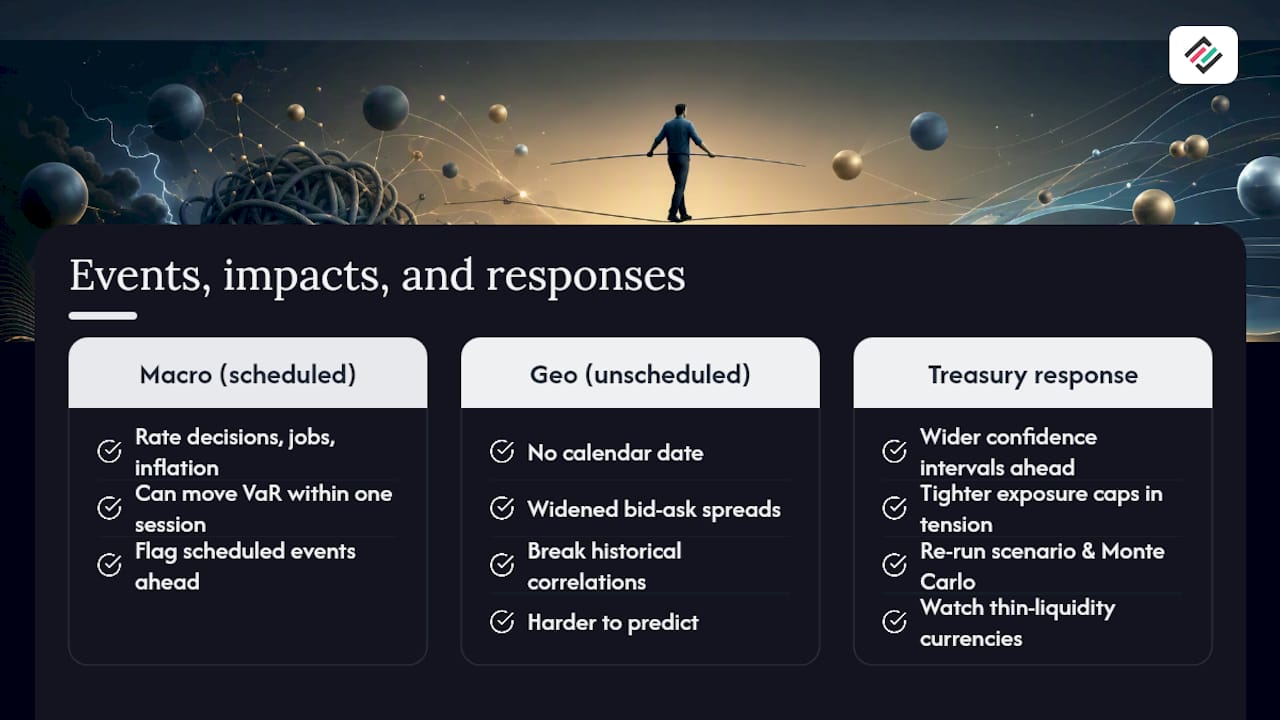
Interest rate differentials drive a large share of currency movement, and a central bank surprise, an unexpected hold, a larger-than-expected cut, can move a VaR calculation meaningfully within a single trading session. Pre-trade models need to flag scheduled events (rate decisions, employment reports, inflation prints) so treasury doesn't run a routine hedge approval process right into a volatility spike.
Geopolitical events are harder to schedule around but arguably matter more, because they don't come with a calendar date. A sudden escalation, a trade dispute, an election result markets didn't price in, can widen bid-ask spreads and break historical correlations that a standard VaR model assumes hold steady. This is exactly why scenario analysis and Monte Carlo simulation matter alongside VaR: they let treasury ask "what if the euro-dollar correlation that held for the last two years breaks down tomorrow" instead of assuming it won't.
The practical response isn't trying to predict these events. It's building buffers into the model: wider confidence intervals ahead of known risk events, tighter exposure caps during periods of elevated geopolitical tension, and a habit of re-running scenario analysis whenever a major macro assumption shifts. A company hedging exposure into markets with less liquid currencies, where Corphedge's expansion into Poland and Sweden puts the zloty and krona on more corporate radars, should pay particular attention to how thinner trading volumes can amplify the price impact of a geopolitical shock compared to a deeply liquid pair like EUR/USD.
Software Platforms Commonly Used for Pre-Trade FX Analytics
Treasury teams generally fall into three camps on tooling. The first still runs exposure tracking and VaR estimates in spreadsheets, which works at small scale but breaks down fast once multiple currencies, multiple entities, and forecast layering enter the picture. Manual spreadsheet processes are also where data errors and stale rates tend to creep in unnoticed.
The second camp uses enterprise treasury management systems, which handle exposure tracking and reporting well but often bolt VaR or CFaR on as a secondary module rather than building the workflow around it from the start.
The third camp uses dedicated FX risk platforms built specifically around pre-trade risk analytics, where VaR calculation, exposure mapping, live market data, and approval workflow live in one connected system rather than stitched together from separate tools. Corphedge's feature set falls into this category, combining exposure register automation with VaR-based hedge simulation so the analytics and the execution constraints sit in the same platform rather than requiring a manual handoff between a risk spreadsheet and a trading desk.
Whichever category a company sits in, the deciding factor isn't which platform looks most sophisticated. It's whether the tool actually gets used consistently every month, because a powerful model that only gets run quarterly provides far less protection than a simpler one run on a strict monthly cadence.
Case Studies: Pre-Trade Analytics Working in Practice
The clearest documented example comes from Avery Dennison, a multinational packaging and labeling company with FX exposure across dozens of currencies. The treasury team moved from a discretionary hedging approach to an automated, VaR-led model with Monte Carlo simulation built in, and embedded hard constraints, exposure caps and minimum savings thresholds, directly into the execution system rather than relying on trader judgment case by case. After back-testing the model against historical scenarios, the company reported roughly $1 million in annualized savings along with far more consistent, auditable governance around every hedge decision.
The mechanism behind that result is worth unpacking, because it's replicable at smaller scale. Centralizing exposure data meant the treasury team wasn't hedging the same underlying risk twice across different subsidiaries. Embedding constraints into the platform meant nobody could execute a trade that violated the exposure cap, even under pressure during a volatile week. And back-testing before going live caught model weaknesses that would have otherwise surfaced during an actual crisis, when the cost of a bad model is highest.
Smaller companies without Avery Dennison's treasury headcount can apply the same logic at a fraction of the scale: a clean exposure register, a chosen risk metric that matches the actual business objective, and constraints that live in the system rather than in someone's memory. The size of the company changes the numbers involved. It doesn't change the underlying discipline.
What Actually Breaks Pre-Trade Analytics in Practice
The failure modes I see most often aren't exotic. Poor exposure granularity tops the list: treasury lumps committed and forecast flows together, and the resulting hedge ratio is wrong for both. A close second is building constraints as policy documents instead of platform rules, so the cap that exists on paper gets quietly overridden the first time a trader is under pressure.
The third is overconfidence in an untested in-house model. Building a proprietary VaR engine feels rigorous, but without extensive back-testing against real black-swan events, it can produce numbers that look precise and are quietly wrong. External validation or a proven platform beats a homemade model nine times out of ten, simply because someone else has already stress-tested it against the scenarios you haven't thought of yet.
The fixes mirror the failures: keep a short, disciplined exposure register with confidence levels attached, embed constraints where trades actually execute, and back-test on a fixed schedule rather than only after something has gone wrong. For readers who want the quantitative side spelled out further, Corphedge's guide to quantitative FX assessment walks through how to build these checks without needing a dedicated quant team.
— Bartas
See Pre-Trade Analytics Working Inside CorpHedge
Corphedge gives treasury teams the VaR engine, exposure register, and embedded constraints this article describes, in one connected platform instead of three disconnected tools. Where a spreadsheet-based process forces someone to manually recalculate VaR every time an exposure changes, Corphedge's exposure register updates automatically and feeds straight into hedge ratio recommendations along the efficient frontier.
The platform enforces exposure caps and minimum savings thresholds at the execution level, so the governance rules a treasury team writes down actually hold when markets get volatile, not just when things are calm. As Corphedge expands into Poland and Sweden, more treasury teams managing zloty and krona exposure alongside major pairs will find the same VaR-led logic applies regardless of currency liquidity. If your process currently relies on quarterly spreadsheet reviews, see how hedging based on Value at Risk works inside a live platform, or book a product tour to walk through your own exposure data with the team.
Sources
- VALUE-AT-RISK BASED APPROACH FOR CURRENCY HEDGING
- Steps In An FX Hedging Process For Finance And Treasury | Xe Blog
FAQ
What Is Pre-Trade Analytics in FX Hedging?
Pre-trade analytics is the process of running currency exposures through risk models like VaR or CFaR before placing a hedge, so treasury can quantify the risk reduction a hedge would deliver against its cost.
What's the Difference Between VaR and CFaR?
VaR measures potential loss in portfolio value at a given confidence level, while CFaR measures risk to a specific cash flow or budget line, and CFaR often maps more directly to business objectives like protecting EBITDA guidance.
How Often Should Treasury Run Pre-Trade Analytics?
Most treasury teams refresh exposures and rerun VaR or CFaR monthly, tightening the cadence during periods of elevated volatility or ahead of major scheduled economic events.
Why Do Companies Over-Hedge Their FX Exposure?
Over-hedging usually happens when committed and forecast flows get treated the same way in the exposure register, leading to hedge ratios that are too high for uncertain future cash flows.
Can CorpHedge Replace a Spreadsheet-Based Hedging Process?
Yes. Corphedge automates exposure register updates, VaR calculation, and constraint enforcement in one platform, removing the manual recalculation and oversight gaps common in spreadsheet-based workflows.