

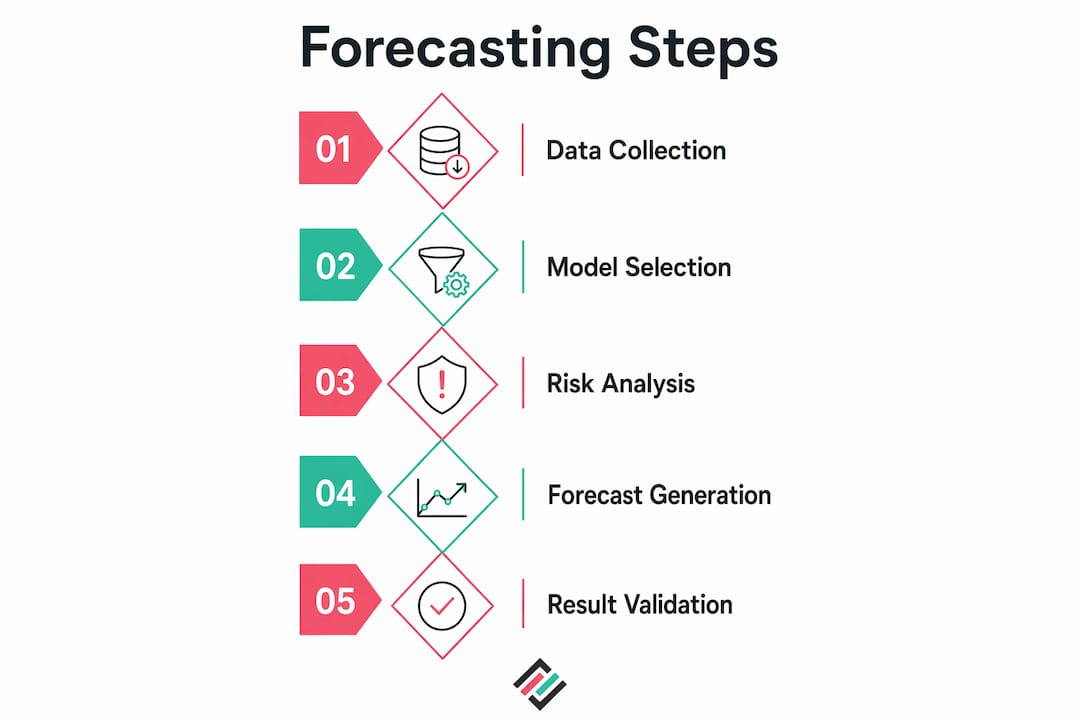
Forecasting exchange rates effectively means combining economic fundamentals, statistical models, and expert judgment — no single method wins consistently. The core approaches professionals rely on include Purchasing Power Parity (PPP), Behavioral Equilibrium Exchange Rate (BEER) models, ARIMA time-series analysis, and Dynamic Stochastic General Equilibrium (DSGE) frameworks. Machine learning tools like LASSO are increasingly useful for filtering noise from macroeconomic data. Political risk and central bank policy add layers that purely quantitative models often miss. Here is a quick map of the territory:
- Fundamental models: PPP, BEER, macroeconomic balance (MB)
- Econometric models: DSGE, Bayesian VAR (BVAR), ARIMA
- Machine learning: LASSO, neural networks, Markov-switching models
- Qualitative overlays: central bank signals, geopolitical risk, market sentiment
- Validation: backtesting, out-of-sample testing, mean-squared error comparison
Table of Contents
- How to forecast exchange rates using fundamental analysis
- Statistical and econometric models that improve forecast accuracy
- Why exchange rate forecasting is harder than it looks
- Practical forecasting tips for analysts covering Central Europe
- Key Takeaways
- FAQ
How to forecast exchange rates using fundamental analysis
Equilibrium-based models are the most durable tools for medium and long-term currency forecasting. The PPP model, which predicts that exchange rates adjust until identical goods cost the same across countries, outperforms the random walk benchmark in both real and nominal exchange rate forecasting, particularly at horizons beyond one year. The BEER model performs nearly as well by incorporating productivity differentials and net foreign assets alongside relative prices.
A key insight from ECB research: real exchange rate adjustments happen primarily through currency movements, not through relative price changes between countries. That means real equilibrium models carry genuine predictive power for nominal rates too, at least for economies with moderate inflation.
Forward rates offer another angle. While they reflect market consensus and interest rate differentials, their predictive accuracy for actual spot rates is mixed in the short run. They work better as a baseline assumption than as a standalone forecast.
Macroeconomic fundamentals to track closely:
- GDP growth differentials between the domestic economy and trading partners
- Inflation rates and central bank targets (anchoring inflation assumptions matters enormously for model accuracy)
- Interest rate differentials and carry trade dynamics
- Current account balances and trade flow trends
- Political stability and geopolitical risk, which can override all of the above in the short term
Understanding exchange rate risk types helps analysts frame which fundamentals to weight most heavily for a given currency pair.
Statistical and econometric models that improve forecast accuracy
ARIMA (AutoRegressive Integrated Moving Average) models are the standard entry point for time-series forecasting. They work by modeling a currency's past values and error terms to project future movements, making them useful for short and medium-term horizons where historical patterns persist. The limitation is that ARIMA treats exchange rates as if they follow a stable statistical process, which breaks down during structural shifts or major shocks.

DSGE models go deeper. They embed exchange rate dynamics within a full macroeconomic framework, accounting for monetary policy, risk premia, and cross-border capital flows. ECB research shows that DSGE models perform well for real exchange rate forecasting when they respect two principles: avoid replicating high volatility observed in the sample, and build in mean reversion toward equilibrium. Where DSGE models stumble is nominal exchange rate forecasting, largely because of poor inflation predictions rather than any fundamental flaw in the exchange rate logic itself.
LASSO (Least Absolute Shrinkage and Selection Operator) addresses a different problem: too many potential predictors. When you have dozens of macroeconomic variables and need to identify which ones actually drive a currency, LASSO filters noise by shrinking irrelevant coefficients toward zero. The result is a leaner, more interpretable model. For analysts applying machine learning to financial forecasting, LASSO is often the first tool worth deploying before more complex neural network approaches.
Combining models consistently outperforms relying on any single one. Anchoring domestic and foreign inflation at realistic long-term levels, then blending DSGE output with a simpler mean-reverting AR model, tends to beat the random walk at horizons of one to two years and beyond.
Why exchange rate forecasting is harder than it looks
Short-term nominal exchange rates often behave like a random walk: the best prediction for tomorrow's rate is today's rate. Financial markets are hit by frequent, large shocks that no model anticipates well. The Riksbank's own forecasts for the Swedish krona have regularly missed, despite sophisticated internal modeling.
The "disconnect puzzle" is real. Models that explain exchange rate movements in hindsight often fail to beat a naive benchmark out of sample. A major reason is inflation forecasting error: DSGE models that fail to predict inflation dynamics accurately will produce poor nominal exchange rate forecasts even when the underlying exchange rate logic is sound.
Research on the Polish zloty confirms the pattern. Non-linear models including Markov-switching specifications and artificial neural networks struggle to consistently outperform the random walk for the PLN, reinforcing that complexity alone does not solve the forecasting problem.
Pro Tip: When selecting a forecasting model, prioritize mean reversion and conservative volatility assumptions over models that closely fit historical data. Overfitting in-sample is the single fastest way to produce forecasts that collapse out of sample.
Practical forecasting tips for analysts covering Central Europe
Poland and Sweden present distinct but related challenges. The PLN is sensitive to European Central Bank policy, regional political developments, and global risk appetite. The SEK responds heavily to Riksbank interventions, global financial flows, and commodity-linked sentiment. Both currencies reward analysts who monitor central bank communications closely.
Daily effective exchange rate data improves forecast accuracy significantly compared to monthly averages, because it captures high-frequency fluctuations that monthly data smooths away. For business budgeting and treasury planning, building forecasts on daily data inputs is a concrete, implementable upgrade.
Central bank foreign exchange operations move rates in ways that unfold gradually. Riksbank FX operations have caused measurable SEK movements that vary by currency and time horizon, which means monitoring the timing and scale of interventions belongs in any SEK forecasting workflow. The same logic applies to NBP (National Bank of Poland) communications for PLN pairs.
Best practices for Central European currency forecasting:
- Use PPP calibration with an imposed, theoretically grounded speed of adjustment rather than one estimated from volatile sample data
- Supplement macro models with LASSO-based variable selection to identify which shocks are actually driving the currency at a given moment
- Track ECB, Riksbank, and NBP policy signals as leading indicators, not lagging confirmations
- Incorporate geopolitical risk scores alongside traditional macro variables, especially for PLN given Central European political dynamics
- Validate every model with out-of-sample backtesting before using it for live decisions
- Monitor FX exposure management practices alongside forecasting to translate predictions into hedging decisions
Once a forecast is in hand, the next step is acting on it. Corphedge's Value at Risk hedging platform lets analysts translate exchange rate forecasts directly into quantified risk positions and hedging strategies, with real-time visibility into currency exposures across portfolios.

Key Takeaways
Combining mean-reverting equilibrium models with high-frequency data and machine learning variable selection gives analysts the most reliable foundation for forecasting exchange rates in Central European markets.
| Point | Details |
|---|---|
| PPP and BEER outperform random walk | Both models beat the random walk benchmark for real and nominal exchange rate forecasting at horizons beyond one year. |
| Daily data improves forecast accuracy significantly | Using daily effective exchange rate data instead of monthly averages significantly sharpens forecast precision. |
| Mean reversion beats volatility replication | Models that exploit gradual real exchange rate reversion outperform those that try to match in-sample volatility. |
| Combining models beats any single approach | Anchoring inflation assumptions and blending DSGE with simpler AR models consistently improves nominal rate forecasts. |
| Central bank operations require active monitoring | Riksbank and NBP interventions move rates gradually, making policy tracking a core part of any SEK or PLN workflow. |
FAQ
Is it possible to predict exchange rates accurately?
Short-term nominal exchange rates often behave like a random walk, making precise prediction very difficult. Longer-horizon forecasts using PPP and BEER equilibrium models do outperform naive benchmarks, particularly for real exchange rates.
What are the main methods for forecasting exchange rates?
The primary methods are fundamental analysis (PPP, BEER), econometric models (DSGE, ARIMA, BVAR), and machine learning techniques like LASSO. Professional forecasters typically combine short-term indicator models with long-term structural macroeconomic frameworks.
Are exchange rates likely to go up or down?
Direction depends on the currency pair, the time horizon, and current deviations from equilibrium. Currencies trading well below their PPP-implied equilibrium tend to revert upward over multi-year horizons, but short-term moves remain highly unpredictable.
How does USD performance affect Central European currencies?
Global monetary policy, particularly from the Federal Reserve, the ECB, and the Bank of England, has a measurable spillover effect on currency returns. A dovish shift across major central banks tends to support emerging and developed market currencies against the dollar.