

The output is a number, or a small set of numbers, that tells the CFO whether currency risk is background noise or a real threat to margin and to covenants.
TL;DR:
- Currency risk exposure must be accurately categorized into transaction, translation, and economic types, with clear tagging of settlement dates and certainty levels for each item.
- Conduct sensitivity analysis using at least two shock sizes, such as ±5% and ±10%, across short-term (30 days) and annual (365 days) horizons to capture immediate and long-term impacts.
- Avoid common pitfalls by including all relevant exposures, using appropriate shock sizes, and reporting impact in absolute terms alongside percentage changes to assess scale accurately.
- Incorporate probabilistic measures like Value at Risk and Cash Flow at Risk to understand the likelihood of shocks and inform materiality thresholds and liquidity planning.
- Transition from manual spreadsheet exercises to operational platforms that provide live exposure dashboards, hedging simulations, and continuous risk monitoring aligned with audit standards.
Table of Contents
- Building the FX Exposure Inventory Before You Run Any Numbers
- How to Run a Currency Sensitivity Analysis Step by Step
- Common Errors That Undermine an FX Sensitivity Table
- Turning the Numbers Into a Decision: Materiality, VaR, and CFaR
- Connecting Sensitivity Results to Hedging Decisions
- Making Sensitivity Analysis Operational, Not a One-Off Spreadsheet Exercise
- A Cadence Risk Managers Can Actually Stick To
- Get FX Sensitivity Analysis Off the Spreadsheet and Into a System
- Where This Guide's Numbers Come From
- Sources
- FAQ
Building the FX Exposure Inventory Before You Run Any Numbers
A sensitivity analysis is only as good as the exposure list underneath it, and most finance teams skip past this step too fast. There are three distinct kinds of currency risk, and conflating them is the single most common reason a sensitivity table gets challenged in an audit.
Transaction exposure is the risk on specific, dated cash flows: a euro invoice you'll pay in 60 days, a dollar receivable due next quarter. Translation exposure hits when you consolidate a foreign subsidiary's balance sheet into your reporting currency; the underlying cash doesn't move, but reported equity does. Economic exposure is the slow-burn kind, where a stronger currency erodes competitiveness over years rather than showing up in a single quarter's numbers.
Public guidance from HM Treasury groups exposure into these same three categories and recommends a short written policy to keep them from blurring together.
Your inventory needs to tag, at minimum:
- Trade receivables and payables in foreign currency, with settlement dates
- Firm purchase or sale commitments not yet on the balance sheet
- Foreign-currency cash, deposits, and borrowings
- Outstanding FX derivatives and their notional amounts
- Intercompany loans and balances, which get missed constantly
- Foreign subsidiary net assets subject to translation on consolidation
Attach a certainty band to each line: firm, likely, or possible. A signed contract in euros is firm. A forecast sale to a new market next year is possible at best. That distinction changes which items you hedge with a forward and which you leave flexible, because hedging a forecast that never materializes creates its own exposure.
How to Run a Currency Sensitivity Analysis Step by Step
This is the spreadsheet-friendly version finance teams can run in an afternoon, and it maps directly onto how SEC filers construct their own disclosure tables.
- Inventory the exposure. For every item, record currency, amount, settlement or measurement date, and certainty band.
- Pick your shocks and horizons. Run at least two shock sizes, commonly ±5% and ±10%, across at least two time horizons: 30 days for immediate cash flow, 365 days for annual planning.
- Convert and calculate impact. Multiply the exposure by the shock percentage to get the currency-denominated impact, then convert to your reporting currency at the current spot rate.
- Aggregate by currency, then consolidate. Sum all euro exposures, all yen exposures, and so on, before rolling everything into one reporting-currency figure.
- Write the disclosure line and build the summary table. State both the percentage move and the absolute currency amount, ready to drop into a treasury report or MD&A section.
Here's a worked example.
Pro Tip: A ±10% FX shock on a foreign-currency revenue line tends to flow through to reported revenue at close to that same percentage once converted, which is why simple shock scenarios remain the standard stress test even at sophisticated treasury desks.
| Exposure | Shock | Impact (local currency) | Impact (reporting currency, illustrative) |
|---|---|---|---|
| foreign-currency net receivables | +10% (euro strengthens) | an increase in profit | Gain on translation |
| foreign-currency net receivables | -10% (euro weakens) | a decrease in profit | Loss on translation |
That single table, expanded across your major currency pairs, is the backbone of an IFRS 7-style disclosure.
Common Errors That Undermine an FX Sensitivity Table
The mistakes that show up most often aren't calculation errors. They're scoping and framing errors that make a table technically correct but practically misleading.
- Excluding nonfinancial or intercompany exposures. Leaving out operational flows or intercompany loans shrinks your reported sensitivity, but research on FX disclosure usefulness finds that entity-level exposure, including nonfinancial items, predicts real currency risk far better than a derivatives-only view.
- Mixing time horizons. Netting a 30-day receivable against a 365-day forecast commitment produces a number that means nothing to anyone reading it.
- Using an arbitrary shock size. A 3% shock with no historical basis looks like you picked the number that made the risk look small.
- Reporting only percentages. A "10% impact" without the underlying currency amount and its effect on profit or equity tells the reader nothing about scale.
For an IFRS 7-style disclosure checklist, confirm you've covered: the risk variable and shock size used, the profit and equity impact in absolute terms, the methodology basis, and a note on any change from the prior period. Details on aligning these outputs with formal currency exchange accounting requirements are worth a closer look before your next audit cycle.
Turning the Numbers Into a Decision: Materiality, VaR, and CFaR
A sensitivity table tells you what happens under one scenario. It doesn't tell you how likely that scenario is, or what to do about it. That's where probabilistic tools and clear thresholds take over.
Translate your shock results into terms the board actually cares about: margin percentage, days of cash runway, and covenant headroom.
- Set materiality thresholds up front, expressed as a percentage of profit, an absolute currency amount, or a liquidity trigger like available cash falling below a covenant floor.
- Bring in Value at Risk (VaR) when you need a probability-weighted exposure cap for daily or weekly limits rather than a single deterministic shock.
- Use Cash Flow at Risk (CFaR) when the question is liquidity, not just P&L, since it translates FX volatility directly into potential cash shortfalls over a defined horizon.
- Set a reporting cadence, weekly for exposure snapshots, monthly for refreshed sensitivity, quarterly for policy review.
VaR and CFaR aren't replacements for the shock table. They're the layer that tells you how often a shock of that size actually happens.
Connecting Sensitivity Results to Hedging Decisions
Once you know the size and likelihood of your exposure, the next question is what to actually do about it. The certainty band you assigned during the inventory step drives the instrument choice.
- Firm, dated flows (a signed euro invoice due in 60 days) generally call for forwards, which lock in a rate with no premium cost.
- Uncertain timing or amount (a possible sale that may or may not close) fits options better, since you pay a premium for the right, not the obligation, to hedge.
- Natural hedges work when you can match currency inflows and outflows operationally, cutting the need for financial instruments entirely.
Practical operating levers beyond derivatives include invoicing customers in your own currency where you have pricing power, extending or shortening payment terms to shift timing, using multi-currency accounts to hold balances instead of converting repeatedly, and centralizing FX decisions rather than letting each business unit hedge independently. This kind of instrument matching is consistent with standard UK guidance on currency risk instruments for smaller and mid-sized exporters.
Presenting that as a band, not a single number, gives the board room to ask questions without forcing a false precision. For a broader menu of tactics that pair with this kind of output, see financial risk reduction strategies for currency exposure.
Making Sensitivity Analysis Operational, Not a One-Off Spreadsheet Exercise
A shock table run once a quarter tells you where you stood on the day you ran it.
Corphedge's platform is built around that gap, with live exposure dashboards that update as positions change, hedging simulation tools to test forward and option scenarios before committing capital, and export formats built for treasury and MD&A reporting. It also connects with partner platforms like Corpay for execution.
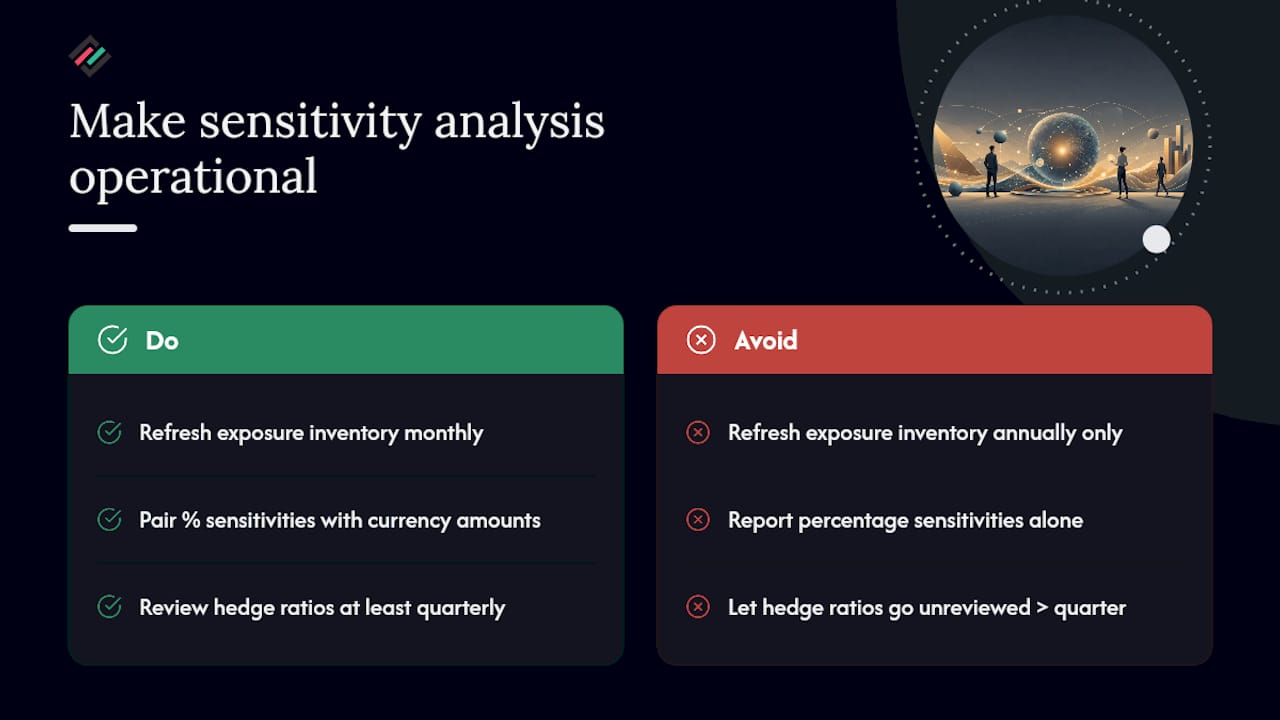
A short checklist worth adopting: confirm your exposure inventory is refreshed monthly, not annually; pair every percentage sensitivity figure with an absolute currency amount; and never let a hedge ratio sit unreviewed for more than a quarter.
A Cadence Risk Managers Can Actually Stick To
Weekly, pull a snapshot of your top three currency exposures and flag anything that moved past a set alert level. Quarterly, review the hedging policy itself, reset hedge ratios, and prepare the disclosure language before it's due, not after.
— Bartas
Get FX Sensitivity Analysis Off the Spreadsheet and Into a System
Corphedge is the alternative to running currency risk in scattered spreadsheets: live exposure tracking, hedging simulation built on Value at Risk analytics, and reports formatted for treasury and MD&A use, all in one platform instead of a patchwork of files someone updates when they remember to.

As Corphedge expands into new European markets, including those using the zloty and krona alongside the euro, more finance teams will have a single dashboard to track multiple currency exposures rather than reconciling numerous spreadsheets. If your team is newer to structured FX risk work, the FX hedging course is a one-off purchase that walks through building the exposure inventory and shock tables covered here. For teams ready to see the exposure dashboard and VaR-based hedging simulation directly, the platform use-cases page is the place to start, and the features page covers the operational advisory and integration options, including Risk Safari Tours for hands-on guidance. Book a look at the dashboard before your next quarterly review.
Where This Guide's Numbers Come From
The sensitivity table format follows SEC disclosure examples and IFRS 7 requirements. Exposure guidance draws on HM Treasury-aligned SME guidance, and shock methodology follows FinancialModelingPrep's stress-testing approach.
Sources
- SEC filing: sensitivity analysis examples
- Using VaR and CFaR to manage FX budget risk in 2026 — XE
- Currency risk management for SMEs: practical UK guide — Nasara Connect
- Stress-testing revenue with forex data — FinancialModelingPrep
FAQ
How Do I Perform a Currency Sensitivity Analysis?
Inventory every currency exposure with its amount, date, and certainty, then apply a shock (commonly ±5% or ±10%) to calculate the change in profit, cash flow, or equity in both percentage and absolute currency terms.
What Are the Three Types of FX Exposure Covered in Sensitivity Analysis?
Transaction exposure (dated cash flows), translation exposure (consolidation of foreign subsidiaries), and economic exposure (long-term competitive impact) are the three categories most sensitivity frameworks address.
What Does Sensitivity Analysis Mean in a Financial Model?
In a financial model, sensitivity analysis shows how an output, like profit or cash flow, changes when one input, like an exchange rate, moves by a defined amount while other variables stay fixed.
How Do You Interpret FX Sensitivity Analysis Results?
Compare the absolute currency impact against a materiality threshold, such as a percentage of profit or a liquidity covenant, and use VaR or CFaR to add a probability estimate before deciding whether to hedge or escalate.
Does Corphedge Support VaR-Based FX Sensitivity Analysis?
Yes, Corphedge's platform includes Value at Risk analytics alongside live exposure tracking and hedging simulation tools, letting finance teams move from a static shock table to an ongoing risk-monitoring process.