

The FX Global Code applies to corporates, and it's voluntary, but ignoring it is getting harder to justify. If your treasury team trades currency at any real volume, the immediate move is to run the GFXC proportionality self-assessment or name a project lead who owns the scoping work.
That first step produces two things fast:
- A short list of which of the 55 principles actually apply to your firm
- An initial gap list showing where current practice falls short
Everything else, gap analysis, remediation, training, the Statement of Commitment, follows from that starting point.
Key Takeaways
Corporate adoption of the FX Global Code succeeds when treasury teams prioritize proportionality and documentation over exhaustive, unfocused compliance work.
| Point | Details |
|---|---|
| Code is voluntary but consequential | It supplements, not replaces, regulation, yet counterparties increasingly expect it. |
| Start with proportionality | Use the GFXC self-assessment tool to narrow 55 principles to what applies to your role. |
| Prioritize remediation by urgency | Case study data shows only a fraction of applicable principles usually need real fixes. |
| Document every decision | Non-applicability calls and remediation steps need an audit trail, not just intent. |
| CorpHedge supports the workflow | CorpHedge's platform helps treasury teams track exposure and document policy alignment as they work through adherence. |
Table of Contents
- What the FX Global Code Is and Why It Matters for Corporate Treasury
- The Six Leading Principles Explained for Corporate Practice
- Roadmap to Adherence: Prioritized Steps for Corporates
- How to Use the GFXC Proportionality Self-Assessment
- Common Implementation Pitfalls and What a Real Case Study Shows
- Publishing a Statement of Commitment and Owning Ongoing Adherence
- A Practitioner's View on Staging the Work
- Turning Your Gap Analysis Into an Operating Habit
- Sources
- FAQ
What the FX Global Code Is and Why It Matters for Corporate Treasury
The FX Global Code is a set of 55 principles of good practice for the wholesale foreign exchange market, built by central banks and market participants and last updated in December 2024. It's not a law. No regulator will fine you for skipping it, and no corporate is legally required to adopt it.
That voluntary status is exactly why it carries weight. Adoption signals something regulation can't force: that your treasury function chose a higher bar. The GFXC's own guidance on buy-side engagement points to three concrete payoffs corporates get from aligning with the Code:
- Stronger counterparty confidence, since banks and platforms increasingly check whether clients operate to Code standards
- Clearer internal policies, because the principles force decisions that many treasury teams have never written down
- Access to industry forums, templates, and training materials the GFXC maintains for adopters
Only around a third of firms report that adjusting internal procedures is their toughest adoption hurdle, according to Association of Corporate Treasurers research, which puts the real friction point in process change, not principle-reading.
The Six Leading Principles Explained for Corporate Practice
The Code groups its 55 principles into six categories, and the BIS summary is the cleanest reference for how they fit together. Here's what each means in practice for a corporate treasury desk, not a bank dealing room:
- Ethics. Document how you handle conflicts of interest and fair dealing with counterparties. If a bank relationship manager also advises on hedge structure, write down how that's managed.
- Governance. Assign clear ownership of FX decisions, define who signs off on trades above a threshold, and set an escalation path when something goes wrong.
- Execution. Give unambiguous order instructions, understand your execution options, and keep at least a basic sense of transaction cost analysis on larger trades.
- Information sharing. Set rules for what internal FX positions and strategy can be shared externally, and make sure communications with counterparties are accurate, not just fast.
- Risk management and compliance. Build controls, reconcile positions regularly, and keep an audit trail that would survive a client or auditor asking "show me."
- Confirmation and settlement. Confirm trades promptly and reduce settlement risk, particularly on same-day or cross-time-zone deals.
Pro Tip: Start your gap analysis with governance and risk management. Those two groups tend to expose the most existing weaknesses, and fixing them makes the other four principle groups easier to implement.
Roadmap to Adherence: Prioritized Steps for Corporates
The GFXC's Roadmap to Adherence lays out a sequence that works whether you're a mid-size exporter or a multinational treasury center. Follow it in order rather than jumping to the parts that feel easiest.
- Form a cross-functional project team and name a single lead who owns the timeline. This person usually sits between treasury operations and compliance.
- Identify your FX activities and run the proportionality self-assessment to see which principles apply given your actual trading role.
- Conduct a gap analysis, then prioritize remediation by urgency, not by how many principles you can check off fastest.
- Deliver staff training, formalize written policies, and set a recurring review cadence, quarterly or annual, depending on trading volume.
- Publish a Statement of Commitment and monitor adherence going forward.
Practical checklist for step one:
- Pick a lead who has authority to pull in compliance, not just treasury staff
- Set a hard deadline for the self-assessment, two weeks is realistic
- Loop in whoever manages counterparty relationships early, since Principle groups on ethics and information sharing touch that role directly
Our corporate forex strategy guide walks through the exposure-assessment piece of step two in more depth.
How to Use the GFXC Proportionality Self-Assessment
Proportionality means you only apply principles relevant to your actual role and activity level in FX markets, not the full 55 as if you were a bank market-maker. The self-assessment tool walks you through your activities and outputs which principles genuinely apply.
Run it, then document every "not applicable" call with a short rationale.
- Buy-side corporates typically exclude principles covering market-making or anonymous trading platforms, since they don't operate in that capacity
- Keep the exclusion reasoning in writing, not just in someone's head, because auditors and counterparties may ask later
- Revisit the assessment whenever your trading activity changes materially, adding a new currency pair or a new execution venue, for instance
Common Implementation Pitfalls and What a Real Case Study Shows
The biggest mistake corporates make is treating adoption as a checkbox exercise. GFXC guidance is explicit that the Code works when principles get embedded into daily workflow, not filed away after a signature. Beyond that, three patterns show up repeatedly:
- Under-resourced remediation, where the gap analysis happens but nobody owns the fixes
- Unclear ownership between treasury and compliance, so action items stall
- Training that covers the Code once at launch and never again
Fixes are straightforward: prioritize documentation over discussion, assign one remediation owner per gap, and keep training short but recurring rather than a single onboarding session.
A GFXC case study on a small corporate's adoption process found that of 55 principles, 46 applied to the firm, but only 11 actually required remediation work. Prioritizing those 11 let the team make real progress with limited staff.
The firm completed its core adoption work in roughly two months by focusing resources on the handful of principles that needed genuine remediation, rather than spreading effort evenly across all 55.
That's the practical lesson: proportionality isn't just a filtering exercise, it's what makes adoption achievable for a treasury team of three people instead of thirty.
Publishing a Statement of Commitment and Owning Ongoing Adherence
A senior treasury signatory, typically the treasurer or CFO, signs the Statement of Commitment, then it goes on the GFXC's public register alongside other adopting firms.
- Include your entity name, the date of commitment, and a brief statement of scope on the public filing
- Set a review interval, annual is common, to reassess principles as trading activity or regulation shifts
- Expect counterparties and even procurement processes for FX services to reference your public commitment when evaluating you as a client
Public signaling changes how banks and platforms price and prioritize your business, since it tells them you've done the internal work rather than just claiming to.
A Practitioner's View on Staging the Work
Treasury teams that treat this as a two-month sprint, not a year-long compliance project, tend to succeed. Start with governance and risk management principles, since fixing those exposes what else needs work. Document everything as you go. CorpHedge built its FX exposure monitoring guide around exactly this kind of staged, documentation-first approach, because that's what actually moves a gap analysis to a signed Statement of Commitment.
Turning Your Gap Analysis Into an Operating Habit
Running a proportionality self-assessment tells you what applies. Staying aligned afterward is the harder, ongoing part, and it's where most treasury teams lose momentum once the initial project wraps up.

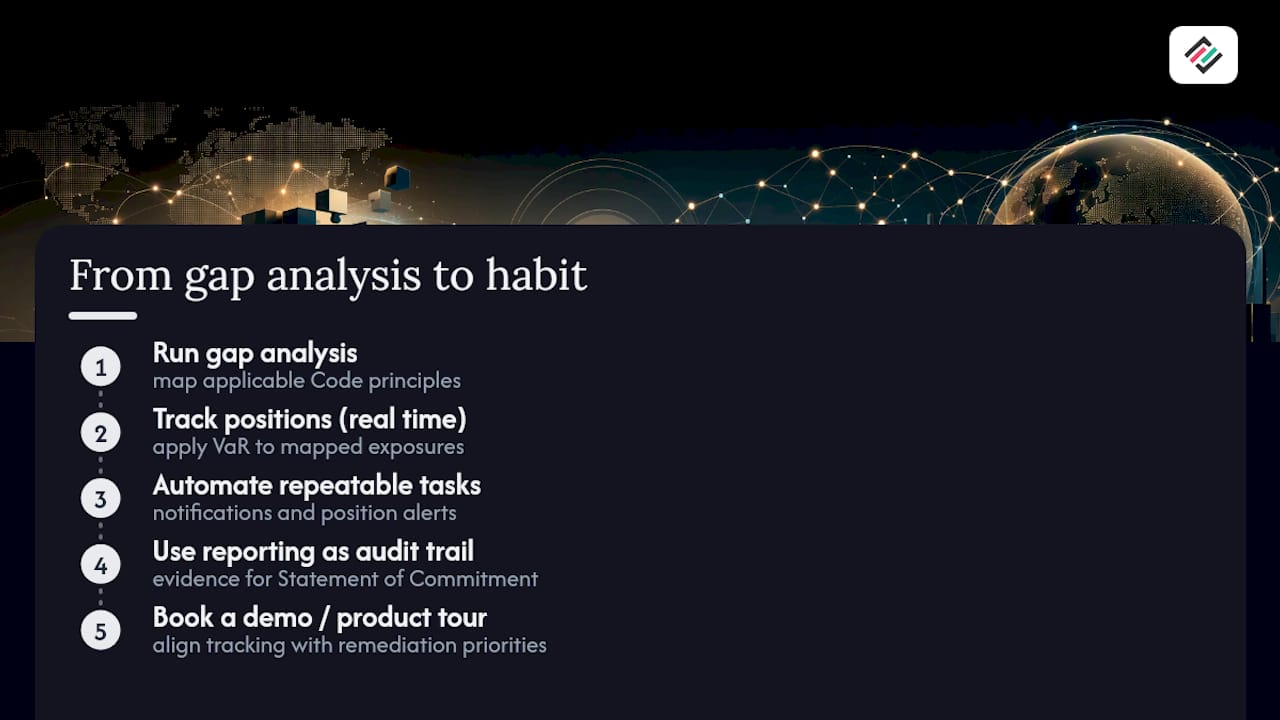
CorpHedge's platform tracks currency positions in real time and applies Value at Risk analysis to the same exposures your gap analysis just mapped, so the governance and risk-management principles from the Code stay operational instead of sitting in a policy document nobody reopens. Reporting output doubles as the audit trail your Statement of Commitment implies you're keeping. Firms preparing for a demo often use the product tour first to see how position tracking and automated notifications line up with their remediation priorities, particularly if resources are thin, similar to the small corporate in the GFXC case study that focused on just 11 principles. For firms weighing technology-enabled compliance more broadly, Neota Logic's risk automation work shows a comparable pattern: automation handles the repeatable parts so staff can focus on judgment calls. Book a CorpHedge demo to see how the platform fits your remediation timeline.
This article is general information, not a substitute for advice from a qualified financial advisor. Consult a qualified financial professional about your own circumstances before acting on anything here.
Sources
Start with the FX Global Code itself, then the Roadmap to Adherence for sequencing, and Adopting the Code for templates and training materials.
FAQ
What Is the FX Global Code?
It's a set of 55 global principles of good practice for the wholesale foreign exchange market, developed by central banks and market participants and most recently updated in December 2024.
How Many Leading Principles Are There in the FX Global Code?
The Code organizes its 55 individual principles into six leading principle groups: ethics, governance, execution, information sharing, risk management and compliance, and confirmation and settlement.

Does the FX Global Code Legally Apply to Corporates?
No. Adherence is voluntary, but a growing number of banks and platforms expect corporate counterparties to align with it, which makes adoption a practical, not legal, priority.
What's the First Step for a Corporate Adopting the Code?
Run the GFXC proportionality self-assessment or appoint a project lead to determine which principles apply to your specific trading activity before starting a gap analysis.
How Long Does Adoption Typically Take?
A GFXC case study on a small corporate found core adoption work completed in roughly two months, by prioritizing the principles that actually required remediation rather than all 55 at once.