

A sound FX deal confirmation workflow gets every trade from execution to an agreed, matched record on the same day, with someone independent of the dealer checking it. The deal is binding once the terms are agreed, but the written confirmation is what proves those terms, catches booking errors early and protects your settlement. For a corporate treasury team the practical goal is simple: capture the trade, enrich it with settlement instructions, confirm it within hours, match it against the bank's record, and escalate anything that does not match. We built this guide around that sequence and, at each step, show where it tends to go wrong and what visibility a platform such as Corphedge adds.
TL;DR
- Confirm every FX trade within two hours of execution and in any case by the end of the trade date, as the Bank of England's NIPS Code sets out for the UK wholesale market.
- A confirmation should record both parties, trade and settlement dates, currencies and amounts, the rate and settlement instructions.
- Matching means comparing your record with the counterparty's. Any difference is investigated and fixed immediately, and the cycle restarts until both sides agree.
- Keep confirmation independent of whoever dealt the trade, and escalate unconfirmed trades to senior treasury management.
- The 2026 FX Definitions go live on 22 November 2027, so templates and messaging will change for new trades.
Table of Contents
- What an FX deal confirmation is and what it must record
- The workflow, step by step
- Timing rules at a glance
- Controls that keep confirmations honest
- Reconciling confirmations with exposure data
- What is changing: the 2026 FX Definitions
- Perspective
- How Corphedge supports the workflow
- FAQ
- Sources
What an FX deal confirmation is and what it must record
A confirmation is the document or message in which both counterparties set out the terms of a trade. The Foreign Exchange Committee (a US central bank sponsored body) notes in its 2013 best practice review that a trade is legally binding from the moment terms are agreed, yet the written confirmation remains essential because it documents what the parties are bound to.
The Bank of England's Non-Investment Products Code (November 2011), usually called the NIPS Code, lists what a confirmation should include:
- the identity of both parties, including office locations;
- the FX deal number or reference;
- the operation type: new, amend, cancel or duplicate;
- the trade date;
- the settlement date, which for an FX swap means the maturity date;
- the currency and amount bought and sold;
- the exchange rate;
- both parties' standard settlement instructions (SSIs) for the currencies dealt.
SSIs are the bank accounts and agents each side uses to pay and receive a given currency. The Foreign Exchange Committee's 2016 recommendations for non-dealer participants add the legal entities and their roles, the branch or office acting and any term required by statute or regulation.
For deliverable forwards documented under ISDA templates, the annotated confirmation templates for the 2026 FX Definitions show the standard fields: transaction type, trade date, amounts and currency payable by each party, forward rate, settlement date, settlement and rounding, plus optional provisions for disruption events, early termination and averaging.
A practical point for corporates: the legal entity is the field that most often differs from what the treasurer has in mind. A group with several subsidiaries should state which entity is the party to each trade, because a confirmation naming the wrong one is a mismatch even when every number is right.
The workflow, step by step
The sequence below follows the flow the Foreign Exchange Committee describes and the timing rules of the NIPS Code, translated into what a corporate finance team does.
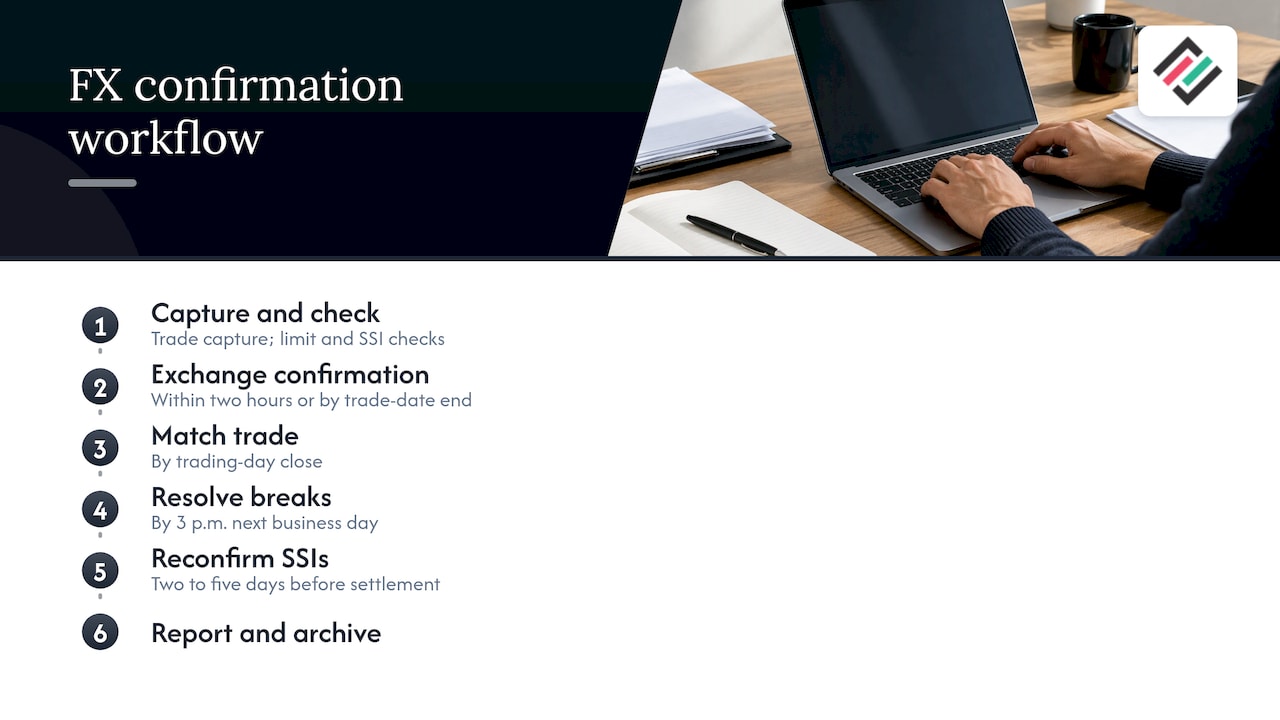
1. Capture the trade at execution
The dealer or treasurer books the trade immediately in your treasury system or exposure record: counterparty, legal entity, currency pair, amounts, rate, trade and value dates. Late or incorrect allocations and bookings made after currency cut-offs are among the causes of FX payment errors listed in the GFMA's September 2025 paper.
Where it goes wrong: trades agreed by phone or chat and keyed in hours later, or exposures held in a spreadsheet that nobody else sees. A live record of positions makes the booking visible to finance the moment it exists. Corphedge's platform tracks currency positions and offers live market data and portfolio reporting, so the executed trade sits next to the exposure it was meant to cover.
2. Check limits and enrich with settlement instructions
In larger institutions the trade data flows to credit systems for pre-settlement limits, then to operations, who make sure SSIs are on file. Deals with SSIs on file move straight to confirmation. For a corporate, the equivalent is checking the trade against your hedging policy and counterparty limits, and attaching the correct bank details for each currency.
Where it goes wrong: stale SSIs. Under the NIPS Code, changes to SSIs should be notified 10 working days to one month before they take effect, through a secure, authenticatable message with positive acknowledgement. An emailed change of account details with no acknowledgement is exactly the gap that payment errors and fraud exploit.
3. Issue or receive the confirmation promptly
The NIPS Code expects procedures for prompt exchange and processing of confirmations within two hours of the deal being struck, and by the end of the trade date at the latest. The ACI Model Code (March 2012) says the same: both parties send or affirm within two hours of booking. Passing details in batches is not recommended.
Where it goes wrong: waiting for the bank's confirmation to arrive and never noticing when it does not. Set a rule that every trade without a received confirmation is visible on a list by the end of the day. Automated notifications are one way to make that happen, and our guide to setting FX alerts that trigger real treasury action shows how to tie them to a defined response.
4. Match against your own record
Matching is the comparison of the confirmation received with your internal booking, field by field. The ACI Model Code says matching should happen as soon as possible and no later than the close of the trading day, as a pre-settlement activity. The FX Global Code strongly recommends automated matching using standardized message types.
Where it goes wrong: matching a confirmation against the dealer's note rather than the booked record, which confirms nothing about booking accuracy. The Foreign Exchange Committee's guidance on electronic validations warns that affirmation on an electronic front-end validates trade details but may not confirm the trade was booked correctly in each firm's own records.
5. Resolve breaks
When details differ, FX Global Code Principle 48 (December 2024) says to investigate internally and inform the counterparty so the issue is resolved as soon as practicable. Reconcile all alleged trades and notify senders of confirmations for trades you do not recognize. Under the NIPS Code, discrepancies should be advised no later than 3.00 p.m. on the business day following the trade date.
The ACI Model Code adds the mechanics: the party whose original confirmation was wrong issues a new one, the cycle restarts until fully matched, and any discrepancy creating risk should be closed out in the market pending final resolution. Amendments to financial details go through a cancellation plus a new confirmation, or an amend message, with the cancellation advice sent within two hours.
6. Reconfirm instructions before settlement
For forwards, the NIPS Code treats it as good practice to reconfirm settlement instructions between two and five days before the settlement date. The Foreign Exchange Committee's non-dealer recommendations say two days before value. Settlement instructions then go to the paying banks one day before settlement or on the day, depending on the currency.
7. Report and archive
Keep the confirmation, the match result and any amendment history with the trade. Auditors and regulators ask for the trail, and so does your own board. Our article on FX trade audit trails and MiFIR fields covers what to capture.
Timing rules at a glance
| Step | Benchmark | Source |
|---|---|---|
| Confirmation exchanged | Within 2 hours of the deal, by end of trade date at the latest | Bank of England NIPS Code (2011); ACI Model Code (2012) |
| Matching complete | As soon as possible, no later than close of the trading day | ACI Model Code (2012) |
| Discrepancy advised | By 3.00 p.m. on the next business day after trade date | NIPS Code |
| Cancellation advice | Within 2 hours | NIPS Code; ACI Model Code |
| Forward SSI reconfirmation | 2 to 5 days before settlement | NIPS Code |
| SSI change notice | 10 working days to 1 month before implementation | NIPS Code |
| Payment recall and kickback | No longer than 5 business days | GFMA, September 2025 |
These are market codes of good practice, not statute for corporates, but banks you deal with operate to them, so your process works best when it runs to the same clock.
Controls that keep confirmations honest
The NIPS Code calls a robust, independent confirmation process an important defense against loss: it identifies errors early in the trade cycle and helps limit rogue-trader risk and late-payment penalties. Four controls carry most of the weight.
Independence. Confirmation should be a back-office function separate from deal execution. The ACI Model Code goes further: front office should not be able to modify confirmations. Smaller finance teams cannot always staff a separate back office, which makes defined roles and approval rules essential. Our guide to fixing FX segregation of duties in 30 to 90 days sets out a realistic path.
Secure channels. The NIPS Code discourages non-authenticated email, fax or post and points to SWIFT or automated confirmation matching. The GFMA recommends authenticated methods such as SWIFT and ISO 20022 messaging.
Straight-through data. FX Global Code Principle 44 encourages automatic transmission from front office to operations systems over secure interfaces where data cannot be changed or deleted in transit. Where that is not possible, adequate controls must stand in.
Exception escalation. Unconfirmed trades on trade date should go to operations and front-office management, with documented steps, named people and protective actions. The FX Global Code asks that senior management receive regular figures on the number and age of unconfirmed deals. A weekly count of open confirmations, with the oldest age, is enough to start.
The GFMA's September 2025 paper lists what usually causes payment errors downstream: booking errors, incorrect settlement instructions, netting changes, rescinds from payment-versus-payment systems such as CLS, formatting errors and funds sent to the wrong entity within the same group. Every one of these is cheaper to catch at confirmation than at settlement.
Reconciling confirmations with exposure data
Confirmation tells you the trade is agreed. It does not tell you whether the hedge covers the exposure it was meant for. Once trades are matched, finance teams reconcile them against forecast exposures and the bank's statements. Our guide to FX risk data reconciliation for UK finance teams covers that second loop, and the international payment hedging workflow shows where confirmation sits in a payment cycle.
What is changing: the 2026 FX Definitions
UK treasury teams documenting FX derivatives under ISDA terms should know the templates are being replaced. The Bank of England's FXJSC Legal Sub-Committee minutes of 16 June 2026 record that the 2026 FX Definitions create a single digital, versioned framework with matrix-based templates for non-deliverable transactions. They are intended to simplify operations and reduce reliance on master confirmations for vanilla trades.
The ISDA and EMTA FAQ of 16 October 2026 gives 22 November 2027 as the go-live date. From then the 2026 definitions become the market standard for all cleared and new non-cleared FX derivatives, and SWIFT will stop supporting the 1998 definitions. The same FAQ says firms need not amend or re-sign ISDA master agreements where definitions are incorporated at confirmation level, and existing transactions are expected to keep referencing the 1998 definitions until they roll off.
In practice: ask your banks which confirmation formats they will use for new trades after go-live, update your matching rules for the new template fields, and keep both versions in your process while older forwards run off.
Perspective
Most confirmation failures we see discussed in treasury teams are not exotic. They are a trade booked late, a legal entity named wrongly, or a confirmation nobody noticed had not arrived. The codes agree on the cure: speed, independence and a clear escalation path.
Our view is that a finance team should see its currency positions, its hedges and its open items in one place. That is why Corphedge combines position tracking, live market data, Value at Risk analysis, portfolio reporting and automated notifications with operational expert advice. When a trade is confirmed and matched, you can see at once how it changes your exposure, and when something is outstanding, the right person is told.
Our platform is built for internationally active companies that want enterprise-grade analytics without enterprise-scale cost. A disciplined confirmation workflow is the first thing that makes that analysis trustworthy, because every number downstream starts from a matched trade.
Bartas
How Corphedge supports the workflow
Corphedge is an online platform for corporate FX risk management. It gives finance teams live currency position tracking, hedging strategy simulation, Value at Risk analysis, portfolio reporting, compliance integrations and automated notifications, and it integrates with Corpay. Our operational expert advice helps teams shape processes like the one above around how they actually trade. You can see the Corphedge platform in use, or read about operational expert advice and Risk Safari Tours. We are expanding to Poland and Sweden, so groups with subsidiaries there can work from the same view.

For teams that want to train analysts on the fundamentals, our FX hedging course is a one-off purchase at 220 EUR. For a wider process, the executive FX checklist lays out a four-week workflow, and our note on the FX Global Code for corporates explains what to do first.
FAQ
How quickly should an FX trade be confirmed?
The NIPS Code sets two hours from the deal being struck, and by the end of the trade date at the latest. The ACI Model Code uses the same benchmark, measured from booking. Corporates should treat end of day as the hard limit and chase anything outstanding before then.
What does confirmation matching mean in FX?
Matching compares the confirmation you receive with your own booked record of the trade, field by field: parties, dates, currencies, amounts, rate and settlement instructions. A full match means both sides agree the terms. Any difference is a break to be investigated and corrected before settlement.
What should we do when a confirmation does not match?
Investigate your own record first, then tell the counterparty straight away. The party whose confirmation was wrong issues a corrected one and the cycle restarts until both agree. Under the NIPS Code, discrepancies should be advised by 3.00 p.m. on the next business day, and disputed trades escalated to senior treasury management.
Do we still need confirmations if the trading platform validates the deal?
Yes. The Foreign Exchange Committee's guidance says platform affirmation checks trade details but may not confirm that each firm booked the trade correctly. Confirmation also keeps checking independent of the dealer and supports the accuracy of settlement instructions.
Does the 2026 FX Definitions change affect us now?
Not for trades already documented, which are expected to keep referencing the 1998 definitions until they roll off. For new trades, the go-live date is 22 November 2027, so talk to your banks now about template and messaging changes.
Sources
- Bank of England, Non-Investment Products Code (NIPS Code), November 2011
- Foreign Exchange Committee, 2013 Best Practice Review
- Foreign Exchange Committee, Foreign Exchange Transactions recommendations for non-dealer participants, 2016
- Foreign Exchange Committee, Supplementary Guidance on Electronic Validations
- FX Global Code, December 2024
- ACI FX Best Practices Operations Model Code, March 2012
- GFMA, Reduce FX payment errors and associated risks, September 2025
- ISDA, 2026 FX Definitions annotated confirmation templates
- Bank of England, FXJSC Legal Sub-Committee minutes, 16 June 2026
- ISDA and EMTA, 2026 FX Definitions FAQ, 16 October 2026