

A clean foreign currency audit comes down to eight verifiable actions: identify all FX-exposed entities and accounts, verify the rate source for every material transaction, revalue monetary items at the closing rate, confirm non-monetary items at historical or fair-value rates per IAS 21, reconcile every foreign-currency bank account to the general ledger in original currency, validate hedge designation and effectiveness evidence, confirm consolidation translation methods and intercompany eliminations, and verify disclosure of realized versus unrealized FX gains and losses separately.
A pass looks like this: all material FX exposures traced to source documents, every rate documented to an independent market source (ECB or the relevant national central bank), and hedge designation evidence linked directly to the underlying exposure.
Immediate audit checklist:
- Identify all entities, accounts, and contracts with foreign-currency exposure
- Confirm functional currency determination for each entity in scope
- Verify rate source for each transaction (ECB, national central bank, or approved bank feed)
- Revalue all monetary items at the balance-sheet closing rate
- Confirm non-monetary items use historical rate (or fair value where applicable)
- Reconcile all foreign-currency bank accounts to GL subledgers in original currency
- Obtain hedge designation documents, hedge IDs, and effectiveness test results
- Test consolidation translation method and intercompany FX eliminations
- Confirm disclosures: realized vs. unrealized FX gains/losses, policy statement, rate source
Key Takeaways
A foreign currency audit passes when every material FX exposure is traced to source documents, every rate is documented to an independent market source, and hedge designation evidence is linked directly to the underlying exposure.
| Point | Details |
|---|---|
| Revalue monetary items at closing rate | IAS 21 requires closing-rate revaluation; verify realized and unrealized FX gains/losses are disclosed separately. |
| Use one official rate source | ECB or the relevant national central bank; mixed sources are the top trigger for audit adjustments. |
| Hedge IDs are non-negotiable | Assign a unique ID to every derivative at inception and map it to the underlying exposure before year-end. |
| Reconcile in original currency | Bank reconciliations must be prepared in the account's original currency, not converted to functional currency. |
| Corphedge centralizes audit evidence | The platform provides timestamped rate snapshots, hedge ID mapping, and exportable position reports for audit fieldwork. |
Table of Contents
- 1. How to set scope, materiality, and responsibilities for a foreign currency audit
- 2. The full area-by-area audit procedures and tests
- 3. How to choose samples and what evidence to collect
- 4. Common pitfalls and red flags to act on immediately
- 5. Key accounting standards and authoritative sources for Central Europe
- 6. A ready-to-use audit work program template for Central Europe
- What practitioners actually get wrong about FX audit readiness
- Corphedge cuts the evidence-collection burden for FX audits
- Sources
- FAQ
1. How to set scope, materiality, and responsibilities for a foreign currency audit
Before any testing begins, you need a clear picture of what is in scope and who owns each piece of evidence. Skipping this step is the single fastest way to miss a material exposure.
Identifying FX-exposed entities and accounts
Start by mapping every entity in the group that transacts in a currency other than its functional currency. The scope typically covers:
- Foreign-currency sales and purchase contracts
- Cash and bank accounts denominated in non-functional currencies
- Foreign-currency loans and borrowings (intercompany and third-party)
- Trade receivables and payables in foreign currencies
- Derivative contracts (forwards, options, swaps)
- Intercompany balances where the two parties have different functional currencies
For Central European subsidiaries operating in PLN, CZK, HUF, or SEK alongside EUR or USD exposures, national supplements clarify which official rates apply for initial recognition and balance-sheet valuation, and where exceptions exist for specific item categories.
Setting materiality for FX misstatement risk
FX materiality can be set as an absolute threshold (e.g., a fixed currency amount per entity) or as a relative measure (a percentage of total assets, revenue, or net monetary position). For groups with high FX volatility, a relative approach tied to the net open position often catches more risk. Document the basis and apply it consistently across entities.
Roles and evidence responsibilities
| Role | Responsibility | Evidence to produce |
|---|---|---|
| Treasury | Rate source logs, hedge contracts, derivative valuations | Rate screenshots, ISDA/hedge agreements, valuation reports |
| Local accounting | Transaction postings, revaluation journals, bank reconciliations | GL extracts, revaluation workpapers, bank statements in original currency |
| Central finance | Consolidation workpapers, intercompany eliminations, translation schedules | Group translation workpapers, elimination entries, subsidiary trial balances |
| External auditor | Independent rate verification, sampling, hedge effectiveness review | Workpapers, rate confirmations, hedge testing documentation |
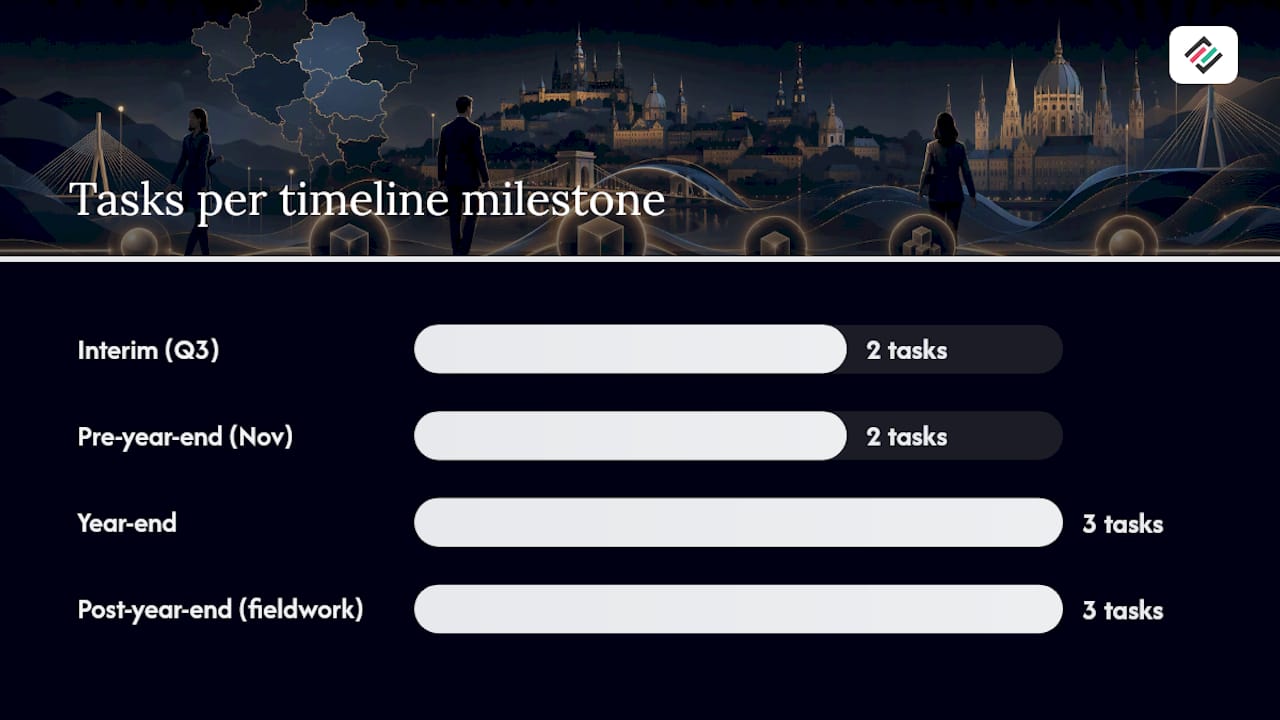
Timeline milestones
- Interim (Q3): extract bank statements in original currency; confirm rate source policy is in place
- Pre-year-end (November): obtain draft hedge documentation and effectiveness test schedules
- Year-end: collect closing-rate evidence (ECB or national central bank screenshot dated balance-sheet date), final bank reconciliations, and subsidiary translation workpapers
- Post-year-end (fieldwork): complete sample testing, confirm disclosures, sign off on consolidation eliminations
2. The full area-by-area audit procedures and tests
This is the core of any foreign exchange audit list. Work through each area in sequence; each one has a distinct evidence set and a distinct failure mode.
Monetary items: revaluation testing
IAS 21 requires monetary items to be revalued at the closing rate, with realized and unrealized FX gains and losses computed and disclosed separately. For each sampled monetary item, capture:
- Transaction date and original currency amount
- Rate used at initial recognition (transaction-date rate)
- Closing rate applied at balance-sheet date
- Independent rate source (ECB or national central bank)
- Resulting FX gain or loss posted to P&L
Sample revaluation recalculation (EUR receivable, PLN functional currency):
A receivable is recognized at a recorded exchange rate carrying a corresponding GL balance. At year-end, revaluation is done using the ECB closing rate, resulting in an unrealized FX gain or loss. Verify journal entries to reflect this gain or loss accurately. Workpaper fields: entity, account code, transaction date, original EUR amount, transaction rate, closing rate, rate source URL, GL balance before revaluation, revalued balance, FX gain/loss amount.

Non-monetary items: rate verification
Non-monetary items (property, plant and equipment, inventory, prepayments) stay at the historical rate used on the date of the transaction, unless measured at fair value, in which case the rate at the fair-value measurement date applies. Practical accounting guidance details how to classify items and determine the correct rate. Confirm the entity has not inadvertently revalued non-monetary items at the closing rate, which is a common error.
Bank account reconciliations
A year-end checklist must include bank reconciliations for all foreign-currency accounts, documentation of the exchange rate per transaction, proof of internal authorization, and indexed records linking material transactions to balance-sheet items. For each foreign-currency account:
- Obtain bank statement in original currency (not converted)
- Agree closing balance to GL subledger in original currency
- Test a sample of cash receipts and payments: verify FX conversion postings match the rate documented at transaction date
- Confirm any outstanding items are properly explained and aged
Automating this step with a multi-currency reconciliation tool reduces the manual effort of matching original-currency balances across multiple subsidiaries.
Hedge accounting
Lack of a clear mapping between a hedge derivative and its underlying exposure is one of the most common audit findings. Auditors treat the documentation trail as the primary defense. For each hedging relationship, verify:
- Hedge designation document exists and was prepared before or at hedge inception
- Unique hedge ID assigned and traceable in the risk management system
- Underlying exposure mapped to the hedge instrument
- Valuation report for the derivative at balance-sheet date
- Effectiveness test results (prospective and retrospective) documented and within acceptable bounds
- Hedge accounting entries correctly reflect the chosen method (fair value or cash flow hedge)
Consolidation and translation
For groups with Central European subsidiaries, the most complex area is validating intercompany FX transactions. Auditors expect a consolidated audit trail showing consistent netting policies and verified internal exchange rates between subsidiaries. Test:
- Correct translation method applied (closing rate for balance sheet, average rate for P&L, or historical rate where required)
- Translation differences taken to other comprehensive income (OCI), not P&L
- Intercompany FX balances fully eliminated on consolidation
- Subsidiary trial balances translated at rates consistent with group policy
Disclosures
Confirm the financial statements separately disclose realized and unrealized FX gains and losses, state the accounting policy for FX translation, and identify the rate source if required by local regulation. Central European practice notes stress documenting the rate chosen and saving external rate publications as audit evidence.
Pro Tip: Require the client to use a single official market reference rate throughout the year. Mixing rate sources is the top trigger for audit adjustments and reconciling differences. One source, one policy, documented in treasury procedures.
3. How to choose samples and what evidence to collect
Risk-based sampling works best for FX items. Stratify the population by transaction size and by period: high-volatility months (when the functional currency moved sharply against major trading currencies) carry more misstatement risk and deserve a larger sample. Target intercompany transactions and any period where the rate source changed.
Workpaper fields every FX test must capture:
- Entity name and functional currency
- Account code and description
- Transaction date
- Original currency and amount
- GL posting amount in functional currency
- Rate used (numeric value)
- Rate source (URL or screenshot reference, dated)
- Supporting invoice or contract reference
- Bank confirmation reference (for cash items)
- Hedge ID (for hedged items)
- Auditor's recalculated amount and variance
| Evidence type | Who obtains it | Retention location |
|---|---|---|
| ECB / national central bank rate screenshot | Auditor (independent pull) | Audit file, dated PDF |
| Bank statement in original currency | Local accounting / treasury | Audit file, indexed by account |
| Bank confirmation letter | Auditor (direct request) | Audit file, signed original |
| Hedge designation document | Treasury | Audit file, linked to hedge ID |
| Derivative valuation report | Treasury / counterparty bank | Audit file, dated at balance-sheet date |
| Revaluation journal with rate detail | Local accounting | Audit file, GL extract |
| Consolidation translation workpaper | Central finance | Group audit file |
Save rate screenshots as immutable PDFs with the URL and timestamp visible. A screenshot that can be edited or that lacks a visible date is not sufficient audit evidence.
4. Common pitfalls and red flags to act on immediately
Most material FX misstatements trace back to a small set of recurring errors. Knowing them in advance lets you direct testing where it matters.
Common pitfalls:
- Using mixed rate sources across subsidiaries (some using ECB, others using bank feeds, others using internal treasury rates without documentation)
- Missing or incomplete hedge designation documents, especially for hedges entered mid-year
- Bank reconciliations prepared in functional currency only, masking original-currency differences
- Intercompany FX balances not fully eliminated, leaving residual translation differences in consolidated equity
- Non-monetary items inadvertently revalued at the closing rate
Red flags that indicate deeper problems:
- Unexpectedly large unrealized FX gains at year-end with no corresponding open position in the treasury system
- Missing hedge IDs or hedges with no traceable link to an underlying exposure
- Inconsistent functional currency designations across entities in the same group
- Rate used in the books differs from the ECB or national central bank rate by more than a rounding margin, with no documented explanation
- Revaluation journals posted without a rate source reference
Immediate action checks when a red flag appears:
- Request the rate source log for the full year (which source, which date, who approved)
- Obtain bank confirmations directly from the bank for all foreign-currency accounts
- Pull all hedge contracts with their designation dates and map them to open exposures
- Request the consolidation workpaper showing intercompany elimination entries
If suspicious FX activity is detected during the audit, auditor guidance outlines obligations under AML frameworks, including risk assessment procedures and statutory notification rules where relevant.
5. Key accounting standards and authoritative sources for Central Europe
Every checklist item needs a standard or regulator source behind it. The table below maps the main audit areas to their primary references.
| Checklist area | Authoritative reference |
|---|---|
| Revaluation of monetary items at closing rate | IAS 21 |
| Non-monetary items at historical rate | IAS 21 |
| Realized vs. unrealized FX gains/losses disclosure | IAS 21 |
| Transaction date and rate selection (Poland) | Polish Accounting Act supplement |
| Exchange rate source for balance-sheet valuation | ECB published rates; NBP (Poland), CNB (Czech Republic), MNB (Hungary), NBU (Ukraine), Riksbank (Sweden) |
| Hedge accounting designation and effectiveness | IFRS 9 |
| Consolidation translation differences | IAS 21 |
| AML obligations for auditors | National AML legislation; KACR guidance |
Accepted exchange-rate sources for Central Europe:
- European Central Bank (ECB): publishes daily reference rates for EUR pairs; the standard reference for EUR-functional entities
- Narodowy Bank Polski (NBP): official PLN rates for Polish entities
- Česká národní banka (CNB): official CZK rates for Czech entities
- Magyar Nemzeti Bank (MNB): official HUF rates for Hungarian entities
- Sveriges Riksbank: official SEK rates for Swedish entities (relevant as Corphedge expands into the Swedish market)
When citing a rate in a workpaper, record the source URL, the publication date, and the specific currency pair. A rate pulled from a commercial bank feed is acceptable only if the treasury policy explicitly permits it and the rate is reconciled to the central bank reference.
6. A ready-to-use audit work program template for Central Europe
The template below is structured as a work program auditors can paste into their audit software (CaseWare, TeamMate, or a comparable platform) or adapt as an Excel/Word file. It covers five sections: planning, tests of details, hedge testing, consolidation translation checks, and evidence log.
Sample workpaper rows:
| Step | Procedure | Expected source document | Assertion tested |
|---|---|---|---|
| — | Confirm functional currency for each entity in scope | Board resolution or accounting policy document | Completeness, accuracy |
| — | Select sample of monetary items; recalculate revaluation at closing rate; agree to ECB/central bank rate | GL extract, ECB rate screenshot, revaluation journal | Valuation, accuracy |
| — | Confirm non-monetary items use historical rate; verify no closing-rate revaluation applied | Fixed asset register, purchase invoice, GL posting | Valuation |
| — | Obtain bank statement in original currency; agree to GL subledger; test sample FX conversion postings | Bank statement, GL subledger, bank confirmation | Completeness, accuracy |
| — | Obtain hedge designation document; verify hedge ID; map to underlying exposure; review effectiveness test | Hedge designation memo, derivative contract, valuation report | Existence, valuation |
| — | Test consolidation translation: closing rate for balance sheet, average rate for P&L; verify OCI treatment of translation differences | Group consolidation workpaper, subsidiary trial balance | Accuracy, presentation |
Localization notes:
- For Polish subsidiaries: apply NBP mid-rate for PLN transactions; check the Polish Accounting Act supplement for exceptions on specific item types
- For Swedish entities (SEK): use Riksbank published rates; note that Corphedge is expanding into Sweden, so Swedish-subsidiary audit procedures should be built into the group template from the current cycle
- For Czech and Hungarian subsidiaries: CNB and MNB rates respectively; confirm whether local GAAP or IFRS applies at the subsidiary level
The template is available as an .xlsx or .docx file. Audit-readiness resources can supplement the template with exception-reduction playbooks that speed the evidence-collection phase.
What practitioners actually get wrong about FX audit readiness
The conventional wisdom is that FX audits are primarily a technical accounting problem: get the rates right, apply IAS 21, and you are done. That framing misses where most audit friction actually originates.
The real problem is operational. Finance teams often know the standard well enough. What they lack is a consistent, retrievable evidence trail. Rate screenshots get saved in personal email folders. Hedge designation documents are drafted after the fact. Bank reconciliations are prepared in functional currency because that is what the ERP exports by default, and nobody questions it until the auditor asks for the original-currency version.
The result is not a misstatement, necessarily. It is a week of back-and-forth between the audit team and treasury, reconstructing evidence that should have been captured at the time of the transaction. That friction is expensive, and it is entirely avoidable.
Three process changes make a measurable difference. First, assign a unique hedge ID to every derivative at inception and record it in both the treasury system and the accounting system. The documentation trail is the primary defense in hedge accounting; without a traceable ID, auditors cannot confirm the link between instrument and exposure. Second, set a single official rate source in the treasury policy and require all subsidiaries to use it. Inconsistent rate sources are the top trigger for audit adjustments. Third, configure your ERP or reconciliation tool to export bank statements in original currency as a standard output, not a special request.
None of these changes require new software. They require a decision and a documented policy. The audit team will notice the difference immediately.
Corphedge cuts the evidence-collection burden for FX audits
The hardest part of a foreign currency audit is not the testing. It is assembling the evidence: rate screenshots, hedge IDs, position histories, and exportable reconciliation reports, all indexed and retrievable on demand.

Corphedge centralizes exactly that. The platform maintains live rate feeds with timestamped snapshots, assigns hedge IDs and maps them to underlying exposures, and generates exportable audit reports covering position histories, VaR-based hedging documentation, and revaluation schedules. Every item on the checklist above has a corresponding evidence output the platform can produce. Finance teams in Poland and Sweden can use Corphedge to deliver a clean, indexed evidence package to auditors at the start of fieldwork rather than spending the first week reconstructing it.
Auditors still need to perform independent testing and verify rates against ECB or national central bank sources. Corphedge does not replace that. What it removes is the operational friction that turns a two-day evidence review into a two-week delay. Book a demo tour to see how the platform maps to your audit checklist.
Sources
Auditors and finance teams working on a foreign exchange audit list for Central Europe should keep these primary references on hand:
This article is general information, not a substitute for advice from a qualified financial advisor. Consult a qualified financial professional about your own circumstances before acting on anything here.
FAQ
What should an audit checklist for foreign currency include?
A foreign currency audit checklist must cover functional currency confirmation, monetary item revaluation at the closing rate, non-monetary item rate verification, bank reconciliations in original currency, hedge designation and effectiveness evidence, consolidation translation testing, and disclosure of realized versus unrealized FX gains and losses.
What are the seven standard audit procedures?
The seven core audit procedures are inspection, observation, inquiry, confirmation, recalculation, reperformance, and analytical procedures. For FX audits, recalculation (revaluing monetary items at the closing rate) and confirmation (bank confirmations in original currency) carry the most weight.
What should you not say during an audit?
Avoid volunteering information beyond what is asked, making estimates without documented support, or describing rate sources as "standard practice" without being able to produce the actual source. Every claim about a rate, a hedge, or a reconciliation needs a document behind it.
How does IAS 21 affect the foreign exchange audit process?
IAS 21 requires monetary items to be revalued at the closing rate and non-monetary items to remain at historical rates, with realized and unrealized FX gains and losses disclosed separately. Auditors verify that each of these treatments is applied consistently and that the rate source is traceable to an independent market reference such as the ECB or a national central bank.
Can a platform like Corphedge replace independent audit testing?
No. Corphedge centralizes rate feeds, hedge IDs, and exportable position reports to reduce evidence-collection friction, but auditors must still independently verify rates against ECB or national central bank sources and perform their own substantive testing. The platform supports audit readiness; it does not substitute for the auditor's independent judgment.