

TL;DR:
- Europages.fi is a sourcing tool with over 2.2 million suppliers and no treasury or FX risk management features.
- For Central European supplier discovery, platforms like Kompass and wlw offer strong regional coverage and structured data, while treasury platforms such as Corphedge provide VaR-based FX hedging for currencies like PLN, HUF, and CZK.
If you're searching for Europages.fi alternatives, the answer splits cleanly into two paths. For expanding your vendor network and sourcing suppliers in Central Europe, use a dedicated B2B directory. For managing currency risk on the payments that follow, use a treasury/FX platform. Conflating the two is where finance teams lose time and money.
Quick routing:
- Expanding your vendor network for supply continuity → Kompass, wlw, or Bureau van Dijk/Orbis
- Paying suppliers and controlling FX costs → Corpay or a multi-currency payment provider
- Managing balance-sheet and P&L volatility from PLN, HUF, or CZK moves → Corphedge
Europages lists over 2.2 million suppliers and draws roughly 1 million buyer visits per month. It is a sourcing tool, full stop. It has no hedging engine, no VaR model, and no treasury workflow. Marketplaces = sourcing; treasury platforms = FX risk control.
Table of Contents
- What are the best Europages.fi alternatives for supplier discovery?
- Which FX and treasury platforms work for Central Europe?
- What red flags should you watch for in B2B directories?
- How do PLN, HUF, and CZK exposures change your platform choice?
- Corphedge is the practical next step for FX risk in Poland and Sweden
- FAQ
- Key Takeaways
What are the best Europages.fi alternatives for supplier discovery?
For procurement teams, the choice comes down to data depth, regional coverage, and whether the platform links to company registries or VAT records.
| Platform | Central Europe coverage | Data depth | Primary use case | Pricing model | GDPR compliant |
|---|---|---|---|---|---|
| Kompass | Strong (PL, CZ, HU, SK) | Structured product taxonomy | Supplier sourcing | Subscription | Yes |
| wlw | DACH + neighboring CE | High local visibility | B2B procurement | Subscription / lead-based | Yes |
| Bureau van Dijk / Orbis | Extensive | Financials, ownership, KYC | Due diligence, credit | Enterprise contract | Yes |
| Dun & Bradstreet | Global, CE included | Credit scores, company health | Supplier risk assessment | Enterprise contract | Yes |
| LinkedIn Sales Navigator | Global | Contact accuracy, org charts | Outreach, validation | Subscription | Yes |
| Europages | Strong CE focus | Basic listings, RFQ | Supplier discovery | Subscription / freemium | Yes |
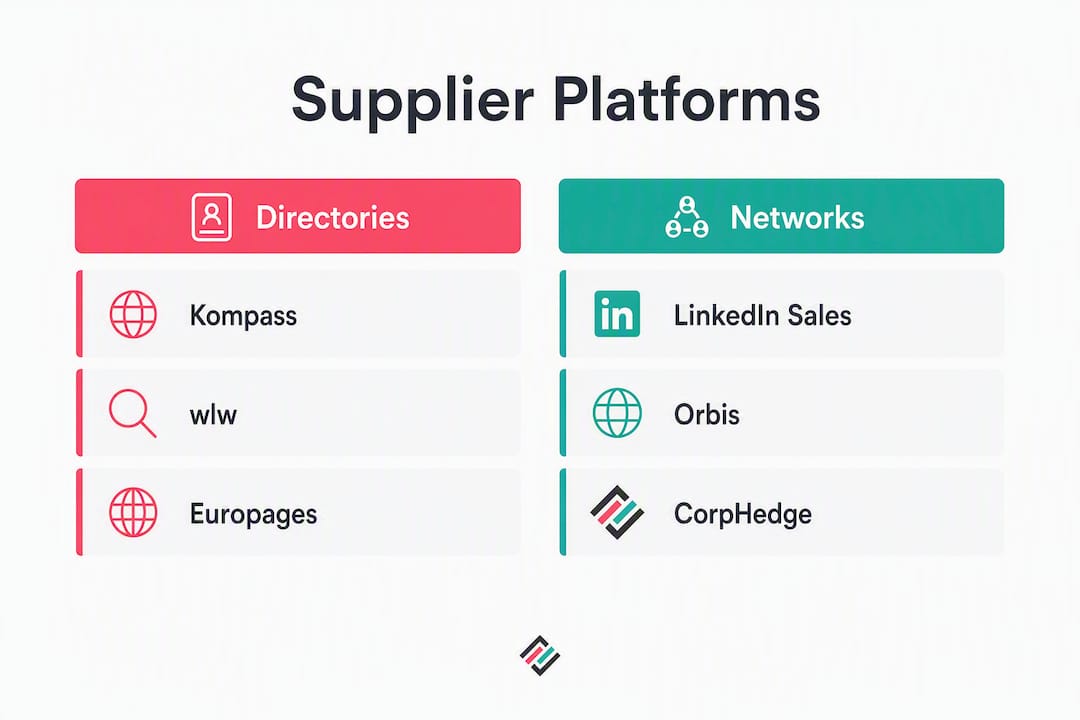
Kompass has been indexing Central European manufacturers since the 1940s. Its structured product taxonomy means a procurement team in Warsaw can filter by ISO certification, production capacity, or HS code, not just keyword. Wer liefert was (wlw) dominates DACH supplier search and has meaningful penetration into Polish and Czech industrial segments, making it a practical complement when your supply chain crosses the German border.
Bureau van Dijk / Orbis is a different animal. It is not a sourcing marketplace but a commercial dataset: ownership structures, audited financials, and UBO chains. Finance teams use it for KYC and credit checks on new suppliers before onboarding, not for browsing catalogs. Dun & Bradstreet serves a similar function, adding D-U-N-S-based credit scores and supplier health indicators that integrate into procurement risk workflows.
LinkedIn Sales Navigator belongs in the mix when contact quality matters more than catalog depth. It surfaces verified decision-maker profiles and company org charts, which is useful for validating a supplier's finance or procurement contact before sending an RFQ.
Pro Tip: When evaluating any directory for Central Europe, check whether it links to national company registries (KRS in Poland, OR in Czechia, Cégbíróság in Hungary). A listing without a registry link is self-reported data, and self-reported data goes stale fast.
Value-added features that matter to finance teams specifically:
- Supplier financial summaries and credit ratings (Orbis, D&B)
- Certification document uploads (ISO 9001, CE marking) on Kompass
- Request-for-quote workflows with audit trails (Europages, Kompass)
- Localized search in Polish, Czech, and Hungarian (wlw, Kompass)
Localized keyword strategy matters here: buyers in Budapest search differently than buyers in Gdańsk, and a directory that only indexes German-language terms will miss half your potential supplier base.
Which FX and treasury platforms work for Central Europe?
For currency risk management, the right tool class is a dedicated treasury or FX platform. Multi-currency accounts and hedging solutions are not features you find in a B2B marketplace.
| Platform | CE currency support | Primary use case | ERP/TMS integration | Pricing model | VaR hedging | GDPR |
|---|---|---|---|---|---|---|
| Corphedge | PLN, HUF, CZK, SEK + major pairs | VaR-based hedging, position tracking | Yes (ERP, accounting APIs) | Subscription SaaS | Yes | Yes |
| Kantox | Major CE pairs | Dynamic hedging, payment automation | Yes | Enterprise contract | Partial | Yes |
| Corpay | 140+ currencies incl. CE | Cross-border payments, FX execution | Yes | Transaction / subscription | No | Yes |
| Kyriba | Major CE pairs | Enterprise TMS, liquidity, risk | Deep ERP (SAP, Oracle) | Enterprise contract | Yes | Yes |

Corphedge is the recommended fit for mid-market corporates operating in Central Europe, particularly teams now expanding into Poland and Sweden. Its VaR-based hedging methodology gives finance directors a statistically grounded exposure limit rather than a gut-feel hedge ratio. Exposure forecasting and automated reporting are table-stakes features for any serious treasury platform; Corphedge adds real-time position tracking and integration with accounting systems on top.
Kantox specializes in dynamic hedging and payment automation, useful for companies with high transaction volume and predictable FX flows. Corpay is primarily a payment execution provider with FX conversion built in, covering 140+ currencies including PLN, HUF, and CZK. It handles the payment rail but does not offer VaR-based portfolio hedging. Kyriba is an enterprise TMS with deep SAP and Oracle integration, better suited to large multinationals than to mid-market teams that need a faster pilot cycle.
The biggest implementation barrier is data consolidation. Before any platform can calculate VaR reliably, you need ERP data, bank statements, and historic trades in one place. Standardizing documentation before go-live also prevents cross-border payment holds caused by mismatched invoice and contract details. Budget four to six weeks for data mapping alone. Machine learning-driven pricing feeds are an emerging differentiator worth asking about when you evaluate execution venues.
Three use-case scenarios:
- Procurement team adding Polish suppliers → start with Kompass or wlw for discovery, then run KYC via Orbis
- Finance team paying CZK invoices monthly → Corpay handles execution; Corphedge manages the hedge
- CFO reporting currency P&L impact to the board → Corphedge's VaR model and portfolio reporting are the right tool
What red flags should you watch for in B2B directories?
Data staleness is the most common problem. A directory that was last verified two years ago will show defunct companies, wrong contacts, and outdated certifications. Check the "last updated" timestamp on individual records, not just the platform's marketing copy.
Pay-per-lead pricing models create a misaligned incentive: the directory profits from sending you contacts regardless of quality. Subscription models with verified badges and registry linkage tend to produce cleaner data. Missing VAT numbers or company registry IDs are a hard red flag, especially for Central European suppliers where KRS, IČO, or Cégbíróság registration is publicly verifiable. Poor contact quality (generic info@ addresses, no named contact) signals that the listing was self-submitted and never validated.
How do PLN, HUF, and CZK exposures change your platform choice?
These three currencies share a common trait: they are liquid but volatile against EUR and USD, and they are not deliverable in all FX venues. A platform that covers only G10 pairs will leave your Polish or Hungarian exposure unhedged.
Corphedge supports PLN, HUF, and CZK natively, which matters for transaction hedging on supplier payments and for balance-sheet translation. Kyriba covers these pairs through its banking connectors but requires enterprise-scale implementation. Kantox handles them for payment automation but is better suited to high-volume, lower-complexity flows. Specialized trading infrastructure improves pricing accuracy on less-liquid pairs like HUF, where bid-ask spreads widen quickly during risk-off periods.
Regulatory context also differs by country. Polish NBP reporting requirements, Czech CNB foreign exchange regulations, and Hungarian MNB rules each impose distinct documentation standards for corporate hedging. A platform with localized compliance support saves your legal team significant work at go-live.
Corphedge is the practical next step for FX risk in Poland and Sweden
The directories above solve supplier discovery. Corphedge solves what comes after: the currency risk that lands on your balance sheet once those supplier contracts are signed.
Corphedge is a VaR-based hedging platform built for mid-market corporates, with active expansion into Poland and Sweden. It tracks multi-currency positions in real time, runs scenario simulations, and connects to your ERP or accounting system without a six-month implementation project. A typical pilot runs four weeks: data sample audit in week one, integration mapping in weeks two and three, and a parallel run against your existing process in week four. Subscription pricing scales with exposure size, not headcount. Request a product demo to see localized support for PLN, HUF, CZK, and SEK in action.
FAQ
What is Europages used for?
Europages is a B2B supplier directory for sourcing and procurement, listing over 2.2 million suppliers. It has no treasury or FX functionality.
Which Europages alternative covers Central European suppliers best?
Kompass and wlw offer the strongest structured coverage for Poland, Czechia, Hungary, and Slovakia, with localized search and product taxonomy.
Can a B2B directory replace an FX hedging platform?
No. Directories handle supplier discovery; treasury platforms like Corphedge handle currency exposure, VaR-based hedging, and payment risk.
Does Corphedge support PLN, HUF, and CZK?
Yes. Corphedge supports these Central European currencies natively, making it suited for finance teams managing cross-border supplier payments and balance-sheet exposure in the region.
How long does a treasury platform pilot typically take?
A focused pilot runs roughly four to six weeks, covering data import, ERP integration mapping, and a parallel run against existing processes.
Key Takeaways
For Central European finance teams, supplier directories and FX treasury platforms solve different problems and must be selected separately, not interchangeably.
| Point | Details |
|---|---|
| Two distinct tool classes | B2B directories handle sourcing; treasury platforms handle currency risk. Never substitute one for the other. |
| Best CE supplier directories | Kompass and wlw lead for procurement; Bureau van Dijk/Orbis and D&B add credit and KYC depth. |
| PLN, HUF, CZK require native support | Choose an FX platform that covers these pairs natively, not just G10 currencies. |
| Pilot timeline is four to six weeks | Data consolidation is the main barrier before VaR calculations become reliable. |
| Corphedge for mid-market FX | Corphedge offers VaR-based hedging with native CE currency support and active expansion into Poland and Sweden. |