

A cross-currency swap is a bilateral over-the-counter contract where two parties exchange principal amounts in different currencies at the start, pay periodic interest on the currency they received, and re-exchange the original principals at maturity at the same agreed rate. That single structure does a lot of work: it locks in an effective exchange rate for the full tenor, converts a foreign-currency liability into a domestic one, and lets a company or bank access funding markets it could not reach cheaply on its own.
Organizations reach for cross-currency swaps in four main situations:
- Long-term FX hedging: aligning a foreign-currency debt obligation to the currency in which revenue is earned, eliminating multi-year translation risk.
- Funding optimization: borrowing in a market where the issuer has a comparative advantage, then swapping the proceeds into the needed currency.
- Liability-to-revenue alignment: matching the currency of interest and principal payments to operating cash flows.
- Central-bank liquidity backstops: swap lines between central banks provide emergency foreign-currency funding to domestic banks during market stress.
Three risks run through every swap structure: counterparty risk (the other party defaults before maturity), basis risk (mismatched interest-rate benchmarks create unexpected cash-flow gaps), and liquidity/exit risk (unwinding an OTC long-dated swap is expensive). The sections below unpack each one.
According to BIS data cited in practitioner guidance, cross-currency swap trading volumes grew from $54 billion per day in 2013 to $108 billion per day in 2019, a signal of how central these instruments have become to global treasury management.
Key Takeaways
A cross-currency swap locks in an effective exchange rate for the full tenor by exchanging principal and interest in two currencies, making it the most direct instrument for long-term FX liability management.
| Point | Details |
|---|---|
| Core structure | Initial principal exchange, periodic interest in received currency, re-exchange at maturity at the agreed rate. |
| When to use swaps | Tenors of two years or more, large notionals, and clear funding or hedging benefit over rolling forwards. |
| Primary risks | Counterparty default, cross-currency basis shifts, and costly early termination on OTC trades. |
| Central Europe context | NBP holds a precautionary ECB swap line; EMIR clearing and UMR margin rules apply to Polish and Swedish entities. |
| Corphedge application | VaR analysis, scenario simulation, and centralized reporting support every step of the swap evaluation and monitoring process. |
Table of Contents
- How currency swaps are structured: the main types
- Step-by-step mechanics with a worked example
- What drives the price and value of a cross-currency swap?
- Who actually uses currency swaps, and why?
- Key risks and what practitioners often underestimate
- How central-bank swap lines work in Central Europe
- Documentation, accounting, and reporting essentials
- When should you use a currency swap versus alternatives?
- How regulatory frameworks in Central Europe affect currency swaps
- Tax implications and reporting in Central European jurisdictions
- What Central European finance teams actually do in practice
- Corphedge helps you evaluate and manage currency-swap exposure
- Sources
- FAQ
How currency swaps are structured: the main types
Not every instrument called a "swap" works the same way. The taxonomy matters because ISDA documentation, pricing, and accounting treatment all depend on which type you are actually using.
Cross-currency swap (CCS): Both principal and interest are exchanged. The two parties swap notionals at inception, pay interest in the currency they received throughout the tenor, and reverse the principal exchange at maturity. This is the instrument most people mean when they say "currency swap." It is the right tool for long-term hedging and funding optimization.
FX swap: A spot transaction paired with a forward transaction in the opposite direction. No interest payments occur between the two legs. FX swaps are short-term instruments, typically overnight to one year, used for liquidity management and rolling short-dated FX positions. They are far more common by volume than cross-currency swaps.
Basis swap: Both legs pay floating interest, but in different currencies or referencing different benchmarks. A EUR/USD basis swap might exchange EURIBOR-based payments for SOFR-based payments. Basis swaps are used to manage mismatches between funding benchmarks across currencies.
Cross-currency interest-rate swap: A hybrid where one leg pays fixed and the other pays floating, across two currencies. Common when a corporate wants to convert a fixed-rate foreign bond into a floating-rate domestic liability.
ISDA terminology is the operational standard. Whether an initial exchange of principal occurs, and whether it is optional or mandatory, determines how the trade is confirmed, margined, and reported under EMIR in Europe.
Step-by-step mechanics with a worked example
Understanding how currency swaps work is clearest with a concrete cash-flow map. The mechanics follow four steps.
-
Set the terms. Both parties agree on notional amounts in each currency, the exchange rate used for the principal swap, interest conventions (fixed or floating, day count, benchmark), payment frequency, and maturity. For a cross-currency swap, the notionals are sized so that, at the agreed rate, they are economically equivalent.
-
Initial exchange of principals. At inception, Party A delivers, say, $100 million to Party B, and Party B delivers £62.5 million to Party A, reflecting an agreed rate of $1.60 per pound. Each party now holds the foreign currency it needs. Economically, this is equivalent to each party taking out a loan in the other's currency.
-
Periodic interest payments. Throughout the life of the swap, Party A pays interest on the £62.5 million it received (in sterling), and Party B pays interest on the $100 million it received (in dollars). Payments are typically semi-annual. The interest rates are fixed at inception or tied to a floating benchmark. Neither party is exposed to exchange-rate moves on these cash flows because each pays in the currency it received.
-
Final re-exchange at maturity. At the end of the tenor, the original principals are returned: Party A gives back £62.5 million, Party B gives back $100 million, at the same $1.60 rate agreed at the start. The exchange-rate risk on principal is fully eliminated.
This structure is exactly what HMRC's corporate finance manual illustrates: a UK parent lends $100 million to its US subsidiary, enters a five-year cross-currency swap to exchange $100 million for £62.5 million at $1.60, swaps semi-annual interest payments, and re-exchanges at maturity, producing the same economic result as a sterling domestic loan.
Operationally: most cross-currency swaps are executed OTC, intermediated by a bank dealer. Settlement follows standard ISDA confirmation terms. If the swap is subject to EMIR clearing obligations (which applies to many financial counterparties in the EU), it may need to be cleared through a central counterparty (CCP), with initial and variation margin posted daily.
Pro Tip: Before execution, confirm whether your swap falls under EMIR's clearing threshold for your entity type. Non-financial counterparties in Central Europe that exceed the clearing threshold for OTC derivatives must clear through an authorized CCP, which changes the margining and operational requirements significantly.
What drives the price and value of a cross-currency swap?
Three levers determine the economics of a cross-currency swap at inception and its mark-to-market value over time.
The agreed exchange rate and notional sizes fix the principal exposures. Because both principals are set at inception, any subsequent move in the spot rate does not change the contractual cash flows, but it does affect the mark-to-market value of the swap on the balance sheet.
Interest-rate differentials determine the net cost or benefit of the interest legs. A company swapping from a high-interest-rate currency into a low-rate currency will pay less interest but may pay a spread to compensate the counterparty. The spread is negotiated at inception and reflects both the rate differential and the cross-currency basis.
Discounting and the cross-currency basis are where valuation gets nuanced. Each leg is valued by discounting its future cash flows at the appropriate risk-free rate for that currency. Post-LIBOR, USD legs are discounted using SOFR curves, while euro legs use €STR. The post-LIBOR transition to compounded SOFR for USD legs, alongside EURIBOR and €STR coexistence in Europe, creates basis and operational risks that treasuries must stress-test before executing swaps.
Mark-to-market sensitivity matters for P&L and balance sheet management. As interest rates and exchange rates move, the fair value of an outstanding swap changes. Under IFRS 9 or local GAAP equivalents in Central Europe, this fair-value volatility flows through either profit and loss or other comprehensive income, depending on whether hedge accounting is applied.
Who actually uses currency swaps, and why?
The benefits of cross-currency swaps are not evenly distributed. Different organizations use them for structurally different reasons.
- Corporate treasuries use swaps to align debt-service currency with operating revenue. A Polish exporter earning euros but holding PLN-denominated debt faces a natural mismatch; a EUR/PLN cross-currency swap can resolve it over a multi-year horizon without requiring a new bond issuance.
- Banks and financial institutions use swaps for balance-sheet management, converting funding raised in one currency into another to match asset and liability profiles. A Swedish bank raising USD in the bond market and deploying it in SEK assets will swap the proceeds.
- Investors use cross-currency swaps to hedge the currency exposure on foreign-currency bond holdings, separating the credit and duration decision from the FX decision.
- Central banks use swap lines as systemic liquidity backstops, not as routine funding tools. When dollar funding dried up in March 2020, the Federal Reserve activated swap lines with 14 central banks, allowing them to lend dollars to domestic banks that could not access USD markets directly.
For Poland specifically, the Narodowy Bank Polski (NBP) maintains a precautionary swap arrangement with the ECB, giving it access to euro liquidity if needed. This matters for Polish corporates: when local FX liquidity tightens, the NBP's access to ECB swap lines can stabilize the EUR/PLN market, indirectly affecting the cost and availability of corporate hedges. Sweden's Riksbank has historically maintained close coordination with the ECB and the Fed on swap-line access, relevant context for Swedish corporates managing EUR or USD exposures. Corphedge's expansion into both Poland and Sweden reflects the growing demand for structured FX risk tools in markets where swap-line dynamics directly shape corporate hedging costs.
Key risks and what practitioners often underestimate
Cross-currency swaps remove exchange-rate risk on principal. What they substitute is a different set of exposures that are less visible but equally real.
Counterparty risk is the most obvious. For a five-year or ten-year swap, the exposure to the counterparty's default accumulates over time. A credit support annex (CSA) under the ISDA master agreement mitigates this by requiring collateral posting as the mark-to-market value moves. Without a CSA, the exposure is bilateral and uncollateralized.
Basis risk arises when the floating benchmarks on the two legs do not move in lockstep. A EUR/PLN swap where the EUR leg references EURIBOR and the PLN leg references WIBOR will generate unexpected net cash flows if the spread between those benchmarks shifts. Post-LIBOR, the coexistence of term SOFR and compounded SOFR for USD legs adds another layer of basis that treasuries must model explicitly.
Liquidity and exit risk is the one practitioners most often underestimate. OTC cross-currency swaps are not exchange-traded. Exiting early requires finding a willing counterparty or novating the trade, and the bid-offer spread on a long-dated swap in a stressed market can be substantial. This is not a theoretical concern: during the 2008 and 2020 stress episodes, bid-offer spreads on long-dated cross-currency swaps widened sharply.
Collateral and margining add operational burden. Daily variation margin calls require treasury teams to have liquid assets available on short notice. Initial margin under EMIR's uncleared margin rules (UMR) can be substantial for large notionals. Teams should model collateral requirements as part of the pre-trade analysis, not as an afterthought.
Calculate the resulting variation margin call. If your treasury cannot fund that call from existing liquidity, the notional size is too large for your operational capacity.*
How central-bank swap lines work in Central Europe
Currency swap lines between central banks are bilateral agreements that allow one central bank to obtain foreign currency from another, lend it to domestic banks, and repay it at a pre-agreed rate. They are not a routine funding tool. They are a backstop, activated when private market funding in a foreign currency becomes unavailable or prohibitively expensive.
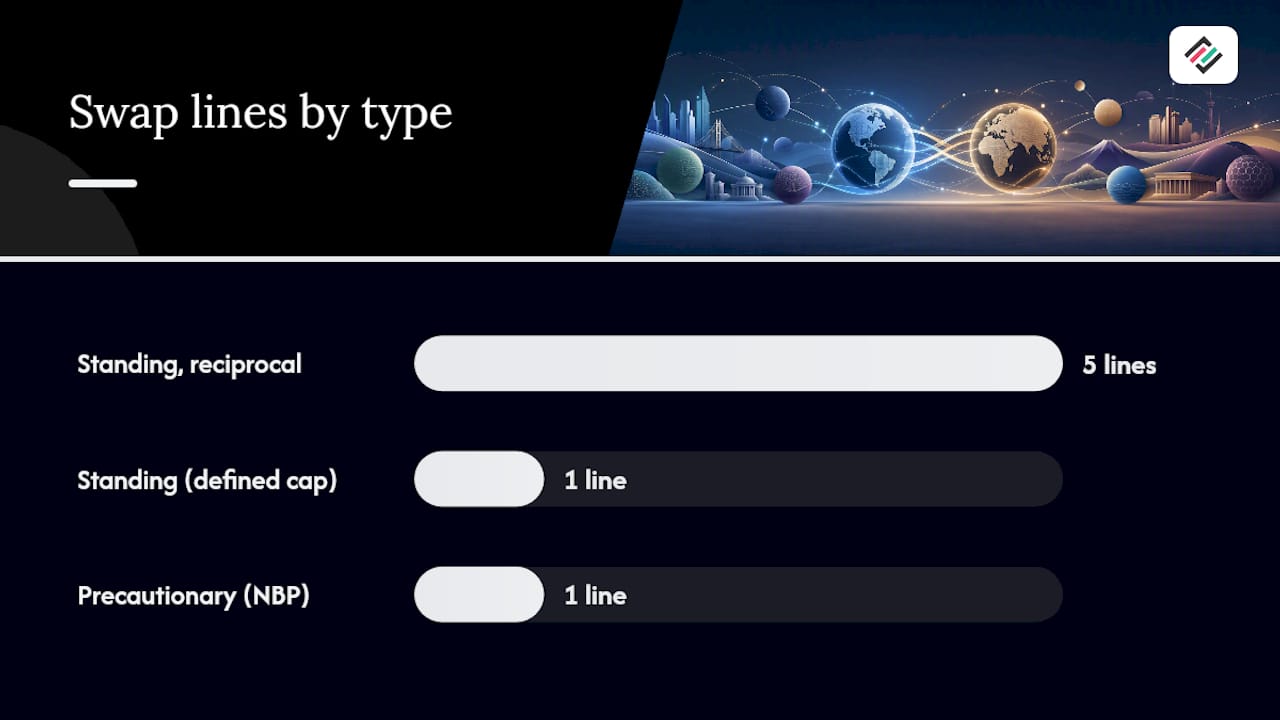
The Eurosystem maintains standing reciprocal swap lines with the Federal Reserve, Bank of England, Bank of Japan, Swiss National Bank, and Bank of Canada. These are unlimited in size and standing in duration, meaning they do not expire. The ECB also established a swap arrangement with the People's Bank of China in 2013, and maintains a broader network of liquidity lines that includes both standing and temporary arrangements with defined caps and expiry dates.
The Swiss National Bank's swap arrangements illustrate how pricing works at the central-bank level: the cost of the swap reflects the interest-rate spread between the two currencies, and principal risk is mitigated through collateral requirements, typically high-quality domestic assets pledged by the borrowing bank.
| Central Bank | Counterparty | Type | Key Feature |
|---|---|---|---|
| ECB | Federal Reserve | Standing, reciprocal | Unlimited size, no expiry |
| ECB | Bank of England | Standing, reciprocal | Unlimited size, no expiry |
| ECB | Swiss National Bank | Standing, reciprocal | Unlimited size, no expiry |
| ECB | Bank of Japan | Standing, reciprocal | Unlimited size, no expiry |
| ECB | Bank of Canada | Standing, reciprocal | Unlimited size, no expiry |
| ECB | People's Bank of China | Standing | Defined cap, established 2013 |
| NBP | ECB | Precautionary | Access to euro liquidity |
For corporate treasuries in Poland and Sweden, the practical implication is indirect but real. When the NBP or Riksbank can access foreign currency via swap lines, local FX markets remain more liquid during stress periods. That liquidity supports tighter bid-offer spreads on corporate hedges and reduces the risk of a sudden funding gap in EUR or USD.
Documentation, accounting, and reporting essentials
Before executing any cross-currency swap, three documentation layers need to be in place.
ISDA master agreement and CSA: The ISDA master agreement governs the legal relationship between counterparties, including netting, default, and termination provisions. The credit support annex defines collateral terms: what assets are eligible, the threshold below which no margin is called, and the minimum transfer amount. Confirm both documents are signed and operationally tested before the first trade.
Hedge accounting designation: Under IFRS 9, a cross-currency swap can be designated as a cash-flow hedge (hedging variability in future cash flows), a fair-value hedge (hedging changes in fair value of a recognized asset or liability), or a net investment hedge (hedging the FX exposure on a foreign subsidiary). Each designation has different P&L and OCI treatment. Misdesignation, or failing to document the hedging relationship at inception, means fair-value changes flow directly through P&L, creating volatility that management and auditors will question.
Tax and local reporting in Central Europe: In Poland, cross-currency swap settlements are generally treated as financial income or expense for corporate income tax purposes, with mark-to-market gains and losses recognized under Polish GAAP or IFRS as applicable. In the Czech Republic and Hungary, similar principles apply, though the specific timing of recognition and the treatment of unrealized gains can differ. Local tax advisers should confirm the treatment before execution, particularly for swaps that cross fiscal year-ends. EMIR reporting obligations require all OTC derivatives, including cross-currency swaps, to be reported to a trade repository. Polish entities report under EMIR as implemented in Polish law; Swedish entities report under EMIR as applied in Sweden.
Pro Tip: For Central European subsidiaries of multinational groups, confirm whether the parent's ISDA master agreement covers the local entity or whether a separate agreement is needed. Many banks require entity-level documentation, and assuming group coverage is a common and costly mistake.
When should you use a currency swap versus alternatives?
The decision is not always obvious. Use this checklist to triage whether a cross-currency swap is the right instrument for your situation.
- Quantify the exposure duration. If the FX exposure lasts less than 12 months, a forward contract is almost always simpler, cheaper, and easier to exit. Cross-currency swaps earn their complexity for tenors of two years and beyond.
- Assess notional size. Swaps carry fixed legal and operational costs (ISDA setup, CSA negotiation, margin infrastructure). For notionals below roughly €5–10 million, those fixed costs may outweigh the pricing advantage over forwards.
- Model the present value of alternatives. Run a comparative PV of a swap versus a rolling forward strategy over the same horizon. Include the cross-currency basis, the bid-offer spread on each instrument, and the cost of margin funding. VaR analysis helps quantify which alternative leaves the smallest residual risk.
- Check your ability to post margin. If your treasury cannot reliably fund daily variation margin calls, an OTC swap is operationally unsuitable. Consider whether a cleared swap (with CCP margining) or a structured forward better fits your liquidity profile.
- Evaluate funding benefits. If you can issue debt in a market where you have a comparative cost advantage and swap the proceeds, the all-in funding cost may be lower than borrowing directly in the target currency. Model this explicitly.
- Confirm accounting treatment. If hedge accounting is not achievable (due to documentation gaps or entity structure), the fair-value volatility of a swap may create more P&L noise than the underlying FX exposure it hedges.
- Prefer alternatives when: the exposure is short-term, optionality has value (use options instead), or your team lacks the operational capacity to manage margining and daily settlement.
Corphedge's scenario simulation and VaR-based hedging tools map directly to steps 3, 4, and 6, letting treasury teams run comparative analyses without building bespoke spreadsheet models.
How regulatory frameworks in Central Europe affect currency swaps
Central European entities executing cross-currency swaps operate under EMIR (the European Market Infrastructure Regulation), which applies across EU member states including Poland, the Czech Republic, Hungary, and Slovakia. EMIR imposes three main obligations: trade reporting to an authorized trade repository, clearing through a CCP for certain standardized OTC derivatives above the clearing threshold, and risk-mitigation techniques (including timely confirmation, portfolio reconciliation, and margin exchange) for uncleared trades.
The clearing threshold under EMIR distinguishes financial counterparties (FCs) from non-financial counterparties (NFCs). Most large corporates in Central Europe are NFCs. An NFC that exceeds the gross notional clearing threshold for OTC derivatives (€3 billion for credit and equity derivatives; €3 billion for interest-rate, FX, and commodity derivatives) becomes subject to mandatory clearing. Corporates below the threshold are still subject to bilateral margin rules under EMIR Refit if they trade with financial counterparties above a certain size.
For Swedish entities, EMIR applies through its incorporation into Swedish law. Sweden's Finansinspektionen supervises compliance. The practical obligations are identical to those in EU member states, though post-Brexit nuances apply when trading with UK counterparties under UK EMIR.
The uncleared margin rules (UMR) under EMIR require initial margin to be exchanged bilaterally for large OTC derivative portfolios. Phase 6 of UMR, which captured smaller entities, means that many mid-sized Central European corporates now face initial margin obligations they did not previously have. This increases the operational and liquidity cost of maintaining uncleared cross-currency swaps.
Tax implications and reporting in Central European jurisdictions
Tax treatment of cross-currency swaps in Central Europe is not uniform, and the differences matter for after-tax hedging cost.
In Poland, swap settlements are recognized as financial income or expense under the Corporate Income Tax Act. Mark-to-market gains on swaps designated as hedges may be deferred under IFRS hedge accounting, but Polish tax law does not automatically follow IFRS timing. Unrealized gains can be taxable in the period they arise under Polish tax rules, creating a timing mismatch between accounting and tax.
In Czech Republic and Hungary, similar principles apply: swap settlements are generally taxable as ordinary income or deductible as expense in the period of settlement, but the interaction with local GAAP versus IFRS can create differences in timing.
Transfer pricing is a material consideration for intragroup swaps. If a Central European subsidiary enters a cross-currency swap with its parent treasury center, the terms must be at arm's length under OECD transfer pricing guidelines as implemented locally. Tax authorities in Poland and the Czech Republic have increased scrutiny of intragroup derivative transactions in recent years.
VAT does not generally apply to financial derivatives in Central Europe, consistent with EU VAT Directive exemptions for financial services. However, any advisory or structuring fees paid to banks or advisers in connection with swap execution may carry VAT.
EMIR trade reporting is also a tax-adjacent obligation: reported notional amounts and fair values create a paper trail that tax authorities can and do use in audits of derivative transactions. Consistent treatment between EMIR reports and tax filings is a practical compliance requirement.
This article provides general information only. Tax treatment varies by jurisdiction, entity type, and specific transaction structure. Confirm the applicable rules with a qualified tax adviser in the relevant Central European jurisdiction before executing any swap.
What Central European finance teams actually do in practice
Finance teams in Poland, the Czech Republic, Hungary, and Sweden tend to approach currency swaps more cautiously than their Western European counterparts, and for good reason. Local banking markets are shallower, bid-offer spreads on long-dated cross-currency swaps are wider, and internal treasury expertise is less uniformly developed.
The typical decision sequence runs like this: the treasury first assesses whether local-currency funding is available and at what cost. If a PLN or CZK bond or loan is accessible at competitive rates, the team avoids the swap entirely. Only when foreign-currency funding offers a material cost advantage does the swap conversation begin. At that point, the team collects quotes from two or three relationship banks, models the all-in cost including basis and margin, and takes the analysis to the CFO or finance committee for approval.
The trade-off between operational simplicity and potential cost savings is real. A rolling forward strategy requires less infrastructure and no ISDA negotiation, but it leaves residual rollover risk and may be more expensive over a five-year horizon. A cross-currency swap is cleaner economically but demands margin infrastructure, daily monitoring, and hedge accounting documentation that smaller treasury teams often lack.
For Poland and Sweden specifically, Corphedge's expansion into these markets reflects the gap between the sophistication of the instruments available and the tools most local treasury teams have to evaluate them. Post-trade controls, scenario analysis, and VaR reporting are not optional for teams running swap books; they are the difference between a hedge that works and one that creates unexpected P&L volatility.
Corphedge helps you evaluate and manage currency-swap exposure
Currency swaps deliver real economic benefits, but only when the analysis behind them is rigorous. The gap most Central European treasury teams face is not access to swaps; it is the analytical infrastructure to evaluate them properly before execution and monitor them after.
Corphedge gives finance teams the tools to close that gap. The platform's VaR-based hedging analysis lets you model the residual risk of a swap versus a forward strategy over the same horizon, stress-test margin scenarios, and compare all-in costs before committing. Scenario simulation covers benchmark shifts, basis widening, and early-termination costs, the three variables most teams undermodel. Reporting and position tracking are centralized, so hedge accounting documentation and EMIR compliance data stay in one place. For teams in Poland and Sweden evaluating their first cross-currency swap or reviewing an existing book, a platform demo shows exactly how the analysis maps to your specific exposure profile.
Sources
The sources below are the primary references for this guide. Each serves a distinct purpose for readers who want to go deeper.
- Cross-Currency Swap: Definition, How It Works, Uses, and Example
- Currency swap lines
- Swiss National Bank FAQ: swaps and foreign exchange swaps
- Gov
- Benefits of Cross Currency Swaps | Manage Interest Rate and Currency Risks | Citizens
This article is general information, not a substitute for advice from a qualified financial advisor. Consult a qualified financial professional about your own circumstances before acting on anything here.
FAQ
What is a currency swap in simple terms?
A currency swap is a contract where two parties exchange amounts of money in different currencies, pay each other interest during the contract period, and swap the money back at the end, all at a pre-agreed exchange rate.
Who benefits from a currency swap?
Corporates hedging long-term foreign-currency debt, banks managing balance-sheet currency mismatches, investors hedging foreign bond holdings, and central banks providing emergency foreign-currency liquidity to domestic banks all use currency swaps for structurally different reasons.
How do cross-currency swaps work mechanically?
At inception, both parties exchange principal in their respective currencies. During the swap's life, each pays interest in the currency it received. At maturity, the original principals are returned at the same rate agreed at the start, eliminating exchange-rate risk on the principal amount.
What is a real example of a currency swap?
A UK parent company lends $100 million to its US subsidiary, then enters a five-year cross-currency swap: it exchanges $100 million for £62.5 million at $1.60 per pound, swaps semi-annual interest payments, and re-exchanges the principals at maturity, producing the same economic result as a sterling loan.
What are the main risks in a currency swap?
The three primary risks are counterparty default risk (mitigated by a CSA and collateral posting), basis risk from mismatched interest-rate benchmarks, and liquidity/exit risk from the difficulty and cost of unwinding an OTC long-dated swap before maturity.