
TL;DR:
- Currency risk can silently erode small business margins due to exchange rate fluctuations during payment windows. Managing exposure through mapping, timely hedging tools like forward contracts, and rolling strategies ensures protection aligns with actual obligations. Continuous monitoring and strategic planning help small businesses mitigate currency volatility and protect profits effectively.
Currency risk for small business is one of those costs that doesn't show up in your budget until it's already done the damage. 64% of US small businesses report annual margin erosion of 2 to 5% directly tied to exchange rate movements. That's not a rounding error. On a $500,000 annual trade volume, that's up to $25,000 quietly walking out the door. The timing gap between sending an invoice and receiving payment makes the problem worse, since exchange rates rarely sit still for 30, 60, or 90 days. This guide walks you through how to identify your exposure, map your risks, and apply hedging tools that actually fit a small business operation.
Table of Contents
- Understanding currency risk for small business and why it matters
- Preparing to manage your currency risks: assess and map exposures
- Execution: practical hedging strategies for small businesses
- Verifying and monitoring your currency risk management
- Why timing and rolling coverage are the keys most small businesses overlook
- How CorpHedge helps small businesses master currency risk
- Frequently asked questions
Key Takeaways
| Point | Details |
|---|---|
| Currency risk impact | Small businesses lose 2-5% of profit margins annually due to currency fluctuations if unmanaged. |
| Exposure mapping | Identify and map all foreign currency payables and receivables by timing to understand and manage risks. |
| Hedging tools | Use forward contracts, limit orders, and multi-currency accounts to mitigate FX risk effectively. |
| Rolling coverage | Implement rolling hedge plans covering 3-6 months of exposure to stay aligned with operational cash flows. |
| Active monitoring | Regularly track FX exposures and hedge effectiveness with alerts and KPI reviews to protect margins. |
Understanding currency risk for small business and why it matters
Currency risk, also called foreign exchange (FX) risk, means the chance that a shift in exchange rates between the date you invoice a customer and the date you receive payment will reduce what you actually earn. For small businesses in international trade, that window between invoice and settlement is where the damage happens.
Consider a US-based importer paying a supplier in euros. If the dollar weakens by 4% during a 45-day shipping cycle, the cost of that invoice just increased by 4% with no change in the actual goods or terms. Currency volatility can erase margins on individual shipments by 3 to 5% over typical 30 to 60 day shipping cycles. For businesses running on 10 to 15% net margins, that's not a minor fluctuation. That's a material hit.
Understanding where your small business currency exposure actually lives helps you decide what to protect. The main types include:
- Transaction risk: Direct exposure from receivables or payables denominated in a foreign currency
- Translation risk: Changes in the reported value of foreign assets or revenues when converted to your home currency
- Economic risk: Long-term shifts in exchange rates that affect your competitive pricing and market position
- Operational timing risk: The gap between when you commit to a price and when money actually changes hands
You can read more about how each of these creates different challenges in this breakdown of types of currency risk. For most small businesses in trade, transaction risk and operational timing risk are where attention should focus first.
Preparing to manage your currency risks: assess and map exposures
Before you can protect your margins, you need to know exactly where the exposure sits. Most small businesses underestimate this step. They know they trade in foreign currencies, but they haven't mapped how much, in which currencies, and over what time periods.
Start by pulling together every foreign currency obligation or expectation your business carries. This means outstanding payables to foreign suppliers, receivables from international customers, upcoming contracts priced in foreign currency, and any recurring payments like software licenses or service fees in other currencies. Mapping your full FX exposure by currency and time bucket is the foundation of effective hedging.

Organize these exposures into time buckets so you can see when risk actually lands:
| Time bucket | Example exposure | Hedge priority |
|---|---|---|
| 0 to 30 days | Supplier invoice due in EUR | High, near-term and certain |
| 31 to 60 days | Shipment payment in GBP | High, confirmed exposure |
| 61 to 90 days | Customer receivable in CAD | Medium, nearly certain |
| 91 to 180 days | Projected purchase order in JPY | Lower, less confirmed |
| 180+ days | Budgeted forecast transactions | Optional, scenario planning |
Once your exposure map is built, a few additional practices sharpen your picture:
- Forecast regularly: Update FX positions monthly as new orders, invoices, and contracts come in
- Set variance alerts: Define thresholds, for example a 2% rate move, that trigger a review of your open positions
- Track net exposure per currency: Offset payables against receivables in the same currency before hedging the remainder
- Review payment terms: Longer payment windows mean longer exposure. Shorter terms reduce risk without any hedging cost
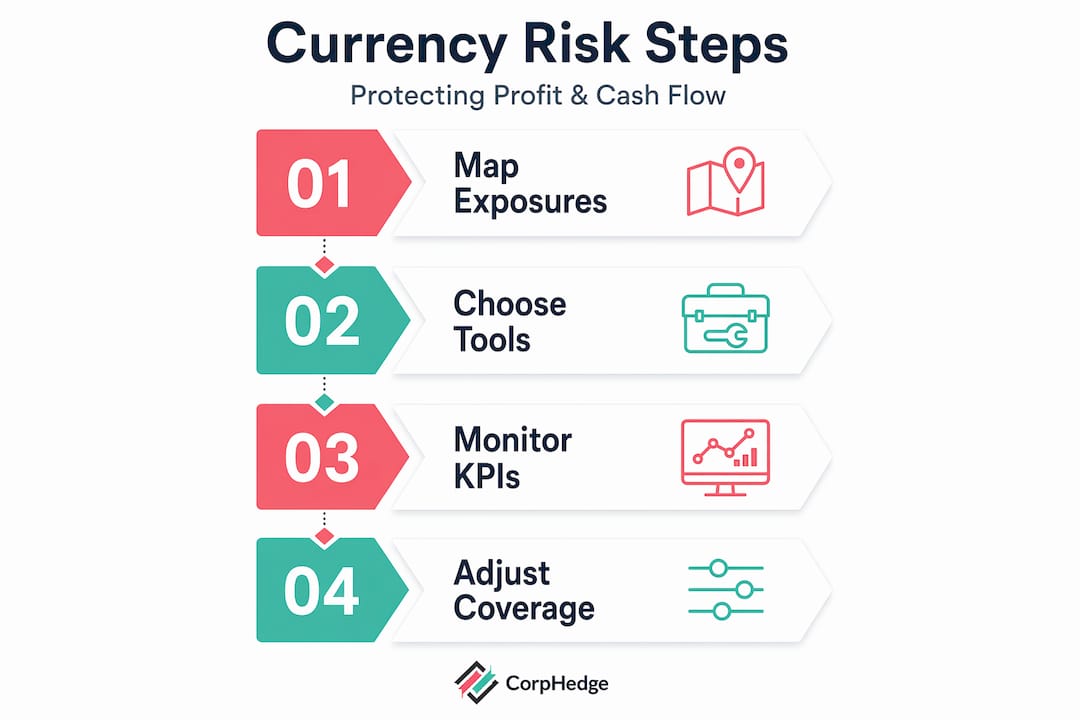
Following structured currency risk management steps makes this process repeatable instead of reactive.
Execution: practical hedging strategies for small businesses
Once you know your exposures, you can match them to the right tools. The good news is that small businesses don't need complex derivatives. Three practical instruments cover most situations.
Forward contracts are the most widely used tool for managing small business international trade risks. A forward contract locks in an exchange rate today for a payment or receipt that happens in the future. Forward contracts fix a rate for future payments typically from 30 days to 12 months ahead, giving you certainty over costs regardless of where the market moves. If you have a confirmed supplier payment due in 60 days, a forward contract eliminates the rate uncertainty on that specific amount.
Limit orders let you set a target exchange rate and execute the transfer automatically when the market reaches it. There's no upfront premium. The downside is that if your target rate is never hit, the order doesn't execute. Limit orders work well for payments that are flexible on timing and where you're willing to wait for a better rate.
Natural hedging uses multi-currency bank accounts to hold foreign currency receipts and apply them directly against foreign currency costs. If you receive US dollars from a US customer and pay a US supplier in dollars, you don't need to convert at all. Matching inflows and outflows in the same currency reduces conversion costs and exposure simultaneously.
Here's how the three tools compare for typical small business scenarios:
| Tool | Best use case | Cost | Certainty |
|---|---|---|---|
| Forward contract | Confirmed, predictable invoices | Spread cost, no premium | High |
| Limit order | Flexible payment timing | None until execution | Conditional |
| Natural hedge | Same-currency in and out | None | High when matched |
| FX options | Uncertain exposure amounts | Premium required | High upside, protected downside |
A key principle from experienced practitioners: use forward contracts for predictable exposure and options only when the exposure itself is uncertain, since options require a premium that reduces margin for confirmed transactions.
Pro Tip: Don't try to hedge 100% of all projected foreign currency volume. Hedge what you can confirm. Covering 70 to 80% of your confirmed near-term exposure with forward contracts, and leaving the rest for limit orders or spot transactions, balances protection with flexibility. Read more about how this fits into currency risk management strategies for practical frameworks.
For businesses building a repeatable process, following established risk management best practices prevents the common mistake of ad-hoc hedging decisions made under pressure.
Verifying and monitoring your currency risk management
Putting hedges in place is not the end of the process. Exchange rates move constantly, new invoices arrive, and payment schedules shift. Without ongoing monitoring, even a well-built hedging plan develops gaps.
Here's a practical monthly review process for small businesses:
- Review your open hedge positions against current invoices and receivables to confirm coverage is still aligned
- Calculate your unhedged exposure per currency by comparing confirmed transactions against existing forwards or limit orders
- Track FX profit and loss (P&L) by comparing the rate you locked in against the rate that would have applied at settlement
- Update your exposure map with new purchase orders, contracts, or customer invoices added since the last review
- Adjust rolling hedge coverage by placing new forward contracts for exposures entering your 30 to 60 day window
Weekly KPI reviews and FX variance alerts help small businesses stay ahead of rapid market moves rather than reacting after the damage is done.
Pro Tip: If your business uses accrual accounting or has international subsidiaries, look at IAS 21 requirements for translating foreign currency transactions. Maintaining clear documentation of your hedge positions simplifies year-end reporting and prevents accounting surprises that undermine the economic benefit of your hedging.
Keeping your forex risk management for SMEs process structured means you spend less time firefighting and more time running your business.
Why timing and rolling coverage are the keys most small businesses overlook
Here's an uncomfortable truth most FX guides skip: the majority of small businesses that hedge currency risk still lose money to currency movements. Not because they chose the wrong tools, but because they hedged the wrong time window.
The instinct is to look at long-term currency trends and take positions based on where you think rates are going over the next year. That's speculation, not hedging. Hedging at the wrong timeframe, using long-term assumptions instead of actual invoice-to-settlement windows, causes unnecessary margin losses because your hedge doesn't match the real exposure.
The exposure that matters is the gap between the moment you commit to a price and the moment you actually pay or receive funds. For most trade businesses, that's a 30 to 90 day window. Everything else is noise until it becomes a confirmed obligation.
A rolling hedge plan, one that covers 3 to 6 months of confirmed exposure and is updated as new invoices and orders are added, aligns protection with reality. Rolling hedge coverage plans aligned with confirmed exposures maintain protection as payment timings shift, balancing flexibility and risk. This approach also means you're never over-hedged on transactions that don't materialize or under-hedged when a large order arrives unexpectedly.
The businesses that manage currency volatility well treat FX risk like inventory management. You wouldn't order 12 months of stock based on a forecast when you can replenish monthly. Apply the same logic to your hedging coverage. Protect what's confirmed, plan for what's probable, and review it as a standing operational routine rather than a financial emergency response. Explore global currency management strategies for how leading firms build this into operations.
How CorpHedge helps small businesses master currency risk
If managing currency risk feels like it requires a full treasury team, that's the problem CorpHedge was built to solve. Small businesses expanding into international markets need real-time visibility into their multi-currency positions without the overhead of enterprise finance tools.

CorpHedge gives you a clear picture of your full FX exposure across currencies, automates variance alerts so you catch rate moves before they hit your cash flow, and supports rolling hedge planning tied to your actual invoice and payment schedule. The platform's hedging based on value at risk approach means your coverage decisions are grounded in quantified risk, not guesswork. Explore the full CorpHedge features to see how exposure mapping, hedge execution, and monitoring work together in one place. Take the CorpHedge product tour to see exactly how it fits your business and scales as your international trade grows.
Frequently asked questions
What is currency risk and how does it affect small businesses?
Currency risk is the chance that exchange rate changes between the time you invoice and receive payment will reduce your profits or increase your costs. Currency volatility erases margins by 3 to 5% over typical shipping cycles, making it a direct threat to profitability in international trade.
How can small businesses assess their currency risk exposure effectively?
Start by mapping all foreign currency receivables and payables by currency and timing buckets, then forecast cash flows and set alerts for significant FX movements. Mapping FX exposure by currency and time bucket is the essential first step before any hedging decision.
What hedging tools are practical for small businesses to manage currency risk?
Forward contracts are the most accessible, locking in a rate for future payments from 30 days to 12 months ahead, complemented by limit orders for flexible timing and multi-currency accounts for natural hedging where inflows and outflows match.
Why is a rolling hedging strategy recommended for small businesses?
Because your currency exposure changes with every new invoice and payment, rolling hedge plans covering a 3 to 6 month horizon keep your protection aligned with actual cash flow and prevent gaps that create margin surprises.