

The five currency impact factors that hit a CFO's P&L hardest are interest-rate differentials, inflation gaps, capital-flow and liquidity shifts, geopolitical shocks, and billing or cost currency mismatches. Each one can move from background noise to a material earnings event within a single quarter. For a CFO running a multi-currency business in Central Europe, the operational response starts with three things: measure your gross exposure by currency pair, set documented limits and governance, and execute short-dated hedges on your most material transactional positions within 30–90 days.
Your immediate action list:
- Diagnose first. Map every revenue stream, cost, and debt obligation by currency. Identify which pairs represent more than 5% of revenue or EBITDA.
- Set limits and governance. A written FX policy with approved instruments, position limits, and a named policy owner is the minimum viable governance structure.
- Execute short-term hedges on material exposures. For transactional exposures in EUR/HUF, EUR/PLN, or USD, a 3–6 month forward cover on confirmed receivables or payables is the fastest risk reduction available.
If the P&L impact exceeds your quarterly earnings buffer, you have a hedging mandate, not a hedging option.*
Key Takeaways
Effective currency risk management for CFOs in Central Europe requires classifying exposures correctly, measuring them with VaR and stress testing, and executing hedges within a documented governance framework before a market event forces your hand.
| Point | Details |
|---|---|
| Five core impact factors | Interest-rate differentials, inflation gaps, capital flows, geopolitical shocks, and billing currency mismatches drive the most material P&L effects. |
| Classify before you hedge | Transactional, translational, and economic exposures require different instruments and different accounting treatment; misclassification wastes hedge budget. |
| Use multiple measurement tools | Combine sensitivity analysis, scenario stress tests, and VaR at — confidence; backtest quarterly to keep models calibrated. |
| Governance is the foundation | A documented FX policy, monthly reconciliations, and multi-currency subledgers are the baseline standard per Group of 31 guidance. |
| Corphedge for CEE CFOs | Corphedge's VaR-based simulation and real-time position tracking give CFOs the diagnostic and execution infrastructure to run a repeatable FX program, with platform support expanding in Poland and Sweden. |
Table of Contents
- What moves exchange rates — currency impact factors CFOs must monitor
- How currency moves translate into financial results and which KPIs to watch
- What are the three types of corporate FX exposure?
- How to measure and stress-test currency impact
- Which hedging instruments and treasury tools do CFOs actually use?
- How to organize treasury operations for repeatable FX outcomes
- What governance and hedge accounting policies does a CFO need?
- Step-by-step checklist to build an operational FX program
- What do Central Europe CFOs need to know about regional FX drivers?
- Common implementation mistakes, timelines, and cost trade-offs
- The CFO's perspective on FX risk in Central Europe
- Sources
What moves exchange rates — currency impact factors CFOs must monitor
Exchange rates are not random. They follow a hierarchy of forces, and knowing which force is dominant at a given moment is what separates a reactive CFO from a prepared one.
Interest-rate differentials and central bank policy
The most persistent driver of currency direction is the gap between real interest rates across countries. When the European Central Bank holds rates while the U.S. Federal Reserve cuts, capital flows toward EUR-denominated assets, pushing the euro up. For a Central European exporter billing in EUR but paying wages in HUF or PLN, that shift compresses margins without a single operational change. Policy surprises, not just the decisions themselves, create the sharpest moves.
Inflation gaps and real yield erosion
Inflation differentials erode purchasing power at different speeds across currencies. For CFOs, the practical signal is the real yield: nominal rate minus inflation. When a currency's real yield turns negative while a trading partner's stays positive, outflows tend to follow.
Capital flows, liquidity, and market microstructure
Sudden shifts in capital flows, whether from risk-off sentiment, a sovereign credit event, or a change in global portfolio allocation, can overwhelm the fundamental picture for weeks. Cross-currency basis spreads and credit default swap spreads on sovereign debt are early-warning indicators that liquidity stress is building. In CEE markets, where FX liquidity is thinner than in G10 pairs, a moderate global risk-off event can produce outsized moves in EUR/HUF or EUR/PLN. Geopolitical volatility in early 2026 caused sharp FX swings, and corporates reported currency losses alongside increased hedging activity as firms scrambled to respond rather than prepare.
Trade balance, commodity prices, and terms of trade
Commodity-exporting economies see their currencies move with commodity prices. Poland's PLN and Hungary's HUF are both sensitive to energy prices because of the region's import dependence on natural gas. A sustained energy price spike raises import costs, widens the current account deficit, and weakens the local currency, compounding the cost pressure on any company with EUR or USD-denominated energy contracts.
Geopolitical risk, sanctions, and capital controls
Geopolitical shocks are the hardest to model and the fastest to materialize. Sanctions regimes can freeze counterparty relationships overnight. Capital controls, even temporary ones, can trap cash in a subsidiary and prevent repatriation. A Deloitte CE survey found that Central Europe's CFOs in 2025 rated geopolitical tensions and inflation as their most significant business risks, placing currency risk squarely inside the strategic threat category rather than a treasury footnote.
CFO monitoring watchlist
| Indicator | Why it matters | Monitoring frequency |
|---|---|---|
| Central bank policy rate and forward guidance | Drives interest-rate differential and capital flows | After each meeting |
| CPI differential (domestic vs. trading partners) | Signals real yield erosion and long-run FX direction | Monthly |
| FX implied volatility | Measures market pricing of near-term uncertainty | Weekly |
| Cross-currency basis spread | Signals funding stress and liquidity conditions | Weekly |
| Sovereign CDS spreads | Early warning of credit/political risk repricing | Weekly |
| Commodity price indices (energy, metals) | Feeds into trade balance and local currency pressure | Weekly |
Pro Tip: FX implied volatility often lags geopolitical news by 24–48 hours. If you see a CDS spread widen sharply on a sovereign name in your supply chain, move before the options market reprices.
How currency moves translate into financial results and which KPIs to watch
Understanding the macro drivers is only useful if you can trace them to a specific line on your income statement or balance sheet. The transmission is direct and often faster than a quarterly reporting cycle allows you to catch.
Driver-to-P&L mapping
| Macro driver | Primary corporate impact | KPI to monitor monthly |
|---|---|---|
| Interest-rate differential shift | Financing cost change on FCL debt; FX gain/loss on intercompany loans | Weighted average cost of debt by currency |
| Inflation gap widening | Input cost inflation in import-heavy COGS; pricing power erosion in export markets | Gross margin by currency pair |
| Capital flow reversal / liquidity stress | Mark-to-market losses on open positions; collateral calls on derivatives | Unrealized FX position P&L; derivative margin balance |
| Commodity/energy price shock | Direct cost increase if energy contracts are in foreign currency | Energy cost as % of COGS; FX-adjusted EBITDA |
| Geopolitical shock / sanctions | Revenue disruption in affected markets; trapped cash in subsidiaries | Repatriation rate; days sales outstanding by market |
| Billing currency mismatch | Revenue recognized in a depreciating currency; cost base in appreciating currency | Realized vs. forecasted FX variance |
A concrete example makes this tangible. Suppose a Central European manufacturer exports €10 million of goods per quarter, with production costs denominated in HUF.
Monthly KPIs that detect currency stress early
Report these four metrics to your CFO dashboard every month without exception: cash conversion cycle by currency (a lengthening cycle in a depreciating market is a double hit), gross margin by currency pair (the fastest signal of billing mismatch), realized versus forecasted FX variance (tells you whether your hedge program is working), and the ratio of foreign-currency debt to total debt (tracks your balance sheet sensitivity to rate and FX moves simultaneously).
What are the three types of corporate FX exposure?
CFOs who lump all currency risk into one bucket consistently over-hedge some positions and ignore others. The classification matters because each exposure type requires a different instrument and a different accounting treatment.
Transactional exposure covers cash flows that are already contracted or highly probable: a receivable in EUR, a payable in USD, a dividend repatriation in CZK. This is the most visible exposure and the most straightforward to hedge with forwards or vanilla options. The risk is specific, dated, and measurable.
Translational exposure arises when a parent company consolidates subsidiaries that report in different currencies. A Polish subsidiary reporting in PLN contributes to a EUR-reporting parent's balance sheet at the closing rate and to its income statement at the average rate for the period. The resulting translation gain or loss flows through other comprehensive income (OCI) under IFRS, not through P&L, but it affects equity and leverage ratios. Many CFOs under-hedge this because it does not hit earnings directly, but a large adverse translation move can breach debt covenants tied to equity.
Economic exposure is the subtlest and most strategic. It describes how a sustained currency shift changes a company's competitive position: pricing power in export markets, relative cost versus foreign competitors, and long-run demand for its products. Hedging instruments can buy time, but the real response is operational: repricing, sourcing shifts, or market diversification.
Checklist to classify an exposure:
- Is the cash flow already contracted or highly probable within 12 months? → Transactional
- Does it arise from consolidating a foreign subsidiary's balance sheet or income statement? → Translational
- Does it reflect a long-run shift in competitive position or pricing power? → Economic
- Does it involve a foreign-currency loan or intercompany financing? → Transactional (cash flow) with potential balance sheet (translational) overlay
- Will it qualify for hedge accounting under IFRS 9? → Requires formal designation, documentation, and effectiveness testing from day one
Getting the classification right before choosing an instrument prevents the most common hedging error: applying a short-dated forward to what is actually a multi-year economic exposure, which creates a rolling hedge cost without addressing the underlying competitive problem.
How to measure and stress-test currency impact
The measurement question is not which single metric to use. It is which combination gives you a complete picture without false precision. The Group of 31 report documents broad adoption of VaR combined with stress testing and sensitivity analysis as the standard corporate toolkit, with a clear call for backtesting and calibration to keep models honest.
Core measurement approaches
Sensitivity analysis is the starting point for most treasury teams. It is fast, transparent, and easy to explain to a board. The limitation is that it assumes a single-factor move and ignores correlation breakdowns.
Scenarios should be grounded in historical episodes, not invented. The 2022 energy crisis and the 2015 Swiss franc floor removal are both useful templates for CEE-relevant stress scenarios.
Value at Risk (VaR) gives a probabilistic loss estimate over a defined horizon at a given confidence level. VaR is useful for setting position limits and communicating risk to the board in a single number, but it systematically underestimates tail risk during correlation breakdowns.
Monte Carlo simulation is appropriate when your exposure portfolio is complex enough that analytical VaR becomes unreliable: multiple correlated currency pairs, optionality, or non-linear payoffs. It is computationally heavier but produces a full distribution of outcomes rather than a single point estimate.
Pro Tip: Backtest your VaR model quarterly against realized P&L. Most corporate treasury teams skip this step and discover the problem during a crisis.
Model governance requires three things: a documented calibration methodology, a backtesting log reviewed by someone independent of the trading desk, and a formal model review at least annually. These are not bureaucratic extras. They are what auditors and lenders look for when they assess the credibility of your hedging program.
Which hedging instruments and treasury tools do CFOs actually use?
The instrument menu is wider than most finance teams use in practice. The right choice depends on your exposure type, your tolerance for premium cost, and your hedge accounting objectives.
Forwards are the workhorse. A forward contract locks in an exchange rate for a future date, eliminating upside and downside uncertainty on a specific cash flow. Zero premium, straightforward documentation, and easy to designate for hedge accounting under IFRS 9. The drawback is inflexibility: if the underlying transaction does not materialize, you are left with an open position.
Vanilla options give you the right but not the obligation to exchange at a set rate. You pay a premium for that flexibility, which is why regional exporter surveys show a reluctance to use options at scale, particularly among mid-sized CEE companies where premium costs are felt directly in treasury budgets. Options make sense when the underlying exposure is uncertain in timing or amount, or when you want to preserve upside on a favorable rate move.
Zero-cost option structures (risk reversals, collars) combine a bought option with a sold option to eliminate the net premium. You cap your upside but remove the cash outlay. These are common among CEE exporters who want protection without a premium line item.
Cross-currency swaps exchange both principal and interest payments in two currencies over a defined term. They are the standard instrument for hedging long-dated foreign-currency debt, particularly relevant for companies carrying EUR or USD-denominated loans in a HUF or PLN cost environment.

Natural hedging means structuring your business so that revenues and costs in the same currency offset each other. Sourcing inputs in the same currency as your export revenue, or invoicing in your cost currency where customers will accept it, reduces the gross exposure before any financial instrument is needed.
Netting and pooling aggregate payables and receivables across subsidiaries before going to the market, so you only hedge the net position. A group with a EUR payable in one subsidiary and a EUR receivable in another can net them internally and eliminate the external hedge cost entirely.
Multi-currency accounts allow a company to hold, receive, and pay in multiple currencies without forced conversion at each transaction. They reduce conversion costs and give treasury the flexibility to time conversions when rates are favorable.
Operational checklist for instrument execution:
- Confirm ISDA Master Agreement and Credit Support Annex (CSA) are in place with each banking counterparty before the first trade
- Verify KYC documentation is current with all counterparties
- Confirm collateral and margining arrangements, especially for longer-dated instruments
- Designate hedges for IFRS 9 hedge accounting at inception, with formal documentation of the hedging relationship, the hedged item, and the effectiveness testing method
- Establish settlement and confirmation workflows in your treasury management system before execution
For transactional exposures, typical maturities run 3–12 months. Longer-dated hedges, beyond 12 months, are generally reserved for capital expenditure commitments, long-term supply contracts, or foreign-currency debt service. The further out you hedge, the wider the bid-ask spread and the more collateral you may need to post.
How to organize treasury operations for repeatable FX outcomes
A hedging strategy that lives in a spreadsheet and depends on one person's memory is not a program. It is a single point of failure. The operational infrastructure matters as much as the instrument choice.
End-to-end process flow
Real-time position visibility is the operational prerequisite for everything else. Without a live view of your aggregate currency exposure across entities, you cannot net efficiently, you cannot respond to intraday market moves, and you cannot give your board an accurate risk number. ERP integration, whether through SAP, Oracle, or a dedicated treasury management system, should feed positions automatically rather than relying on manual uploads.
RBI insights emphasize that local banking partners reduce costs and provide better regulatory navigation in CEE compared with a global-only approach. For a company operating in Poland, Hungary, or the Czech Republic, a regional bank relationship often delivers tighter spreads on local currency pairs and faster settlement than routing everything through a global bank's London desk.
The role split is straightforward but must be documented: business units own the exposure data and the forecast accuracy, treasury owns the hedging decision and execution, and accounting owns the reconciliation and hedge documentation. Blurring these lines is where audit findings and restatements originate.
What governance and hedge accounting policies does a CFO need?
Governance is not the paperwork that follows a hedging program. It is the structure that makes the program defensible when a trade goes wrong, an auditor asks questions, or a board member wants to understand the risk.
FX policy checklist:
- Documented policy statement covering objectives, scope, approved instruments, and prohibited activities (speculative trading must be explicitly excluded)
- Position limits by currency pair and by instrument type
- Named policy owner (typically the CFO or Treasurer) with a defined escalation path for limit breaches
- Approved counterparty list with credit limits per counterparty
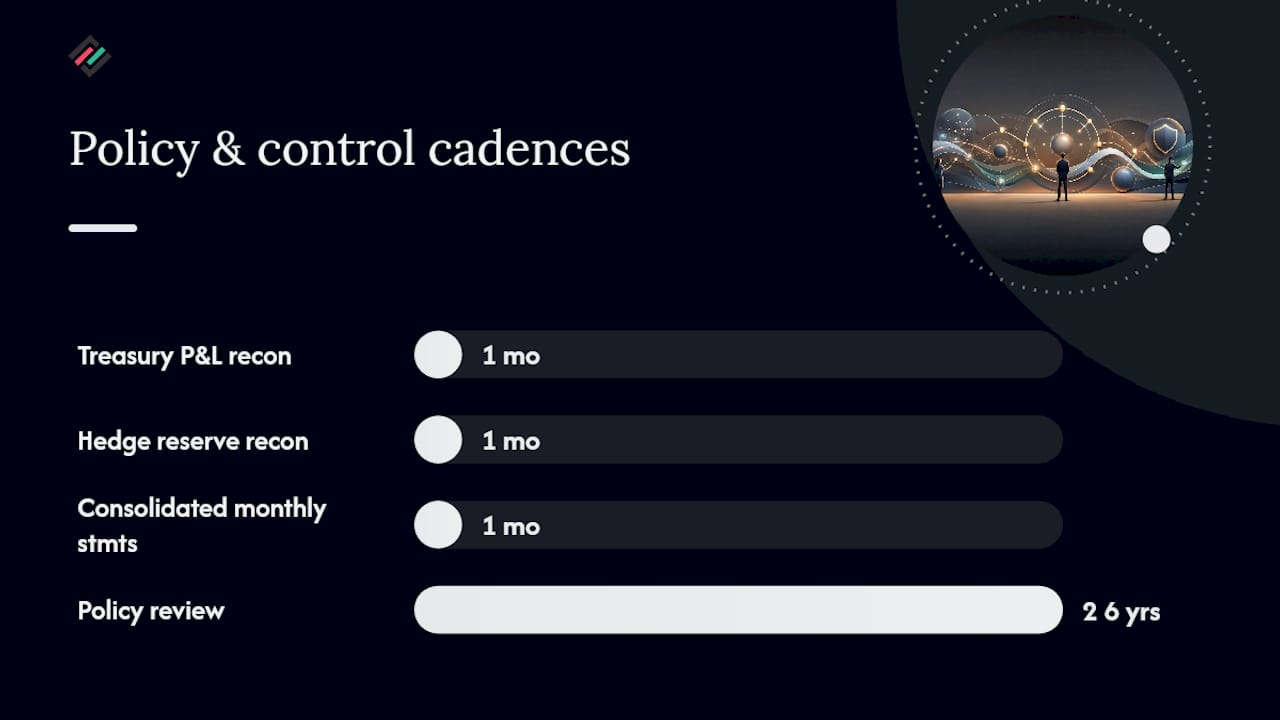
- Formal policy review scheduled every 2–3 years, or immediately following a material market event or business model change
- Hedge ratio guidelines by exposure type (transactional, translational, economic) and by time horizon
The Group of 31 report recommends uniform FX accounting procedures, monthly reconciliations of treasury hedging results to consolidated GAAP/IFRS P&L, and the use of multi-currency subledgers. These are not aspirational best practices. They are the baseline that auditors and lenders expect from a company of any meaningful scale.
Hedge accounting under IFRS 9 requires formal designation at inception, ongoing effectiveness testing (qualitative or quantitative), and a clear audit trail from the hedged item to the hedging instrument. The person who owns derivative accounting must be distinct from the person who executes trades. Monthly reconciliation of the hedge reserve in OCI to the underlying exposure is the minimum cadence. Quarterly is not enough.
Controls and audit readiness require multi-currency general ledgers that capture FX gains and losses at the transaction level, monthly consolidated internal statements that separate operating performance from FX effects, and an independent model review for any VaR or scenario model used in board reporting. The JurisLedger perspective on CFO advisory governance reinforces that documented governance structures are increasingly a prerequisite for lender confidence, not just an internal discipline.
Step-by-step checklist to build an operational FX program
Most FX programs fail not because the strategy was wrong but because the rollout was unsequenced. The phases below reflect how a realistic program comes together.
| Phase | Key activities | Typical duration | Primary responsibility |
|---|---|---|---|
| Diagnose | Exposure mapping, currency pair identification, sensitivity analysis on top 3 pairs | 2–4 weeks | CFO, Finance leads |
| Design | FX policy drafting, instrument selection, counterparty setup (ISDA/CSA), system requirements | 4–8 weeks | CFO, Treasury, Legal, External advisers |
| Pilot | Execute first hedges on highest-priority exposures, test accounting reconciliation, validate reporting | 30–90 days | Treasury, Accounting |
| Scale | Extend program to all material exposures, integrate TMS with ERP, train business unit finance leads | 3–6 months | Treasury, IT, Business units |
Quick wins to prioritize in the first 30–90 days:
- Standardize billing currency where customers will accept it, to reduce gross transactional exposure
- Open multi-currency accounts to avoid forced conversion on receipts
- Execute 3–6 month forwards on confirmed receivables or payables in your top two currency pairs
- Designate a single owner for FX policy and hedge accounting documentation
Cost categories to budget: hedge premiums (relevant for options; zero for forwards), FX bid-ask spreads (typically 5–30 basis points depending on pair and volume), system integration costs (TMS implementation or ERP module activation), and external advisory fees for policy drafting and ISDA negotiation. The highest value-per-dollar spend is usually the policy and governance design phase, because errors there compound through every subsequent trade.
What do Central Europe CFOs need to know about regional FX drivers?
Central Europe is not a homogeneous FX environment. EUR/HUF, EUR/PLN, EUR/CZK, and EUR/RON each have distinct sensitivity profiles, and a hedging program designed for a G10 company will miss the region's specific dynamics.
Regional characteristics that change the calculus:
- HUF and PLN are among the most volatile currencies in the EU, with sensitivity to both global risk-off events and domestic political developments
- Energy import dependence means commodity price shocks transmit quickly into current account pressure and local currency weakness
- Foreign currency loan prevalence is structurally significant: CNB research confirms that higher corporate FCL holdings intensify the transmission of foreign monetary shocks through exchange rates and financing costs, making companies with EUR or USD-denominated debt doubly exposed when local currencies weaken
- Regulatory environments differ: Hungary and Romania have historically imposed capital controls or FX restrictions during stress periods, which a hedging program must account for in counterparty and settlement planning
Regional impact example: A Hungarian manufacturer exporting to Germany with a EUR 5 million annual receivable and a HUF cost base faces a direct margin impact from EUR/HUF moves. A 7% EUR/HUF appreciation (HUF strengthening) on that receivable reduces the HUF-equivalent revenue by approximately HUF 350 million at a 390 base rate, before any hedge. On a 25% gross margin, that single move eliminates roughly HUF 87.5 million of profit, or about 7% of annual gross profit on that contract.
Deloitte CE's 2025 CFO survey confirms that currency stability is a competitive differentiator: companies that hedge proactively maintain more consistent pricing and protect margins when peers are forced to absorb FX losses or reprice contracts mid-year.
RBI recommends a hybrid approach for CEE execution: combining a global bank for complex structured products with a regional bank for local currency execution, regulatory navigation, and market color. For companies in Poland and the Czech Republic specifically, local banking relationships often deliver meaningfully tighter spreads on PLN and CZK pairs than a London-based desk quoting the same instruments.
There is no universal hedging strategy: the right program for a Polish exporter with EUR receivables and PLN costs looks nothing like the right program for a Romanian importer with USD-denominated inputs. Capital structure, cash flow timing, and competitive dynamics all shape the design.
Common implementation mistakes, timelines, and cost trade-offs
The most expensive hedging mistakes are not bad trades. They are structural errors that get baked into the program at the design stage.
Copying a peer's hedging strategy is the most common. What works for a large German exporter with deep liquidity, a sophisticated TMS, and a 12-person treasury team does not translate to a mid-sized CEE company with two treasury staff and a regional bank relationship. RBI's guidance is explicit on this point: bespoke design based on your own capital structure and cash flow profile is the only defensible starting point.
Poor accounting reconciliation creates audit risk and distorts management reporting. When the hedge reserve in OCI does not reconcile to the underlying exposure, you cannot tell whether your hedges are working or whether accounting errors are masking trading losses.
Underestimating liquidity needs for collateral is a recurring problem when companies first enter longer-dated or structured instruments. A mark-to-market move against your position can trigger a margin call that strains working capital at exactly the moment when the underlying business is also under pressure from the same FX move.
Ignoring netting opportunities inflates gross hedge volumes and costs. A group that hedges each subsidiary's exposure independently, without netting intercompany flows first, pays bid-ask spreads and potentially option premiums on positions that cancel each other out internally.
Typical program timelines: policy and governance design takes 4–8 weeks with external support. System integration, if you are connecting a TMS to an ERP, realistically takes 3–6 months. The most common delay is ISDA and CSA negotiation with banking counterparties, which can take 6–12 weeks if legal review is slow. Build that into your timeline before you need the first hedge.
The CFO's perspective on FX risk in Central Europe
The companies that treat FX risk as a treasury back-office function consistently underperform those that manage it at the CFO level. The reason is straightforward: currency moves affect pricing decisions, capital allocation, and competitive positioning, not just the treasury P&L line. When a CFO owns the FX program, the hedging strategy stays connected to the business strategy.
At Corphedge, the framing we use with clients is to diagnose your gross exposure first, simulate the hedging alternatives before committing to any instrument, and then operationalize the program with the governance and reporting infrastructure that makes it repeatable. The simulation step is where most companies skip ahead and pay for it later.
Corphedge is currently expanding its platform support to Poland and Sweden, which reflects where the demand for structured FX programs is growing fastest in the region. Local execution matters, and having platform infrastructure that connects to regional banking channels and regulatory environments is part of what makes a program work in practice rather than just on paper.
How Corphedge supports CFOs managing currency exposure
Corphedge gives CFOs a purpose-built platform for the exact workflow this guide describes: identify gross exposures, simulate hedging strategies using VaR-based analysis, and track live positions across currency pairs without manual spreadsheet reconciliation.
Three capabilities that map directly to the checklist above:
- VaR-based hedging simulation: model the P&L impact of different hedge ratios and instruments before execution, using your actual exposure data
- Real-time multi-currency position tracking: see your aggregate net exposure by currency pair at any moment, with automated alerts when positions approach policy limits
- Reporting and subledger integrations: connect to your ERP and banking channels so hedge accounting reconciliation runs on a defined cadence, not a manual scramble at quarter-end
Corphedge supports companies in Central Europe, with active platform expansion into Poland and Sweden for local-currency execution and regional compliance support. To see how the platform handles your specific exposure profile, request a demo tour and walk through a live simulation with the team.
Sources
FAQ
What are the main currency impact factors for CFOs?
The five highest-impact factors are interest-rate differentials, inflation gaps between trading partners, capital-flow and liquidity shifts, geopolitical shocks, and billing or cost currency mismatches. Each one can affect P&L, cash flow, and balance sheet within a single quarter.
What factors determine exchange rates?
Exchange rates are driven by interest-rate differentials between central banks, relative inflation rates, trade and current account balances, commodity prices, capital flows, and political or geopolitical risk. In CEE markets, commodity price sensitivity and political risk tend to amplify moves beyond what fundamentals alone would predict.
How do CFOs calculate currency exposure?
Why does currency risk matter more in Central Europe?
CEE currencies such as HUF, PLN, CZK, and RON are more volatile than G10 pairs and more sensitive to commodity price swings and political events. Companies with foreign-currency loans face a compounding effect: when the local currency weakens, both the cost base and the debt service burden rise simultaneously, as CNB research on FCL holdings confirms.
How can a CFO start managing FX risk quickly?
Simultaneously, draft a one-page FX policy naming approved instruments and a policy owner. Those two steps, done within 30 days, reduce the most acute risk while the full program is being designed.
This article is general information, not a substitute for advice from a qualified financial advisor. Consult a qualified financial professional about your own circumstances before acting on anything here.