

What is risk assessment and what does it actually involve?
Risk assessment is a systematic process of identifying hazards, evaluating how likely they are to cause harm, and deciding what to do about them. The goal is not to eliminate all risk, which is rarely possible, but to keep risks at levels that are acceptable and manageable.
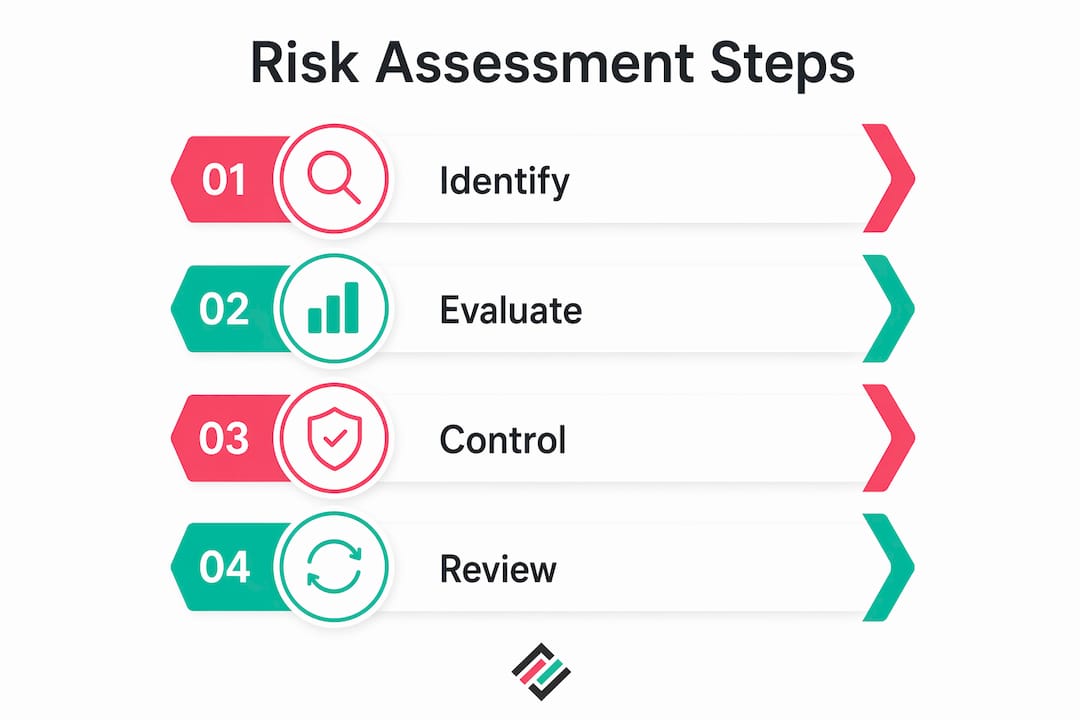
Every risk assessment moves through four core stages:
- Hazard identification: Spotting what could cause harm, whether physical, chemical, biological, ergonomic, or psychosocial
- Risk evaluation: Judging the likelihood and severity of harm if the hazard is not controlled
- Control measures: Deciding what actions to take, and implementing them in order of priority
- Monitoring and review: Checking that controls stay effective and updating the assessment when circumstances change
No single method fits every situation. EU-OSHA's guidance is explicit on this point: different methods suit different circumstances, and organizations should choose approaches that match their context.
Why conducting risk assessments matters for organizations
Risk assessments protect people, assets, and operations. That is the short answer. The longer one involves legal obligations, financial exposure, and the kind of organizational culture that actually prevents incidents rather than just documenting them afterward.
Key reasons organizations conduct risk assessments:
- Legal compliance: Under Lithuanian Labor Code Article 264, employers must assess all workplace risks, covering ergonomic, chemical, biological, and psychosocial factors
- Informed decision-making: Assessments give managers ranked priorities rather than a vague sense of "things could go wrong"
- Reduced liability: Documented assessments demonstrate due diligence, which matters when incidents lead to regulatory scrutiny
- Organizational resilience: Teams that understand their risk profile respond faster and more effectively when something does go wrong
- Regulatory alignment: EU directives on workplace safety, AML, and cybersecurity all require formal risk evaluation processes
For companies expanding into Central European markets, including Poland and Sweden, understanding the local regulatory baseline is not optional. It is the starting point.

How to conduct a risk assessment step by step
The EU-OSHA four-stage framework is the most widely adopted structure in Central Europe. Here is how it works in practice:
-
Identify hazards and who is at risk. Walk the workplace, review incident records, and consult workers directly. Include non-routine tasks like cleaning or maintenance, which are often overlooked. Every person who could be affected, including contractors and visitors, belongs in scope.
-
Evaluate risks by likelihood and severity. For each hazard, estimate how probable harm is and how serious it would be. This produces a priority ranking. Existing controls count here, but only if they are actually working.
-
Decide on and implement control measures. Work through the hierarchy: eliminate the hazard first, then substitute, then engineer controls, then administrative controls, then personal protective equipment. Document what you decide and who is responsible for each action.
-
Monitor, review, and update. Assessments go stale. Schedule regular reviews, but also build in trigger-based reassessment for events like new equipment, process changes, or incidents. A review calendar alone is not enough.
Throughout every stage, consult workers and their representatives. They often know the real hazards better than anyone in a management role.
Qualitative vs. quantitative risk assessment methods
The two main methodological families differ in how they express risk: one uses descriptive categories, the other uses numbers.

| Feature | Qualitative | Quantitative |
|---|---|---|
| Output | High / Medium / Low ratings | Numerical scores or probabilities |
| Data needed | Expert judgment, observation | Statistical data, historical records |
| Speed | Faster, lower cost | Slower, more resource-intensive |
| Best for | Workplace safety, initial screening | AML, cybersecurity, financial risk |
| Limitation | Subjective; results vary by assessor | Requires reliable data; can create false precision |
In Lithuania, AML and cybersecurity risk assessments must use mandatory scoring methods, typically 1–4 scales, conducted at least every four years. Designated authorities aggregate these scores into composite risk levels for regulatory reporting.
Key considerations when choosing a method:
- Use qualitative approaches for initial assessments or where data is limited
- Apply quantitative scoring where regulations require it or where decisions involve significant financial exposure
- Combine both when you need speed without sacrificing rigor. A qualitative screen followed by quantitative deep-dive on high-priority risks is a common and practical approach
The Swedish Chemicals Agency draws a useful distinction: hazard describes a substance's intrinsic properties, while risk combines that hazard with actual exposure. That distinction matters when choosing how to score and weight your findings.
What organizations actually gain from risk assessments
The benefits go well beyond avoiding fines, though that alone often justifies the effort.
- Fewer incidents: Identifying hazards before they cause harm is cheaper, in every sense, than responding after the fact
- Regulatory compliance: Meeting Lithuanian, Polish, Swedish, and EU-level requirements avoids enforcement action and reputational damage
- Better resource allocation: Prioritized risk rankings tell you where to spend your safety and compliance budget first
- Stronger risk culture: Teams that participate in assessments develop sharper awareness of hazards in their daily work
- Competitive positioning: Companies that can demonstrate mature risk management processes win contracts and partnerships that require it, particularly in regulated sectors
For financial organizations, the connection between risk assessment and profitability is direct. Understanding your risk measurement methods shapes every hedging and capital allocation decision you make.
Risk assessment examples across fields in Central Europe
Risk assessment applies across nearly every sector. The methods and triggers differ; the underlying logic does not.
-
Workplace safety (Lithuania): Employers must assess all operational factors under Lithuanian Labor Code Article 264. A manufacturing plant in Vilnius, for example, would assess chemical exposure, machinery hazards, and shift-work fatigue as separate risk categories, each with its own control plan.
-
Cybersecurity (Lithuania): Financial institutions and critical infrastructure operators conduct scored cybersecurity risk assessments using mandatory 1–4 scales. These feed into national composite risk profiles reviewed by designated authorities.
-
AML and financial crime: Banks and payment firms in Central Europe run AML risk assessments that score customer types, transaction patterns, and geographic exposure. The output determines monitoring intensity and due diligence requirements.
-
Natural disaster risk (Sweden): The Swedish Civil Contingencies Agency (MSB) guides municipalities through structured risk and vulnerability analyses covering floods, storms, and infrastructure failures. These assessments directly inform emergency planning and resource pre-positioning.
-
Environmental and public health: Chemical manufacturers assess exposure pathways, concentrations, and population vulnerability. The Swedish Chemicals Agency framework, covering hazard identification, exposure assessment, and risk characterization, is a regional reference standard.
Risk assessment is not a compliance checkbox. When done well, it is the clearest picture an organization has of what could actually go wrong and how bad it would be. That picture drives every meaningful safety and resilience decision.
What Central European regulatory agencies say about best practices
The Swedish Civil Contingencies Agency (MSB) frames risk analysis around three core questions: What could happen? How likely is it? What are the consequences? These questions sound simple, but they discipline the process and prevent assessors from drifting into vague generalities.
"Risk analysis is a tool to support management decision-making, not an end in itself. The focus should be on adverse scenarios, their likelihood, and their impacts." — MSB Guide to Risk and Vulnerability Analyses
Regulatory requirements in Lithuania and across the EU reinforce this framing. Risk assessment must produce usable outputs, not just documentation. That means results need to be ranked, communicated to decision-makers, and acted on.
Pro Tip: Build reassessment triggers into your process from the start. EU-OSHA recommends reviewing assessments not only on a schedule but whenever a significant change occurs, such as new equipment, a process modification, or a near-miss incident. Waiting for the annual review cycle after a major change is one of the most common compliance gaps.
A frequent mistake practitioners make is focusing only on likelihood while ignoring exposure factors like the number of people affected or how long they are exposed. A low-probability event affecting thousands of people may warrant more attention than a high-probability event affecting one person. Risk matrices are decision tools, not perfect measures of risk.
Challenges and limitations you should know about
Risk assessments are only as good as the information and judgment behind them. Several structural limitations affect even well-designed processes.
Subjectivity in qualitative assessments is the most common problem. Two experienced assessors can look at the same hazard and assign different severity ratings. Without calibration sessions or shared scoring criteria, results across teams or sites become inconsistent.
Data gaps undermine quantitative approaches. Scoring models require reliable historical data, and many organizations, particularly smaller ones, simply do not have it. Filling gaps with assumptions produces false precision rather than genuine insight.
Scope creep and scope gaps pull in opposite directions. Assessors sometimes expand scope until the process becomes unmanageable, or they exclude non-routine tasks and end up with blind spots. Cleaning shifts, contractor activities, and temporary process changes are routinely missed.
Static assessments in dynamic environments are a persistent failure mode. An assessment completed before a major equipment upgrade or a shift in workforce composition can actively mislead decision-makers by suggesting a level of control that no longer exists.
How to interpret and communicate risk assessment results
A completed assessment that sits in a folder helps no one. The results need to reach the people who can act on them, in a form they can actually use.
Start with the priority ranking. High-severity, high-likelihood risks demand immediate action. Medium risks need scheduled controls. Low risks warrant monitoring but not emergency response. Presenting results as a ranked list rather than a raw data dump makes the path forward obvious.
Tailor communication to the audience. Senior leadership needs the financial and legal exposure picture. Operations teams need specific hazard descriptions and control instructions. Workers need to understand what changed in their immediate environment and why.
For financial risk specifically, the risk reporting checklist approach, covering composite scores, trend lines, and threshold breaches, gives executives the structured view they need to make capital and hedging decisions. The same principle applies across sectors: format the output for the decision the recipient needs to make.
Document everything. Records of what was assessed, what was found, what was decided, and who is responsible form the audit trail that regulators and insurers will ask for. EU-OSHA recommends that assessment records be accessible to workers and their representatives, not just management.
Key Takeaways
Risk assessment is a four-stage systematic process, covering identification, evaluation, control, and review, that keeps hazards at manageable levels and satisfies legal obligations across Central European regulatory frameworks.
| Point | Details |
|---|---|
| Four-stage process | Every assessment covers hazard identification, risk evaluation, control measures, and ongoing review. |
| Legal obligation in Lithuania | Lithuanian Labor Code Article 264 requires employers to assess all workplace risks, including ergonomic and psychosocial factors. |
| Method choice matters | Qualitative methods suit initial screening; Lithuanian AML and cybersecurity rules require mandatory 1–4 numerical scoring scales. |
| Reassessment triggers | Reviews should follow process changes or incidents, not just scheduled audits, per EU-OSHA guidance. |
| Communication is part of the process | Results must reach decision-makers in ranked, actionable form, with full documentation accessible to workers. |
FAQ
What is the meaning of risk assessment?
Risk assessment is a systematic process of identifying hazards, evaluating how likely and severe the harm could be, and deciding on controls to keep risks at acceptable levels.
What are the 5 main steps of a risk assessment?
EU-OSHA's standard framework covers four stages: identify hazards, evaluate risks by likelihood and severity, implement control measures, and monitor and review. Some frameworks split the control stage into decision and implementation, producing five steps.
What is a risk assessment in the workplace?
A workplace risk assessment identifies physical, chemical, biological, ergonomic, and psychosocial hazards that could harm workers, then sets out controls to prevent injury or illness. In Lithuania, this is a legal requirement under Article 264 of the Labor Code.
Why is risk assessment important?
Risk assessment protects people from harm, keeps organizations legally compliant, and gives decision-makers a ranked picture of where to focus resources. Without it, hazards go unaddressed until they cause incidents.