

Under Article 9 of UK EMIR, every UK counterparty trading FX derivatives must report the transaction to an FCA-registered or recognised trade repository by the next business day after execution, modification, or termination. FX swaps can require one report or two, depending on whether the swap was booked as a single contract or two linked forwards. Firms also need to track a fresh set of validation rules and XML schema changes landing on January 26, 2026, which will touch reconciliation and field-level accuracy across the board.
TL;DR:
- Firms must update their reporting systems to reflect the new schema and validation rules by January 26, 2026, to avoid accidental rejections.
- FX swap reports should be based on whether the contract was concluded as a single trade or two linked forwards, with clear documentation to prevent mismatches.
- Delegation of reporting does not transfer legal responsibility; firms must maintain oversight of their counterparty's report accuracy and include active notifications for intragroup and threshold exemptions.
- Reconciliation of FX reports must be conducted frequently, ideally monthly, with urgent attention to common issues like UTI mismatches, LEI expiries, and omitted package identifiers.
- Accurate, timely resolution of reporting errors and breaks is a regulatory requirement, with firms expected to escalate and resolve issues as quickly as possible.
Table of Contents
- UK FX Transaction Reporting: The Rules at a Glance
- Who Actually Has to Report: FCA and Bank of England Roles
- What Data Actually Goes Into an EMIR FX Report
- How FX Swaps Should Be Reported Under UK EMIR
- Reconciliation, Errors, and What Regulators Actually Expect
- What's Changing in 2026: New Validation Rules and Schemas
- Building an Operational Compliance Checklist for 2026
- How CorpHedge Thinks About EMIR-Ready FX Reporting
- Where CorpHedge Fits Into Your FX Reporting Workflow
- Sources
- FAQ
UK FX Transaction Reporting: The Rules at a Glance
Scope comes first. UK EMIR applies to financial counterparties (FCs) such as banks, investment firms, and insurers, and to non-financial counterparties (NFCs) that trade derivatives above certain thresholds. Both must report, though intragroup transactions can qualify for an exemption if the firm has notified the FCA and meets the conditions set out in the technical standards.
The clock starts the moment a trade is concluded, modified, or terminated. Article 9 sets the deadline at the next business day, no exceptions for weekends or bank holidays beyond the standard business-day calculation. Miss that window and the firm is already out of compliance, regardless of whether the trade itself was reported correctly once it did go through.
Two dates matter more than any others right now. September 30, 2024 was the baseline for new or modified trades to comply with the updated reporting technical standards. Firms with legacy positions got a transition window that closed on March 31, 2025, after which every outstanding position had to reflect the new field structure regardless of when it was originally booked.
Here's what a compliance team should have pinned to the top of its regulatory tracker:
- Reporting deadline: the business day following execution, modification, or termination of a derivative contract.
- Baseline compliance date: the date from which new and modified trades must comply with revised technical standards.
- Transition deadline: March 31, 2025, for legacy trade updates to align with the new reporting fields.
- Next major change: validation rules and XML schema updates effective January 26, 2026.
- Primary references to monitor: the FCA's reporting obligation page, the Bank of England's UK EMIR Reporting Q&As, and the Bank Standards Instrument.
The Bank of England and the FCA jointly maintain UK EMIR Reporting Q&As that walk through transitional arrangements, error handling, and product-specific quirks like FX swap treatment. Any team that hasn't bookmarked that page is operating without the regulator's own worked examples, which is a strange way to run a reporting function that gets audited on accuracy.
Who Actually Has to Report: FCA and Bank of England Roles
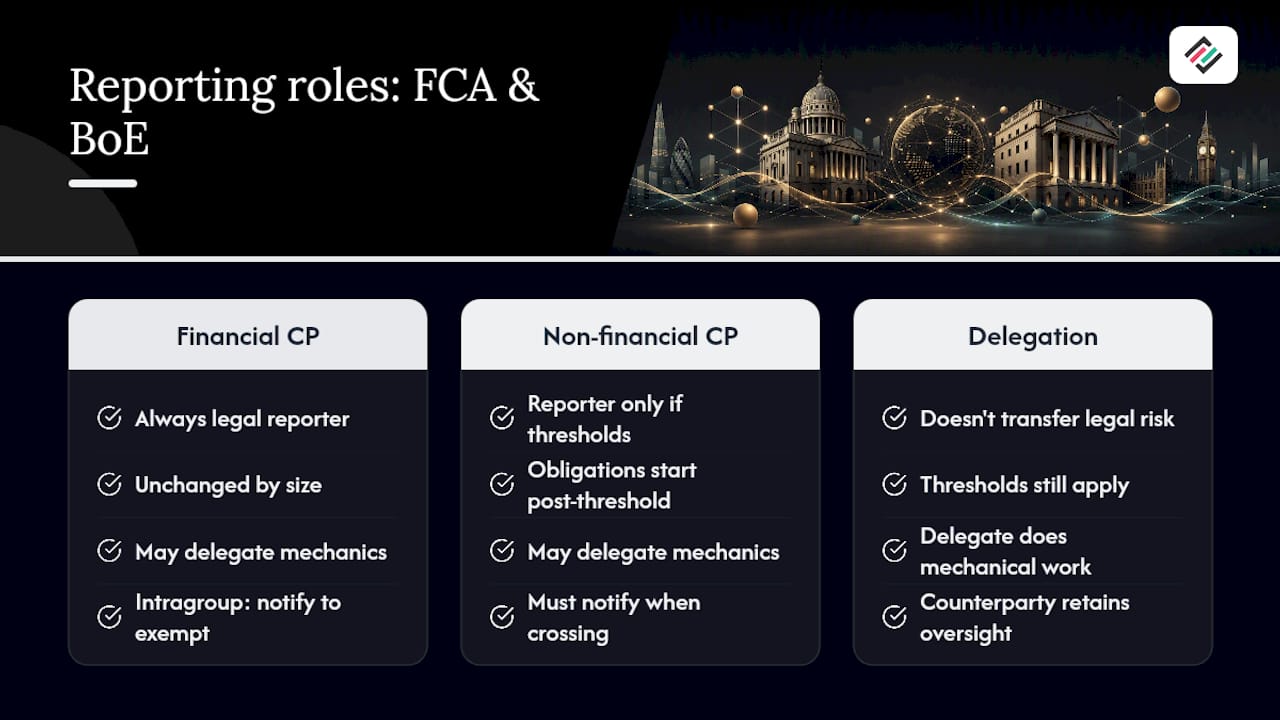
The legal reporting obligation sits with both parties to a trade, financial and non-financial alike, though the compliance burden looks different depending on which side of that line a firm falls on. A financial counterparty carries the reporting obligation regardless of the size of its derivatives book. A non-financial counterparty only breaches thresholds and takes on additional obligations, like clearing, once its notional derivatives exposure crosses the levels set in the technical standards.
Delegation changes who does the mechanical work, not who owns the legal risk. A firm can delegate reporting to its counterparty, a third-party vendor, or a trade repository connection provider, but the underlying obligation to ensure the report is complete and accurate stays with the counterparty itself. If a delegated report goes out wrong, the regulator doesn't care whose system generated the error. It cares whether the counterparty that owed the obligation had reasonable controls in place to catch it.
That distinction trips up more firms than it should. Treasury teams sometimes assume that once a bank counterparty agrees to report on their behalf, the compliance question is closed. It isn't. Regulatory guidance treats delegation as an operational convenience, not a liability transfer, which means oversight of the delegate's output still belongs on the internal compliance calendar.
Intragroup exemptions require active notification, not passive eligibility. A firm doesn't get to simply decide its intragroup trades qualify and stop reporting. It has to notify the FCA, meet the conditions in the technical standards (both entities consolidated in the same group accounts, adequate centralized risk evaluation, no legal impediment to prompt transfer of funds), and keep that notification current if group structure changes.
Clearing-threshold notifications work on a similar logic. An NFC that crosses the clearing threshold in any derivative asset class has to notify both the FCA and ESMA-equivalent UK bodies, and that notification triggers obligations that go beyond reporting, including mandatory clearing for new contracts in that asset class. Firms that hover near the threshold should be running the calculation more than once a year. A single large hedge executed near a reporting period end can push a firm over the line without anyone noticing until the next audit.
The practical takeaway for risk managers: map every FX counterparty relationship against these three questions before assuming reporting is handled. Who has the legal obligation? Who has been delegated the mechanical task? And has anyone actually filed the intragroup or threshold notifications the exemption depends on? Answering those three questions honestly is where most reporting gaps get found, usually after the fact rather than before it.
What Data Actually Goes Into an EMIR FX Report
The Bank Standards Instrument: The Technical Standards (EMIR Reporting and Data Quality and Miscellaneous Amendments) Instrument 2025 sets out the minimum data fields a report must contain, and it's a longer list than most treasury teams expect on their first read. Counterparty identifiers, product classification, notional amounts, currency pairs, settlement dates, collateral fields where applicable, and event dates all have defined formats and defined validation logic tied to them.
Trade-level reporting captures the individual transaction: the specific FX forward, swap, or option executed on a given day, with its own Unique Trade Identifier (UTI). Position-level reporting, by contrast, aggregates certain exposures where the technical standards permit it, typically for products that get netted or rolled in ways that make daily trade-by-trade reporting impractical. FX derivatives are almost always reported at trade level rather than position level, given the bespoke nature of most corporate FX hedges, but firms running large flow books should confirm which convention applies to each product line rather than assuming trade-level reporting is universal.
UTI generation follows a defined hierarchy: one counterparty generates the identifier, shares it with the other side, and both parties reference the same UTI when submitting to their respective trade repositories. Delegation of UTI generation is permitted, but the rules for who generates first and how it gets communicated are specific, and cross-referencing failures here are one of the most common causes of reconciliation breaks between counterparties. If both sides generate their own UTI independently, or one side fails to pass the identifier along in time, the two reports arrive at the trade repository looking like two unrelated trades rather than two sides of the same one.
Legal Entity Identifiers are non-negotiable. Every counterparty to a reportable trade needs an active LEI, and a lapsed LEI is treated the same as a missing one for reporting purposes. Firms that let LEI renewals slip, which happens more often than compliance teams like to admit given the annual renewal cycle, will find their reports rejected or flagged even though the underlying trade data is perfectly accurate. The fix is procedural, not technical: build LEI renewal into the same calendar that tracks reporting deadlines, and treat a 60-day advance renewal reminder as standard practice rather than an afterthought.
Legacy trades versus outstanding positions is where firms most often get caught out during a transition period like the one that closed in March 2025. A trade booked years ago under an older field structure doesn't get grandfathered forever. Once it's still outstanding past a transition deadline, it needs to be updated to reflect current reporting standards, which for firms with long-dated FX hedges (a three-year forward hedging a supply contract, for instance) means going back through the book and remediating positions that were compliant when booked but aren't compliant under the current rules.
Here's a quick reference for the fields that cause the most friction in practice:
| Field | Common issue | Practical fix |
|---|---|---|
| UTI | Mismatched identifiers between counterparties | Agree generation hierarchy in trade confirmation templates |
| LEI | Lapsed renewal blocking valid reports | Calendar reminder 60 days before expiry |
| Notional currency | Wrong currency pair order or base/quote confusion | Standardize a single data entry convention across the desk |
| Event date/type | Miscoded modification vs new trade | Train trade capture staff on action/event type definitions |
| Package identifier | Missing on linked FX swap legs | Confirm swap booking convention with counterparty upfront |
How FX Swaps Should Be Reported Under UK EMIR
This is the single most common source of confusion in FX derivatives reporting, and it comes down to how the trade was actually booked rather than how it's economically understood. An FX swap, by its nature, is two legs: a near-date exchange and a far-date reverse exchange. But whether that gets reported as one trade or two depends entirely on the contractual structure.
Guidance from the Bank of England draws a clear line: when an FX swap is concluded as a single FX Swap contract, it gets reported as one message. When it's concluded as two separately negotiated FX Forward legs that happen to be executed together, each leg gets its own report, and the two reports are linked using a Package identifier that ties them together as a single economic transaction in the trade repository's records.
That distinction sounds academic until it isn't. Two desks trading with each other under the assumption that "an FX swap is an FX swap" can end up submitting mismatched reports, one side treating it as a single contract, the other treating it as two linked forwards, with no Package identifier connecting them. The trade repository sees what looks like inconsistent reporting between counterparties, which is exactly the kind of discrepancy that triggers a reconciliation break and, eventually, a regulator inquiry if it recurs.
The fix isn't technical. It's contractual and operational. Confirmation templates and trade capture systems should specify, at the point of execution, which construction applies to a given swap. That decision should be documented in the ISDA or other master agreement framework governing the relationship, not left to whichever trader happens to book the trade that day. Draft Q&A guidance from the Bank of England explicitly recommends formalizing this approach in the confirmation process precisely because informal or inconsistent practice is what generates the mismatches in the first place.
Practical steps for a treasury or reporting team working through this:
- Confirm with every active FX swap counterparty which reporting construction they use, single contract or package of two forwards, and get it in writing.
- Update trade capture systems to flag the construction type automatically at the point of booking, rather than relying on manual classification after the fact.
- Where the package approach applies, verify the Package identifier populates correctly on both legs before the report goes to the trade repository.
- Run a periodic sample reconciliation specifically on FX swaps, since these are a disproportionately common source of reconciliation breaks relative to their share of overall trade volume.
Getting this right once, at the contractual level, saves months of chasing individual mismatched reports later.
Reconciliation, Errors, and What Regulators Actually Expect
Regulators don't grade reporting on effort. The standard is complete, accurate, and on-time data, full stop, and the Bank of England's guidance is explicit that reconciliation breaks must be resolved "as soon as practicably possible" rather than on some extended timeline convenient to the reporting firm. That phrase does a lot of work. It doesn't specify a fixed number of days, but it does mean a break sitting unresolved for weeks because nobody prioritized it is a supervisory problem waiting to surface.
Material errors carry a separate obligation: notify the relevant Authority. Not every typo in a report rises to that level, but a systemic issue, wrong notional values across a batch of trades, a UTI generation failure affecting an entire counterparty relationship, or a misapplied action/event type across a product line, does. The threshold for "material" isn't always obvious in the moment, which is why compliance teams benefit from having a documented internal escalation policy that doesn't rely on someone's individual judgment call under time pressure.
Large or complex remediation projects deserve their own governance, not a quiet bulk-fix run over a weekend. Regulatory guidance treats significant remediation as something firms should engage with the Authority on bilaterally rather than resolve unilaterally, partly because a badly executed bulk remediation can introduce new reconciliation breaks even as it fixes the old ones.
The most common error patterns worth building specific controls around:
- UTI mismatches from independent generation by both counterparties instead of following the agreed hierarchy.
- LEI issues, usually a lapsed renewal rather than a genuinely missing identifier.
- Action/event type miscodes, where a modification gets reported as a new trade or vice versa.
- Currency pair or notional formatting inconsistencies, particularly across systems that weren't originally built with EMIR field structures in mind.
- Package identifier omissions on FX swaps booked as linked forward legs.
Pro Tip: Run a monthly, not quarterly, sample reconciliation against your top five FX counterparties by volume. Reconciliation breaks compound. A mismatch that takes ten minutes to fix in week one can take half a day to untangle by week twelve once dozens of related trades have been booked on top of the unresolved discrepancy.
Regulators treat clean reporting data as a systemic risk input, not a paperwork exercise. That framing matters for how a compliance team should prioritize its time: a firm with consistently poor data quality doesn't just risk enforcement, it degrades the aggregate market surveillance that trade repository data is designed to support, which is precisely why supervisory attention tends to concentrate on repeat offenders rather than isolated one-off errors.
What's Changing in 2026: New Validation Rules and Schemas
The Bank of England finalized a fresh round of amendments to UK EMIR trade repository reporting requirements in its August 2025 Policy Statement, and the practical implementation date for the associated validation rules and XML schema updates is January 26, 2026. That gives reporting teams a defined window to test and deploy changes rather than an open-ended "coming soon."
Field-level validation changes are where the operational impact actually lands. Updated schemas typically tighten formatting requirements on specific fields, close gaps that allowed inconsistent reporting under the old rules, and in some cases add new mandatory fields tied to collateral or valuation reporting. A validation rule that used to accept a range of acceptable formats for a given field might now reject anything outside a single standardized format, which means a reporting pipeline that worked fine on January 25 can start throwing rejections on January 27 if it wasn't updated in advance.
This is a recurring pattern, not a one-time event. Schema and validation-rule updates arrive on a cycle, and treating regulatory-change management as a continuous operational task rather than a periodic project is what separates firms that sail through implementation dates from firms that scramble the week before.
Practical testing steps worth building into any change-management process:
- Set up a recurring calendar check against the Bank of England's published amendment schedule, not a one-time read of the current Policy Statement.
- Use trade repository test environments to validate schema changes against sample trade data well before the live implementation date.
- Version-control every schema and mapping file internally, so a rollback is possible if a deployed update introduces unexpected rejections.
- Automate schema and version checks in reporting pipelines rather than relying on manual pre-deployment review, particularly given how frequently these updates recur.
- Cross-check field-level changes against your specific product mix. A schema update focused on collateral fields might be largely irrelevant to a firm with no collateralized FX positions, but material for one that posts variation margin regularly.
Firms that treat these updates as routine maintenance, not fire drills, are the ones that avoid the January scramble entirely.
Building an Operational Compliance Checklist for 2026
Getting UK EMIR FX reporting right isn't a one-time project. It's an ongoing operational discipline that needs the same rigor as any other regulatory obligation on the compliance calendar. Here's a sequence that works for most reporting teams, regardless of firm size.
- Confirm reporting responsibility for every FX counterparty relationship. Document whether the firm reports directly, delegates to a counterparty, or delegates to a third-party vendor, and confirm that delegation agreements are current.
- Audit LEI status across all active counterparties. Flag any LEI within 90 days of expiry and assign an owner responsible for renewal before that window closes.
- Review UTI generation hierarchy with every FX swap and forward counterparty. Get the agreed approach documented in writing, ideally referenced in the governing trade confirmation or master agreement.
- Establish the FX swap reporting convention (single contract vs package of two forwards) per counterparty relationship, and update trade capture systems to reflect it automatically.
- Update reporting pipelines and schemas ahead of the January 26, 2026 implementation date, and run validation tests against a trade repository test environment before go-live.
- Set up automated reconciliation against trade repository data, ideally daily for high-volume FX desks, with exception workflows that route mismatches to a named owner rather than a shared inbox.
- Designate a data owner for each major field category (identifiers, notional and currency fields, event/action types, collateral fields) so accountability for a given error type is never ambiguous.
- Define remediation SLAs internally, distinguishing minor field corrections from material errors requiring Authority notification, so the escalation decision doesn't get made ad hoc under deadline pressure.
- Maintain a regulatory-change calendar tracking Bank of England and FCA publication schedules, not just implementation dates, so upcoming amendments are visible months in advance rather than weeks.
- Run a quarterly internal audit of reporting completeness and accuracy, sampling across counterparties and product types rather than relying solely on trade repository feedback to surface issues.
A checklist like this only works if it has an owner. Assign the whole sequence to a named individual or small team with authority to escalate, not a rotating responsibility that gets deprioritized whenever a busier quarter comes along.
How CorpHedge Thinks About EMIR-Ready FX Reporting
Reconciliation breaks rarely start with the trade repository submission. They start upstream, in inconsistent position data, mismatched trade capture, or a counterparty relationship where nobody agreed on the FX swap reporting convention before the first trade went through. Real-time visibility into open FX positions, paired with consistent data structures across every hedge in the book, is what keeps reporting inputs clean before they ever reach a validation rule.
That's the operational principle behind how CorpHedge approaches FX exposure data: a single, current view of positions and hedges reduces the chance that reporting teams are reconciling against stale or conflicting figures after the fact. Integrations with existing treasury and banking systems matter here too, since reporting accuracy depends heavily on whether trade data arrives consistently formatted in the first place, rather than requiring manual cleanup before it can be reported at all.
None of this replaces a compliance team's own regulatory judgment. But treating data quality as a design principle, not a downstream fix, is the difference between a reporting function that spends its time on genuine edge cases and one that spends its time chasing UTI mismatches that never should have happened.
— Bartas
Where CorpHedge Fits Into Your FX Reporting Workflow
Clean EMIR reporting starts with clean position data, and that's the specific gap CorpHedge closes for finance teams. Instead of stitching together spreadsheets, bank statements, and trade confirmations to figure out what's actually outstanding before a report goes out, CorpHedge gives you a real-time view of FX positions and hedges in one place, which is the exact input reporting teams need clean before UTIs, LEIs, and swap classifications ever get finalized.

The platform's feature set covers live market data, Value at Risk analysis, and reporting integrations built for firms actively managing currency exposure, not just tracking it after the fact. As CorpHedge expands into Poland and Sweden alongside its existing UK coverage, the same operational logic applies everywhere: fewer manual handoffs between position tracking and compliance reporting means fewer reconciliation surprises down the line. If your FX hedging strategy relies on Value at Risk modeling, the same data feed that drives your risk analysis is the one that should be feeding your reporting pipeline.
Take a look at the product tour to see how position tracking and reporting workflows connect, or book a demo walkthrough with the team to talk through your specific counterparty and reporting setup.
FAQ
What Is the Deadline for Reporting an FX Derivative Under UK EMIR?
Counterparties must report a derivative contract, including FX forwards and swaps, to an FCA-registered or recognised trade repository no later than the business day following its execution, modification, or termination.
Do Both Sides of an FX Trade Have to Report It?
Yes. Both the financial counterparty and the non-financial counterparty to a trade carry the legal reporting obligation, though either side can delegate the mechanical submission while retaining ultimate accountability for accuracy.
How Should an FX Swap Be Reported, as One Trade or Two?
It depends on how the swap was concluded: a single FX Swap contract gets reported as one message, while two negotiated FX Forward legs get reported separately and linked with a Package identifier.
What Happens if a Reconciliation Break Isn't Fixed Quickly?
Regulators expect breaks resolved as soon as practicably possible, and unresolved or material errors should be flagged to the relevant Authority rather than left to accumulate silently.
What Changes on January 26, 2026?
New validation rules and XML schema updates from the Bank of England's August 2025 Policy Statement take effect, affecting field-level formatting and reporting pipeline requirements across UK EMIR submissions.