

TL;DR:
- Risk officers oversee the identification, assessment, and management of risks across five key domains to support sound governance. They must facilitate proactive risk reporting, justify governance decisions, and adapt to increased personal accountability under new regulations. Their role now involves managing extended supply chain risks, enabling growth, and ensuring personal liability compliance in high-stakes environments.
The role of risk officers is defined as owning how an organization identifies, assesses, and manages financial, operational, strategic, regulatory, and reputational risks. The Chief Risk Officer (CRO) is the recognized industry title for this function, and the position has moved from a compliance checkbox to a board-level governance priority. Regulatory frameworks like MaRisk and senior management designations like SMF4 now attach direct personal accountability to the role. For corporate executives and finance professionals, understanding what risk officers actually do, and why their function is becoming more complex, is no longer optional. It is a prerequisite for sound governance.
What are the core responsibilities of risk officers?
The CRO role covers five risk domains: financial, operational, strategic, regulatory, and reputational. Each domain requires its own identification process, assessment methodology, and control framework. The risk officer does not just flag problems. The function builds the systems that catch problems before they escalate.
Day-to-day risk management duties include:
- Risk identification and assessment: Scanning the business for exposures across all five domains and quantifying their likelihood and potential impact.
- Framework development: Building and maintaining the policies, procedures, and controls that govern how risk is managed across the organization.
- Reporting to the board: Translating technical risk data into clear summaries that allow executives and directors to make informed decisions.
- Cross-functional collaboration: Working directly with compliance, finance, legal, and IT teams to align risk controls with business operations.
- Incident response: Leading the organization's reaction to risk events, from cyber breaches to regulatory investigations.
Risk reporting is one of the most underrated parts of the job. A risk officer who cannot communicate clearly to a board is a risk officer who cannot do the job. The risk reporting checklist used by finance executives in 2026 reflects this: boards now expect structured, data-backed risk summaries on a regular cycle, not just during crises.
Pro Tip: Build your risk reporting template around three questions: What is the exposure? What is the control? What is the residual risk? Boards retain that structure far better than dense technical reports.

How have 2026 regulatory changes shaped risk officer governance?
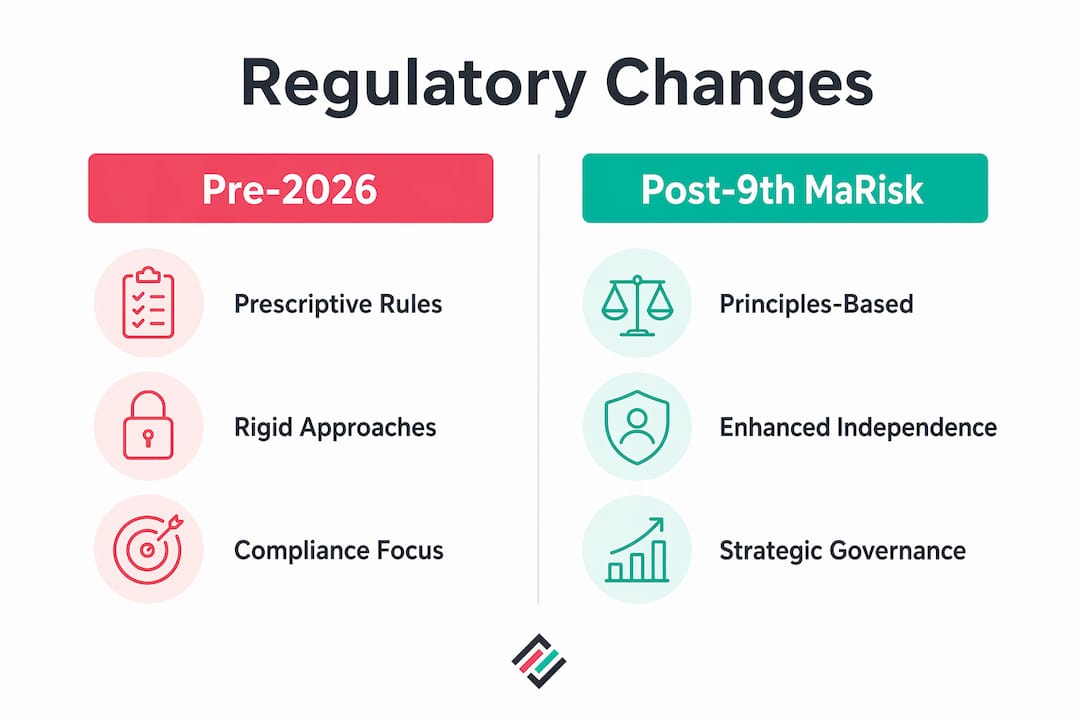
The 9th MaRisk amendment in Q2 2026 marks a significant shift in how regulators expect risk governance to work. The amendment moves from prescriptive rules to principles-based governance. That sounds like more freedom, but it actually increases individual accountability. Risk officers must now justify their governance choices, document their reasoning, and continuously review whether their frameworks remain fit for purpose.
The practical implications break down into four areas:
- Proactive risk identification: Institutions can no longer rely on regulatory checklists. Risk officers must demonstrate that they actively seek out new exposures before they materialize.
- Documented governance rationale: Every significant governance decision requires written justification. Regulators expect to see the reasoning, not just the outcome.
- Independent risk committees: Financial institutions in Central Europe with at least 5% market share of balance sheet assets must form an independent risk exposure and management committee with non-executive members, effective as of july 2026.
- Cooperation between risk control and compliance: The amendment explicitly requires these two functions to work together, not operate in parallel silos.
The independence requirement deserves particular attention. Large regulated institutions must maintain a risk management function that reports directly to supervisory bodies, not solely to the CEO. This structural requirement exists to prevent the risk function from being subordinated to short-term commercial pressure.
| Governance area | Pre-2026 approach | Post-9th MaRisk approach |
|---|---|---|
| Rule structure | Prescriptive requirements | Principles-based with documented justification |
| Individual accountability | Shared institutional responsibility | Direct personal responsibility for risk officers |
| Committee independence | Recommended for large institutions | Mandatory at 5% market share threshold |
| Risk-compliance cooperation | Encouraged | Explicitly required |
What emerging risks are risk officers prioritizing now?
The 2025 European Chief Risk Officer Survey identifies nth-party risks as the top strategic priority for CROs heading into 2026 and beyond. Nth-party risk refers to the risk that originates not from your direct vendors, but from your vendors' vendors, and the layers beyond that. A software provider your bank relies on may itself depend on a cloud infrastructure provider in a jurisdiction with different resilience standards. That chain of dependency is now a recognized risk category.
The shift toward integrated risk functions reflects this complexity. Financial services firms are moving away from siloed models where cyber risk, operational resilience, and third-party oversight each sit in separate teams. The integrated approach treats these as interconnected exposures that require a single, coordinated view.
"The risk function of 2026 is not a gatekeeper. It is an intelligence function. Its job is to map the full network of dependencies the organization relies on, stress-test that network, and tell the board what breaks first."
Risk officers now use scenario analyses and data-driven modeling to answer questions that did not exist five years ago. What happens to our payment processing if a fourth-tier cloud vendor in Eastern Europe goes offline? How does a regulatory change in Poland or Sweden affect our cross-border FX exposure? These are the questions driving the financial risk management strategies that global companies are building today.
- Nth-party risk mapping requires visibility beyond tier-one suppliers.
- Digital dependency audits are becoming a standard part of annual risk assessments.
- Scenario analyses now include geopolitical disruption, not just financial stress tests.
- Integrated risk functions reduce the blind spots that siloed teams create.
How do risk officers balance enabling growth with managing exposure?
The most common misconception about risk officers is that their job is to say no. The CRO function is defined by enabling the organization to take the right risks knowingly and well, not by eliminating risk entirely. A company that takes no risk takes no growth. The risk officer's job is to make sure the risks being taken are understood, priced correctly, and aligned with the organization's stated risk appetite.
Risk appetite frameworks formalize this balance. They define the types and levels of risk the organization is willing to accept in pursuit of its objectives. A well-constructed framework gives business units clear boundaries within which they can move quickly, without needing risk sign-off on every decision.
| Risk posture | What it means | Risk officer's role |
|---|---|---|
| Risk-averse | Minimize exposure, accept lower returns | Set tight controls, flag deviations |
| Risk-neutral | Accept market-level exposure | Monitor and report against benchmarks |
| Risk-seeking | Accept higher exposure for higher returns | Define limits, stress-test scenarios |
Risk heat maps and scenario analyses are the primary tools risk officers use to communicate trade-offs to boards. A heat map shows the concentration of risk across the business at a glance. A scenario analysis answers the question: what does our balance sheet look like if this specific event occurs? Together, they give executives a factual basis for decisions that would otherwise rely on intuition.
Pro Tip: When presenting risk appetite to a board, anchor the conversation to a specific business decision already on the table. Abstract risk tolerance discussions rarely land. Concrete trade-offs always do.
For companies operating across borders, including those expanding into markets like Poland and Sweden, currency risk strategies form a critical part of the risk officer's toolkit. FX exposure can erode margins faster than most operational risks, and it requires its own governance layer.
What accountability do risk officers carry in high-stakes environments?
In regulated financial institutions, the risk officer role carries direct personal liability. The SMF4 designation in the UK, and equivalent senior management functions in other jurisdictions, makes the CRO legally accountable for the adequacy and effectiveness of the risk management framework. This is not an advisory role. It is a named, regulated function with documented responsibilities filed with the regulator.
The accountability structure requires:
- Statements of Responsibility: Written documents that define exactly what the risk officer is personally accountable for.
- Regulatory filings: Active engagement with supervisory bodies, not just internal reporting.
- Framework adequacy reviews: Regular assessments confirming that controls remain effective as the business changes.
- Post-incident analysis: Documented reviews of what failed, why it failed, and what changed as a result.
Crisis management quality is tested within the first 48 hours after a major incident. Pre-coordinated plans involving legal, IT, and communications teams determine whether an event is contained or escalates into an existential threat. Risk officers who wait for a crisis to build their response plan will always be behind. The plan must exist, be tested, and be known by every team involved before the incident occurs. Monitoring SEC filing red flags is one practical example of how proactive risk oversight catches structural problems before they become crises.
Key Takeaways
The role of risk officers is to build and operate the governance systems that allow organizations to take calculated risks, meet regulatory requirements, and respond to crises before they become catastrophic.
| Point | Details |
|---|---|
| Core function | Risk officers own identification, assessment, and management across five risk domains. |
| 2026 regulatory shift | The 9th MaRisk amendment increases personal accountability and requires documented governance rationale. |
| Emerging priority | Nth-party risks from extended supply chains are now a top CRO focus for 2026. |
| Strategic balance | Risk officers enable growth by defining risk appetite, not by blocking decisions. |
| Personal liability | SMF4 and equivalent designations make CROs legally accountable for framework adequacy. |
Why the risk officer role is the most underestimated position in corporate governance
I have spent years watching organizations treat the risk function as a compliance cost rather than a strategic asset. That view is changing, but not fast enough. The executives who get the most value from their risk officers are the ones who bring them into business decisions early, not after the term sheet is signed.
The 9th MaRisk amendment is forcing a cultural shift that many institutions were not ready for. Principles-based governance sounds liberating until you realize it means the risk officer's judgment is now on the line, not just the institution's policy manual. That raises the bar for who should hold the role and what skills they need.
The risk officers I have seen succeed in 2026 share three traits. They communicate in business language, not risk jargon. They build relationships with the CFO and general counsel before a crisis, not during one. And they treat scenario analysis as a strategic planning tool, not a regulatory exercise. The ones who struggle are still operating as if their job is to produce reports. The job is to change decisions.
The integration of cyber, operational resilience, and third-party oversight into a single risk function is not a trend. It is the new baseline. Any organization still running these as separate silos is carrying more risk than it knows.
— Bartas
Corphedge and the risk management tools finance teams need
Currency risk sits at the intersection of financial exposure and strategic decision-making, which makes it one of the most direct applications of everything a risk officer manages.
Corphedge builds FX risk management solutions for corporate finance teams that need more than a spreadsheet. The platform applies Value at Risk methodology to help organizations quantify their currency exposure and build hedging strategies that align with their risk appetite. For companies operating across European markets, including Poland and Sweden, Corphedge provides real-time position visibility and integration with existing finance workflows. Finance professionals looking to bring the same rigor to FX risk that their risk officers apply to operational and regulatory risk can explore corporate FX risk management use cases directly on the Corphedge platform.
FAQ
What is the primary role of a risk officer?
The risk officer owns how an organization identifies, assesses, and manages risks across financial, operational, strategic, regulatory, and reputational domains. The function exists to enable informed risk-taking, not to eliminate risk entirely.
What skills are most important for a risk officer in 2026?
Risk officers need strong analytical skills for scenario modeling and data interpretation, combined with the communication ability to translate technical findings into board-level decisions. Regulatory literacy, particularly around frameworks like MaRisk and SMF4, is now a baseline requirement.
How does the 9th MaRisk amendment affect risk officer responsibilities?
The 9th MaRisk amendment shifts governance from prescriptive rules to principles-based requirements, placing greater personal accountability on risk officers to justify and document their governance choices continuously.
What are nth-party risks and why do they matter?
Nth-party risks are exposures that originate from vendors' vendors and the layers beyond direct suppliers. They matter because digital dependencies have made extended supply chains a primary source of operational and cyber risk for financial institutions.
Can a risk officer be held personally liable?
Under designations like SMF4 in the UK, and equivalent senior management functions in other regulated jurisdictions, risk officers carry direct personal liability for the adequacy of the risk management framework, requiring documented Statements of Responsibility filed with regulators.