

IFRS 7 asks you to show investors how much exchange-rate movements could move your profit or loss and equity, currency by currency, using year-end exposures and a range of changes that is reasonably possible. The disclosure is only as good as the exposure data behind it. Finance teams that hold positions, hedges and intercompany balances in one place can produce the analysis from live data instead of rebuilding it in a spreadsheet every year-end, which is the approach our platform is built around.
This guide is for CFOs, finance directors and risk managers at companies that report under IFRS, including UK-adopted international accounting standards. It covers what counts as currency risk, what the sensitivity analysis must contain, how to pick the rate changes, and the mistakes that reviewers keep finding.
TL;DR
- Under IFRS 7, currency risk is one of three components of market risk. It arises on financial instruments denominated in a currency other than your functional currency.
- Paragraph 40 requires a sensitivity analysis for each type of market risk, showing the effect on profit or loss and equity of reasonably possible changes, plus the methods, assumptions and any changes to them.
- Use year-end exposures, each currency with significant exposure, and a range based on history, volatility and the assumptions you use internally. Do not use a stress test.
- Translation of foreign operations is excluded, but loans or derivatives hedging that translation risk, and most intercompany balances, are included.
- If you already manage risk with a value-at-risk model that captures interdependencies, paragraph 41 lets you disclose that instead.
Table of Contents
- What IFRS 7 means by currency risk
- What the paragraph 40 sensitivity analysis must contain
- What is in scope and what is not
- Choosing the reasonably possible change
- A worked example of reading the result
- Value at risk as an alternative under paragraph 41
- Six errors that keep appearing
- Lack of exchangeability: the IAS 21 change
- Building the analysis from live exposure data
- Where Corphedge fits
- Our perspective
- FAQ
- Sources
What IFRS 7 means by currency risk
IFRS 7 Appendix A defines currency risk as the risk that the fair value or future cash flows of a financial instrument will fluctuate because of changes in foreign exchange rates. PwC's UK accounting manual sets out that it is one of three components of market risk, alongside interest rate risk and other price risk. So when you read "market risk" in an annual report note, currency risk is a named part of it, not a separate topic.
The practical test is in paragraph B23: currency risk arises on financial instruments denominated in a currency other than the functional currency, and translation-related risk is not part of the foreign currency sensitivity analysis (PwC UK manual, risk management). The functional currency is the currency of the primary economic environment in which an entity operates. A UK subsidiary that earns and spends in sterling has sterling as its functional currency. A euro-denominated receivable on its books is exposed. A euro-functional subsidiary whose net assets you convert into sterling for the group accounts is a translation matter, which is a different question.
Functional versus presentation currency
If your presentation currency differs from your functional currency, the IFRS 7 disclosures are given by reference to the functional currency. PwC's UK guidance on IAS 21 explains the reason: exposure to currencies other than the functional currency is what affects future performance. A group reporting in sterling with a euro-functional parent should therefore measure sensitivity against the euro, not the pound.
This is why a clean map of exposures by entity and functional currency is the starting point. If you want a broader view of the exposure types behind that map, our guide to types of currency risk covers transaction, translation and economic exposure.
What the paragraph 40 sensitivity analysis must contain
Unless you use a value-at-risk analysis under paragraph 41, paragraph 40 of IFRS 7 requires three things, as set out in the IFRS 7 text on PwC's UK site:
- A sensitivity analysis for each type of market risk you are exposed to at the end of the reporting period. It shows how profit or loss and equity would have been affected by reasonably possible changes in the relevant risk variable at that date.
- The methods and assumptions used to prepare it.
- Any changes from the previous period in those methods and assumptions, and the reasons.
For currency risk, paragraph B24 means you disclose the analysis for each currency to which you have significant exposure. A group with a dominant euro and dollar book and small positions in a dozen other currencies would normally show the two large ones separately. PwC's FAQ on aggregating sensitivity disclosures adds that aggregation should give an overall picture without combining exposures with significantly different characteristics.
Year-end exposure, not the year's profit
You do not have to work out what profit or loss would have been had rates been different during the period. Paragraph B18(a), explained in PwC's UK manual, has you assume a reasonably possible change happened at the reporting date and apply it to the exposures that existed on that date. You also do not need to show every point in the range: the effects at the limits of the reasonably possible range are enough.
That is why the output is usually a short table: for each currency, the effect on profit or loss and on equity of a strengthening and a weakening.
When year-end is not representative
If the year-end position does not reflect your exposure during the year, for example because you carry large balances only around the year-end, you must say so and give the reason. The IASB standard text requires disclosure of that fact when the analyses are unrepresentative of a risk inherent in the instruments.
What is in scope and what is not
Most mistakes come from the boundary of the exposure set. The rules in B23 and the PwC commentary give a clear pattern:
| Item | In the currency sensitivity analysis? |
|---|---|
| Monetary items (cash, receivables, payables, borrowings) in a non-functional currency | Yes |
| Derivatives and loans used as hedges of translation risk | Yes |
| Foreign-currency intercompany receivables and payables | Yes, because the profit or loss effect of IAS 21 revaluation is not fully eliminated on consolidation |
| Translation of net assets of foreign operations into the presentation currency | No |
| Non-monetary items such as investments in foreign operations | No |
The intercompany point catches many groups out. The balances eliminate in the consolidated statement of financial position, yet the exchange differences can still reach consolidated profit or loss, so they belong in the analysis (PwC UK manual, para 47.114). For a group with a treasury centre lending to subsidiaries in several currencies, this can be the largest number in the table.
Choosing the reasonably possible change
The standard does not give you a percentage. It asks for a change that is reasonably possible, and that is a judgement you have to be able to defend.
The IASB's IFRS 7 supplement, as summarised by PwC, says reasonably possible movements should be based on historic movements and volatilities, management's knowledge and experience of financial markets, and future expectations and economic forecasts. The assumptions should be consistent with those management uses internally for budgeting, planning and its financial risk management strategy.
Two further points from the PwC UK manual (para 47.111):
- The period is the time until you next give these disclosures, usually the next annual report, so think in terms of twelve months.
- It is a reasonably possible change, not a worst-case scenario or a stress test.
A practical way to document the choice is to take the historical volatility of each currency pair over a period you can justify, scale it to twelve months, and check that the result matches the ranges your treasury already uses in the budget. If the budget assumes a 7% move on dollar-sterling and the note assumes 12%, auditors and regulators will ask why.
The UK regulator has pushed in this direction. The FRC's Closing Out review, summarised on IAS Plus, expects companies to explain how the macroeconomic environment affects their financial risk exposures and to reflect recent volatility in the range of reasonably possible changes. The FRC's thematic work on financial instruments, noted in EY's UK Financial Reporting Update for February 2026, aims to help companies tailor policies and risk disclosures to their own circumstances. Boilerplate that could sit in any company's report is the thing to avoid.
A worked example of reading the result
The IASB supplement includes a manufacturing case that shows how the output reads. It assumes a reasonably possible movement of 11% either way in the entity's currency against the US dollar over twelve months. Post-tax profit would be 96k higher if the currency strengthened by 11% and 96k lower if it weakened, with other components of equity 56k lower and 56k higher respectively, all other variables held constant (PwC summary of the supplement).
A reader of an annual report can take three things from a table like this:
- Direction. Profit rising when the home currency strengthens means the company is net short the foreign currency on its monetary items. The reverse means net long.
- Size. Compare the profit effect with profit before tax and with covenant headroom. A 96k swing means little for a large group and a lot for a thin-margin one.
- Equity versus profit. A separate equity effect usually points to hedge accounting reserves, such as cash flow hedges, moving through other comprehensive income rather than profit or loss.
For your own note, the same logic works as a review check: if the profit effect looks odd given what you know about your balance sheet, an exposure is probably missing or sitting in the wrong entity.
Value at risk as an alternative under paragraph 41
Paragraph 41 allows an entity that already prepares a sensitivity analysis such as value at risk, reflecting interdependencies between risk variables like interest rates and exchange rates, and that uses it to manage financial risks, to disclose that instead of the paragraph 40 analysis. The IFRS 7 text attaches conditions: you explain the method, the main parameters and assumptions, and the objective of the method and its limitations that may mean the information does not fully reflect fair value.
For companies that already run a VaR-based hedging policy, this avoids maintaining two parallel sets of numbers. Our pages on hedging based on value at risk and our guide to value at risk in currency risk management explain how the measure works at portfolio level.
Six errors that keep appearing
BDO's May 2026 article on common errors in currency risk sensitivity analysis lists six recurring mistakes. They map neatly onto a pre-close checklist:
- Using average exposure instead of year-end exposure.
- Repeating the same currency change every year instead of a reasonably possible change for the period.
- Ignoring the twelve months until the next disclosure.
- Including translation of investments in foreign operations, which are non-monetary items.
- Excluding net-investment hedge loans where settlement is neither planned nor likely.
- Leaving out loans or derivatives used to hedge translation risk, which are monetary items and must be included.
Numbers 1 and 2 are data problems: you need positions at the reporting date by entity and currency, and a documented rationale for the range. Numbers 4 to 6 are classification problems: each balance has to be tagged correctly before it enters the model. Teams that gather this by emailing subsidiaries at year-end usually find the errors late.
Lack of exchangeability: the IAS 21 change
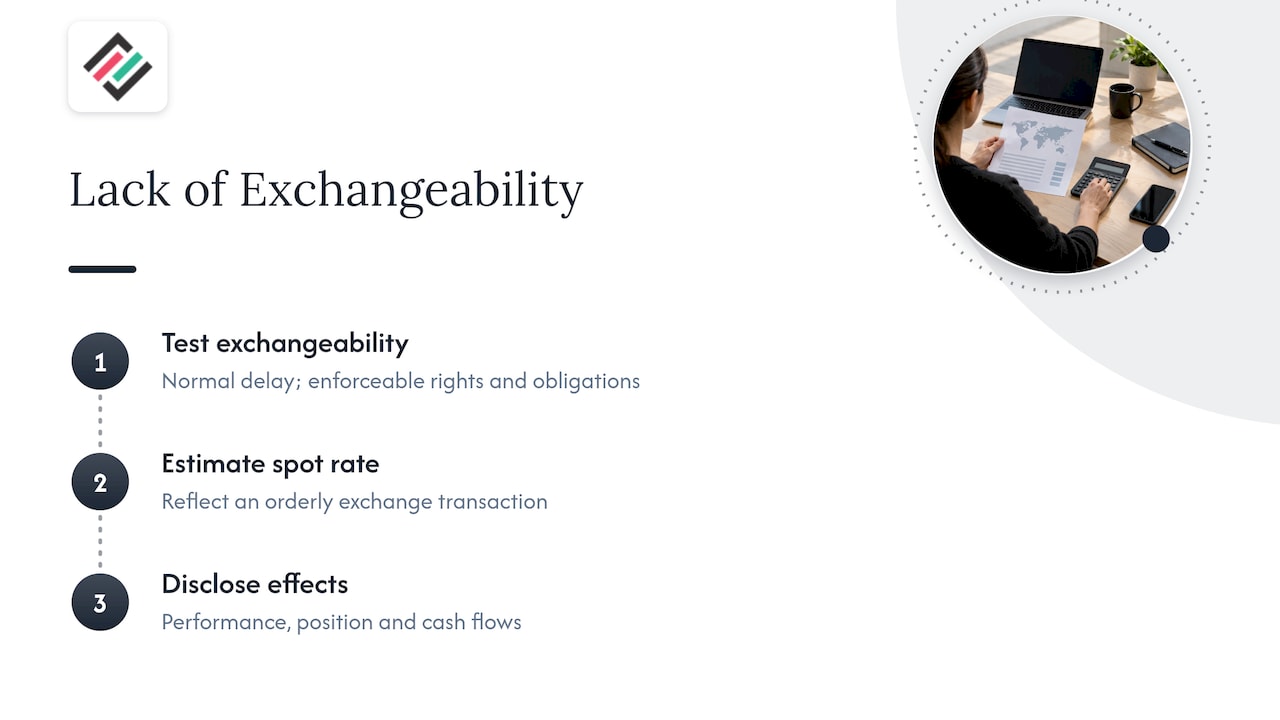
One recent change touches currency disclosures. The IASB's August 2023 amendments to IAS 21 on lack of exchangeability apply to annual periods beginning on or after 1 January 2025, with early application permitted, according to IAS Plus. EY's March 2026 IFRS update summarises the mechanics: a currency is exchangeable when it can be obtained within a normal administrative delay through a market that creates enforceable rights and obligations. If not, you estimate a spot rate that reflects an orderly exchange transaction, and disclose how the lack of exchangeability affects or is expected to affect performance, position and cash flows. Comparatives are not restated.
If you trade into or hold balances in restricted currencies, add them to your review list. Check the current UK endorsement status of the amendment against the official UK endorsement information before finalising the note.
Building the analysis from live exposure data
The disclosure itself is a year-end task, but the inputs exist all year. The steps below turn that into a routine.
- List exposures by entity and functional currency. Include cash, receivables, payables, borrowings, intercompany balances and derivatives.
- Classify each item. Monetary or non-monetary, in or out of scope, hedge or not.
- Set the range per currency. Base it on volatility, management's view and the assumptions you use for budgeting, and keep the working paper.
- Apply the strengthening and weakening to year-end balances. Show profit or loss and equity separately.
- Check representativeness. Compare year-end exposure with the average during the year and disclose if they differ materially.
- Write the methods and assumptions, and what changed. Reviewers read this narrative closely.
Our platform covers currency position tracking, hedging strategy simulation, Value at Risk analysis, portfolio reporting and live market data, so the exposure list, the hedge positions and the risk figures sit in the same place. For steps 1, 3 and 4 that means the numbers you disclose are the numbers you manage with. See how the Corphedge platform is used. Related reading on the reporting side: currency risk reporting for finance teams and board reporting on currency risk.
Where Corphedge fits
Corphedge is an online platform for corporate FX risk management. It offers currency position tracking, hedging strategy simulation, Value at Risk analysis, portfolio reporting, live market data and automated notifications, with operational expert advice available alongside. For teams that want the underlying methodology first, we also sell an FX hedging course for €220, one-off, on the Academy page.
If your year-end sensitivity note is the point where exposure data gets stitched together by hand, the Corphedge platform is where we would start.
Our perspective
Sensitivity analysis is often treated as an accounting exercise done once a year. We see it differently. The same questions, how large is the exposure in each currency, how far could the rate reasonably move, what does that do to profit and equity, are the questions a finance team should be asking all year to manage risk.
That is why we built Corphedge around live position tracking, Value at Risk analysis and portfolio reporting for companies of all sizes. Our aim is enterprise-grade analytics that SMEs can afford and use daily. When the exposure picture is current and the ranges are the ones you actually use to plan, the IFRS 7 note stops being a separate project. It becomes a summary of work you have already done.
We are also expanding to Poland and Sweden, where internationally active finance teams face the same year-end question in their own reporting context.
Bartas
FAQ
Does IFRS 7 require a currency sensitivity analysis for every currency?
It requires one for each currency to which you have significant exposure. Small positions in minor currencies can be grouped, provided the aggregation gives an overall picture and does not combine exposures with significantly different characteristics.
Do I include translation of foreign subsidiaries?
No. Translation of net investments in foreign operations is not part of the foreign currency sensitivity analysis. Loans or derivatives used to hedge that translation risk are monetary items and are included.
What range of exchange-rate change should I use?
Use a change that is reasonably possible over the period until your next disclosure, normally twelve months. Base it on historical movements and volatility, management's market knowledge and expectations, and keep it consistent with the assumptions used in your budget and risk strategy. It is not a worst-case scenario.
Can I use value at risk instead?
Yes, if you prepare a VaR-type analysis that reflects interdependencies between risk variables and use it to manage financial risks. You then disclose the method, its main parameters and assumptions, and its objective and limitations.
Which currency do I measure against if my presentation currency differs?
Your functional currency. The disclosures refer to exposure against the functional currency because that is what affects future performance.
Sources
- PwC UK manual: Scope of IFRS 7 and disclosures
- PwC UK manual: Risk management (paras 47.86 - 47.127)
- PwC UK manual: IAS 21 presentation and disclosure
- IFRS 7 Financial Instruments: Disclosures (PwC UK)
- IFRS 7 Nature and extent of risks (IASB text)
- PwC FAQ 47.111.1 on aggregating sensitivity disclosures
- IFRS News: IFRS 7 supplement
- BDO: Common errors in currency risk sensitivity analysis
- IAS Plus: FRC Closing Out review
- EY UK Financial Reporting Update, February 2026
- IAS Plus: New and revised pronouncements as at 30 September 2024
- EY IFRS Update, March 2026