

Creating reliable, bank-ready financial reports is time-consuming and error-prone for teams managing foreign exchange risk. Many legacy platforms require lengthy configuration, charge for automated reporting, or restrict access to key workflows without a sales process. This side by side comparison makes it possible to choose an FX risk management solution with automated reports that fit your team size and support needs.
Table of Contents
- Corphedge
- Treasury Systems
- MORS Software
- Trovata
- Ripple Treasury
- HighRadius Financial Statement Software
- Comparison of alternatives
Corphedge

At a Glance
Real-time FX risk tracking and valuation combined with automated reports and VaR-based stress testing. According to the company, Corphedge has earned industry recognition including a top risk management solution award. The platform targets SMEs and treasury teams with cloud access and expert support such as live sessions and strategy guidance.
Core Features
-
Real-time FX risk tracking and valuation. Live position feeds and immediate valuation let finance teams see exposure changes as markets move.
-
Custom FX hedging policy setup. Teams can encode hedge rules and enforce them across positions for consistent execution.
-
Automated risk reports and sensitivity analysis. Scheduled reports reduce manual reconciliation and put scenario outputs into CFO-ready formats.
-
Historical data backtesting and stress testing tools. Use past rates to test hedging approaches and simulate adverse currency moves.
-
Portfolio management, cash flow analysis, notifications, and macroeconomic insights. The suite also supports API links to trading platforms such as Corpay.
Key Differentiator
Corphedge packages enterprise-grade analytics into an interface and support model aimed at smaller firms. The platform pairs analytical capabilities like VaR analysis and backtesting with live expert sessions. That combination brings tools usually reserved for large corporates into an SME workflow and daily reporting cadence.
Pros
-
User-friendly for SMEs and CFOs. The interface and setup focus on finance teams that lack dedicated treasury desks.
-
Affordable access to enterprise-style risk analysis. The product claims lower cost of entry while keeping features for larger accounts.
-
Provides real-time, actionable insights. Live valuation plus scheduled reports speed decision cycles and reporting to banks or lenders.
-
Broad strategy support including hedging, natural hedging, and VaR. Teams can test passive and active approaches with historical stress tests.
-
Integrates with trading and compliance systems. API links and partnerships reduce duplicate data entry for treasury and accounting.
Cons
- The platform’s complexity may overwhelm new users without prior FX risk knowledge and can require dedicated training or vendor support for full use.
Who It's For
Finance teams at SMEs, CFOs, and treasurers who manage regular cross-border receipts or payables will find this useful. The product fits organizations that need automated bank-ready reports and want to apply formal hedging rules without building internal tools. It also suits firms preparing for formal credit discussions where transparent FX reporting matters.
Unique Value Proposition
Real-time valuation plus automated risk reporting reduces the time your team spends reconciling FX positions and preparing documents for banks. Corphedge ties live analytics to support sessions so smaller finance teams can adopt formal hedging policies faster. The result is clearer bank-ready reports and more consistent policy execution.
Real World Use Case
A manufacturing SME used Corphedge to map monthly foreign-currency payables and receivables, then created a hedging policy and automated reports for the CFO. That setup cut unexpected FX hits and produced a regular report suitable for bank credit reviews and internal budgets.
Pricing
Corphedge lists pricing as informational only. Public tier details are limited and the vendor appears to provide tailored quotes based on company size and feature needs. Prospective buyers should request a demo and a written pricing proposal.
Website: https://corphedge.com
Treasury Systems
At a Glance
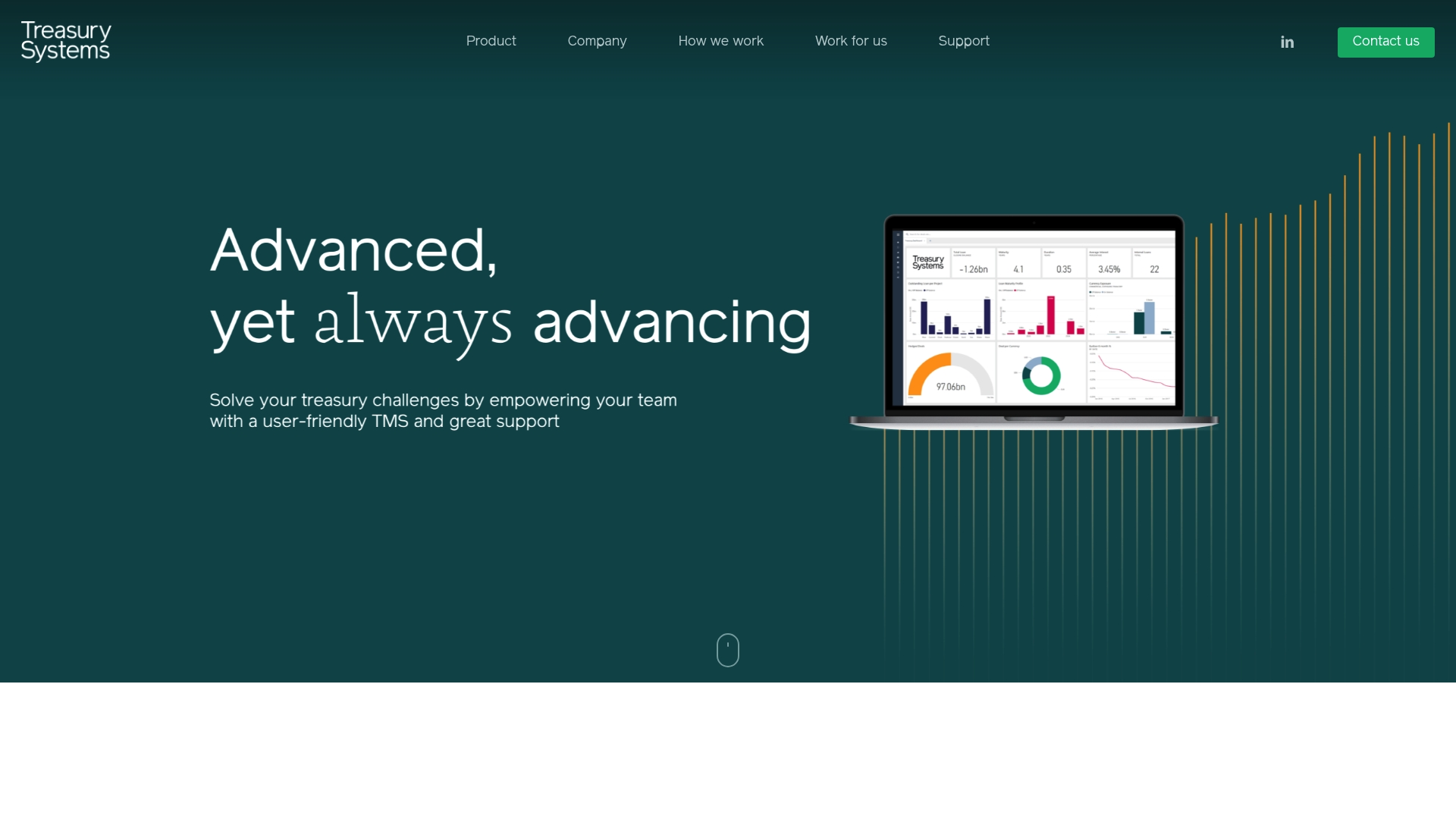
According to the vendor, Treasury Systems reports use by treasurers in over 90 companies worldwide. The product pairs a cloud-first treasury management system with continuous upgrades and a product lineage that dates back since 1984. That history shows in the feature depth and the emphasis on enterprise integrations.
Core Features
-
User interface designed for treasury teams with modern UI and configurable workspaces for front, middle, and back office users.
-
Automated deal capture and processing that reduces manual entry and speeds up trade lifecycle tasks.
-
Real-time risk management with policy monitoring and alerts to flag exposures as market moves occur.
-
Data visualization dashboards and customizable reporting, including connectors for Power BI to export and flesh out reports.
-
Integrations with market data providers, trading stations, ERP systems, and banks. The product also includes automation tools such as Autopilot for scheduling and routine notifications.
Key Differentiator
Treasury Systems focuses on being a next-generation cloud-based TMS while keeping a long operational history. Its steady product updates and deep links to market data and trading platforms set it apart for teams that must keep treasury workflows aligned with external liquidity and price feeds. That combination targets treasury departments that need integration first and feature breadth second.
Pros
-
Comprehensive coverage across front, middle, and back office functions. This reduces the need for separate point solutions in many treasury stacks.
-
Strong automation and workflow capabilities. Autopilot and scheduled tasks cut repeated manual steps for teams that manage many counterparties.
-
Robust risk monitoring with real-time policy checks. Treasuries can surface breaches and document exceptions for audit trails.
-
Flexible reporting with Power BI connectivity. The ability to push data into Power BI helps finance teams produce bank-ready management packs.
-
Long product tenure and ongoing upgrades since the 1980s. That tenure suggests mature handling of treasury use cases and regulatory changes.
Cons
-
Pricing details are not published in public materials. That lack of transparency requires contacting sales for cost estimates.
-
Complex setup and a broad feature set likely require formal training. Smaller teams may need partner support or lengthy onboarding.
-
Public third-party reviews emphasize innovation potential more than consistent user experience feedback. You may need to pilot to judge fit.
When It May Not Fit
If your treasury team is very small or lacks dedicated technical support, this TMS may feel oversized. Organizations seeking an out of the box simple cash tracker will find the setup and training overhead heavy. Also, nonenterprise firms with limited integration needs will pay for capabilities they do not use.
Notable Integrations
-
Power BI and Microsoft Power BI for reporting and dashboards.
-
Market data providers such as Reuters and Bloomberg for pricing and reference data.
-
Trading platforms including FXall, 360T, and Bloomberg FXGO for execution connectivity.
-
ERP systems and direct bank connections via the Nomentia platform.
Who It's For
This product fits treasury functions in medium to large multinational corporations. It targets teams that require automation, real-time monitoring, and bank-ready reporting across multiple currencies and markets. Treasury staff with access to IT or vendor support will get the most value.
Real World Use Case
A multinational runs Treasury Systems to automate deal entry and reconciliation across multiple legal entities. The system pulls market feeds, monitors FX exposure in real time, and exports management packs into Power BI. That setup reduced manual work and improved compliance documentation for treasury and audit teams.
Pricing
Public pricing is not listed. Treasury Systems presents its offering as informational and provides pricing on request through sales. Expect enterprise licensing and implementation costs tied to integration scope and user count.
Website: https://treasurysystems.com
MORS Software
At a Glance
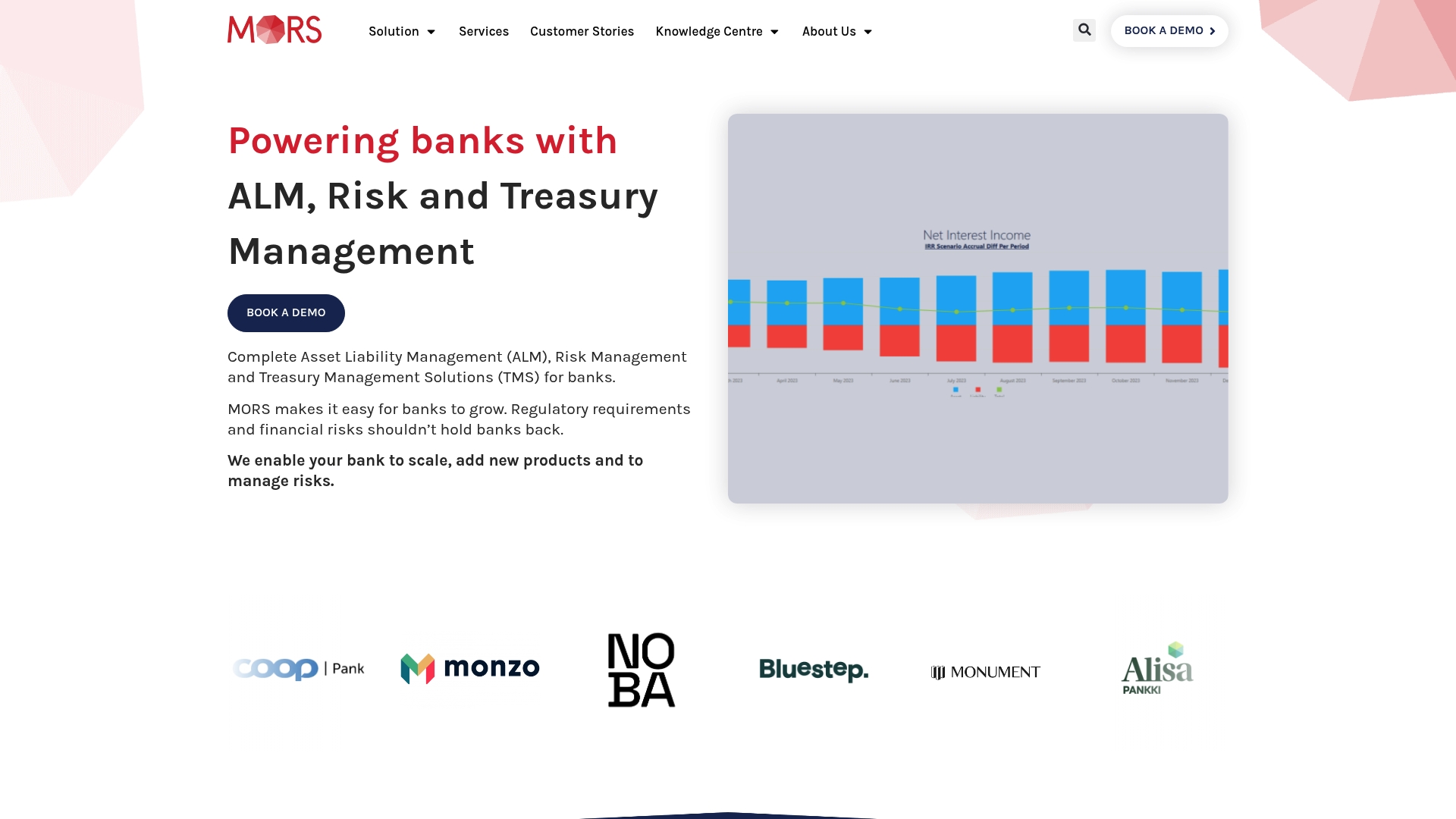
According to the vendor, implementations typically complete in 4–8 months. This speed pairs with a fixed price approach and a Finnish culture that emphasizes straightforward delivery. MORS targets banks that need integrated treasury and risk controls from day one. The vendor lists recognized clients and industry awards as evidence of market traction.
Core Features
-
Asset Liability Management (ALM) and Treasury Management System (TMS) combined in one product, removing the need to reconcile separate ledgers.
-
Flexible module model that lets banks deploy the full system or pick individual modules for specific needs.
-
Real time or near real time operation for monitoring liquidity, exposures, and intraday positions.
-
Designed for scalability so the same implementation can grow with the bank as volumes rise.
-
Track record with clients such as Monzo, bunq, and Nordax Bank as stated in vendor materials.
Key Differentiator
MORS claims to be the only risk management system that truly combines ALM and TMS in one integrated solution for banks. That single system approach reduces data handoffs between treasury and risk. For banks that prefer one vendor for both functions, MORS offers a clear product fit. It will not appeal to teams that want many best of breed point solutions.
Pros
-
Fast implementations. The vendor reports typical delivery in 4–8 months, which suits banks that must move quickly and limit project risk.
-
Fixed price projects reduce budget surprises. The vendor emphasizes set fees instead of open ended engagements.
-
Recognized client list and awards show the product has been deployed in real bank environments. That helps when you need vendor references for auditors.
-
Partnership style delivery with ongoing support and customization options for specific treasury workflows.
-
Integrated ALM and treasury features let risk teams run consolidated scenarios without manual data assembly.
Cons
-
Several third party reviews and Trustpilot feedback note the system can feel complex to customize without dedicated support.
-
Advanced modules require ongoing training to get full value from the product.
-
Integration with legacy core and general ledger systems can require custom development depending on your bank infrastructure.
When It May Not Fit
If your bank lacks a dedicated project team for integration work, this product may add strain during deployment. Banks that prefer lightweight point solutions for discrete treasury tasks will find the integrated model heavier than required. Institutions seeking out of the box connectors to very old legacy systems should budget for bespoke engineering.
Who It's For
Medium and small banks, challenger banks, and neobanks that want a single vendor for treasury and ALM functions. Teams that prefer fixed price projects and predictable implementation timelines will get the most from MORS. Banks aiming to consolidate risk and treasury reporting into one system will benefit most.
Real World Use Case
A challenger bank uses MORS to automate treasury operations and monitor liquidity positions in near real time. The bank cut manual reconciliations between ALM and treasury reports and sped up monthly reporting cycles. That allowed risk managers to react faster to intraday funding moves.
Pricing
Not applicable. Informational only. Vendor materials emphasize fixed price projects rather than a per seat subscription. Expect project pricing to depend on scope modules and integration complexity, with the vendor offering a clear quote before work begins.
Website: https://morssoftware.com
Trovata
At a Glance
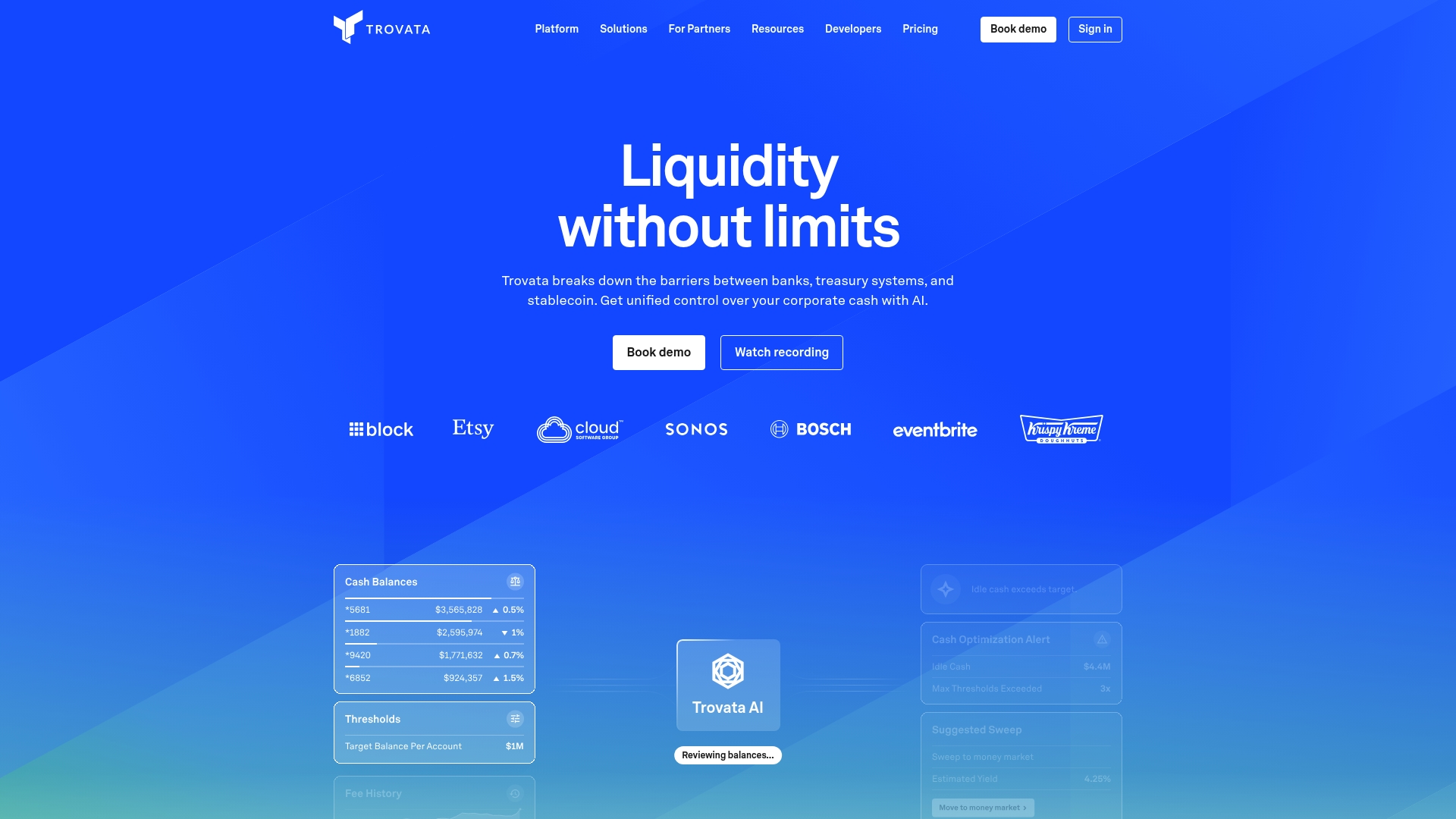
According to the vendor, Trovata supports connections to hundreds of global banks via API, SWIFT, and SFTP. That claim signals a focus on enterprises with many banking relationships. The platform pairs bank connectivity with AI driven workflows and stablecoins for programmable liquidity. For treasury teams this combination aims to reduce manual reconciliation and speed up cash movement.
Core Features
Trovata centralizes bank data and turns it into live cash views, forecasts, and reports. The platform provides automated treasury workflows for payments and FX risk tasks. It also offers managed connectivity to normalize data across multiple banks and integrate with finance systems.
- Unified bank data and cash visualization that collects balances and transactions in one view.
- AI automation for forecasting and routine treasury tasks.
- Fully managed bank connectivity to normalize feeds across API, SWIFT, and SFTP.
- Real time cash visibility, forecasting, and reporting for multi entity finance teams.
- Automated workflows for payments initiation, FX risk management, and accounting integration.
Key Differentiator
Trovata’s core edge is its universal banking API layer combined with AI automation and stablecoins for global programmable liquidity. That technical approach lets finance teams move digital money and run rules across jurisdictions. The design makes sense for firms that need both high volume connectivity and automated cash operations.
Pros
-
Supports broad bank connectivity and multiple transfer methods, which reduces custom integration work for banks.
-
Runs on a modern cloud environment, which helps with scalability for large account counts.
-
Integrates with ERP and accounting platforms, so data flows into reporting and reconciliation.
-
Automates treasury tasks, lowering repetitive manual work and the chance for posting errors.
-
Adds AI driven insights for cash management and forecasting to improve short term liquidity decisions.
Cons
-
Complex multi bank and multi entity setups can take longer to implement.
-
The vendor does not publish standard pricing, which means you must ask for a quote to budget accurately.
-
The platform’s depth may exceed the needs of small businesses that have simple cash management needs.
When It May Not Fit
If your company runs a single bank with simple cash flows, Trovata’s scale and managed connectivity may add unnecessary complexity. Teams without dedicated treasury resources could find the onboarding demands high. Organizations that require fixed list pricing for procurement may need a different vendor or a custom contract.
Notable Integrations
- Netsuite
- Oracle ERP
- Sage Intacct
- SAP
- FloQast
- SWIFT
- Custodians and investment platforms
Who It's For
Finance, treasury, and accounting teams at mid sized to large enterprises that need real time liquidity visibility will benefit most. The product suits organizations with multiple banking relationships and complex cash workflows. Treasury groups that want to automate forecasting and payments will find the platform aligned to their needs.
Real World Use Case
A multinational connects all banking relationships to Trovata to automate cash flow forecasting and manage currency risk across jurisdictions. The company reduced manual file handling and consolidated visibility into one reporting layer. Finance leaders used that consolidated view to make faster short term funding decisions.
Pricing
Trovata does not list public pricing. Expect enterprise style commercial terms and custom quotes based on bank count and integration scope. Procurement teams should request a proposal and implementation estimate before committing.
Website: https://trovata.io
Ripple Treasury
At a Glance
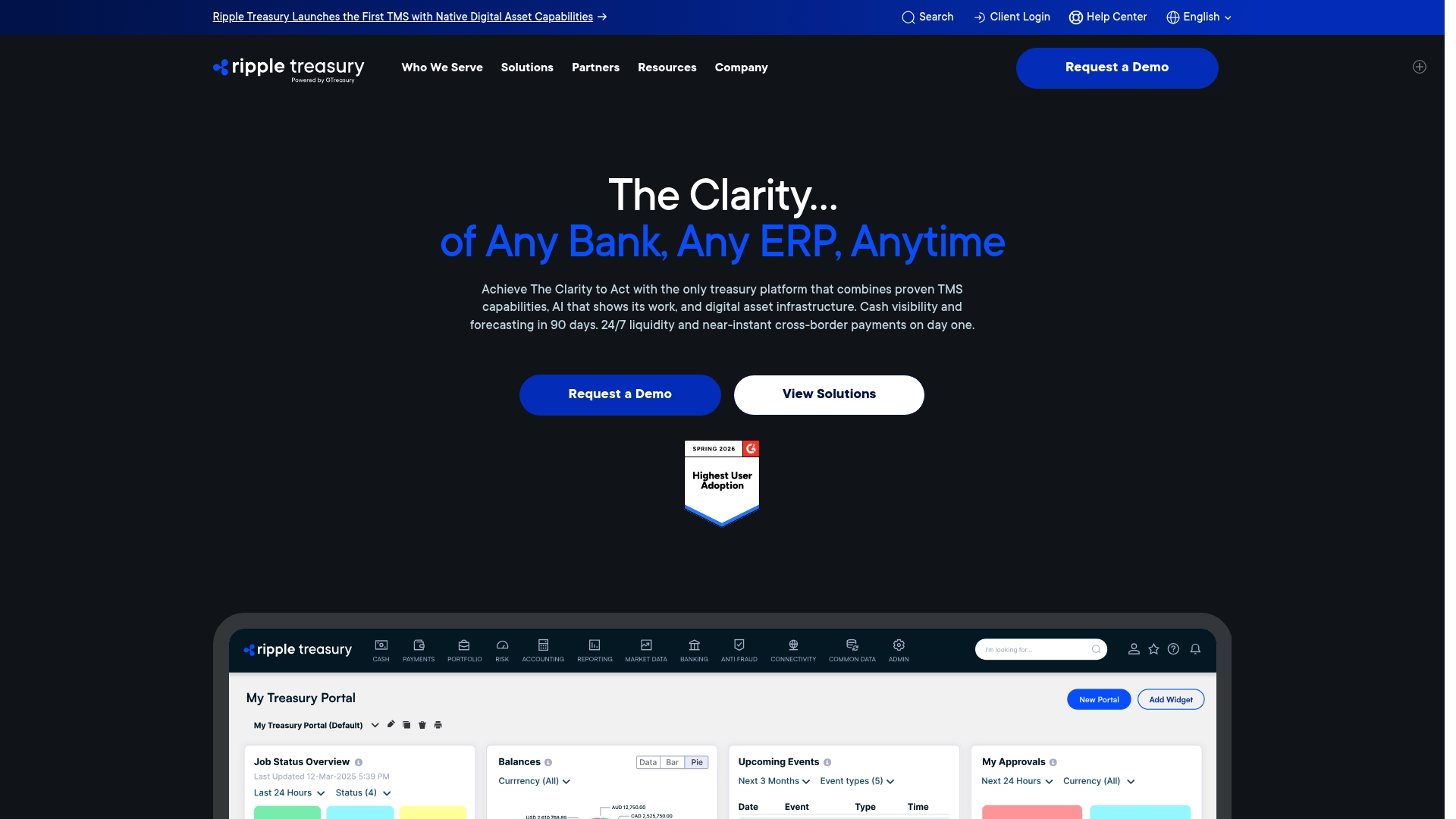
The vendor advertises most core features operational within 90 days. Ripple Treasury targets CFOs building bank-ready financial reporting with combined cash visibility and digital asset controls. The platform pairs a unified treasury system with AI powered forecasting and native digital wallets for cross border liquidity.
Core Features
-
Unified dashboard for cash and digital assets. View bank balances, token holdings, and exposure in one place. This reduces the need to reconcile multiple reports.
-
AI powered cash forecasting and risk management. Forecasts use historical cash flows and market signals to surface short term liquidity gaps. Teams can adjust scenarios and compare outcomes.
-
Digital wallet creation within the platform. Create and manage institutional wallets under the same governance rules as cash accounts. That keeps custody controls and reporting consistent.
-
Real time exposure tracking and market data integration. The system pulls live rates and positions for immediate visibility across currencies and assets.
-
Automation of payments and netting processes. Scheduled payment runs and netting reduce manual transfers and operational overhead.
Key Differentiator
Ripple Treasury combines proven treasury management workflows with embedded AI and native digital asset infrastructure. That means treasury workbooks, forecasting, and tokenized liquidity live in a single platform. For teams that must operate on banking rails and new payment rails at once, that reduces reconciliation and shortens decision loops.
Pros
-
Robust, customizable platform suited to different treasury needs. Admins can tailor modules to match existing processes without rebuilding core controls.
-
Strong digital asset integration with institutional grade compliance. The product groups wallets and cash accounts under common governance and reporting.
-
Fast deployment for core functionality. The vendor advertises short timelines for getting essential features running.
-
Modular design allows tailored solutions. You can add digital asset or treasury modules as requirements change.
-
Trusted by industry leaders across sectors. That claim appears in vendor materials and indicates enterprise adoption interest.
Cons
-
Limited public detail on specific integrations or API capabilities. Procurement teams will need technical documentation before committing.
-
No clear pricing structure is provided. Expect enterprise level, custom pricing rather than fixed subscription tiers.
-
Buyers must verify platform compatibility with legacy ERP and bank connectivity. Migration work may be nontrivial for complex environments.
Who It's For
This product fits CFOs and treasury teams at large enterprises that run both traditional cash and digital assets. It suits organizations that need consolidated reporting for banks and tokenized liquidity. Teams that require modular deployment and vendor supported rollouts will find the platform relevant.
Real World Use Case
A multinational corporation deployed Ripple Treasury to gain real time cash visibility across subsidiaries. Treasury replaced manual spreadsheets with the platform dashboard and automated netting across currencies. That cut reconciliation time and improved intraday liquidity decisions.
Pricing
Pricing is not specified in vendor materials and appears to follow an enterprise level, custom model. Expect implementation, licensing, and optional module fees quoted after needs assessment. Procurement teams should request a detailed statement of work and pricing schedule during vendor evaluation.
Website: https://treasury.ripple.com
HighRadius Financial Statement Software
At a Glance
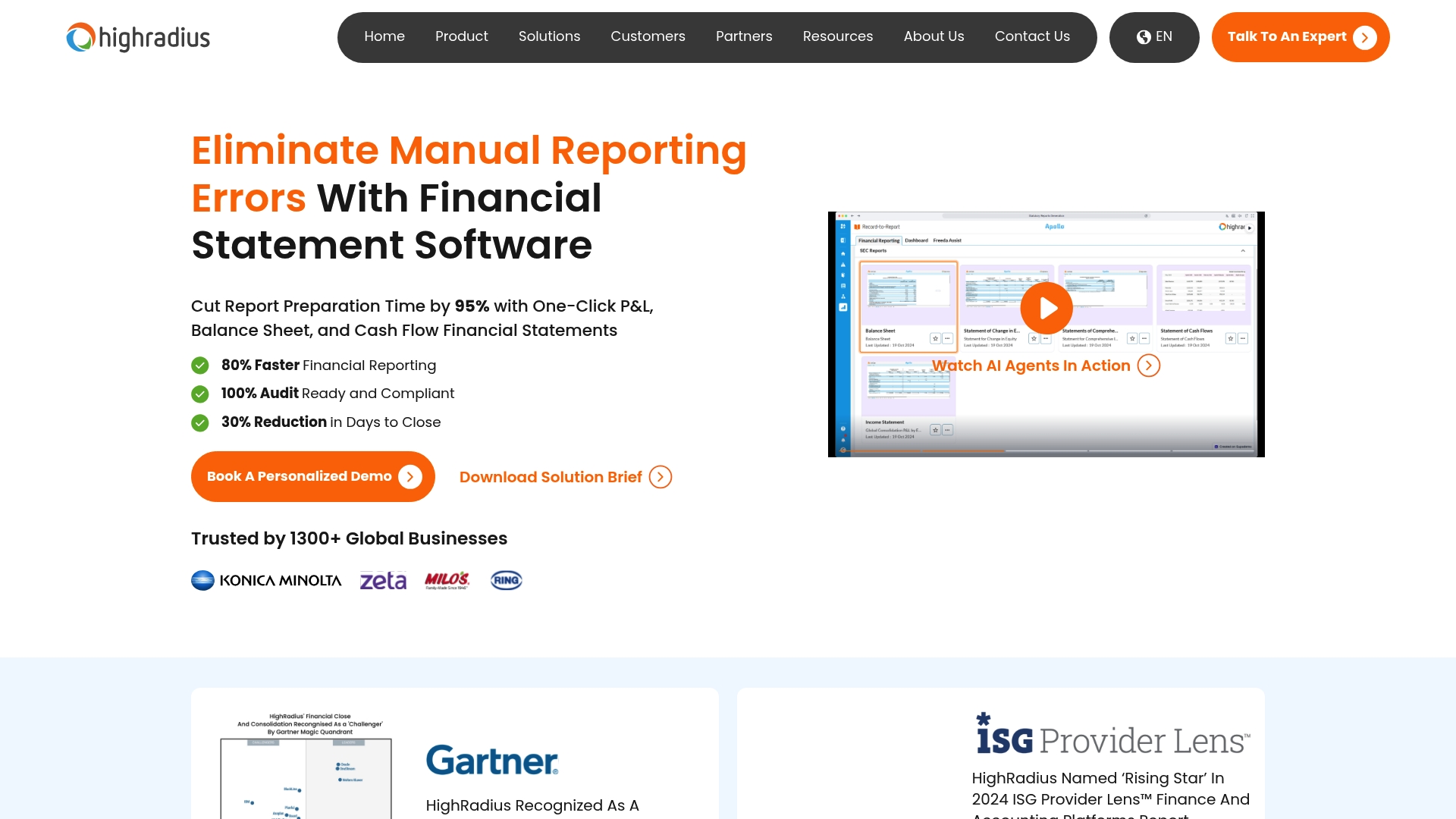
According to the company, HighRadius cuts report preparation time by 95% through one click generation of P&L, balance sheet, and cash flow statements. The vendor reports it is used by over 1,300 global businesses and cites recognition in analyst reports. That combination targets large finance teams that need fast, audit ready reporting.
Core Features
- Automated financial statement generation for P&L, balance sheet, and cash flow with ready templates for common formats.
- One click report creation with template libraries to standardize outputs across entities.
- Real time analytics and variance analysis that surface unusual balances and material movements.
- Audit trail and compliance management that logs adjustments, approvals, and source links.
- Multi entity and multi currency consolidation support for cross border reporting.
Key Differentiator
HighRadius centers on one click automatic generation of compliant, audit ready financial statements with built in error detection and standardization. That approach reduces manual reconciliations and enforces a single report standard across entities. The tool focuses specifically on record to report needs rather than general ledger or planning tasks.
Pros
-
Significantly reduces manual work for month end. That efficiency claim above comes from the vendor and is tied to its one click report flow.
-
Improves data accuracy through automated mappings and validation rules. The vendor asserts high accuracy from these controls.
-
Strengthens audit readiness with retained trails of adjustments and approvals. Auditors can trace numbers back to source ledgers.
-
Handles global reporting by ingesting trial balances, applying eliminations, and supporting multiple currencies. This fits multinational consolidation workflows.
-
Real time dashboards highlight variance drivers so finance can act faster on material items.
Cons
-
Most performance and adoption figures come from vendor materials and analyst mentions rather than independent user reviews.
-
Implementation requires ERP integration and mapping effort. Complexity will vary by ERP landscape and chart of accounts.
-
Training and change management are necessary for enterprise rollouts. Expect a learning curve for reconciliation owners.
-
Specific industry edge cases or limitations are not explicitly documented in the provided materials.
When It May Not Fit
This product is not suited for small finance teams that lack an ERP or central chart of accounts. It will be a heavy lift for firms with fragmented ledgers and minimal integration resources. If you need a lightweight reporting view for a single entity, a simpler tool may be faster to adopt.
Notable Integrations
The vendor reports support for over 50 ERP systems, including SAP, Oracle, NetSuite, and Microsoft Dynamics. Integrations focus on trial balance ingestion, intercompany flows, and ledger mapping to the reporting model.
Who It's For
Large finance organizations with multi entity, multi currency consolidation needs will get the most value. Teams that run formal audit cycles and must produce GAAP or IFRS compliant statements will find the controls useful. Corporate groups with central IT and ERP governance will realize the fastest payback.
Real World Use Case
According to the vendor, a multinational used the software to cut report generation from weeks to hours by consolidating trial balances and automating eliminations. That change improved audit readiness and shortened board reporting cycles.
Pricing
Pricing is not specified in the provided materials and appears to be customized for enterprise requirements. Expect implementation and licensing to reflect number of entities, ERP complexity, and required integrations.
Website: https://highradius.com/product/financial-statement-software
Comparison of alternatives
Selecting an FX risk management solution requires weighing your business's unique needs against the product features available. Several solutions, such as Corphedge and its competitors, offer capabilities tailored to different groups, from SMEs to large enterprises, supporting various levels of integration and analysis capacities.
Adaptability to SME Needs
Corphedge focuses on delivering tools that cater to finance teams with smaller dedicated treasury operations. Thanks to its real-time valuation instruments and stress-testing features, teams can efficiently mitigate risk without the overhead associated with enterprise-scale tools. This contrasts with systems like MORS Software, which targets businesses requiring integrated treasury and ALM systems.
Integration and Automation Features
Ripple Treasury provides a versatile setup for integrating digital assets alongside traditional treasury activities, which distinguishes it in supporting cross-border liquidity management. Trovata excels in bank connectivity, streamlining multi-bank data normalization. These features may outweigh Corphedge for firms needing extensive, entity-spanning integration.
Best fit
- Corphedge is a reliable choice for SMEs that need real-time valuation tools alongside automated reporting without overspending on features meant for larger organizations or banks.
- Ripple Treasury suits enterprises that require handling of digital assets integrated with traditional banking services.
- Trovata benefits large corporations managing complex banking relationships through its multi-bank data consolidation tools.
Our pick
Corphedge leads for SMEs aiming to manage foreign exchange exposure efficiently and require features such as real-time valuation and stress testing. However, businesses with more specialized needs, like extensive integration capabilities or digital asset management, may consider alternatives such as Trovata or Ripple Treasury.
The options presented below highlight platforms tailored for efficient foreign exchange risk management for finance and treasury teams, focusing on features and usability.
| Product | Key Features | Target Audience | Pricing | Limitation |
|---|---|---|---|---|
| Corphedge | Real-time FX tracking, customizable hedging policies, and automated risk analysis tools | SMEs, CFOs, treasury teams | Not disclosed | Complexity may require training for finance teams without FX experience. |
| Treasury Systems | Comprehensive treasury management, real-time policy monitoring, and Power BI connectivity | Medium to large multinational corporations | Not disclosed | Complex setup and customization require dedicated IT and vendor support. |
| MORS Software | Integrated ALM/TMS, real-time monitoring, fixed-price implementation pricing | Medium to small banks, challenger banks | Not disclosed | Advanced modules demand ongoing training for optimal use. |
| Trovata | AI-driven forecasts, bank connectivity, and automated multi-bank treasury workflows | Finance and treasury teams at mid to large enterprises | Not disclosed | Detailed configurations prolong onboarding for multi-entity setups. |
| Ripple Treasury | Consolidated cash/digital asset views, AI forecasting, and digital wallet creation | Large enterprises managing traditional and digital assets | Not disclosed | Compatibility with legacy ERP systems needs meticulous verification. |
Simplify Your Bank-Ready Financial Reporting with Corphedge
Managing foreign exchange risk while producing reliable bank-ready financial reports can feel overwhelming for many finance teams. Key challenges include real-time FX risk visibility, automation of complex hedging policies, and delivering audit-ready documents efficiently. Corphedge bridges these gaps by offering a user-friendly platform that delivers live FX exposure insights, automated risk reports, and stress testing based on Value at Risk methodologies.
Discover how Corphedge can help you:
- Track FX positions and valuations in real time
- Automate policy-driven hedging execution and reporting
- Cut reconciliation time with CFO-ready reports

Ready to reduce manual work and improve your foreign exchange risk controls? Explore more about how Corphedge supports bank-ready financial reporting with advanced analytics and automation on Corphedge. Take control now and request a demo to see how automated FX risk management can streamline your reporting and decision making.
FAQ
What features make Corphedge an ideal choice for bank-ready financial reporting?
Corphedge offers a combination of real-time FX risk tracking and automated reporting, which are critical for creating bank-ready financial documents. This includes real-time valuation and scheduled reports that enable finance teams to maintain accurate and timely disclosures. Consider using Corphedge for streamlined reporting processes and enhanced financial oversight.
How does Corphedge compare to Treasury Systems in terms of automation?
Treasury Systems provides strong automation with its Autopilot feature, which reduces manual entries and speeds up treasury functions. In contrast, Corphedge excels with its real-time analytics and comprehensive reporting capabilities tailored for SMEs, making it particularly effective for companies looking to adopt formal hedging processes without extensive manual tasks. If your needs lean more towards real-time reporting with expert support, Corphedge is a better fit.
Can Corphedge's automated reporting help reduce reconciliation time?
Yes, Corphedge's automated risk reports significantly lessen manual reconciliation efforts. The platform generates scheduled reports that streamline the reporting process and allow CFOs to present bank-ready information effectively. You can expect reduced workload and improved accuracy in your financial statements when using Corphedge.
What is the implementation timeframe for using Corphedge?
Corphedge's setup generally depends on the specific needs of the organization, but it provides expert support during implementation to ensure a smooth transition. Users can expect to engage with support live to tailor the platform effectively. As a starting point, consider requesting a demo to discuss implementation tailored to your firm's requirements.
Does Corphedge support multiple currency management for financial reporting?
Yes, Corphedge specializes in foreign exchange risk management, making it well-suited for organizations that handle multiple currencies in their financial reporting. With its integration capabilities, your team can confidently navigate cross-border financial exposures, which is essential for accurate reporting and risk management.