

Run three scenarios, not ten. Convert each one into a Value at Risk (VaR) figure and a 13-week Cash Flow at Risk (CFaR) number. Set a numeric threshold that automatically triggers a staged hedge. Then repeat the whole exercise on a weekly cadence, not once a year during budget season. That is the entire discipline of currency scenario planning, stripped of the consulting-deck packaging, and it's the difference between a scenario plan that sits in a shared drive and one that actually moves money.
Most currency risk management strategies fail for a boring reason: the scenarios never connect to a decision. Good scenario planning fixes that gap before it opens.
Here's what to put in motion this week:
- Pick three FX scenarios covering your top two or three currency pairs: a base case, an adverse case, and a severe case.
- Compute VaR and 13-week CFaR for each scenario so the impact of currency fluctuations shows up in dollars or pounds, not percentages.
- Set numeric decision thresholds in advance (for example, "CFaR shortfall over $250,000 triggers a staged forward purchase") so the model output leads directly to action.
- Run a lightweight weekly review of top exposures and a monthly refresh of your volatility assumptions and limits.
Assign one person to own the 13-week CFaR update by Friday. That single habit, more than any spreadsheet template, is what separates teams that get ahead of currency swings from teams that react to them three weeks late.
Key Takeaways
Currency scenario planning works when three base/adverse/severe scenarios get converted into VaR and CFaR figures tied to numeric thresholds that trigger staged, pre-approved hedging actions on a fixed weekly to quarterly cadence.
| Point | Details |
|---|---|
| Build three scenarios | Base, adverse, and severe cases sized from historical volatility, not round-number guesses. |
| Compute VaR and CFaR together | VaR shows exposure risk; 13-week CFaR shows the cash shortfall that stress-tests liquidity. |
| Set thresholds in advance | Numeric triggers, like a CFaR shortfall over a defined buffer, remove hesitation from hedge decisions. |
| Fix natural hedges first | Contract currency and payment timing reduce variance before any market hedge is needed. |
| Run a fixed cadence | Weekly exposure checks, monthly assumption refreshes, quarterly full reviews. |
| Automate with a platform when scaling | Corphedge aggregates exposures, calculates VaR and CFaR, and routes threshold alerts to approvers automatically. |
Table of Contents
- When to Run Currency Scenario Planning and What It Should Achieve
- A Step-by-Step Process for FX Scenario Planning
- Designing FX Scenarios That Are Plausible, Not Arbitrary
- How to Calculate VaR and 13-Week CFaR Without a Quant Team
- Turning Scenario Outputs Into Hedging Rules and Approval Thresholds
- Building the Operational Backbone: Data, Roles, and Cadence
- Three Templates You Can Build This Week
- Regulatory and Compliance Considerations in Currency Scenario Planning
- What Actually Makes Scenario Planning Stick
- How CorpHedge Turns These Templates Into a Repeatable System
- Sources
- FAQ
When to Run Currency Scenario Planning and What It Should Achieve
Scenario planning isn't a quarterly ritual you schedule alongside budget season. It's a response to specific triggers, and knowing those triggers is half the battle of building a currency scenario planning ideas program that actually gets used.
Certain events should force an immediate scenario refresh, regardless of where you are in your normal cycle:
- A new market entry or new supplier relationship that introduces a currency you haven't hedged before.
- A material shift in payables or receivables, such as a large contract denominated in a foreign currency.
- A seasonal peak where working capital needs spike in a currency that's historically volatile.
- A sudden volatility spike, like a central bank surprise rate move or a geopolitical shock.
Beyond triggers, scenario planning needs to serve a specific objective, because a plan built for budget protection looks different from one built for liquidity protection. Four common objectives show up across finance teams:
- Budget protection: making sure FX moves don't blow through your annual plan's assumed rates.
- Liquidity protection: confirming you'll have enough cash, in the right currency, at the right time.
- Margin protection: understanding how currency fluctuations compress or expand gross margin on foreign-denominated sales.
- Strategic decisions: informing choices like where to invoice, which entity should hold cash, or whether to enter a new market.
Cadence should map to the objective, not run on a single fixed schedule. Cash execution decisions need a weekly look. Hedge ratio adjustments work fine on a monthly review. Strategic questions, like whether your Poland expansion changes your zloty exposure profile, deserve a full quarterly reassessment. Mixing these up, running strategic scenario reviews weekly or cash checks quarterly, is one of the most common ways teams waste effort on financial planning scenarios that never inform anything.
A Step-by-Step Process for FX Scenario Planning
The process itself is not complicated. It gets complicated when teams skip steps or reverse the order, usually by jumping straight to a spreadsheet before defining scope.
- Define scope and exposures. Decide which legal entities, which currency pairs, and which cash flows (payables, receivables, intercompany loans, forecast revenue) belong in this round of analysis. Scope creep here is the number one killer of usable models.
- Assemble your data. Pull a rolling 13-week cash flow forecast broken out by currency, separating committed flows from forecast ones. Add existing forward contracts and current cash balances by currency.
- Design the model. Choose your scenario set, your time horizon, and your confidence level. This is where you decide if you're running a 30-day VaR at 95% confidence or a 90-day CFaR at 90% confidence.
- Translate scenario rates into money. Apply each scenario's exchange rate to your exposures and produce a sensitivity table, then roll that into your VaR and CFaR outputs.
- Map outputs to action. Every number needs a home. Tie VaR breaches to staged hedging triggers, tie CFaR shortfalls to liquidity actions, and specify who approves what.
A few things matter regardless of company size:
- Keep committed and forecast cash flows in separate columns. Blending them hides how much of your exposure is actually certain.
- Use the same base scenario across departments so treasury, FP&A, and the CFO aren't arguing about whose numbers are right.
- Document your assumptions (which spot rate, which volatility window) so next quarter's update doesn't start from scratch.
Sensitivity and scenario analysis exist to surface faulty assumptions before they become expensive surprises, and they're often the opening move in any hedging conversation between treasury and the CFO.
Pro Tip: Build your scope document once, then reuse it every cycle with only the numbers updated. Teams that redefine scope every quarter spend more time arguing about what counts as an exposure than actually measuring risk.
Designing FX Scenarios That Are Plausible, Not Arbitrary
The most common mistake in economic scenario analysis for currencies is picking round numbers because they feel intuitive. Good scenario design starts from data, not intuition.
Build three core scenarios, and add a fourth only if there's a real strategic reason to model an upside case:
- Base case: current forward rates or a short-term moving average. This isn't a prediction. It's your reference point.
- Adverse case: a shock sized to a one standard deviation move over your horizon, or the worst move seen in the past 12 to 24 months for that pair.
- Severe case: a shock sized to a historical extreme, such as a currency peg break, a surprise central bank move, or a crisis-period swing.
- Favorable case (optional): useful mainly for strategic decisions like pricing or invoicing currency choice, less useful for hedging triggers.
Sizing the shock is where most teams get stuck. A workable shortcut: pull the pair's historical daily or weekly returns, compute the standard deviation over a relevant window (six months captures recent volatility regimes better than five years), then size your adverse case at roughly 1.5 to 2 standard deviations and your severe case at 3 or more. Historical approaches like this are easier to explain to a board than a purely statistical model, while parametric methods let you automate the recalculation every week. Comparing historical scenario analysis against parametric VaR is worth doing once so your team picks the approach that fits its own reporting style.
Attach a narrative to each shock, because a number without a story is hard for non-treasury stakeholders to trust. A severe scenario for GBP/EUR exposure might be framed around a policy divergence event; a severe scenario for USD/PLN might be framed around a regional risk-off move tied to broader emerging-market sentiment. Multi-factor shocks, where a rate move coincides with a liquidity squeeze, are worth modeling for your severe case specifically, since real crises rarely arrive as a single clean variable.
Cap your scenario count at three to five. Beyond that, you're not adding insight, you're adding maintenance burden and diluting the attention each scenario gets in a review meeting.
How to Calculate VaR and 13-Week CFaR Without a Quant Team
This is the part of currency risk management strategies that intimidates finance teams unnecessarily. You don't need a derivatives desk to produce a usable VaR or CFaR figure. You need a spreadsheet, a volatility estimate, and about an hour.
Quick VaR method, step by step:
- Define your exposure: say, a €2,000,000 receivable due in 30 days.
- Pick your horizon: 30 days matches the receivable's maturity.
- Estimate volatility: pull daily EUR/USD returns over the past six months and compute the standard deviation, then scale it to your 30-day horizon (multiply the daily standard deviation by the square root of 30).
- Choose a confidence level: 95% is standard for most corporate treasury use.
- Compute VaR: multiply your exposure by the scaled volatility by the confidence multiplier (1.65 for 95%).
Applied to a €2,000,000 exposure at a 1.65 multiplier, that's a VaR of about €89,000. VaR is built to describe normal conditions, not tail events, which is exactly why CFaR needs to sit alongside it for budget and liquidity stress testing.
13-week CFaR recipe:
- Map every expected cash flow by week and by currency for the next 13 weeks.
- Apply your base, adverse, and severe scenario rates to each week's foreign-currency flows.
- Convert each week's flows to your home currency under each scenario.
- Sum the shortfall between your base case cash position and your adverse or severe case position at your chosen confidence level.
A simplified 13-week cash plan might look like this:
Summed across all 13 weeks, including the flows not shown in this excerpt, that shortfall pattern is your CFaR figure: the cash buffer you'd need to hold, or the hedge you'd need in place, to absorb the adverse scenario without a liquidity gap.
Both VaR and CFaR work best as a pair rather than a substitute for each other: VaR is your exposure thermometer, CFaR is your liquidity stress test, and running only one leaves a real gap in your currency risk visibility.
Pro Tip: If you're a smaller finance team without a dedicated treasury analyst, start with a 30-day VaR window and a 13-week CFaR. That combination covers your near-term liquidity questions and your quarterly budget questions without requiring two separate modeling efforts.
Turning Scenario Outputs Into Hedging Rules and Approval Thresholds
A scenario model that doesn't trigger a decision is a reporting exercise, not risk management. The fix is a threshold table that everyone, from the FP&A analyst to the CFO, has agreed to in advance.
Numeric thresholds should be specific enough that nobody has to interpret them in the moment:
- VaR exceeding a set dollar cap on a given currency pair triggers a staged forward purchase covering a portion of the exposure.
- CFaR shortfall exceeding your minimum cash buffer triggers a drawdown of a credit facility or an emergency liquidity conversation with the board.
- A scenario showing sustained adverse movement across two consecutive weekly reviews triggers a full hedge ratio reassessment, not just a one-off transaction.
A simple decision matrix keeps this consistent:
| Metric Range | Action | Typical Approver |
|---|---|---|
| VaR within normal limit | No action, log and monitor | Treasury analyst |
| VaR exceeds cap on one pair | Staged forward purchase, 25 to 50% of exposure | Treasury manager |
| CFaR shortfall exceeds buffer | Drawdown of working capital facility | Finance director |
| Severe scenario triggers on two metrics | Emergency hedge review, board notification | CFO |
Enterprise programs that work well tend to target hedge ratios in the 70% to 90% range on committed exposures, using automation to keep exposure aggregation current rather than relying on manual quarterly pulls, and measuring hedge effectiveness within an 80% to 125% window to stay aligned with accounting requirements.
Governance breaks down in a few predictable ways: thresholds get set once and never revisited as the business grows, approval authority isn't documented so decisions stall waiting for the right signature, or the model runs but nobody's job description includes acting on it. A short checklist prevents most of this: name an owner for each threshold, put the approval matrix in writing, and revisit both every quarter alongside your hedge ratio review.
Building the Operational Backbone: Data, Roles, and Cadence
Currency scenario planning ideas only work if the underlying data pipeline doesn't require a fire drill every time you need a number. That means deciding, in advance, exactly what data you're pulling, who's responsible for pulling it, and how often the whole cycle repeats.
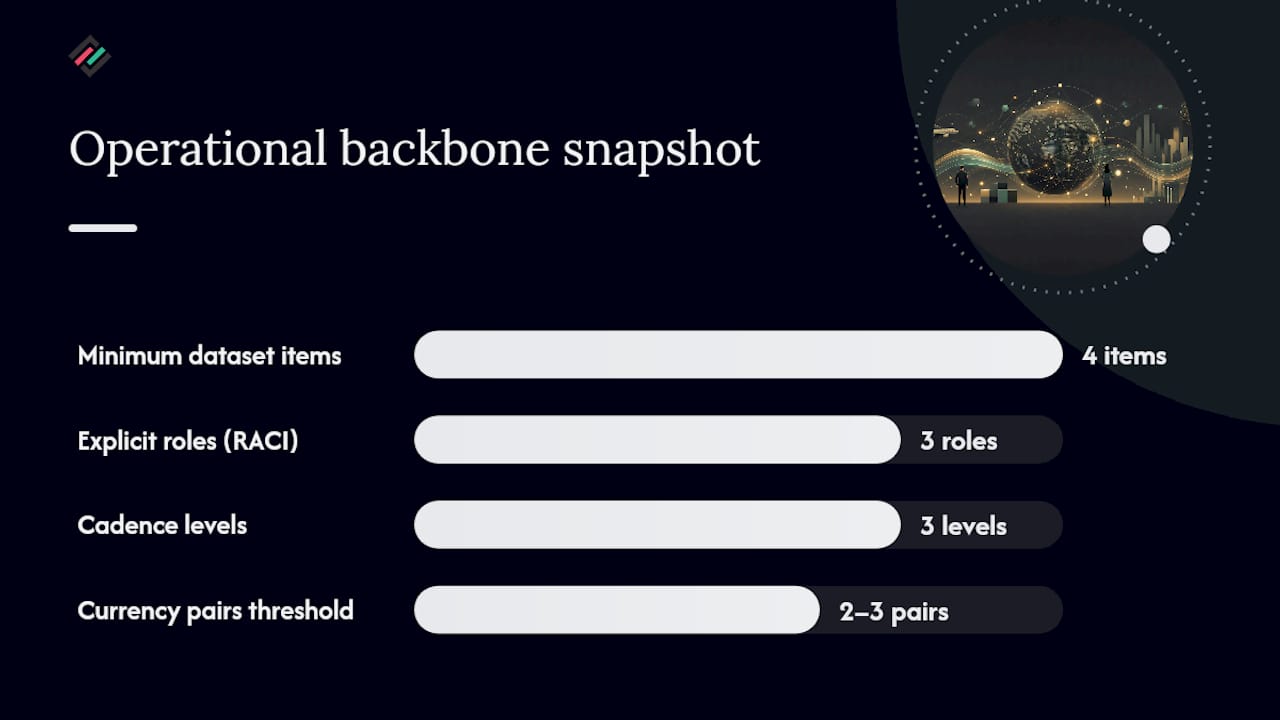
Your minimum dataset should include:
- A rolling 13-week cash flow forecast, broken out by currency and by entity.
- Committed purchase orders and receivables, separated from forecast ones.
- Existing forward contracts and their maturities.
- Current multi-currency cash balances across all banking relationships.
Roles need to be explicit, not assumed. A simple RACI split works: one person updates raw exposure data weekly, one person (often in FP&A) computes VaR and CFaR from that data, and a finance director or CFO approves any action that crosses a threshold. Without this split, the update either doesn't happen or happens inconsistently depending on who has time that week.
Cadence should follow a fixed rhythm rather than an ad hoc one:
| Frequency | Activity | Typical Owner |
|---|---|---|
| Weekly | Update top exposures, check thresholds | Treasury analyst |
| Monthly | Refresh volatility assumptions, review hedge ratios | Treasury manager |
| Quarterly | Full scenario review, lessons learned, threshold recalibration | CFO / finance director |
A weekly 15-minute check on top exposures, paired with a monthly assumption refresh and a quarterly deeper review, keeps the whole system from drifting into theoretical territory where the numbers exist but nobody trusts them enough to act.
On tools: a spreadsheet template is completely adequate for a single-entity company with two or three currency pairs. Once you're tracking multiple entities, multiple currencies, and need real-time exposure visibility, a dedicated platform becomes worth the switch, mainly because monitoring FX exposure manually across entities is where most teams start losing accuracy. The first thing to automate is exposure aggregation, since that's the input every other calculation depends on. VaR and CFaR calculations can stay manual longer without much cost, but once aggregation is automated, automating the calculation layer is a natural next step.
Three Templates You Can Build This Week
You don't need custom software to start. Three spreadsheet templates cover almost everything described above.
- VaR exposure limit sheet. Fields: currency pair, exposure amount, horizon, volatility estimate, confidence multiplier, calculated VaR, and approved limit. The formula is simple multiplication, as shown in the worked example earlier: exposure times scaled volatility times confidence multiplier. Fill in real exposure numbers first, then adjust the limit column based on management's risk appetite.
- 13-week CFaR cash plan. Rows are weeks 1 through 13. Columns are inflows and outflows by currency, the base scenario rate, the adverse scenario rate, and a calculated shortfall column. This is the same layout used in the sample table above, just extended to all 13 weeks rather than a sample of four.
- Scenario matrix and decision trigger sheet. One row per scenario (base, adverse, severe), columns for the shock size, the resulting VaR and CFaR figures, the threshold that scenario crosses, and the specific action that threshold triggers. This sheet is what turns your other two templates into something actionable rather than descriptive.
A few implementation notes worth flagging before you build these:
- Check your data quality first. A CFaR template built on stale receivables data will produce a confident-looking number that's simply wrong.
- Walk through one full example with real numbers before rolling the template out to the wider team, since abstract templates tend to generate more questions than they answer.
- Keep the scenario matrix sheet visible to whoever approves hedges. If it lives in a separate file from the approval conversation, it gets ignored.
Worked examples like these are consistently the most effective way to socialize scenario outputs with stakeholders who don't work in treasury day to day, mainly because a concrete number in a familiar spreadsheet format is far easier to trust than an abstract percentage.
Regulatory and Compliance Considerations in Currency Scenario Planning
Scenario planning doesn't happen in a regulatory vacuum, and ignoring that is a common blind spot in otherwise solid models. If your company applies hedge accounting under standards like IFRS 9 or ASC 815, your hedge effectiveness testing needs to align with the scenarios and thresholds you're using operationally, not run as a separate, disconnected exercise.
Documentation matters as much as the calculation itself. Regulators and auditors generally want to see the rationale behind a hedge decision, not just the transaction: why that scenario was chosen, why that threshold triggered action, and who approved it. Building that documentation into your scenario matrix template from the start, rather than reconstructing it after the fact, saves considerable time during audit season.
Companies expanding into new jurisdictions face an added layer. As currency scenario planning extends into new markets, local reporting requirements and capital controls can affect which hedging instruments are even available, and how quickly a conversion can be executed. This is a live consideration for companies moving into markets like Poland and Sweden, where local banking relationships and settlement timelines can differ from what a treasury team is used to elsewhere. None of this should be read as a substitute for legal or tax advice specific to your entities and jurisdictions. Confirm current requirements with a qualified advisor or your local regulator before finalizing a hedge accounting policy.
What Actually Makes Scenario Planning Stick
Most currency scenario planning fails quietly. Not because the math is wrong, but because the model never gets consulted when a real decision needs to be made. The gap between a technically sound VaR calculation and a finance team that actually changes behavior because of it is almost entirely about habit, not sophistication.
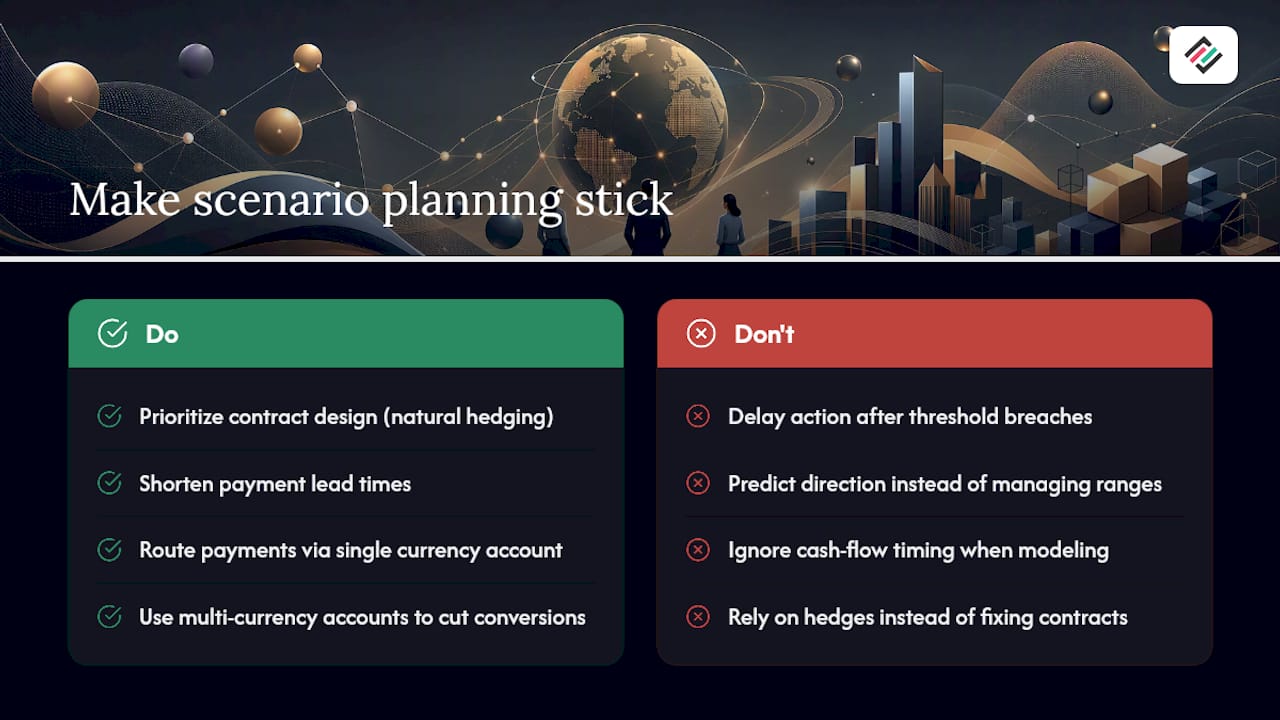
The first thing worth prioritizing, before any market hedge, is fixing the commercial terms that create exposure in the first place. Shortening payment lead times, negotiating contracts in your home currency where you have leverage, and using multi-currency accounts to reduce unnecessary conversions all reduce the variance your VaR and CFaR models are trying to measure. Financial hedges are often an expensive way to compensate for a contract that should have been structured differently from the start, and natural hedging through contract design remains one of the highest-return, lowest-cost interventions available to a finance team, and it's usually the first thing practitioners wish they'd done earlier.
Three traps show up again and again. Teams wait too long to act on a threshold breach because nobody wants to be the one who "locked in a bad rate," which almost always costs more than acting promptly would have. Teams try to predict direction rather than managing a range of outcomes, which turns a risk management exercise into a forecasting bet nobody's actually equipped to make. And teams model net exposures without checking the timing of underlying cash flows, which can mask a real liquidity gap even when the net position looks balanced on paper.
One small operational change that tends to produce outsized results: centralizing payments through a single currency account per major exposure, rather than letting individual business units convert on their own timeline. It doesn't require new software or a policy overhaul, just a decision to route payments through one point. Teams that make this change typically see their scenario models line up much closer to what actually happens in the cash account, because the noise from uncoordinated, one-off conversions disappears. A useful external reference point on implementation is this FX and conversion case study, which shows how a modest operational shift in payment routing produced a measurable reduction in exposure volatility for a mid-sized organization.
How CorpHedge Turns These Templates Into a Repeatable System
Everything described above works in a spreadsheet, and for a single-entity company with one or two currency pairs, that's a fine place to stay. The friction shows up once you're tracking multiple entities, several currencies, and a growing list of thresholds that need to be checked every week without someone manually pulling numbers from four different bank portals.
Corphedge is built around exactly the workflow this article walks through. Exposure aggregation pulls your multi-currency positions into one view instead of a patchwork of spreadsheets. Built-in VaR calculation tools apply the same logic covered in the worked example above, but recalculated continuously rather than once a month. Threshold alerts flag a breach the moment it happens, and approval workflows route the decision to the right person automatically, closing the exact governance gap described in the section on decision thresholds. Reporting output is built for the same nontechnical stakeholder audience that a good scenario matrix needs to reach.
As Corphedge expands into Poland and Sweden, finance teams operating in zloty and krona exposures gain the same real-time tracking and staged hedging workflow already used across other markets. If you're ready to see how your own exposure data would look inside a live threshold and alert system, the product tour walks through the exposure dashboard, VaR calculator, and approval workflow end to end. Book a walkthrough and bring your own 13-week cash plan.
Sources
A handful of sources are worth bookmarking if you're building or refining your own scenario models:
- Using VaR and CFaR to manage FX budget risk in 2026 | XE
- FP&A and Hedging: Integrating scenario analysis | Corpay
- Scenario Planning: Strategy, Steps and Practical Examples | NetSuite
Use these to validate your own shock sizes and volatility windows rather than taking any single source's assumptions at face value. Markets and volatility regimes shift, and a shock size that made sense two years ago may understate or overstate current conditions.
This article is general information, not a substitute for advice from a qualified financial advisor. Consult a qualified financial professional about your own circumstances before acting on anything here.
FAQ
How Do You Create a Currency Scenario Plan?
Define the scope of currencies and entities involved, gather 13-week cash flow data, build three scenarios (base, adverse, severe), convert each into VaR and CFaR figures, then set numeric thresholds that trigger specific hedging or liquidity actions.
What Are the Three Types of Scenarios Used in FX Planning?
Most programs use a base case built from current forward rates, an adverse case sized to roughly one to two standard deviations of historical volatility, and a severe case sized to a historical extreme or crisis-level move.
What Is a Currency Scenario Planning Tool?
It's a spreadsheet template or software platform, like Corphedge, that aggregates currency exposures, calculates VaR and CFaR under different rate scenarios, and flags when a threshold requires a hedging or liquidity decision.
How Often Should Finance Teams Update Their FX Scenarios?
A weekly check on top exposures, a monthly refresh of volatility assumptions and hedge ratios, and a quarterly full scenario review covers most companies' needs without becoming a reporting burden.
What's the Difference Between VaR and CFaR?
VaR estimates potential loss on an exposure over a short horizon under normal market conditions, while CFaR translates that same volatility into a potential cash shortfall figure used for liquidity and budget stress testing.