
TL;DR:
- Managing currency risk across multiple markets is complex, and traditional tools often fall short in governance and real-time visibility. CorpHedge offers a purpose-built SaaS platform with AI-driven scenario modeling, comprehensive position tracking, and structured hedging workflows tailored for corporate treasury teams. It replaces outdated methods by enabling dynamic, evidence-based hedging strategies and consolidates FX risk management into a single, efficient environment.
Managing currency risk across multiple markets is one of the most technically demanding tasks in corporate treasury, and most finance teams are doing it with tools that were never designed for the job. Spreadsheets break down at scale. Retail FX platforms lack governance features. Generic treasury systems treat hedging as an afterthought. CorpHedge was built specifically to close that gap, offering a B2B SaaS platform that gives corporate treasury teams real-time exposure visibility, AI-driven scenario modeling, and structured hedging workflows. This article breaks down how the platform works, where it outperforms traditional approaches, and how your team can put it to work.
Table of Contents
- Key Takeaways
- What CorpHedge actually does for treasury teams
- Hybrid and dynamic hedging: why static approaches fall short
- How CorpHedge compares to traditional FX risk tools
- Implementing CorpHedge in your treasury workflow
- My take on where corporate FX risk management is heading
- See how Corphedge handles your specific exposure
- FAQ
Key Takeaways
| Point | Details |
|---|---|
| Purpose-built for corporates | CorpHedge is designed for treasury teams managing multi-currency FX exposure, not for retail traders or investors. |
| AI-driven risk modeling | The platform uses Value at Risk modeling and scenario analysis to support evidence-based hedging decisions. |
| Hybrid hedging support | CorpHedge facilitates both static and dynamic hedging strategies, adapting to shifting exposure profiles. |
| Policy before platform | A well-defined corporate hedging policy is a prerequisite for getting full value from the platform. |
| Expanding market coverage | Corphedge is actively growing into Poland and Sweden, broadening support for European corporate clients. |
What CorpHedge actually does for treasury teams
Most FX risk tools fall into one of two categories: retail trading platforms with no governance layer, or legacy treasury management systems that bolt on FX as a secondary feature. CorpHedge sits in a different category entirely. It is a centralized FX risk platform built from the ground up for corporate clients managing transaction, translation, and economic currency risk across multiple currencies and geographies.
The core of the platform is a real-time dashboard that aggregates currency positions across your entire portfolio. You see your net exposure by currency pair, by business unit, and by time horizon, all in one place. That visibility alone is a significant step up from the typical spreadsheet model, where positions are reconciled manually and often days behind reality.
Beyond position tracking, the platform's AI-enhanced analytics enable dynamic hedging programs, moving treasury teams beyond static spreadsheet models toward real-time evidence-based strategies. The scenario analysis tools let you model how a 5% EUR/USD move affects your Q3 cash flows, or how a sudden PLN depreciation hits your Polish subsidiary's margins. These are not hypothetical exercises. They are the inputs your CFO needs before approving a hedge program.
Corphedge also supports Value at Risk modeling, which gives treasury teams a statistically grounded estimate of potential losses under adverse market conditions. This is the kind of output that satisfies both internal risk committees and external auditors.
Pro Tip: Before your first demo, map out your three largest currency exposures by notional value and time horizon. Bringing that data into the conversation lets the Corphedge team tailor the product tour to your actual risk profile rather than a generic walkthrough.
Key platform capabilities include:
- Real-time multi-currency position tracking with dashboard visibility
- AI-enhanced scenario analysis and VaR-based hedging workflows
- Support for forwards, options, and hybrid instrument combinations
- Integration with payment platforms including Corpay
- Audit trail and documentation features for hedge accounting compliance
Hybrid and dynamic hedging: why static approaches fall short
The conventional approach to corporate hedging, locking in a fixed percentage of forecasted exposure with forward contracts and leaving it alone until maturity, made sense when FX markets were less volatile and business forecasts were more predictable. Neither of those conditions holds reliably today.
Corporate hedging is about reducing unpredictability in business outcomes, not forecasting market direction. That distinction matters because it shifts the design criteria for a hedging program. You are not trying to pick the right rate. You are trying to keep your margins within a range that keeps the business financeable and your board comfortable.
Hybrid hedging addresses this by combining instruments across different time horizons and strike levels. A typical structure might hedge 70% of near-term exposure with forwards for certainty, while using options to protect against tail risk on longer-dated exposures where the forecast is less reliable. Typical hedge ratios range from 50% to 80% for near-term exposures, with hedge accounting requiring rigorous documentation to reduce income statement volatility.
Dynamic hedging goes further. It adjusts hedge ratios and instrument selection as exposures change, as market conditions shift, and as new information arrives. This is where CorpHedge's AI analytics become genuinely useful. The platform models how your hedge portfolio performs under different rate scenarios and flags when your coverage ratio has drifted outside policy limits.
Here is a practical sequence for building a dynamic hedging program with CorpHedge:
- Define your exposure universe. Identify all currency pairs, business units, and time horizons that generate material FX risk. CorpHedge's dashboard pulls this into a single view.
- Set policy parameters. Hedging policies must define exposures, instruments, approvals, and measure performance. Vague policies fail at the execution stage.
- Run scenario models. Use the platform's VaR and scenario tools to stress-test your proposed hedge ratios against historical and hypothetical rate moves.
- Execute and monitor. Place hedges through integrated channels and track performance against your policy benchmarks in real time.
- Rebalance systematically. Set trigger points for rebalancing rather than reacting emotionally to market moves.
"Effective currency risk management requires tools that translate strategy into actionable insights while providing full portfolio visibility." — Corphedge blog
The shift from a static program to a dynamic one is not just a technology change. It is a governance change. Your policy needs to authorize dynamic adjustments, and your team needs the tools to execute them with speed and auditability. CorpHedge is built to support both.
How CorpHedge compares to traditional FX risk tools

The honest answer to "why not just use a spreadsheet?" is that spreadsheets work fine until they don't. And when they fail in FX risk management, the consequences show up in your P&L before anyone notices the model error. Integrated hedge management systems are becoming essential for compliance and operational efficiency in volatile markets, and the shift from manual tracking to purpose-built platforms is no longer optional for mid-to-large corporates.
Here is how CorpHedge stacks up against the alternatives:
| Feature | Spreadsheets | Generic TMS | CorpHedge |
|---|---|---|---|
| Real-time position tracking | No | Partial | Yes |
| AI scenario modeling | No | No | Yes |
| VaR-based hedging workflows | No | Rare | Yes |
| Hedge accounting documentation | Manual | Basic | Structured |
| Multi-currency dashboard | No | Varies | Yes |
| Payment platform integration | No | Varies | Yes (incl. Corpay) |
| Audit trail | No | Basic | Full |
| Corporate governance layer | No | Partial | Yes |
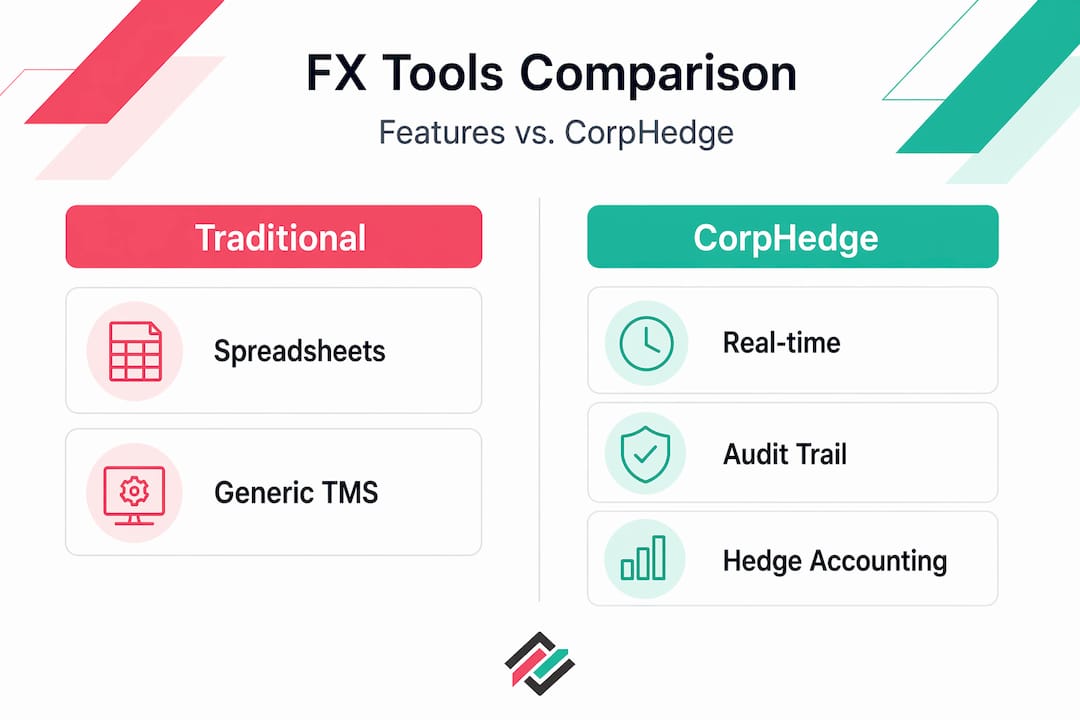
One point worth addressing directly: some finance professionals searching for CorpHedge encounter references to CorpInvestment.ltd. These are entirely unrelated entities. CorpInvestment.ltd is an unlicensed entity flagged for fraud risk by regulators and presents significant financial risk. Always verify licenses before engaging with any financial firm. Corphedge operates as a legitimate B2B SaaS platform focused exclusively on corporate FX risk management.
Pro Tip: When evaluating any FX risk platform, ask specifically about audit trail depth and hedge accounting documentation exports. These are the features that matter most during a regulatory review or external audit, and they are the ones most often missing from generic tools.
The CorpHedge platform is specialized for corporate FX risk management, not a retail trading application. That focus matters because the feature set, the governance layer, and the integration architecture are all designed around the workflows of a treasury team, not an individual trader.
Implementing CorpHedge in your treasury workflow
Getting value from any platform depends on how well it fits into your existing processes. Corphedge is designed to integrate with corporate workflows rather than replace them wholesale, but there are steps that separate teams who get full value from those who don't.
Start with a structured evaluation. Prospective clients can schedule product tours to match platform capabilities with specific exposures and workflows. Bring your actual exposure data to that conversation. A generic demo tells you what the platform can do. A tailored tour shows you how it handles your specific EUR/PLN or SEK/USD positions.
Key steps for a successful implementation:
- Audit your current exposure data. Before onboarding, consolidate your FX exposure data from ERP systems, bank statements, and subsidiary reports. The platform's value scales with the quality of your input data.
- Define your hedging policy first. Success with CorpHedge depends on a solid corporate hedging policy before platform implementation. Document your approved instruments, hedge ratios, approval authorities, and performance benchmarks.
- Map your payment flows. CorpHedge integrates with payment platforms, so identifying your primary payment corridors early allows for tighter integration between exposure identification and hedge execution.
- Establish reporting cadences. Decide who sees what and when. The platform supports real-time dashboards for treasury and periodic reports for CFO and board-level audiences.
- Plan your hedge accounting documentation. If you apply hedge accounting under IFRS 9 or ASC 815, the platform's documentation features need to be configured to your specific designation criteria from day one.
Pro Tip: Run a parallel period during the first 60 days where you track exposures and hedge performance in both your legacy system and CorpHedge. The comparison will surface data gaps and process mismatches before they become material.
The full FX lifecycle support that Corphedge provides, from risk identification through VaR modeling to payment integration and execution monitoring, means you can consolidate what are often three or four separate tools into one governed environment. For teams expanding into new markets like Poland or Sweden, that consolidation is particularly valuable because it prevents the ad hoc tool sprawl that typically accompanies geographic growth.
My take on where corporate FX risk management is heading
I've watched treasury teams spend years defending spreadsheet-based hedging programs to CFOs who wanted more visibility and auditors who wanted better documentation. The argument was always that the spreadsheet worked well enough. And it did, right up until a volatile quarter exposed a position that nobody had properly tracked.
What I've learned from watching this pattern repeat is that the technology gap in corporate FX risk management is rarely about capability. Most treasury professionals understand hedging theory well. The gap is about infrastructure. You can know exactly what hedge ratio you need and still be unable to execute it efficiently when your exposure data is scattered across three systems and your approval workflow runs through email.
Platforms like CorpHedge matter because they close the infrastructure gap without requiring a full treasury transformation. The AI scenario modeling is genuinely useful, not because it replaces judgment but because it makes the inputs to that judgment faster and more reliable. When you can model a 10% GBP depreciation scenario in two minutes instead of two hours, you make better decisions under pressure.
The expansion into Poland and Sweden is a signal worth noting. These are markets where international companies face real currency complexity, particularly around PLN and SEK volatility, and where local treasury teams often lack the tooling that headquarters takes for granted. Corphedge bringing its platform to those markets addresses a real operational need, not just a commercial one.
The treasury teams that will perform best over the next decade are the ones that treat FX risk infrastructure as a strategic investment rather than a compliance cost. That shift in framing changes what you buy, how you implement it, and how you measure success.
— Bartas
See how Corphedge handles your specific exposure
If the gap between your current FX risk setup and what this article describes feels significant, the most direct next step is a tailored product tour with the Corphedge team.
Corphedge offers scheduled demo tours where their team maps the platform's capabilities to your actual currency exposures and treasury workflows. This is not a generic sales presentation. It is a working session designed to show you how the platform handles your specific currency pairs, hedge ratios, and reporting requirements. For teams in Poland and Sweden, Corphedge's growing regional presence means local context is built into the conversation. You can also explore VaR-based hedging workflows directly on the platform to see how scenario modeling integrates with your existing risk policies. The full product feature set is available for review before you commit to anything.
FAQ
What is CorpHedge used for?
CorpHedge is a B2B SaaS platform designed for corporate treasury teams managing foreign exchange risk across multiple currencies. It provides real-time position tracking, AI-enhanced scenario analysis, and VaR-based hedging workflows.
How does CorpHedge differ from a retail FX platform?
CorpHedge is built exclusively for corporate FX risk management, with governance features, hedge accounting documentation, and multi-currency dashboards that retail trading platforms do not offer. It integrates into treasury workflows rather than replacing them.
What is CorpInvestment.ltd and is it related to CorpHedge?
CorpInvestment.ltd is an entirely separate and unrelated entity that has been flagged as unlicensed and high-risk by regulators. Corphedge is a legitimate corporate FX risk management platform with no connection to that entity.
Does CorpHedge support hedge accounting under IFRS 9?
Yes, the platform includes documentation and audit trail features designed to support hedge accounting compliance. Teams should configure designation criteria from the start of implementation to capture the required documentation.
How do I get started with CorpHedge?
Corphedge engages prospective clients through tailored product tours and demos that match platform capabilities to your specific exposure profile and workflows. Pricing is not publicly listed and is discussed during the evaluation process.