

TL;DR:
- Currency risk is addressed proactively with Corpay's automated integration, connecting ERP data, hedge execution, and real-time analytics. Effective daily control and policy-aligned triggers enable treasury teams to manage FX exposures efficiently, reducing costs and volatility without manual intervention. Proper technical setup and ongoing strategy reviews are essential to maximize the system's protective capabilities and align with enterprise risk policies.
Currency risk doesn't wait for your treasury team to finish its monthly close. For finance professionals at multinational companies, the gap between when an FX exposure is created and when it's hedged is where margin quietly disappears. Corpay integration hedging addresses that gap directly, connecting ERP data, hedge execution, and real-time analytics into a single workflow. The common misconception is that this kind of integration is technically burdensome or strategically inflexible. The reality is the opposite, and this guide walks you through exactly how it works.
Table of Contents
- Key takeaways
- Corpay integration hedging: how balance-sheet features work
- Using the Risk Visualizer for real-time FX control
- Invoice-to-hedge workflow for automated FX certainty
- Technical API best practices for Corpay hedging integration
- Aligning Corpay hedging with your enterprise FX policy
- My perspective on deploying Corpay integration in complex environments
- How Corphedge complements your Corpay hedging setup
- FAQ
Key takeaways
| Point | Details |
|---|---|
| Balance-sheet hedging via Corpay | ERP-driven exposure capture feeds proprietary VaR algorithms that trigger hedges automatically based on your policy. |
| Risk Visualizer as daily control | Daily refreshed reports let treasury teams catch coverage shortfalls before they become P&L problems. |
| Invoice-to-hedge workflow separation | Locking FX rates at invoice submission and scheduling payment separately removes timing risk from your payables process. |
| API integration quality matters | Unique clientIntegrationId management and beneficiary validation are non-negotiable for reliable automated execution. |
| Policy alignment drives results | Hedge triggers and coverage levels must reflect your written hedge policy, not generic defaults. |
Corpay integration hedging: how balance-sheet features work
Most treasury teams understand the theory of balance-sheet hedging. Fewer have seen it executed with the kind of automation that actually removes manual intervention from the process. Corpay's balance-sheet hedging pulls exposure data directly from your ERP system, giving you a consolidated global view across all entities and currency pairs in one place.
The analytical engine behind this is worth understanding in detail. Proprietary algorithms calculate net exposures across your portfolio, apply Value at Risk analytics, and identify correlations between currency pairs that affect your overall risk position. This isn't a static snapshot. The system uses those inputs to determine when hedging triggers should fire, based on the mandates written into your hedge policy.
Execution happens through rolling short-term forwards, which keeps the process aligned with how most corporate hedge policies are structured. The practical benefits here are two-sided:
- Reduced transaction costs because hedge frequency is controlled rather than driven by manual calendar schedules
- Lower FX volatility impact on reported earnings because exposures are captured and hedged before they compound
Pro Tip: Map your existing hedge policy mandates to specific VaR thresholds before you configure triggers. A trigger set too loosely will leave you under-hedged; one set too tightly will generate unnecessary transaction costs.
For teams managing exposures across 10 or more currency pairs, the global consolidated view this creates is genuinely difficult to replicate with manual processes or disconnected spreadsheet models. The correlation identification feature is particularly underused. When two of your major currency pairs move together, hedging them independently is inefficient. Corpay's system accounts for that relationship in its net exposure calculations.

Using the Risk Visualizer for real-time FX control
The Risk Visualizer is where Corpay integration hedging moves from back-office process to operational discipline. Daily refreshed reports show your open hedge contracts, current coverage levels, and any shortfalls against your policy targets. For a treasury team managing rolling 12-month exposures across multiple entities, that daily visibility changes how you work.
Scenario testing is the feature that separates proactive risk management from reactive reporting. You can model the impact of a 5% or 10% rate move on your cashflows before it happens, then decide whether your current hedge coverage is sufficient. This is the kind of analysis that used to require a dedicated analyst building custom models. The Risk Visualizer makes it a daily operational task.
Key configuration parameters you control within the tool include:
- Time horizons for exposure measurement and hedge coverage
- Transaction formats aligned to your instrument preferences
- Hedging frequency tied to your policy cadence
Daily control tower use is consistently more effective than waiting for monthly treasury closes to detect over- or under-hedging. By the time a monthly report surfaces a coverage gap, the market may have already moved against you.
Pro Tip: Set a standing daily review of the Risk Visualizer as a formal process step, not an ad hoc check. Teams that treat it as optional tend to catch shortfalls too late to act without incurring elevated hedge costs.
The scenario testing capability also supports board-level reporting. If your CFO asks what a 3% strengthening of the euro does to next quarter's operating margin, you can answer that question with data rather than estimates. That credibility matters when defending your hedge program to senior leadership.
Invoice-to-hedge workflow for automated FX certainty
The invoice-to-hedge workflow is one of the most operationally significant features in the Corpay integration services toolkit, and it's often underutilized by payables teams who don't fully understand the decoupling it enables. The core concept is straightforward: you lock an exchange rate at the moment an invoice is submitted, then schedule the actual payment separately at a later date. This separation removes the exchange rate risk that normally accumulates between invoice receipt and payment execution.
Here is how the end-to-end workflow operates in practice:
- Invoice data extraction. The system pulls invoice and document data from your ERP or accounts payable platform, capturing currency, amount, counterparty, and due date.
- Rate lock at submission. A fixed exchange rate is applied at the point of invoice entry. Corpay supports a six-month fixed rate opt-in, giving payables teams certainty across their forward payment schedule.
- Compliance and beneficiary checks. The workflow runs validation against beneficiary data and compliance requirements before any payment instruction is created.
- Payment scheduling. The actual payment is scheduled independently of the rate lock, allowing treasury and AP teams to optimize payment timing for cashflow purposes without affecting the hedged rate.
- Settlement execution. Corpay executes the payment at the locked rate on the scheduled date, with full audit trail documentation.
For multinational payables teams managing hundreds of cross-border invoices monthly, this workflow eliminates the need to monitor FX rates between invoice receipt and payment. The rate is locked. The risk is removed. The AP team focuses on process, not markets.
Pro Tip: Audit your beneficiary master data before activating the invoice-to-hedge workflow. Errors in beneficiary records are the most common cause of payment failures in automated FX workflows, and correcting them mid-process is costly.
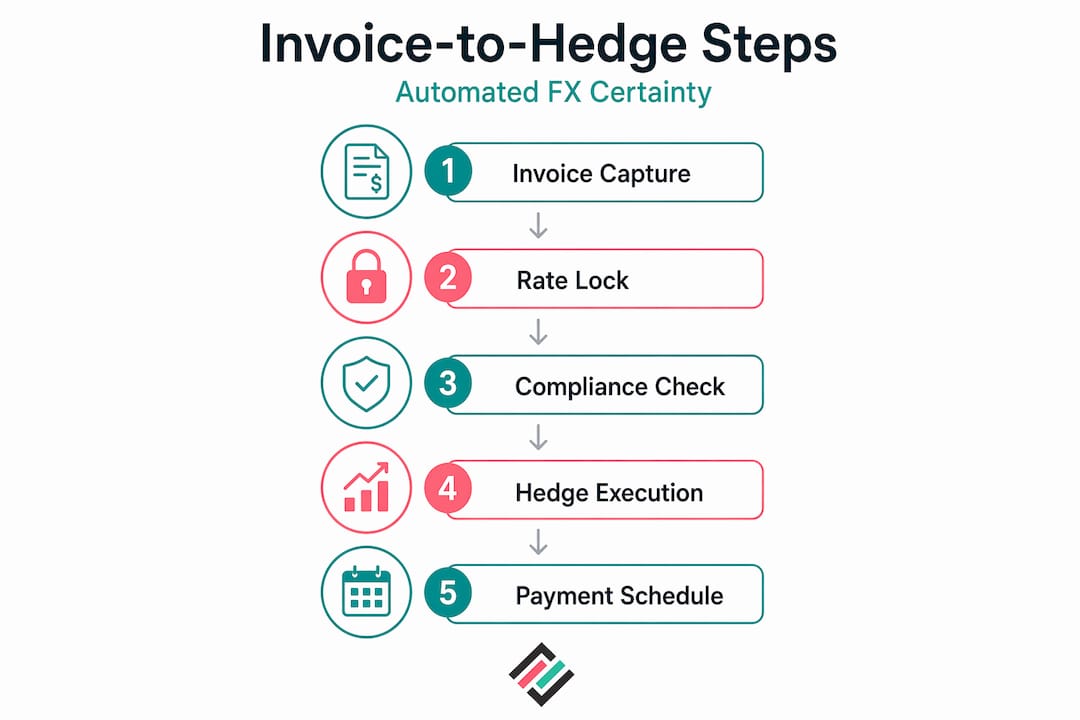
The compliance check embedded in step three is also worth noting for companies operating in regulated industries. Automated screening at the invoice level is faster and more consistent than manual review, and it creates a documented record that satisfies most audit requirements.
Technical API best practices for Corpay hedging integration
Getting the technical integration right is where many projects stall. Corpay's API for payments and FX uses a RESTful HATEOAS architecture that supports high transaction volumes, multithreading, and integration with ERP, TMS, and internal applications. The documentation is thorough, but there are specific implementation decisions that determine whether your integration runs reliably at scale.
| Integration element | Best practice | Common failure mode |
|---|---|---|
| clientIntegrationId | Assign a unique ID per transaction to enable idempotent processing | Duplicate IDs cause double-execution of hedges or payments |
| Beneficiary validation | Validate all beneficiary records in sandbox before go-live | Invalid beneficiary data triggers execution failures downstream |
| Sandbox testing | Run full regression tests including edge cases and error scenarios | Insufficient QA leads to production failures under volume |
| Hedge frequency controls | Tie roll cadence to VaR triggers and policy mandates, not fixed schedules | Fixed-schedule rolling generates unnecessary transaction costs |
| Error handling | Implement structured error logging and alerting for all API responses | Silent failures leave exposures unhedged without team awareness |
Beneficiary validation and unique clientIntegrationId management are the two most critical technical requirements for reliable automated execution. Both are documented in Corpay's developer resources, but they are consistently underweighted during integration planning.
The sandbox environment deserves more time than most teams allocate to it. Treat it as a production replica, not a quick connectivity check. Test your highest-volume scenarios, your error paths, and your edge cases before you go live. The cost of a production failure in an FX hedging workflow, where unhedged exposures can accumulate rapidly, is far higher than the cost of thorough QA.
For teams considering how to integrate Corpay hedging with existing treasury management systems, the API's support for trade finance workflows and ERP connectivity makes it adaptable to most enterprise architectures without requiring a full system replacement.
Aligning Corpay hedging with your enterprise FX policy
Technical integration without policy alignment produces a system that runs but doesn't protect you. The most effective Corpay integration hedging implementations start with a clear translation of the written hedge policy into system parameters. Controlling hedge roll frequency based on VaR triggers rather than fixed calendar schedules is a direct example of this. Your policy defines your risk appetite. The system enforces it automatically.
Practical alignment steps that distinguish high-performing implementations include:
- Mapping exposure types to instruments. Balance-sheet exposures and cashflow exposures require different hedging instruments. Confirm that your Corpay configuration reflects that distinction rather than applying a single instrument type across all exposures.
- Setting coverage bands, not point targets. A hedge policy that requires exactly 80% coverage is harder to maintain than one that specifies a 70% to 90% band. Build that flexibility into your system triggers.
- Monitoring over-hedging as actively as under-hedging. Over-hedging creates its own P&L risk when underlying exposures don't materialize. The Risk Visualizer surfaces both conditions equally.
- Scheduling regular strategy reviews. Currency risk management strategies evolve as your business mix changes. A quarterly review of your hedge policy parameters against actual exposure patterns keeps the system calibrated.
For companies expanding into new markets, including the growing number of multinationals entering Poland and Sweden, the exposure mapping step becomes particularly important. New currency pairs introduce correlations and volatility characteristics that may not be reflected in your existing policy parameters. Update them before you start hedging, not after your first quarter of results.
My perspective on deploying Corpay integration in complex environments
I've watched finance teams spend months building manual FX reporting processes that a well-configured Corpay integration replaces in weeks. The resistance usually comes from two places: skepticism about API reliability and concern about losing visibility into what the system is doing.
Both concerns are legitimate, and both are addressed by the same solution. You need to invest in the setup phase. The teams that get the most value from automated forex hedging are the ones that treat the configuration of triggers, coverage bands, and policy parameters as seriously as they treat the technical API work. The system is only as good as the policy logic you put into it.
What I've learned from watching multi-entity global implementations is that the biggest unrealized value is usually in scenario modeling. Most teams use the Risk Visualizer reactively, checking coverage after the fact. The teams that use it daily for forward scenario testing, asking "what does a 4% euro move do to our Q3 margin?" before the move happens, are the ones that consistently outperform on FX risk metrics. Leveraging daily scenario testing is the single highest-return habit change I'd recommend to any risk manager running a Corpay-integrated hedging program.
The future of this space is tighter integration between FX analytics and ERP data flows, with policy-driven automation handling routine hedge decisions and human judgment reserved for strategy and exception management. That future is already available. Most teams just haven't fully committed to it yet.
— Bartas
How Corphedge complements your Corpay hedging setup
If you're running Corpay integration hedging and want a platform that adds VaR-based hedging analytics on top of your existing workflows, Corphedge is built for exactly that use case.
Corphedge gives finance teams real-time currency position monitoring, Value at Risk strategy modeling, and direct integration with Corpay for consolidated FX exposure management. Whether you're managing exposures across established markets or expanding into newer ones like Poland and Sweden, the platform scales with your needs. You can explore the full feature set through the product tour or book a personalized demo to see how Corphedge fits your specific hedge policy and reporting requirements. The combination of Corpay's execution infrastructure and Corphedge's analytics layer gives risk managers a genuinely complete financial hedging solution.
FAQ
What is Corpay integration hedging?
Corpay integration hedging connects your ERP and financial systems to Corpay's FX execution and analytics platform, automating the process of identifying currency exposures, triggering hedges based on policy mandates, and executing instruments like rolling short-term forwards.
How does the Risk Visualizer support daily FX management?
The Risk Visualizer provides daily refreshed reports on open hedge contracts, coverage shortfalls, and scenario analysis for rate movements, allowing treasury teams to act on exposure shifts before they affect cashflows.
What is the invoice-to-hedge workflow in Corpay?
The invoice-to-hedge workflow locks a fixed exchange rate at invoice submission and schedules payment separately, decoupling FX rate certainty from payment timing and removing exchange rate risk during the invoice-to-payment period.
Why does clientIntegrationId matter in Corpay's API?
A unique clientIntegrationId per transaction enables idempotent processing, preventing duplicate hedge or payment executions that can occur when API calls are retried after a timeout or network error.
How do you align Corpay hedging with an enterprise hedge policy?
Translate your written hedge policy into specific VaR thresholds, coverage bands, and roll cadence parameters within Corpay's configuration. Reviewing those parameters quarterly against actual exposure patterns keeps the system aligned with your current risk profile.