

Bank hedging markup is the spread a bank adds above the mid-market rate when it prices your FX forward, swap, or option. It typically hides inside CVA, FVA, and capital charges rather than showing up as a line item. The fastest way to shrink it: pull your last quarter of trade confirmations, compare each execution rate against the mid-market rate at that exact timestamp, and ask your bank for a component-level breakdown of the spread. What follows covers the mechanics, the behavioral research behind who pays more, and a step-by-step audit you can run this quarter.
TL;DR:
- Most bank hedging markups are a combination of the spread, CVA, FVA, and capital charges, which are embedded within the trade confirmation rather than itemized separately.
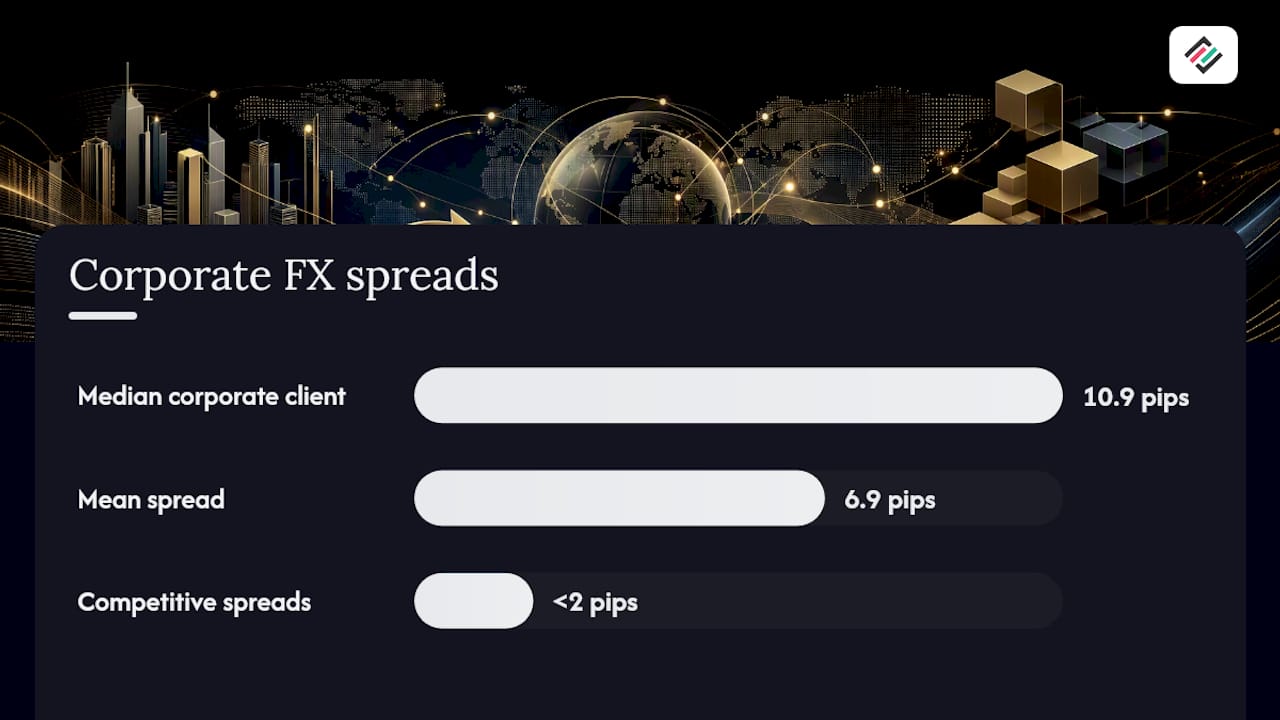
- Median corporate clients pay around 10.9 pips, which is more than five times higher than genuinely competitive spreads below 2 pips, depending on credit profile and bank relationships.
- Benchmarking spreads effectively requires precise, timestamped mid-market rates and evaluating outliers that exceed one standard deviation above the average to identify potential overpricing.
- Running regular RFQs, standardizing collateral and counterparty terms, and documenting multiple bank quotes can reduce spreads by over a third and prevent normalized overpayment.
- Using platforms like CorpHedge enables real-time exposure tracking and trade benchmarking, making it easier for finance teams to identify, control, and lower bank hedging markups.
Table of Contents
- What Creates the Markup: Spread, CVA/DVA, FVA, and Capital Charges
- How Banks Set Markups and Which Clients Pay More
- How to Measure and Benchmark Your Bank Hedging Markup
- Tactical Checklist: Proven Actions That Reduce Hedging Markup
- How CorpHedge Helps Measure, Control, and Lower Bank Hedging Markup
- Common Failures and Simple Governance Fixes
- Get a Clearer View of Your Hedging Costs
- Sources
- FAQ
What Creates the Markup: Spread, CVA/DVA, FVA, and Capital Charges
A bank hedging markup is rarely one number. It's a stack of costs the bank folds into a single all-in rate, and most confirmations never itemize any of it.
The base layer is the spread itself, the gap between the mid-market rate and what you're actually quoted. On top of that sits CVA (credit valuation adjustment), which prices the risk that you default before the trade matures, and DVA (debit valuation adjustment), the mirror image covering the bank's own default risk. Banks price CVA off your positive exposure profile, so a client with a lower credit rating or higher CDS spread pays more for identical notional and tenor, according to NeuGroup's breakdown of how banks price FX swaps with corporates.
Then there's FVA (funding valuation adjustment), which reflects what it costs the bank to fund the trade in its own wholesale markets. When bank funding costs rise, FVA rises with them, even if your credit profile hasn't changed at all.
Regulatory capital adds a fourth layer. Under the SA-CCR framework, longer-dated trades consume more capital, and banks pass that capital cost through the price. A five-year forward carries a meaningfully heavier capital charge than a three-month one on the same notional.
What actually shows up in your quote:
- A quoted spread over mid-market, often 1 to 15 pips depending on client tier
- CVA/DVA adjustments tied to your credit profile and the bank's own
- FVA reflecting the bank's funding cost at execution
- A capital charge that scales with tenor and notional under SA-CCR
- Operational and settlement fees, rarely broken out separately
How Banks Set Markups and Which Clients Pay More
The market for corporate FX hedges runs on price discrimination, and the numbers are stark. The median corporate client pays 10.9 pips, which is 58% above the mean spread of 6.9 pips, while genuinely competitive spreads run under 2 pips, according to CEPR's VoxEU research on bank hedging costs. That gap isn't random. It correlates directly with how sophisticated and well-positioned the client looks to the bank pricing the trade.
Signaling that you can execute through other banks cuts your spread by more than a third, and each additional bank relationship you maintain reduces it further, per the same CEPR research. Relationship banks also weigh your broader facility, especially revolving credit lines, when deciding how competitively to price a hedge versus other business they want to protect.
Signs your organization is likely overpaying:
- No ISDA master agreement or CSA in place
- No independent mid-market benchmark used at execution
- Single-bank dependence for the majority of hedging volume
- No documented history of running competitive RFQs
Pro Tip: Even a paper trail showing you requested quotes from three banks, whether or not you switched, changes how the incumbent bank prices your next trade. Documented alternatives matter more than actual switching.
How to Measure and Benchmark Your Bank Hedging Markup
Benchmarking a hedge markup isn't complicated math. It's disciplined data capture, and most finance teams skip it because confirmations aren't built to make it easy.
- Capture the trade record. Pull execution timestamp, notional, tenor, direction (buy or sell), and the all-in rate from the confirmation.
- Fetch the mid-market rate at that exact timestamp. Use a tick-level or executable data source, not an end-of-day rate, since even a few minutes of drift can distort the comparison. Precision here matters because mismatched timing is one of the most common ways benchmarking goes wrong.
- Calculate the effective spread. Subtract the mid-market rate from your executed rate, convert the difference to pips or basis points, and express it as parts per million (PPM) of notional for cross-trade comparison.
- Adjust for structure. Options carry an embedded premium that needs separating from the hedge spread itself; larger notionals and longer tenors should be benchmarked against similarly sized peer trades, not blended together.
- Flag and investigate outliers. Any trade landing more than one standard deviation above your rolling average spread deserves a direct question to the bank before the next trade.
A rough example: if you execute a $10 million six-month forward at 1.0850 when the mid-market rate at that timestamp was 1.0838, that's a 12-pip spread, or roughly 110 PPM of notional. Track that number monthly by currency pair, alongside the percentage of trades exceeding your internal threshold, and you have a working cost-of-hedging KPI within one reporting cycle.
Tactical Checklist: Proven Actions That Reduce Hedging Markup
Cutting bank hedging markup is less about clever negotiation and more about removing the conditions that let banks price you loosely in the first place.
Run periodic RFQs, even when you don't intend to switch banks. Documenting live quotes from competing counterparties is exactly the signal that reduces spreads by over a third, and it costs you nothing but a few hours of coordination each quarter.

Standardize your ISDA and CSA terms across counterparties, and centralize how collateral gets posted. Collateralization and frequent margin calls materially reduce the CVA a bank has to price in, and negotiating CSA terms often moves the needle more than haggling over a handful of basis points on any single trade, according to NeuGroup's analysis of bank FX pricing. Netting agreements and tighter collateral thresholds also lower the total charges a bank applies to derivative transactions, as Danske's own product cost documentation shows.
Practical steps worth putting on this quarter's agenda:
- Aggregate hedging flows internally, or through a platform, so smaller trades don't each absorb a full per-trade spread
- Use a multi-bank portal or pricing platform to see mid-market comparisons before you execute, not after
- Publish a written hedging policy with named owners and spread-based KPIs, so benchmarking survives staff turnover
- Send a formal request to each relationship bank asking for a mid-market comparison, a CVA/FVA line-item explanation, and historical execution metrics for your account
- Build internal sophistication deliberately, whether through structured training like an FX hedging course or by dedicating time to reviewing hedge structures with your team
Most bank relationship teams, in NeuGroup's practitioner survey work, report that 80% of corporates spread FX trading across seven or more banks specifically to keep pricing honest. That's not overkill. It's the baseline for staying out of the price-discrimination tail.
Pro Tip: Ask for historical execution metrics before you ask for a better price on your next trade. A bank that stalls on providing your own trade history is telling you something about how comfortable it is with what that history would show.
How CorpHedge Helps Measure, Control, and Lower Bank Hedging Markup
Most of the tactics above depend on having clean, timestamped exposure data on demand, which is exactly where manual spreadsheet tracking tends to fall apart. CorpHedge's platform provides live exposure tracking and Value at Risk based strategy simulation, giving finance teams the position-level detail needed to benchmark trades against mid-market rates rather than guessing after the fact.
That visibility supports the parts of this checklist that are otherwise hard to operationalize:
- Real-time position and exposure reporting that makes trade-level benchmarking practical rather than a quarterly scramble
- Integrations, including with Corpay, that reduce the operational friction of running ISDA/CSA-based processes across multiple banks
A useful pilot: run one month where you benchmark effective spreads on a representative basket of hedges using CorpHedge's exposure data alongside your existing bank confirmations, then compare the two views side by side.
Common Failures and Simple Governance Fixes
The biggest reason companies overpay isn't ignorance about markup. It's that once a confirmation clears without a fight, the cost gets normalized. Nobody flags a 12-pip spread as a problem because nobody ever compared it to mid-market in the first place, and the next quarter's trade sets the new baseline.
The fixes that actually change behavior aren't clever. They're boring and recurring: a quarterly execution review that plots average spread against a market benchmark, a KPI tied to spread metrics that someone on the team owns, and a documented RFQ schedule that gets followed whether or not anyone plans to switch banks. Teams that skip the review skip the improvement, every time. The math doesn't require a trading desk. It requires someone with the authority to ask the bank an uncomfortable question and the discipline to ask it every quarter, not just when a trade looks unusually expensive.
— Bartas
Get a Clearer View of Your Hedging Costs
Corphedge is built for finance teams who want to see their currency exposure and hedging costs in one place instead of piecing them together from bank confirmations after the fact. As foreign exchange risk management platforms expand, live exposure tracking, Value at Risk based simulation, and reporting toolkits become available to more internationally active companies trying to answer a simple question: is this hedge priced fairly?
If your team is still benchmarking spreads manually or trusting a single relationship bank's numbers, the Corphedge platform gives you the position-level data to check that yourself before your next trade clears. Pair it with the FX hedging course if you want your team fluent in the mechanics behind CVA, FVA, and capital charges before your next RFQ round. Explore the product tour to see how the reporting fits into a quarterly execution review.
This article is general information, not a substitute for advice from a qualified financial advisor. Consult a qualified financial professional about your own circumstances before acting on anything here.
Sources
This article draws on CEPR's VoxEU research on FX price discrimination, NeuGroup's industry analysis of bank FX pricing, and Redbridge's guide to foreign exchange cost transparency.
- Why many firms get a bad deal when hedging currency risk — VoxEU / CEPR
- Under the hood: how banks price FX swaps with corporates — NeuGroup (Wells Fargo content)
- Total cost and charges for derivative transactions — DanskeCI (bank product guide)
FAQ
What Is a Bank Hedging Markup?
A bank hedging markup is the extra spread or fee a bank adds above the mid-market rate when pricing an FX forward, swap, or option for a corporate client. It typically embeds CVA, FVA, and capital charges rather than appearing as a separate line, which is why independent benchmarking against mid-market rates is the only reliable way to see it.
How Much Markup Do Companies Typically Pay on FX Hedges?
The median corporate client pays 10.9 pips, which is 58% above the mean spread, while genuinely competitive pricing runs under 2 pips, according to CEPR's VoxEU research. Where you land depends heavily on your credit profile, bank relationships, and whether you've signaled access to alternative counterparties.
Why Don't Bank Confirmations Show the Markup Separately?
Confirmations detail the trade itself, notional, tenor, rate, but rarely itemize the margin the bank applied to reach that rate. That's a structural feature of how OTC FX derivatives are quoted, not an oversight, which is exactly why external benchmarking against mid-market data matters.
What's the Fastest Way to Reduce Bank Hedging Markup?
Running periodic RFQs and documenting alternative bank relationships, even without switching, can cut your spread by more than a third. Standardizing ISDA and CSA terms to lower CVA and FVA charges is the second highest-impact lever available to most finance teams.
Can a Platform Like Corphedge Help Lower Hedging Costs?
Corphedge provides live exposure tracking and Value at Risk based strategy simulation that gives finance teams the trade-level data needed to benchmark bank quotes against mid-market rates. Pricing for the Corphedge platform is available on request, while the FX hedging course is priced at €220 as a one-time purchase.