

Centralizing and automating FX risk management for forex company accounting remains needlessly complex without dedicated treasury resources. Too many platforms require manual model building, lack IFRS reporting support, or reserve key automation behind closed pricing and enterprise plans. This comparison highlights price, reporting standards, and automation features across five leading forex risk management platforms so you can pick one to match your needs.
Table of contents
- CorpHedge
- Hedgebook
- TreasuryView
- Tulyp Treasury Platform
- Pangea FX Hedging Software
- Comparison of alternatives
Corphedge
At a glance
Automated trading plans use historical data and Value at Risk (VaR) methods to generate hedging strategies. The system delivers real time FX risk analysis and portfolio valuation so accounting teams see position exposure continuously. According to the company, CorpHedge was recognized as a top risk management provider in 2023. This makes it a practical option for accounting for forex companies that need hands-on hedging guidance without a dedicated treasury team.
Core features
CorpHedge gives finance teams live visibility into currency exposures with real time FX risk analysis and portfolio tracking. It lets you define custom FX hedging policies and run risk sensitivity analysis against market moves. The platform can generate automated trading plans from historical price behavior and Value at Risk scenarios. Professional support is available to guide strategy setup and interpretation of outputs.
Key differentiator
The product’s standout capability is automated hedging plan generation based on historical data combined with VaR modeling. That approach converts historical volatility and exposure into concrete trade plans for non-expert users. The result is fewer manual models and clearer, repeatable hedging steps for accounting and finance teams.
Pros
-
Simplifies FX work for non-experts by turning exposure data into executable hedging plans. This reduces reliance on bespoke spreadsheets.
-
Provides continuous visibility with portfolio tracking and valuation. Teams can reconcile accounting positions to market exposure in real time.
-
Supports strategic choices through risk sensitivity analysis. You can test the impact of FX moves on reported earnings and cash flow.
-
Scales from SME needs to large corporate requirements. The same feature set supports simple hedging rules and multi-entity exposures.
-
Offers professional support to help set up policies and interpret VaR outputs. That helps accounting teams adopt the models faster.
Cons
- Advanced features introduce a learning curve for users without prior FX or risk modeling experience.
Notable integrations
- Corpay for payments and trade execution. This connection helps move from hedging plan to execution within existing bank and payment workflows. Integrations reduce manual data transfers between accounting systems and trading channels.
Who it's for
CorpHedge fits business owners, CFOs, and risk managers at SMEs and large enterprises that handle cross border receipts or payables. It targets teams that need FX exposure visibility but do not run a full corporate treasury. Accounting teams that must report FX effects and meet regulatory reporting timelines will find the tool useful.
Unique value proposition
Automated trading plan generation from historical data and VaR modeling reduces time spent building and validating custom hedging models. That feature changes the workflow from model building to policy enforcement. Teams trade fewer ad hoc decisions and get consistent hedging recommendations tied to accounting positions.
Real world use case
A manufacturing firm with large foreign currency revenues used CorpHedge to define a hedging policy and generate monthly trading plans. The finance team monitored exposure daily and executed trades through integrated partners. Earnings volatility dropped and forecasting for cash flow grew more reliable.
Pricing
Pricing details are not publicly listed and the product data marks pricing as not applicable informational only. Prospective buyers must contact CorpHedge for subscription and deployment costs and for integration fees where applicable.
Website: https://corphedge.com
Hedgebook
At a glance
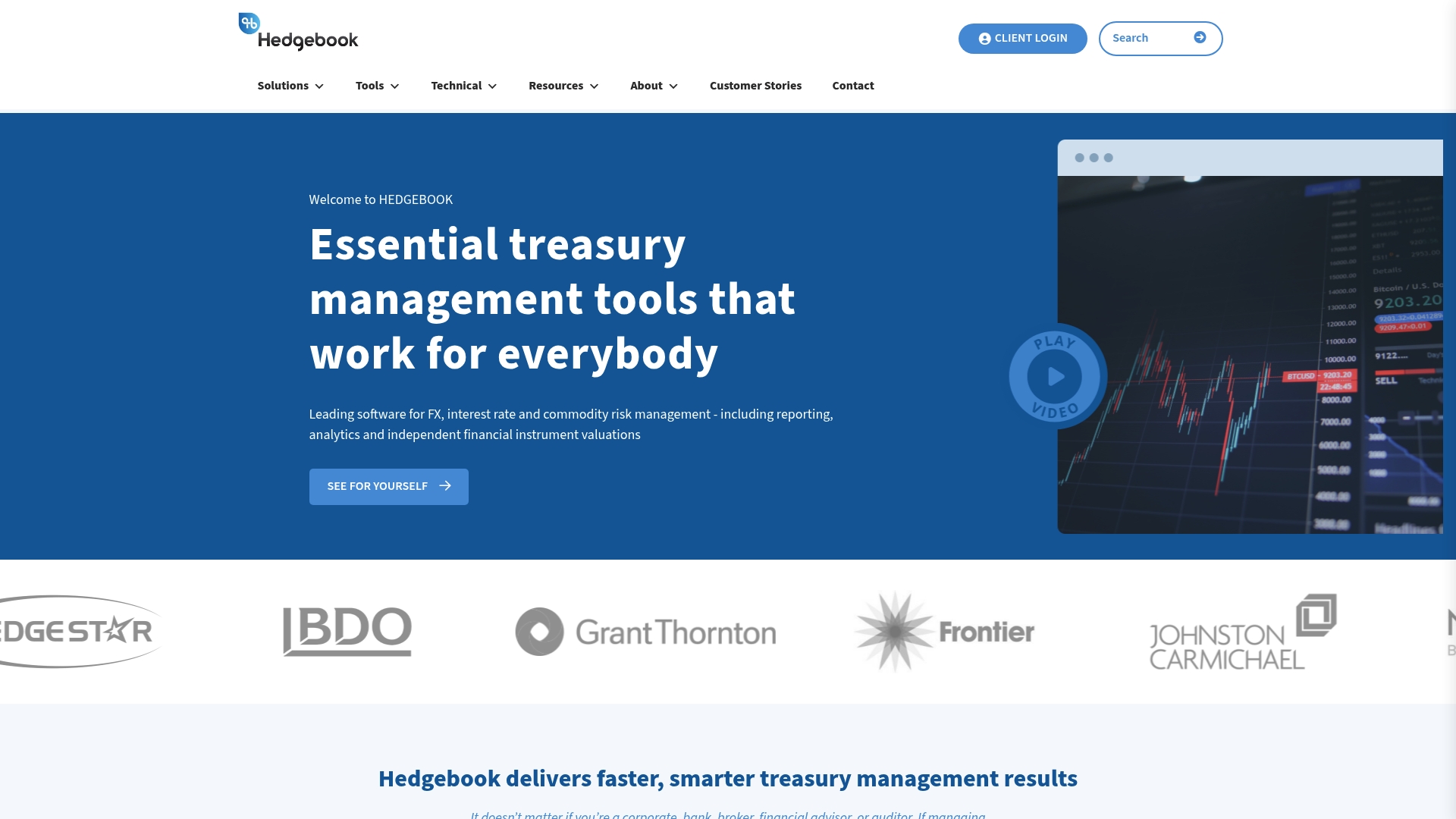
Independent valuations and mark-to-market reporting for FX, interest rate, and commodity instruments. The platform pairs those valuations with scenario analysis and hedge effectiveness testing aligned to IFRS 7 and IFRS 9. It operates in the cloud and targets treasury teams, banks, auditors, brokers, and advisors.
Core features
-
Independent valuations and mark-to-market reporting for derivatives and commodities. Reports use industry benchmark rates.
-
Risk management across FX, interest rates, and commodities. The module records exposures and hedges for ongoing oversight.
-
Financial instrument recording and reporting for FX forwards, options, interest rate swaps, and metals. Each instrument type has tailored valuation logic.
-
Real-time FX rates and market data feeds to update positions and valuations continuously.
-
Scenario analysis with sensitivity testing and hedge effectiveness assessment for IFRS compliance and audit trails.
Key differentiator
Hedgebook centers on independent valuations combined with IFRS-compliant reporting in a cloud delivery model. That combination helps treasury and audit teams separate bank-provided marks from a vendor-neutral view. The focus on multiple instrument classes makes it suitable when you need a single system for FX, interest rates, and commodity positions. The UI and workflows emphasize accessibility for cross-role collaboration.
Pros
-
User interface simplifies complex instruments. Accounts and hedges are easier to review than in spreadsheets.
-
Cloud-based access allows remote teams and external auditors to view consistent reports in real time.
-
Independent valuations provide a vendor-neutral mark-to-market that assists audit and control functions.
-
IFRS standards support for hedge effectiveness testing reduces manual work when preparing compliance documentation.
-
Flexible role support works for corporates, banks, auditors, brokers, and advisors needing shared views.
Cons
-
The provided material shows limited third-party reviews. Buyers have little public feedback to consult.
-
Pricing is not publicly disclosed. That forces direct vendor engagement before you can compare total cost.
-
No integrations are listed in the supplied data. You will need to verify connectivity to your treasury systems and ERP before committing.
Who it's for
Hedgebook fits finance professionals managing FX, interest rate, and commodity risks in corporates, banks, and advisory firms. It suits teams that must produce IFRS-compliant valuations and provide audit-ready evidence. Use it when you need a shared, cloud-based system rather than spreadsheet workflows.
Real world use case
A multinational uses Hedgebook to track its FX hedge program across subsidiaries. The company runs independent valuations for derivatives and produces IFRS reports for external audit. Banks and auditors access consistent position reports during quarter-end review.
Pricing
Not publicly disclosed. Pricing appears to be tailored by organizational size and feature needs according to the vendor data. Contact the vendor for a quote and to discuss deployment scope and any integration work.
Website: https://hedgebook.com
TreasuryView
At a glance
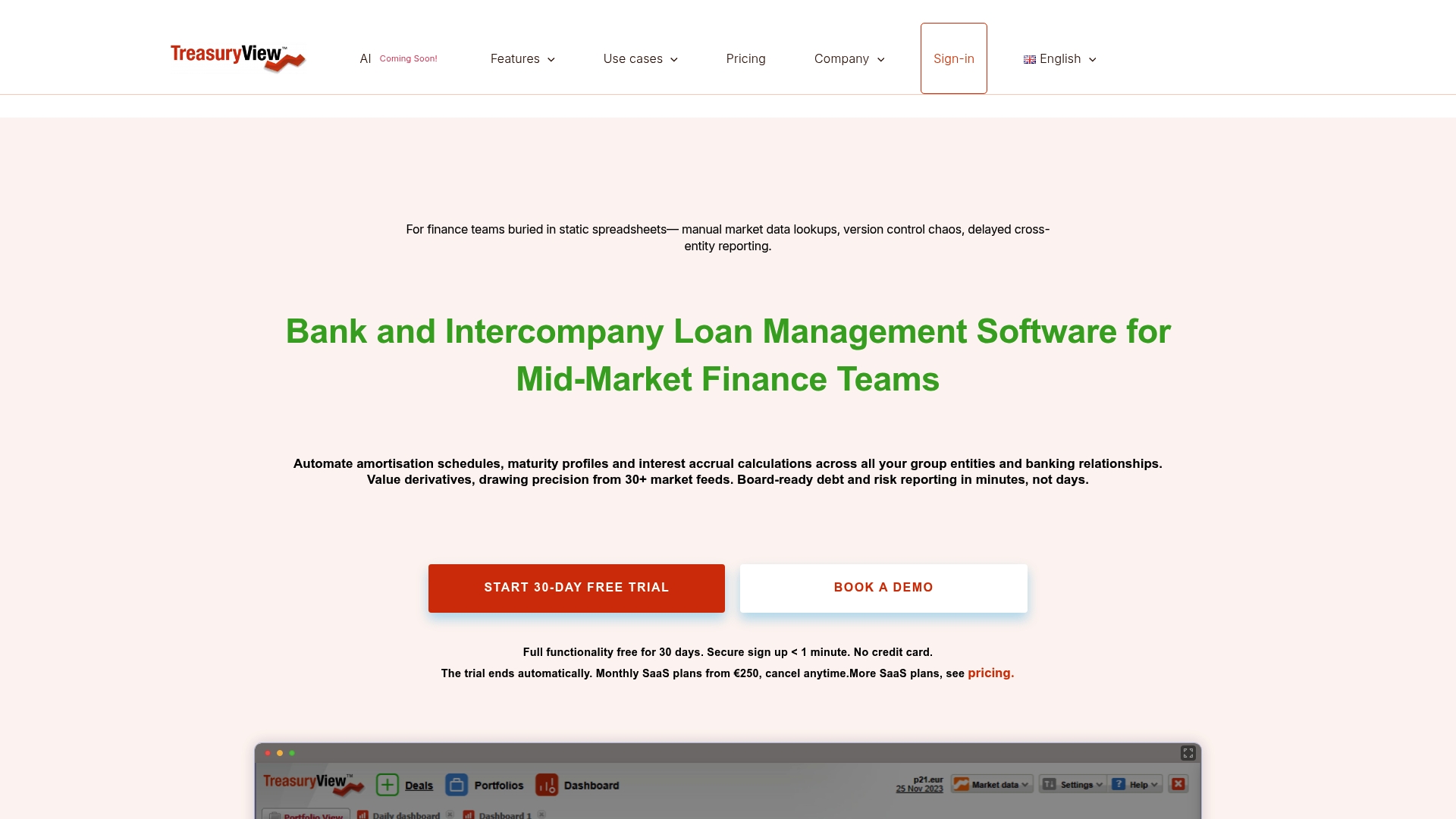
Finance teams managing €10M–€500M debt portfolios are TreasuryView's stated sweet spot. The platform aims to replace spreadsheets by automating interest calculations and producing board ready reporting. Deployment is cloud based and requires minimal IT involvement, which speeds rollout for mid-market teams. That focus makes it practical for teams that need quick results without heavy enterprise projects.
Core features
TreasuryView centers on loan and treasury workflows with automated calculations and live market information. The feature set targets common treasury tasks that usually live in spreadsheets.
- Automated amortization schedules and interest calculations for loans and intercompany debt.
- Real time market data integration to keep valuations up to date.
- Automated and customizable treasury reports for board and compliance needs.
- Centralized dashboard to view loans, hedges, and derivatives in one place.
- Scenario modeling for rate increases and early repayment analysis.
Key differentiator
The platform emphasizes fast, cloud based implementation and automation tailored to SMB finance teams. It prioritizes replacing manual spreadsheets and avoiding large enterprise system projects. That focus reduces setup time and keeps the feature set aligned with mid-market debt management needs.
Pros
-
Easy onboarding with no IT setup required. Teams can start without a long implementation project.
-
Immediate access after sign up; the vendor advertises no credit card required at trial start.
-
The vendor reports 4.8/5 user satisfaction in reviews. That figure suggests strong reception among current users.
-
Automated data updates and included market data cut manual reconciliation work.
-
Affordable entry pricing from €250/month makes trialing the tool feasible for mid-sized teams.
Cons
-
The buyer must accept cloud SaaS and its inherent data security trade offs.
-
The product may lack advanced features needed for highly complex enterprise treasury structures.
-
Offline use is limited because the system depends on internet connectivity.
When it may not fit
Avoid TreasuryView if your treasury has complex, multi layered enterprise structures that require custom workflows and deep integration. It also fits poorly where offline access is critical for day to day operations. Large corporate treasuries that need bespoke bank connectivity may find the feature set narrow.
Notable integrations
TreasuryView lists direct connections and single sign on options that matter to finance teams.
- SAP
- QuickBooks
- Google Docs
- Azure SSO
- RESTful API
Who it's for
Finance teams at mid sized companies that manage debt portfolios in the €10M–€500M range. Teams that want faster rollout and lower implementation overhead will get the most value. Treasury and accounting leads who currently run loan tracking in spreadsheets will see the biggest operational lift.
Real world use case
According to the vendor, a mid sized company replaced spreadsheets with TreasuryView to automate interest calculations, track maturities, and produce board reports. The vendor states that change saved the team over six hours weekly and reduced manual errors. The example illustrates how automated schedules and reporting free treasury staff for higher value work.
Pricing
The product uses monthly SaaS plans starting at €250/month. The vendor lists more detailed tiering and features on the website for buy side budgeting and procurement discussions.
Website: https://treasuryview.com
Tulyp treasury platform
At a glance
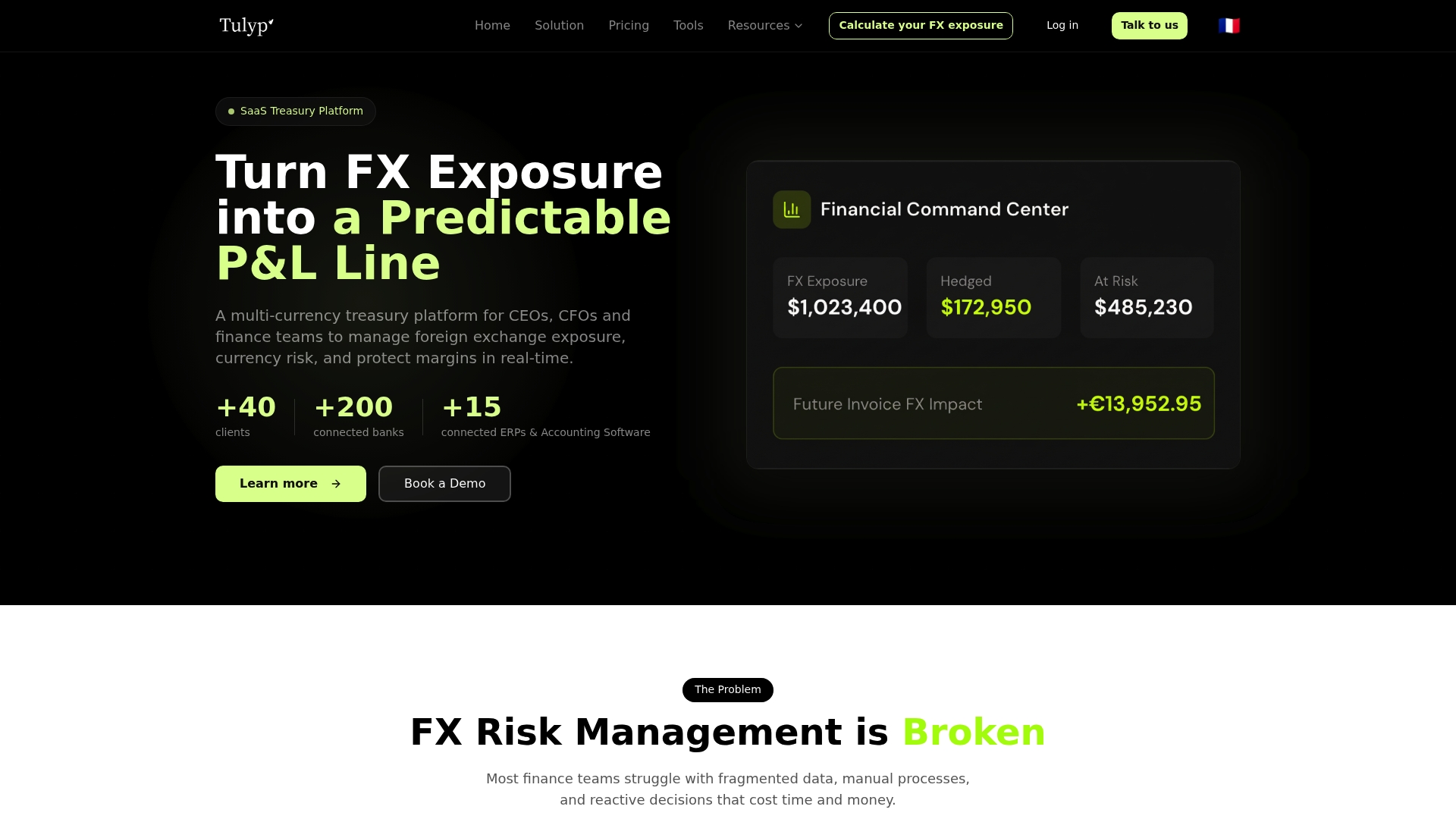
Starts at €129/month for the Starter plan. Tulyp centralizes ERP data, bank feeds, and trading platforms to give finance teams real time FX exposure visibility. The platform is designed so companies without a dedicated treasury team can run scenario analysis and manage hedges from one place.
Core features
Tulyp connects accounting and banking systems, calculates net exposure, runs simulations, and tracks hedges in a single interface. That mix reduces manual reconciliation and surfaces currency risk by time bucket.
- Connects and centralizes data from ERPs, bank feeds, and trading platforms.
- Calculates net FX exposure by currency and by time bucket.
- Simulates market moves to show impact on revenue, margin, and EBITDA.
- Provides real time exposure visibility, alerts, and hedge tracking.
Key differentiator
Tulyp combines continuous exposure calculation with scenario simulation and hedging management aimed at smaller finance teams. The platform targets users who need live visibility and tactical hedging without hiring a treasury desk. That focus makes it more accessible for SMEs than tools built for large treasury departments.
Pros
- Real time exposure: Gives up to date currency exposure and alerting so teams spot threshold breaches fast.
- Automated data collection: Pulls from ERPs and bank feeds to reduce manual imports and reconciliation errors.
- Scenario analysis: Lets you model currency moves and see effects on margin and EBITDA before acting.
- No dedicated treasury required: Designed for finance teams at SMEs and mid sized firms that lack a full treasury staff.
- Flexible plans: Offers tiered plans to match company size and FX volume.
Cons
- Multi entity consolidation and some net hedging features are limited to enterprise plans, which constrains smaller customers needing those capabilities.
- Initial setup can be complex depending on your ERP and banking landscape, so expect implementation effort.
- Advanced integrations and API access are reserved for enterprise clients, which limits customization for lower tiers.
- Automatic invoice import and some workflow automations appear only on higher plans.
When it may not fit
If your business requires full multi entity consolidation across many subsidiaries, Tulyp may not fit unless you choose an enterprise plan. If your team needs open API access for heavy customization, lower tiers will feel restrictive. Choose a different tool if you need every advanced feature without an enterprise contract.
Notable integrations
Tulyp integrates with mainstream accounting and ERP systems commonly used by international finance teams. That makes initial data mapping faster for common stacks.
- Quickbooks
- Xero
- SAP S4 HANA
- Sage Accounting
- Netsuite
- ERPNext
- Invoice Ninja
Who it's for
Finance teams at SMEs and mid sized companies that operate across multiple currencies will benefit most. The product suits CFOs and finance managers who need near real time risk visibility and hedge tracking but do not have a dedicated treasury desk. Companies with straightforward ERP landscapes will see the fastest time to value.
Real world use case
A freight forwarding company uses Tulyp to monitor exposure across several currencies. The team receives real time alerts when exposures exceed set thresholds and runs simulations to check hedge impact on margins. That reduced manual spreadsheet work and helped protect contract profitability during volatile months.
Pricing
Pricing starts at €129/month for the Starter plan and scales up to custom enterprise pricing. Advanced features such as net hedging engines, multi entity consolidation, and API access sit behind higher tiers. Request a demo to confirm which plan includes the features you need.
Website: https://tulyp.io
Pangea FX hedging software
At a glance
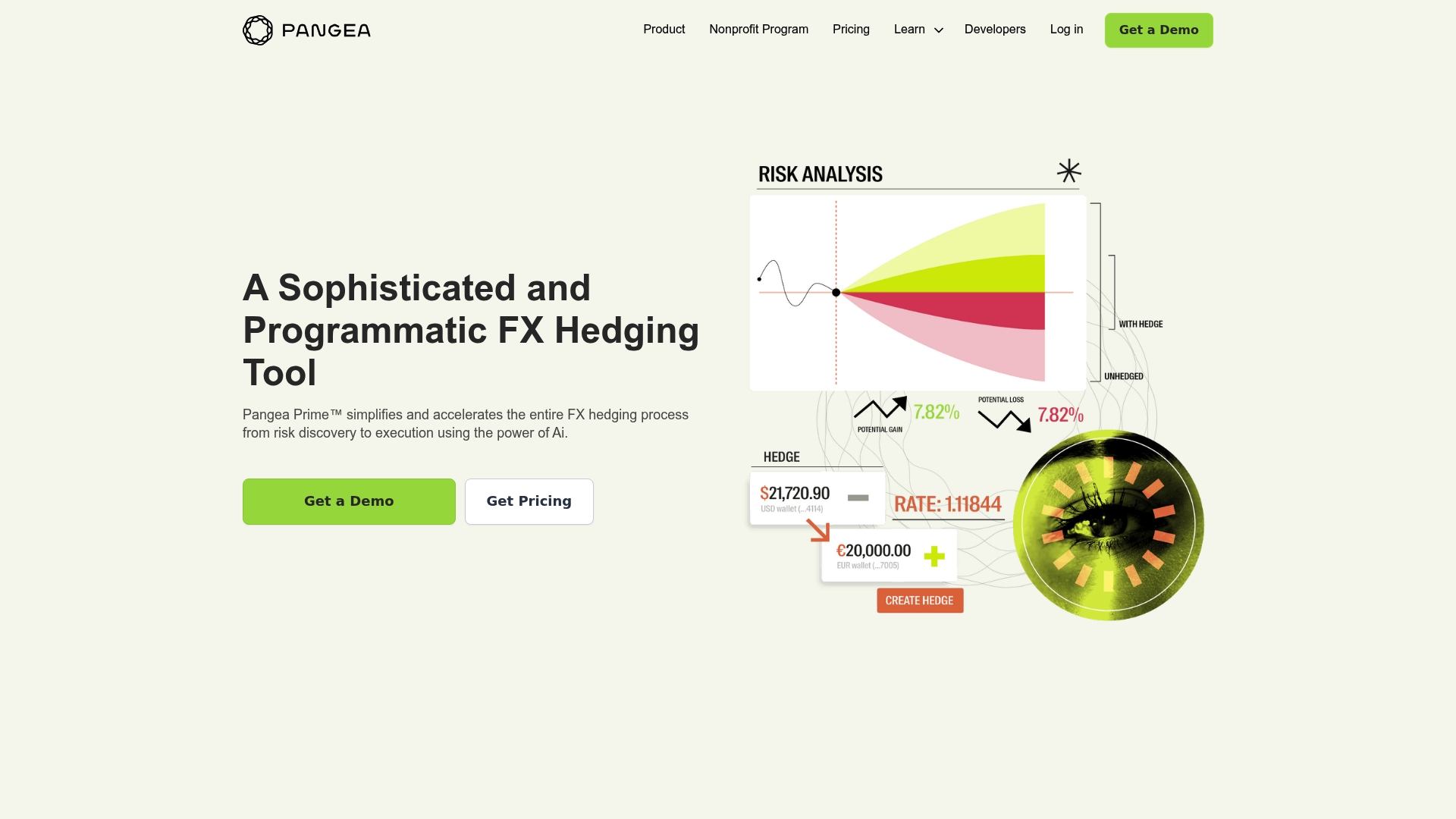
Supports more than 150 currencies for programmatic hedging and global settlement. The platform combines payments, hedging, and settlement into a single interface with API access. According to the company, typical implementations complete in about two weeks. That speed and scope make it practical for teams that need fast go live for cross border operations.
Core features
- AI powered FX risk management and hedging that recommends and executes hedges. One can run automated rules or switch to manual execution.
- Unified platform for payments, hedging, and settlement so trading and cash flows live in one place.
- API integration for programmatic control that supports automated workflows and custom integrations.
- Multi currency management with over 150 currencies for broad market coverage and local currency payouts.
- Automated and manual hedging options including forwards and options to match different risk policies.
Key differentiator
The platform uses AI powered automation to time hedge execution and reduce manual intervention. That automation ties trading logic directly to payment and settlement flows. For teams that want programmatic control, the platform reduces handoffs between treasury and payments. The result is a single place to run strategy, execute trades, and settle funds.
Pros
- Comprehensive operational coverage. Payments, hedging, and settlement sit in the same product which reduces reconciliation work.
- Deep customization and automation. The AI features let you set policy and let the system act within those bounds.
- Transparent, scale based pricing. The vendor advertises clear pricing with no hidden fees which helps budget forecasting.
- Fast implementation. According to the company, most customers launch in about two weeks which shortens project timelines.
- Dedicated customer support. The product data highlights access to advisors for onboarding and strategy guidance.
Cons
- Limited published user feedback in the source material. That lack of third party reviews makes usability harder to verify.
- Feature complexity can require FX expertise. Smaller teams without treasury experience may need outside help.
- Volume based pricing may feel expensive for low transaction volumes. Small users should model costs before committing.
Who it's for
This product fits organizations with meaningful cross border exposure that want programmatic control. Typical buyers include high growth startups, enterprises, nonprofits, and global HR providers. Choose this if you need a single platform for trading and payment flows and you can support a short but focused onboarding project.
Real world use case
A West African cocoa producer used the platform to manage currency volatility and expand credit access. Pangea handled hedging with forwards and options while linking settlement to local payouts. The operation reported steadier cash flow and clearer pricing for buyers and lenders.
Pricing
Pricing is scale based with no hidden fees. The vendor points to a linked pricing page for details and volume tiers. Expect costs to track transaction volume and service level rather than a flat per seat fee.
Website: https://pangea.io/product/fx-hedging-software
Comparison of alternatives
Selecting the most suitable forex risk management solution involves analyzing software feature sets alongside organizational needs. The tools discussed offer diverse functionalities, providing options for businesses with distinct requirements.
Delivering automation and analytics
CorpHedge and Tulyp Treasury Platform excel in providing real-time monitoring and analytics for forex risk. CorpHedge uniquely implements automation in forecasting hedging strategies using historical data, ideal for accounting teams without specialized risk expertise. Tulyp focuses on automation for net exposure visualization and simulation.
Pricing and target audience
TreasuryView's entry point, at €250/month, caters to mid-sized firms seeking accessible treasury solutions without large enterprise budgets, while Hedgebook targets entities requiring IFRS-compliant reporting. Pangea FX Hedging Software offers transparent pricing, scalable with transaction volume, supported by quick implementation.
Best fit
- Businesses seeking automated hedging plans should consider CorpHedge for its historical data-driven features.
- Organizations requiring IFRS-compliant analysis and audits may find Hedgebook beneficial for its emphasis on multi-class risk compliance.
- Mid-sized finance teams managing €10M–€500M debt portfolios may prefer TreasuryView due to its affordable and simple onboarding.
- Companies looking for integration of datasets from ERPs should evaluate Tulyp Treasury Platform.
- For operations requiring extensive currency management, Pangea FX Hedging Software offers significant coverage across 150 currencies.
Our pick
CorpHedge is tailored for teams prioritizing automated solutions coupled with historical data and Value at Risk analysis. It stands apart for transforming raw exposure data into executable hedging insights, providing impactful decisions for organizations of any size. Businesses specializing in complex multi-class risks may still evaluate alternatives offering targeted compliance and reporting solutions.
When choosing a forex risk management platform, comparing key features, differentiators, and user compatibility can assist in identifying the most fitting tool to enhance financial operations.
| Product | Core Feature | Key Differentiator | Best For | Pricing | Notable Limitation |
|---|---|---|---|---|---|
| CorpHedge | Real-time FX risk analysis and hedging strategy generation | Automated plans from historical data and VaR | SMEs and large enterprises | Not disclosed | Advanced features may have a learning curve |
| Hedgebook | Valuations, reporting, and hedge effectiveness testing | Vendor-neutral independent valuation system | Treasury teams and audit professionals | Not disclosed | Limited third-party reviews for insights |
| TreasuryView | Automated loans and treasury workflow management | Tailored to SMB finance teams; fast implementation | Mid-sized companies managing portfolios | €250/month | Offline use dependent on internet |
| Tulyp Treasury Platform | Centralized ERP data and FX exposure management | Real-time exposure and scenario simulation | SMEs with cross-border operations | €129/month | Advanced integrations for enterprise plan |
| Pangea FX Hedging Software | AI-powered FX risk management and settlement | Unified platform for payments and hedging | Global cross-border financial operations | Not disclosed | Requires FX expertise for optimal use |
Take control of your forex accounting with Corphedge
Accounting for forex companies requires clear visibility into currency exposures and consistent, actionable hedging strategies. Corphedge tackles key challenges like reducing reliance on manual spreadsheets and turning complex Value at Risk data into straightforward automated trading plans. This empowers finance teams without dedicated treasury staff to manage FX risk efficiently and confidently.
Benefit from:
- Real time FX risk analysis and portfolio valuation
- Automated policy-driven hedging plans
- Integration with platforms like Corpay to simplify execution
Explore Corphedge to reduce guesswork and gain continuous insight into your currency exposures. Act now to generate precise, compliant hedging strategies tailored for your business needs. Book a demo and start converting exposure data into clear trading actions today.
FAQ
How does Corphedge provide visibility into currency exposures for accounting teams?
Corphedge offers continuous visibility into currency exposures through real-time FX risk analysis and portfolio tracking. This allows accounting teams to reconcile accounting positions with market exposure effectively. Prospective users can expect immediate insights into their currency risk management needs.
What is the difference between Corphedge and hedgebook in terms of independent valuations?
Hedgebook excels in providing independent valuations and mark-to-market reporting, which helps treasury and audit teams with a vendor-neutral perspective. In contrast, Corphedge focuses on automated hedging plan generation based on historical data and VaR modeling, making it better suited for companies that seek hands-on hedging guidance. Evaluating these strengths can help organizations decide based on their specific compliance or strategic needs.
Can i use Corphedge if my company needs to track multi-entity exposures?
Corphedge is designed to scale from small to large corporate requirements; it supports simple hedging rules as well as multi-entity exposures. This makes it suitable for businesses of different sizes and structures looking to manage their forex risks without a dedicated treasury team.
What pricing options does Corphedge offer compared to TreasuryView and its entry costs?
While Corphedge's pricing details are not publicly listed, it requires prospective buyers to contact them for subscription costs, similar to TreasuryView, which starts at €250/month. This approach allows both platforms to tailor pricing based on organizational needs and features, giving you a chance to evaluate the best fit for your budget.
How does Corphedge help teams with risk sensitivity analysis?
Corphedge supports strategic choices by conducting risk sensitivity analysis to test the impact of FX moves on reported earnings and cash flow. This functionality is crucial for businesses needing to understand their exposure and make informed financial decisions instead of relying on manual models.