

TL;DR:
- Technology improves risk management by enabling faster, more precise detection of financial exposures using AI, automation, and analytics.
- It also introduces challenges such as data quality issues, explainability concerns, and board-level accountability that organizations must address responsibly.
The role of technology in risk management is to deliver faster, more precise risk identification and mitigation through AI, automation, advanced analytics, and integrated digital tools. Risk professionals now operate in an environment where manual processes simply cannot keep pace with the volume, speed, and complexity of modern financial exposure. HSBC, for example, uses AI to scan 980 million transactions monthly, cutting analysis time from weeks to days. That single example illustrates what technology does at scale: it turns an impossible manual task into a manageable, repeatable process. For corporate finance leaders and risk managers, understanding which technologies drive real results and how to deploy them responsibly is now a core professional competency.
What key technologies are shaping risk management today?
Technology solutions for risk management fall into four primary categories: artificial intelligence and machine learning, automation, real-time analytics platforms, and cybersecurity infrastructure. Each category addresses a different layer of risk exposure, and the most effective programs combine all four.

Artificial intelligence and machine learning power predictive analytics and anomaly detection. AI models identify patterns across massive datasets that no human team could review manually. Machine learning goes further by improving its own predictions over time. Machine learning models using algorithm-level balancing can improve risk prediction accuracy and F1 scores by over 10 percentage points. That improvement is not marginal. In fraud detection or credit risk modeling, a 10-point accuracy gain directly reduces financial losses.
Automation handles repetitive, rules-based tasks: data collection, report generation, threshold alerts, and transaction flagging. Automation reduces manual errors, freeing finance teams to focus on strategic risk analysis rather than data entry. The practical result is that risk analysts spend less time compiling reports and more time interpreting them.
Real-time risk dashboards consolidate exposure data across business units, geographies, and asset classes into a single view. For multinational companies managing currency exposure across Polish zloty, Swedish krona, and euro positions simultaneously, integrated dashboards are not optional. They are the only way to see total exposure in real time. Data quality and system integration are the foundational requirements that make dashboards useful. Without clean, standardized data inputs, even the best dashboard produces misleading outputs.
Cybersecurity technology rounds out the enterprise risk picture. Modern risk design embeds security and risk assessment directly into business processes rather than treating it as a perimeter defense problem. That shift from "build walls" to "build resilience" defines how leading organizations now approach technology risk.
How does technology improve risk assessment accuracy?
Digital tools in risk management improve accuracy by processing volumes of data that exceed human capacity, then flagging anomalies with speed and consistency that manual review cannot match.
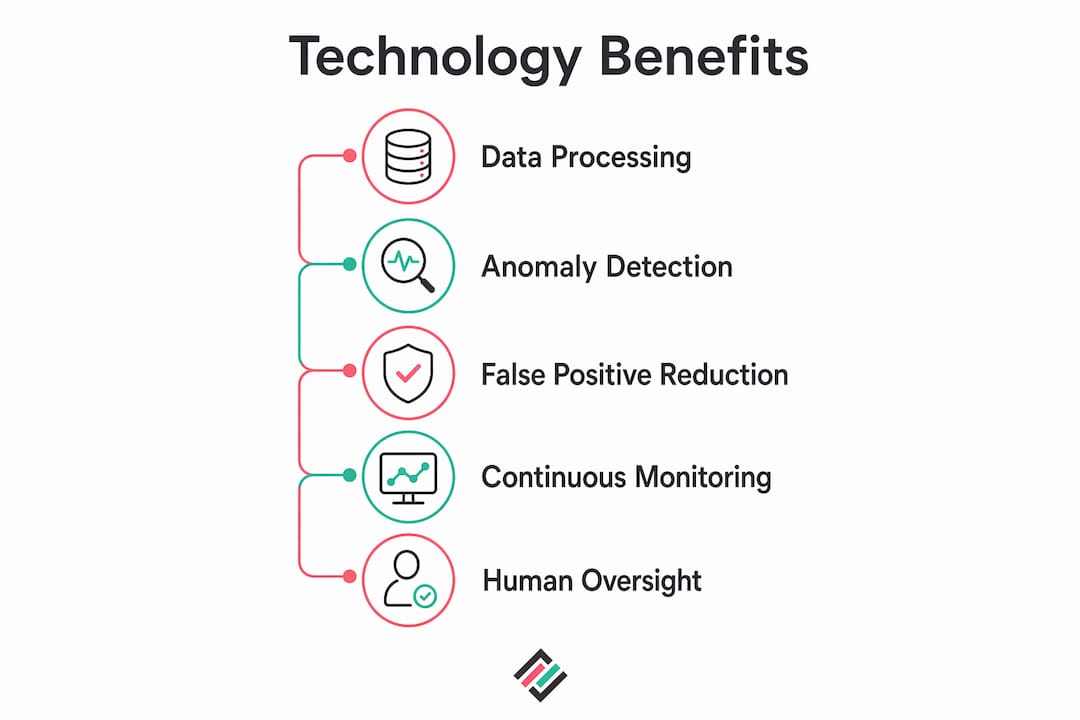
The HSBC example is instructive. Processing 980 million transactions monthly with AI does not just save time. It reduces false negatives, the cases where financial crime goes undetected because a human analyst missed a pattern buried in millions of records. Fewer false negatives mean fewer regulatory penalties and less reputational damage.
Reducing false positives matters equally. When fraud detection systems flag too many legitimate transactions, investigation teams get overwhelmed and real threats get delayed. AI models trained on historical data calibrate thresholds more precisely than static rule sets, which means investigators spend time on genuine risks rather than noise.
Continuous monitoring is another measurable benefit. Technology enables 24/7 surveillance of positions, counterparty exposures, and market movements. For companies with currency exposure in markets like Poland or Sweden, real-time monitoring catches adverse rate movements before they breach risk limits.
Pro Tip: Always pair automated monitoring with predefined escalation rules. Automation catches the signal; a human decision-maker must own the response. Without that structure, alerts pile up and get ignored.
The balance between automation and human oversight is not a philosophical debate. It is a compliance requirement. Financial teams must maintain auditability and explainability of AI-generated decisions to satisfy regulators. A model that produces accurate outputs but cannot explain its reasoning creates legal exposure, not just operational risk.
What are the challenges of relying on technology in risk management?
Technology introduces its own category of risk when deployed without adequate governance. The three most significant challenges are data quality, AI explainability, and board-level accountability.
Data quality is the foundation everything else rests on. Successful AI integration depends critically on data quality and standardized accounting policies. Garbage in, garbage out is not a cliché in risk management. It is a description of how automated systems amplify errors at scale. A flawed data feed does not produce one wrong answer. It produces millions of wrong answers, all delivered with algorithmic confidence.
The "black box" problem refers to AI systems that produce outputs without transparent reasoning. Over-reliance on unexplainable AI risks compliance failures and systemic errors in financial risk management. Regulators in the EU and beyond now require firms to explain automated decisions that affect financial outcomes. A model that cannot be explained cannot be defended.
Board-level accountability is the governance challenge most organizations underestimate. Cybersecurity and technology risk are fiduciary responsibilities, not IT department issues. Executive negligence in technology risk oversight can create personal liability for board members. That reality changes the conversation from "what does IT recommend" to "what are we legally required to govern."
Pro Tip: Build a technology risk register that sits alongside your financial risk register. Every automated system in your risk stack should have an owner, a review schedule, and a documented escalation path.
Additional challenges include:
- Vendor dependency: third-party technology failures become your operational failures
- Staff capability gaps: teams that cannot interpret model outputs cannot challenge them
- Integration complexity: legacy systems often resist clean data exchange with modern platforms
- Regulatory lag: technology evolves faster than compliance frameworks, creating gray areas
How are upcoming regulations shaping technology use in risk management?
Two regulatory frameworks define the compliance environment for risk technology in 2026: the EU AI Act and the Digital Operational Resilience Act (DORA).
The EU AI Act enforces obligations on companies using high-risk AI systems, effective august 2, 2026. Risk management systems that make or influence consequential financial decisions fall into the "high-risk" category. That classification triggers requirements for transparency, human oversight, data governance, and conformity assessments. Companies operating in EU markets, including Poland and Sweden, must audit their AI-driven risk tools against these standards now, not after the deadline.
DORA requires financial institutions to assess and monitor ICT third-party risk, making vendor technology risk management central to operational continuity. If your risk platform relies on a third-party data provider or cloud infrastructure, DORA requires you to document, test, and manage that dependency as a formal risk. The regulation treats technology resilience as a financial stability issue, not an IT maintenance task.
| Regulation | Scope | Key requirement | Effective date |
|---|---|---|---|
| EU AI Act | High-risk AI systems in EU markets | Transparency, human oversight, conformity assessment | August 2, 2026 |
| DORA | Financial institutions using ICT third parties | ICT vendor risk assessment and monitoring | Already in force |
Compliance with these frameworks demands proactive strategy integration and continuous process updates. Organizations that treat compliance as a one-time project will fall behind. The regulatory environment now requires ongoing governance, not a single audit.
Measuring IT investments by business continuity outcomes rather than typical IT metrics ensures technology drives meaningful risk mitigation results. That framing matters for board conversations: the question is not "what did we spend on technology" but "what risk did that spending actually reduce."
What practical steps can organizations take to integrate technology effectively?
Effective technology integration in risk management follows a sequence. Skipping steps creates the exact problems described above: bad data, unexplainable models, and governance gaps.
-
Map your processes before automating them. Automation applied to a broken process produces a faster broken process. Document current risk workflows, identify where errors occur, and fix the process logic before introducing technology.
-
Improve data quality first. Standardize data inputs across systems, reconcile inconsistencies, and establish data governance policies. This step is unglamorous and time-consuming. It is also the single most important determinant of whether your technology investments work.
-
Start with task automation, then move to predictive models. Automate report generation, alert thresholds, and data aggregation before deploying machine learning for risk prediction. Build confidence in your data infrastructure before trusting it with complex models. For deeper context on this phased approach, the role of automation in risk management guide covers the sequencing in detail.
-
Maintain human decision authority at key points. Define which decisions require human sign-off regardless of what the model recommends. Automated systems support decisions. They do not replace accountability.
-
Build cross-functional teams. Risk, IT, finance, and legal must collaborate on technology deployment. Siloed implementation produces tools that work technically but fail operationally because the people using them were not involved in designing them.
-
Invest in staff capability. Teams that cannot read a model's output cannot challenge it when it is wrong. Training risk professionals to interpret and question technology outputs is as important as the technology itself. For currency risk specifically, risk management best practices provide a practical framework for technology-enabled mitigation.
Key Takeaways
Technology transforms risk management by replacing slow, error-prone manual processes with AI, automation, and real-time analytics that improve accuracy, speed, and regulatory compliance.
| Point | Details |
|---|---|
| AI drives speed and accuracy | HSBC scans 980 million transactions monthly, cutting analysis from weeks to days. |
| Data quality is foundational | AI amplifies errors at scale, so clean, standardized data must come before automation. |
| Explainability is a compliance requirement | Regulators require firms to explain AI-generated decisions affecting financial outcomes. |
| EU AI Act and DORA set the 2026 standard | High-risk AI systems and ICT third-party dependencies now carry formal regulatory obligations. |
| Human oversight remains non-negotiable | Automation supports decisions; accountability must stay with a named human decision-maker. |
Why technology alone will not save your risk program
I have watched organizations invest heavily in risk technology and still produce worse outcomes than teams using simpler tools with better discipline. The pattern is consistent: the technology gets deployed before the underlying process is understood, and the model becomes a black box that nobody challenges because it sounds authoritative.
The most resilient risk programs I have seen treat technology as a force multiplier for human judgment, not a replacement for it. Technology integrated as a strategic business framework measures IT investments against business continuity goals, not IT metrics. That distinction separates organizations that use technology to genuinely reduce risk from those that use it to produce impressive dashboards.
The 2026 regulatory environment makes this more urgent. The EU AI Act and DORA do not just add compliance tasks. They force organizations to answer hard questions about who owns each automated decision and what happens when the model is wrong. Those are questions that should have been asked at deployment, not at audit time.
My honest view: the companies that will get the most from risk technology in the next three years are not the ones with the most advanced models. They are the ones that have done the unglamorous work of cleaning their data, training their people, and building governance structures that treat technology risk as a board-level responsibility.
— Bartas
How Corphedge supports technology-driven risk management
Corphedge builds the kind of technology infrastructure that risk management professionals actually need: real-time currency position visibility, Value at Risk frameworks, and platform integrations that connect risk data across your organization.
For companies managing foreign exchange exposure in markets like Poland and Sweden, the gap between manual hedging decisions and technology-enabled risk management is measured in basis points and compliance penalties. Corphedge's hedging based on Value at Risk gives finance leaders a structured, data-driven framework for currency risk decisions. The FX risk management platform puts real-time exposure data and risk analytics in one place, so your team spends time on strategy rather than spreadsheets. See how it works with a platform demo.
FAQ
What is the role of technology in risk management?
Technology in risk management delivers faster, more accurate risk identification through AI, automation, and real-time analytics. It replaces manual processes that cannot scale with the volume and complexity of modern financial exposure.
How does AI improve risk assessment accuracy?
AI scans large transaction volumes and detects anomalies that manual review misses. Machine learning models can improve risk prediction accuracy by over 10 percentage points compared to traditional rule-based approaches.
What does the EU AI Act require for risk management systems?
The EU AI Act, effective august 2, 2026, requires companies using high-risk AI systems to demonstrate transparency, human oversight, and data governance. Risk management tools that influence consequential financial decisions fall into the high-risk category.
What is the biggest risk of relying on technology in risk management?
The biggest risk is deploying AI on poor-quality data or without explainability controls. Automated systems amplify errors at scale, and models that cannot explain their outputs create both compliance exposure and operational blind spots.
How does DORA affect technology use in financial risk management?
DORA requires financial institutions to formally assess and monitor ICT third-party risk. Any technology vendor or cloud provider in your risk infrastructure must be documented, tested, and managed as a formal operational risk.