
TL;DR:
- Many corporate finance teams underestimate FX risk until sudden currency moves erode profit margins.
- Professional FX hedge academies teach systematic, policy-driven frameworks that protect cash flow regardless of market direction.
- These programs focus on advanced derivative instruments, regulatory compliance, and technology integration to build institutional risk management.
Most corporate finance teams think they understand FX risk until a sudden currency move wipes out a quarter's margin. The gap between basic hedging knowledge and genuine mastery is where profits get lost, and a professional FX hedge academy exists precisely to close that gap. This is not about predicting where EUR/USD will trade next month. It is about building systematic, policy-driven frameworks that protect cash flow regardless of market direction. If you are a CFO, treasurer, or senior finance executive managing multi-currency exposures, what follows covers the structured training, advanced instruments, regulatory obligations, and operational integration that separate reactive hedging from a real risk management program.
Table of Contents
- Key Takeaways
- What a Professional FX Hedge Academy Actually Offers
- Advanced hedging strategies taught in professional programs
- Regulatory standards: IFRS 9 and ASC 815 in 2026
- Integrating FX hedging into treasury operations
- My honest take on what separates good programs from great ones
- Corphedge: professional FX hedging training and platform
- FAQ
Key Takeaways
| Point | Details |
|---|---|
| Proactive over reactive | Stabilizing cash flows through structured frameworks beats trying to time currency markets every time. |
| Training covers derivatives depth | Advanced programs go beyond forwards to teach cylinders, participating forwards, barrier options, and portfolio overlays. |
| Compliance is non-negotiable | IFRS 9 and ASC 815 require formal hedge designation at inception. Retroactive documentation disqualifies hedge accounting. |
| Technology amplifies execution | Treasury platforms automate effectiveness testing, documentation, and accounting entries, cutting compliance workload significantly. |
| Peer learning accelerates outcomes | Programs offering CPD credits and networking allow finance leaders to benchmark strategies and avoid costly mistakes. |
What a Professional FX Hedge Academy Actually Offers
The term "professional FX hedge academy" covers a range of program formats, and the differences matter depending on your role and goals. You are not choosing between beginner courses or retail trading content. These programs target finance professionals who already understand FX basics and need to operate at institutional level.
Training formats and structures
Intensive bootcamps last 3 to 5 days and offer concentrated coverage of FX governance, derivative application, and treasury technology integration. These work well for teams that need rapid capability uplift before a new hedging program launch. Modular online courses, on the other hand, spread content across six to twelve weeks with self-paced modules covering individual topics like options pricing, hedge accounting documentation, or counterparty risk. Both formats have their strengths, and the best programs combine synchronous workshops with on-demand materials.
Core curriculum in a serious program covers FX governance framework design, the mechanics and pricing of derivative instruments (forwards, cross-currency swaps, FX options), treasury management system integration, regulatory compliance under IFRS 9 and ASC 815, and performance reporting. Programs also typically offer up to 35 CPD credits, which matter for professional certifications like ACT or CFA.

A critical distinction from retail trading courses: the focus is always on the corporate context. You are hedging identifiable business exposures, not speculating on currency direction. The analytical lens is always the impact on EBITDA, cash flow stability, and financial statement presentation.
Pro Tip: When evaluating programs, ask whether case studies use real corporate treasury scenarios with actual P&L attribution. Programs that teach through corporate examples transfer far better than those built on trading desk scenarios.
Peer learning opportunities within cohort-based programs let treasury leaders benchmark their own frameworks against peers across sectors. A manufacturing CFO working through a hedging policy design exercise alongside a tech company treasurer often surfaces blind spots that no textbook exercise can replicate.
Advanced hedging strategies taught in professional programs
The real value of advanced training is the expansion of your instrument toolkit well beyond vanilla forwards. Moving beyond forwards to structured derivatives and integrating FX risk into enterprise risk management with advanced analytical tools is a core focus at every reputable professional FX hedge academy.
Here is what advanced programs actually teach in this area:
- Participating forwards: Lock in a worst-case rate while retaining partial upside if the market moves favorably. These are particularly useful when budget rates are conservative relative to market consensus.
- Cylinders (collars): Buy an option at one strike, sell another at a different strike. The net premium is reduced or eliminated. Corporate treasuries use these when the board wants cost certainty without paying full option premium.
- Seagull structures: Combine three options to create a cost-neutral or near-zero premium hedge with defined participation bands. Popular in manufacturing and commodity-linked industries with tight margins.
- Barrier options (knock-in/knock-out): Significantly cheaper than vanilla options because they extinguish or activate at a barrier level. High reward when the barrier is unlikely to be hit. High risk when it is.
- FX overlay strategies: Portfolio-level hedging that manages aggregate exposure across multiple currency pairs simultaneously, rather than hedging each transaction individually.
Stress testing and Value at Risk analysis sit at the core of enterprise risk management integration. You learn to quantify worst-case scenarios across portfolio exposures, model tail risks that vanilla hedges miss entirely, and present findings in board-level reporting language. The Corphedge platform supports VaR-based hedging methodologies that align directly with what these programs teach.
Separating hedging costs from currency alpha is another concept that transforms how treasury teams report performance. When you can show the board exactly what the hedge program cost versus what currency movements saved or cost the business, the conversation shifts from "are we spending too much on hedging?" to "here is the precise value our risk framework delivered."
Pro Tip: Before committing to any structured derivative, model the full lifecycle P&L under three scenarios: rate moves in your favor, rate moves against you past the barrier, and rate stays flat. Most treasury disasters come from products that were not stress-tested beyond the sales presentation.
AI applications in FX risk analytics are increasingly taught in advanced programs, covering automated exposure aggregation, predictive hedge ratio modeling, and real-time monitoring of hedge effectiveness ratios. This is not speculative. Treasury teams at mid-size multinationals are already deploying these tools, and training that ignores them is already behind the curve.
Regulatory standards: IFRS 9 and ASC 815 in 2026
Hedge accounting compliance is where most corporate treasury programs have their biggest gaps, and the consequences of getting it wrong are severe. Marked-to-market derivative accounting without hedge accounting qualification creates earnings volatility that can spook analysts, lenders, and boards alike.
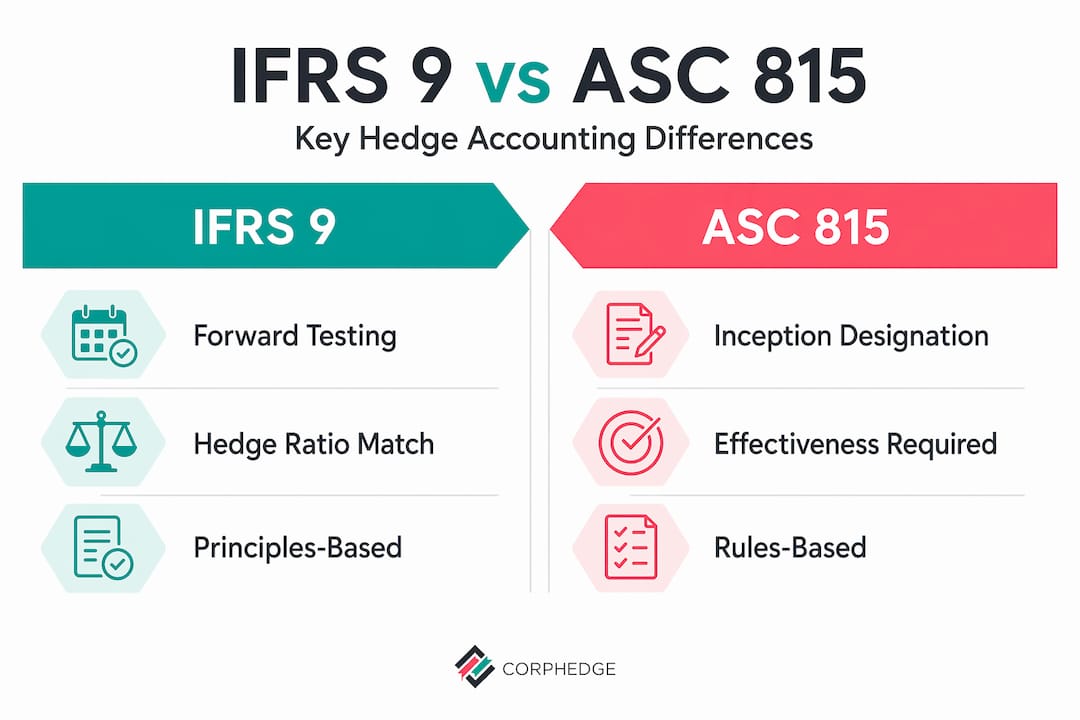
| Requirement | IFRS 9 | ASC 815 |
|---|---|---|
| Formal designation | Required at inception | Required at inception |
| Retroactive designation | Prohibited | Prohibited |
| Effectiveness testing | Forward-looking, principles-based | Quantitative, both prospective and retrospective |
| Documentation | Contemporaneous, mandatory | Contemporaneous, mandatory |
| Hedge ratio flexibility | Rebalancing permitted without dedesignation | Rebalancing requires new designation |
| Eligible hedged items | Broader, includes risk components | More prescriptive category rules |
IFRS 9 and ASC 815 both require formal designation and contemporaneous documentation of hedging relationships at inception. This is the most commonly missed requirement in corporate programs. Finance teams often designate hedges informally or after the fact, which disqualifies the hedge accounting treatment entirely. The resulting earnings volatility can be avoided entirely with the right process design from the outset.
IFRS 9 requires forward-looking effectiveness testing and a match between the hedge ratio and the company's actual risk management objective. This replaced the retrospective 80 to 125 percent bright-line test under IAS 39, making the standard more flexible but also more principles-based. You need to understand your own risk management intent clearly before you can demonstrate compliance.
Treasury platforms like Kyriba and GTreasury automate the entire hedge accounting workflow: designation, effectiveness testing, documentation generation, and accounting journal entries. Advanced training teaches you to configure and use these platforms rather than maintain manual spreadsheet processes that auditors routinely challenge.
A professional FX hedge academy addresses compliance not as a checklist exercise but as a framework design problem. You learn to build documentation templates, establish review cadences, and create governance policies that hold up under external audit, not just internal review.
Integrating FX hedging into treasury operations
Understanding hedging instruments is only half the work. Embedding a hedging program into your treasury function so it actually runs reliably requires policy design, technology integration, and stakeholder management at the same time.
- Design an FX policy document first. Define hedge ratios by exposure type (forecast revenue, firm commitments, balance sheet), approved instruments, maximum tenor, counterparty limits, and performance benchmarks. Without a written policy, every hedge decision becomes discretionary and defensible only by outcome.
- Map exposures systematically. Many corporate teams underestimate the importance of holistic exposure mapping before hedging. Aggregate exposures at portfolio level rather than hedging transaction by transaction. This reduces over-hedging, minimizes premium spend, and clarifies net risk positions.
- Integrate your treasury management system. Connect your ERP to your TMS so FX exposure data flows automatically into your hedging decision engine. Manual data extraction between systems is a primary source of hedging errors and documentation gaps.
- Build a counterparty risk framework. Diversify hedging across at least two bank counterparties, establish credit thresholds, and include CSA (Credit Support Annex) agreements to manage collateral requirements under adverse market moves.
- Establish a hedge performance reporting cadence. Quarterly reporting to the board should show net hedge gain or loss, cost of hedging, rate achieved versus budget rate, and remaining open exposure. This is the language that builds organizational confidence in the treasury function.
Pro Tip: The biggest integration failure I see is when treasury builds a hedging program in isolation from accounting. The people who need to produce the quarterly hedge accounting disclosures must be part of the policy design from day one. Retrofitting accounting requirements onto a live program is expensive and often forces program redesign.
Proactive FX risk management consistently outperforms reactive approaches. The objective is never to predict currency moves. It is to stabilize cash flows so that your business can plan, invest, and price competitively regardless of what EUR/PLN or USD/SEK does in the next quarter. For companies expanding into Poland and Sweden in particular, this discipline is foundational.
My honest take on what separates good programs from great ones
I have seen a lot of treasury teams go through professional training and come back with binders full of notes and almost no change in their actual hedging programs. The training was fine. The implementation never happened.
What actually changes outcomes is when a program forces participants to apply concepts to their own live exposures during the training itself. Not hypothetical case studies. Their actual balance sheet, their actual forecast exposures, their actual derivative portfolio. That application pressure is what converts knowledge into decision-making capability.
The other thing I keep coming back to is the accounting integration point. The clearest signal of a reactive program is when treasury and accounting operate in silos. Treasury executes hedges, accounting struggles to document them, and the whole arrangement falls apart at audit time. Every professional training program worth its fee puts this problem front and center from day one.
Advanced structured products like participating forwards and cylinders genuinely do lower hedging costs when the team understands them properly. But without training, the same instruments that improve cost performance become instruments that create surprise losses when market conditions hit a barrier or a collar strike. Knowledge is genuinely the difference between risk reduction and risk amplification here.
Continuous education and the network that comes with it are undervalued by most treasury leaders. The peer who runs treasury at a similarly-sized manufacturer in your sector has already solved three problems you are about to face. A good professional FX hedge academy puts you in the same room.
— Bartas
Corphedge: professional FX hedging training and platform
Corphedge has built its FX hedging course specifically for corporate finance teams and treasury professionals who need more than theoretical knowledge. The curriculum moves directly from derivative instrument mechanics to live application within governance frameworks, hedge accounting compliance, and treasury system integration.
The Corphedge academy is designed for finance leaders in international businesses, including companies operating in Poland and Sweden where currency volatility directly affects operating margins. Custom training options address sector-specific exposure profiles and regulatory requirements relevant to your market. Alongside the academy, Corphedge's risk management platform gives treasury teams real-time exposure visibility, Value at Risk analytics, and automated hedge accounting workflows. The platform and the training are designed to work together, so what you learn in the course maps directly to the tools you use daily. Explore the Corphedge academy and platform to see how your team can move from reactive to systematic FX risk management.
FAQ
What does a professional FX hedge academy cover?
A professional FX hedge academy covers FX governance framework design, derivative instruments including forwards, options, and structured products, hedge accounting under IFRS 9 and ASC 815, treasury technology integration, and enterprise risk management. Programs typically offer CPD credits and include both technical training and practical application.
How is IFRS 9 hedge accounting different from ASC 815?
IFRS 9 uses forward-looking, principles-based effectiveness testing and allows hedge ratio rebalancing without full redesignation. ASC 815 requires both prospective and retrospective quantitative testing and is more prescriptive about eligible hedged items. Both standards prohibit retroactive hedge designation.
Why is proactive FX hedging better than reactive hedging?
Proactive hedging stabilizes cash flows through systematic frameworks rather than responding to market moves after they happen. Reactive programs expose businesses to budget shortfalls and earnings volatility that could have been mitigated with advance designation and structured instruments.
What advanced instruments are taught in FX hedging courses?
Advanced programs teach participating forwards, cylinders, seagull structures, barrier options, and FX overlay strategies. These instruments reduce hedging costs compared to vanilla forwards when used appropriately and are covered in professional trading courses designed for corporate treasury professionals.
How do treasury management systems support hedge accounting compliance?
Treasury management systems automate hedge designation, effectiveness testing, documentation, and accounting journal entries. Platforms aligned with IFRS 9 and ASC 815 workflows reduce manual error and produce the contemporaneous documentation that auditors require, removing one of the most common sources of hedge accounting disqualification.