
TL;DR:
- Hedge accounting aligns financial reporting with a company's risk management strategy, reducing earnings volatility. Proper documentation, effectiveness assessment, and monitoring are essential for compliance under IFRS 9 and US GAAP. Viewing hedge accounting as a strategic advantage can improve investor confidence and enable better capital allocation.
Many international finance teams run economically sound hedging programs and still watch earnings swing unpredictably quarter after quarter. The culprit is rarely the hedge itself. It is the gap between how the hedge works in the real world and how it is reflected in the financial statements. Hedge accounting bridges that gap, but only when it is applied correctly. Misapplication, incomplete documentation, or a misaligned hedge ratio can unravel months of careful risk management work and introduce the very volatility your team was trying to eliminate.
Table of Contents
- What is hedge accounting and why does it matter?
- Core mechanics: How hedge accounting works under IFRS 9
- Navigating credit risk, effectiveness, and forecast transactions
- Hedge accounting vs. US GAAP: ASC 815 and IFRS 9 key differences
- A practical checklist for decision-makers implementing hedge accounting
- Why effective hedge accounting is an overlooked strategic advantage
- Streamline your hedge accounting with advanced risk solutions
- Frequently asked questions
Key Takeaways
| Point | Details |
|---|---|
| IFRS 9 aligns with risk management | Hedge accounting must follow real-world risk management and consistent hedge ratios. |
| Credit risk affects qualification | Increased credit risk can cause hedges to fail effectiveness testing and increase P&L volatility. |
| Rigorous governance is essential | Proper documentation and ongoing review are critical to keep hedge accounting compliant. |
| IFRS 9 vs. ASC 815 contrasts | IFRS 9 is flexible and principles-based; ASC 815 is prescriptive and documentation-driven. |
| Practical steps drive results | True performance comes from integrating risk, finance, and robust procedures—beyond just compliance. |
What is hedge accounting and why does it matter?
Standard accounting treats derivatives at fair value through profit or loss. That sounds straightforward until you realize that the item being hedged, say a future foreign currency receivable, may not be marked to market at the same time or in the same way. The result is an accounting mismatch: gains and losses on the hedging instrument hit the income statement in one period, while the offsetting exposure on the hedged item hits in a different period. Your economics are fine. Your reported earnings look chaotic.
Hedge accounting fixes this by allowing companies to align the timing of gain and loss recognition between the hedging instrument and the hedged item. This is not a creative accounting trick. It is a recognized framework under both IFRS 9 and US GAAP that reflects the actual purpose of the hedge. Without it, even a perfectly structured forward contract can create reported volatility that confuses investors and distorts performance metrics.
Here is why global companies invest heavily in this discipline:
- Earnings stability: Hedge accounting smooths reported results so they reflect underlying business performance, not derivative mark-to-market swings.
- Investor confidence: Stable, predictable earnings attract long-term institutional investors who penalize volatility.
- Strategic alignment: Strategic risk management becomes more credible when the accounting treatment mirrors the economic intent.
- Regulatory compliance: Under IFRS 9, the framework is explicitly designed so that hedge accounting criteria align with the entity's actual risk management strategy, not just accounting convenience.
"Under IFRS 9 hedge accounting, the objective is to align hedge accounting with the entity's risk management strategy, and hedge accounting is permitted only when specified qualifying criteria are met, including designation and documentation at inception."
The key word there is permitted. Hedge accounting is optional, but once you choose not to apply it, you accept the accounting mismatch and all the volatility that comes with it.
Core mechanics: How hedge accounting works under IFRS 9
IFRS 9 replaced the older IAS 39 framework with a more principles-based approach that is explicitly tied to how a company actually manages risk. That is a meaningful shift. Under IAS 39, companies often had to structure hedges around accounting rules rather than economic logic. IFRS 9 reversed that priority.
Here is how the qualifying process works in practice:
- Designation and documentation at inception: Before the hedge starts, you must formally document the hedging relationship, the risk management objective, the hedged item, the hedging instrument, and how you will assess effectiveness. This is not a formality. Missing or incomplete documentation is one of the most common reasons hedge accounting fails audit review.
- Hedge ratio alignment: The hedge ratio used for accounting must match the ratio used in your actual risk management practice. You cannot hedge 80% of an exposure operationally and then designate 100% for accounting purposes.
- Ongoing effectiveness assessment: You must regularly confirm that the hedge is still effective, meaning the hedging instrument continues to offset changes in the hedged item's fair value or cash flows within an acceptable range.
- System and process integration: Effectiveness testing requires data. Companies that run this process manually in spreadsheets face serious operational risk. Integrating your treasury management system with your accounting platform is not optional at scale.
| IFRS 9 qualifying step | What it requires | Common failure point |
|---|---|---|
| Designation at inception | Formal documentation before hedge starts | Late or incomplete documentation |
| Hedge ratio alignment | Ratio matches risk management practice | Accounting ratio differs from operational ratio |
| Effectiveness assessment | Regular testing using approved methods | Infrequent testing or wrong methodology |
| Credit risk consideration | Credit risk must not dominate the hedge | Counterparty deterioration ignored |
| Forecast probability | Hedged transaction must remain highly probable | Transaction no longer expected to occur |
Pro Tip: Build your hedge accounting documentation template before you execute the first trade. Retroactive documentation is a red flag for auditors and creates unnecessary compliance risk.

The hedge accounting compliance steps under IFRS 9 are more flexible than many finance teams realize, but that flexibility comes with a responsibility to document your reasoning thoroughly. Auditors want to see a clear line from your risk management strategy to your accounting treatment.
Navigating credit risk, effectiveness, and forecast transactions
This is where hedge accounting gets genuinely difficult. The framework is clear in theory. Real markets are not.
Credit risk is a significant and often underestimated threat to hedge accounting qualification. When counterparty credit risk increases substantially, it can begin to dominate the fair value changes of the hedging instrument. At that point, the hedge no longer behaves as expected, and credit risk impacts on hedge effectiveness can cause your effectiveness tests to fail. According to KPMG, increased credit risk can affect both hedge effectiveness testing and the measurement of hedge ineffectiveness, potentially pushing companies into P&L recognition they did not anticipate.
Forecast transactions add another layer of complexity. To qualify for cash flow hedge accounting, the hedged transaction must be highly probable, not just possible. That assessment must be ongoing. If market conditions shift and the forecast transaction becomes less certain, the hedge may need to be discontinued, and any amounts sitting in the cash flow hedge reserve may need to be reclassified to profit or loss immediately.
Here is a comparison of the most common triggers for hedge accounting failure and practical ways to address them:
| Failure trigger | Why it matters | Practical mitigation |
|---|---|---|
| Incomplete inception documentation | Disqualifies the hedge from the start | Use standardized templates reviewed by legal and finance |
| Hedge ratio drift | Accounting ratio no longer matches risk management | Build ratio monitoring into monthly treasury review |
| Counterparty credit deterioration | Can dominate fair value changes, breaking effectiveness | Use high-quality counterparties, monitor credit ratings actively |
| Forecast transaction no longer probable | Requires immediate P&L reclassification | Reassess probability quarterly with documented evidence |
| Ineffective portion exceeding tolerance | Excess ineffectiveness goes directly to P&L | Adjust hedge ratio proactively rather than reactively |
Key risk factors to monitor continuously:
- Counterparty credit ratings and any covenant or collateral triggers
- Probability assessments for all forecast transactions, especially in volatile sectors
- Hedge ratio drift caused by changes in the volume or timing of the hedged exposure
- Macro events such as sanctions, trade disruptions, or currency controls that affect both the hedged item and the instrument
Pro Tip: Do not wait for your quarterly effectiveness test to catch problems. Set up real-time alerts for counterparty rating changes and significant moves in your hedged exposures. Early detection gives you time to rebalance rather than discontinue.
Following currency risk best practices means treating effectiveness monitoring as a continuous process, not a periodic checkbox.
Hedge accounting vs. US GAAP: ASC 815 and IFRS 9 key differences
If your company operates across multiple jurisdictions, you are likely navigating both IFRS 9 and ASC 815 simultaneously. Understanding where they diverge is essential for building a consistent global hedge accounting program.
The philosophical difference is significant. IFRS 9 is principles-based. It asks whether your hedge accounting treatment reflects your actual risk management strategy. ASC 815, the US GAAP standard, is more prescriptive. It tells you exactly what to do and when, leaving less room for judgment but also less room for flexibility.
According to EY, IFRS 9 provides more flexibility in effectiveness assessment and hedge designation mechanics, while ASC 815 emphasizes prescriptive documentation requirements, strict criteria for forecasted transactions, and a more structured ongoing assessment cadence.
Practical differences that affect global teams:
- Effectiveness testing: IFRS 9 allows a qualitative assessment in many cases. ASC 815 often requires quantitative testing with specific methods.
- Designation flexibility: IFRS 9 permits hedging components of risk more easily. ASC 815 has narrower rules about what can be designated as the hedged risk.
- Rebalancing: IFRS 9 explicitly allows hedge ratio rebalancing without discontinuing the hedging relationship. ASC 815 has no equivalent provision, meaning adjustments often require dedesignation and redesignation.
- Documentation timing: Both require documentation at inception, but ASC 815 is more specific about what that documentation must contain and when it must be completed.
For companies reporting under both standards, the currency risk management strategies must be carefully designed so that the same economic hedge can satisfy both frameworks, or separate hedging relationships must be designated for each reporting entity.
A practical checklist for decision-makers implementing hedge accounting
After exploring the frameworks and their real-world challenges, here is a structured reference you can use to implement or audit your own hedge accounting program. This draws directly from leading implementation experience under IFRS 9.
- Document before you trade. The hedging relationship must be formally designated and documented at inception. This includes the risk management objective, the nature of the risk being hedged, the hedging instrument, and the hedged item.
- Align your hedge ratio with operations. The hedge ratio used for accounting must be the same as the ratio used in your risk management practice. Audit this alignment regularly.
- Build credit risk monitoring into your process. Assign responsibility for tracking counterparty credit quality and define thresholds that trigger a review of hedge effectiveness.
- Assess forecast probability on a rolling basis. For cash flow hedges, maintain documented evidence that each hedged transaction remains highly probable. This is especially important in businesses with variable revenue streams.
- Establish a governance structure. Hedge accounting cannot survive market volatility if it is managed informally. Assign clear ownership, define escalation paths, and schedule regular reviews at the treasury committee level.
- Invest in systems integration. Manual processes cannot reliably support the data requirements of ongoing effectiveness testing. Integrate your treasury, ERP, and accounting systems.
- Test your discontinuation protocol. Know in advance what happens when a hedge fails. Who decides? How quickly is the cash flow hedge reserve reclassified? Is the process documented and tested?
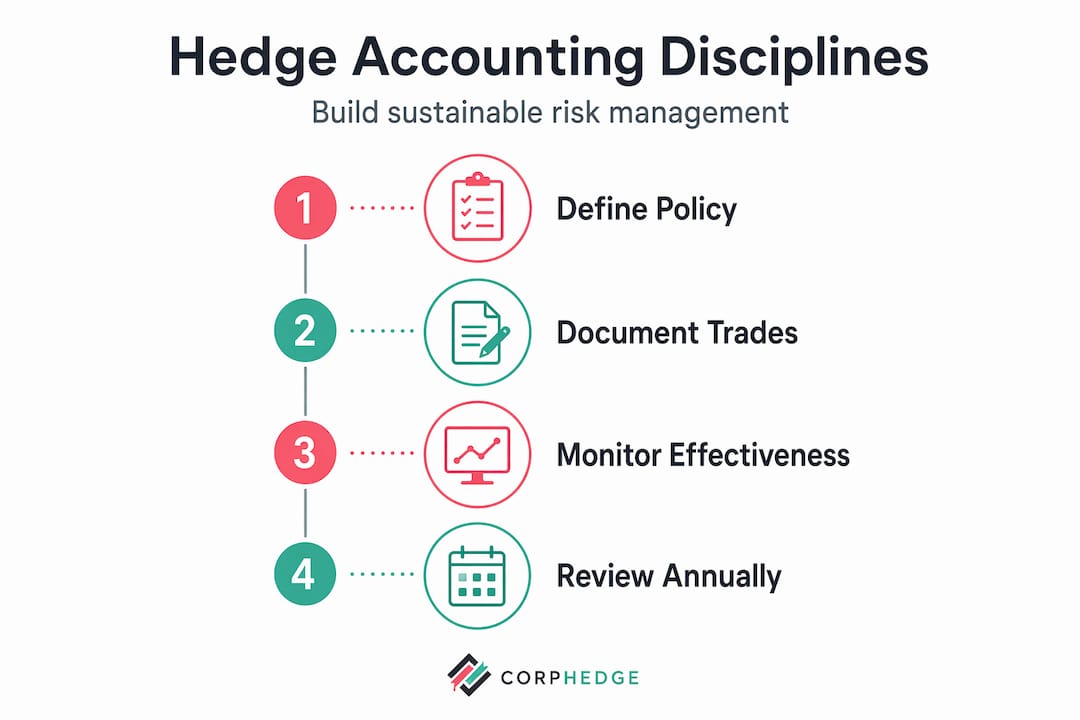
Pro Tip: Treat your hedge accounting governance framework as a living document. Review it annually and after any significant change in your business model, currency exposure profile, or counterparty relationships.
The financial risk reduction strategies that work long term are the ones built on process discipline, not just technical knowledge.
Why effective hedge accounting is an overlooked strategic advantage
Most companies approach hedge accounting as a compliance obligation. They implement it because their auditors expect it, their lenders require it, or their CFO wants smoother earnings. That framing is not wrong, but it is incomplete, and it causes companies to miss most of the real value.
Here is the uncomfortable truth: the companies that treat hedge accounting as a strategic tool, rather than a reporting requirement, consistently outperform their peers on capital efficiency and investor communication. When your financial statements accurately reflect your economic position, you can have a fundamentally different conversation with your board and your investors. You are not explaining away volatility. You are demonstrating that your risk management program is working exactly as designed.
There is also a capital allocation dimension that almost nobody talks about. When earnings are stable and predictable, treasury teams can make more aggressive, value-creating decisions elsewhere in the business. The budget that would have been held as a volatility buffer can be deployed into growth. That is a real, quantifiable advantage.
The harder truth is that sustainable hedge accounting excellence requires integrating risk, finance, and treasury into a single, coherent governance structure. Most companies still run these as separate functions with separate objectives. Treasury hedges the exposure. Finance records the transaction. Risk monitors the portfolio. Nobody owns the hedge accounting lifecycle end to end. That fragmentation is where most programs fail, not in the technical application of IFRS 9.
Reducing earnings volatility with expert help is achievable, but only when your organization treats hedge accounting as a strategic priority rather than an annual audit deliverable.
Streamline your hedge accounting with advanced risk solutions
Building a robust hedge accounting program requires more than technical knowledge. It requires the right infrastructure to monitor positions in real time, test effectiveness continuously, and respond quickly when market conditions shift.
CorpHedge gives international finance teams the tools to do exactly that. From hedging based on value at risk to real-time currency position monitoring, the platform is built for the operational demands of modern hedge accounting. You can explore the full range of FX risk management solutions and see how leading companies are simplifying compliance while improving performance outcomes. For a detailed look at what the platform delivers day to day, the FX exposure management features page walks through every capability. Hedge accounting does not have to be a burden. With the right tools, it becomes a competitive asset.
Frequently asked questions
What is the hedge ratio and why is it important in hedge accounting?
The hedge ratio is the quantitative relationship between the hedging instrument and the hedged item. IFRS 9 requires it to match the ratio used in actual risk management, ensuring the accounting treatment reflects economic reality rather than an artificial construct.
When does hedge accounting need to be discontinued?
Hedge accounting must be discontinued when the hedging relationship no longer meets the qualifying criteria, such as when hedge effectiveness fails due to increased credit risk or when the forecast transaction is no longer highly probable. Any amounts in the cash flow hedge reserve are then reclassified to profit or loss.
Can companies use different hedge ratios for accounting and risk management?
No. IFRS 9 explicitly requires that the hedge ratio for accounting match the ratio used in the company's actual risk management strategy. Using a different ratio for accounting purposes would misrepresent the economic hedging relationship.
What are the main differences between IFRS 9 and ASC 815 in hedge accounting?
IFRS 9 is more flexible and principles-based, allowing qualitative effectiveness assessments and hedge ratio rebalancing without discontinuation. ASC 815 is more prescriptive, with stricter documentation requirements and a more structured ongoing assessment cadence that leaves less room for judgment.