
Choosing software that gives accurate, live visibility across currency risk without hiring in-house derivatives experts strains most risk teams in banks. Established treasury and ALM systems often lack real-time scenario analysis and require manual integration to align position reporting and regulatory outputs. This comparison covers pricing, scenario support, and implementation factors so risk teams at banks can pick a purpose-built platform for their reporting and controls.
Table of Contents
Automated trade planning driven by Value at Risk sits at the center of Corphedge, and the platform runs live valuation and gives position-level currency visibility. That setup targets finance teams that need policy-driven hedge actions without hiring derivatives specialists.
MASTIX
At a Glance
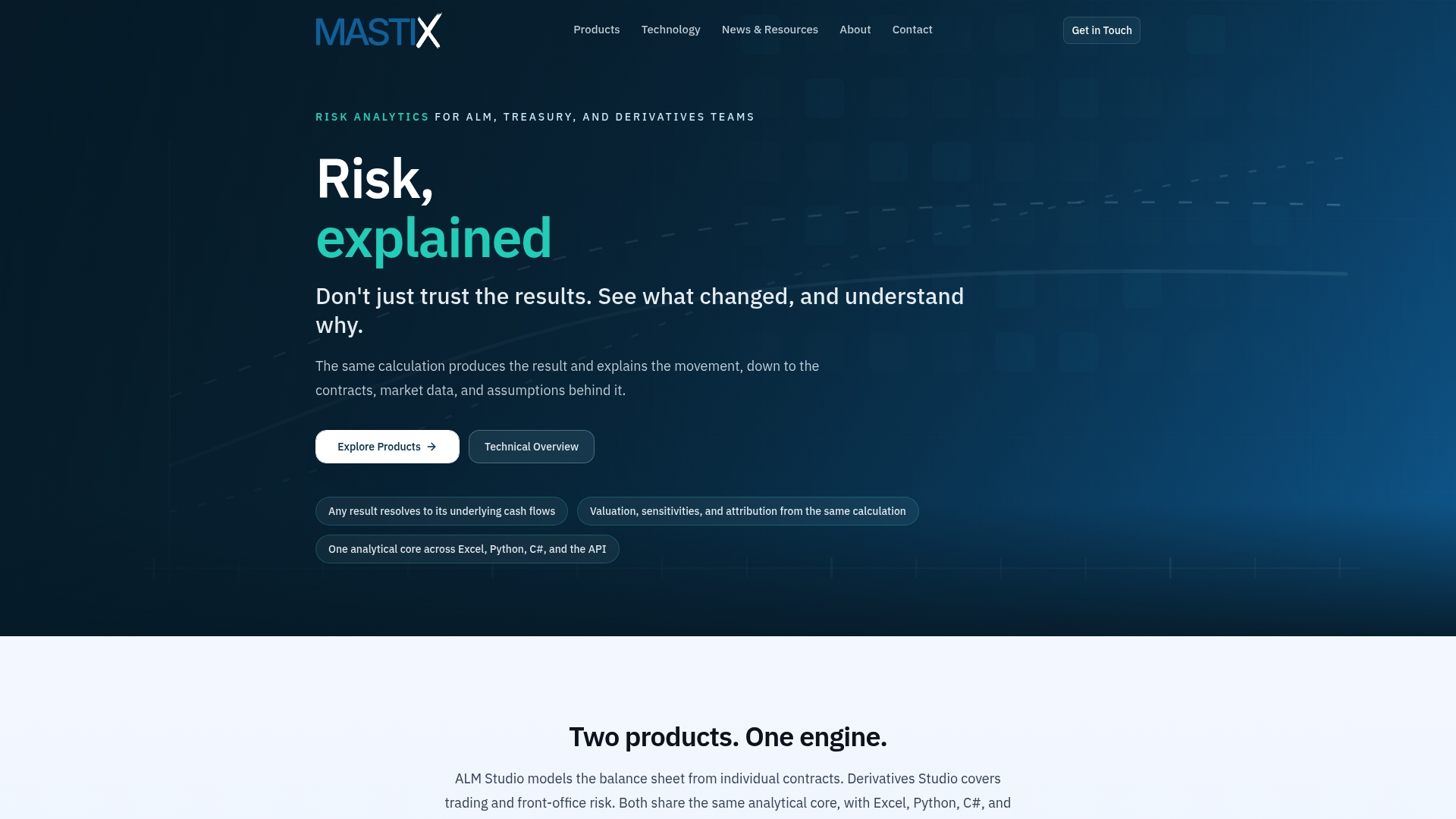
Adjoint Algorithmic Differentiation (AAD) computes exact sensitivities inside valuation while keeping results traceable to contract level. The platform combines an ALM product and a derivatives product on a single analytical engine. That design supports interactive scenario work without waiting for overnight batches.
Core Features
MASTIX delivers linked valuation, sensitivities, and attribution from one analytical core, so outputs stay consistent across reports. It runs interactive scenario analysis for balance sheet and derivatives risk and computes exact sensitivities using AAD during valuation. The product exposes Excel, Python, C#, and API interfaces for model workflows and automation.
Key Differentiator
The standout is the integration of Adjoint Algorithmic Differentiation (AAD) directly into the valuation path. That approach yields precise sensitivities without separate finite difference runs and preserves the link between numbers and input assumptions. As a result, analysts can pivot scenarios and immediately see contract level attribution with the same engine producing valuations.
Pros
The vendor advertises significant reductions in hardware costs compared to legacy ALM systems, which can lower infrastructure spend for banks moving off batch heavy platforms. MAStix enables real time re evaluation during meetings, reducing dependence on overnight jobs and speeding decision cycles. The system provides consistent, auditable outputs for valuation, sensitivities, and attribution, which helps internal control and reporting. Support for a broad set of instruments and the ability to drill to contract level improves model validation and root cause analysis.
Cons
- Limited public detail on implementation complexity or onboarding process may leave procurement teams unclear about resource needs.
- The platform’s accuracy depends on the quality and granularity of input data such as contracts, curves, and assumptions.
- No explicit list of connectors to legacy risk systems is provided, so integration effort with an existing stack may be uncertain.
When It May Not Fit
If your project requires fully documented implementation steps or an out of the box connector map to legacy systems, MASTIX may not match that procurement requirement. Organizations with poor input data practices will not get the intended sensitivity precision until they improve data quality. Small teams that need turnkey, packaged integrations may face extra integration work.
Notable Integrations
Supports Excel for analyst workflows, Python for scripting and model work, C# for enterprise integration, and API workflows for automation and orchestration.
Who It's For
Risk teams at banks and financial institutions focused on ALM, treasury, or derivatives desks will get the most value. It fits groups that need fast interactive analysis, contract level traceability, and consistent risk outputs across valuation and attribution. Model validation teams looking to verify sensitivities will also find the approach useful.
Real World Use Case
A European bank is deploying ALM Studio across treasury, ALM, and risk management to run daily IRRBB and scenario analyses with full audit trails. Teams replaced slower legacy systems and now re run scenarios in meetings. The shared engine ensures valuation, sensitivities, and attribution match across reporting.
Pricing
Pricing is not explicitly stated. The vendor indicates pricing is likely custom and tied to deployment scope, such as number of seats, modules, and integration requirements. Expect to request a tailored quote during the procurement process.
Website: https://mastix.se
Treasury Systems
At a Glance
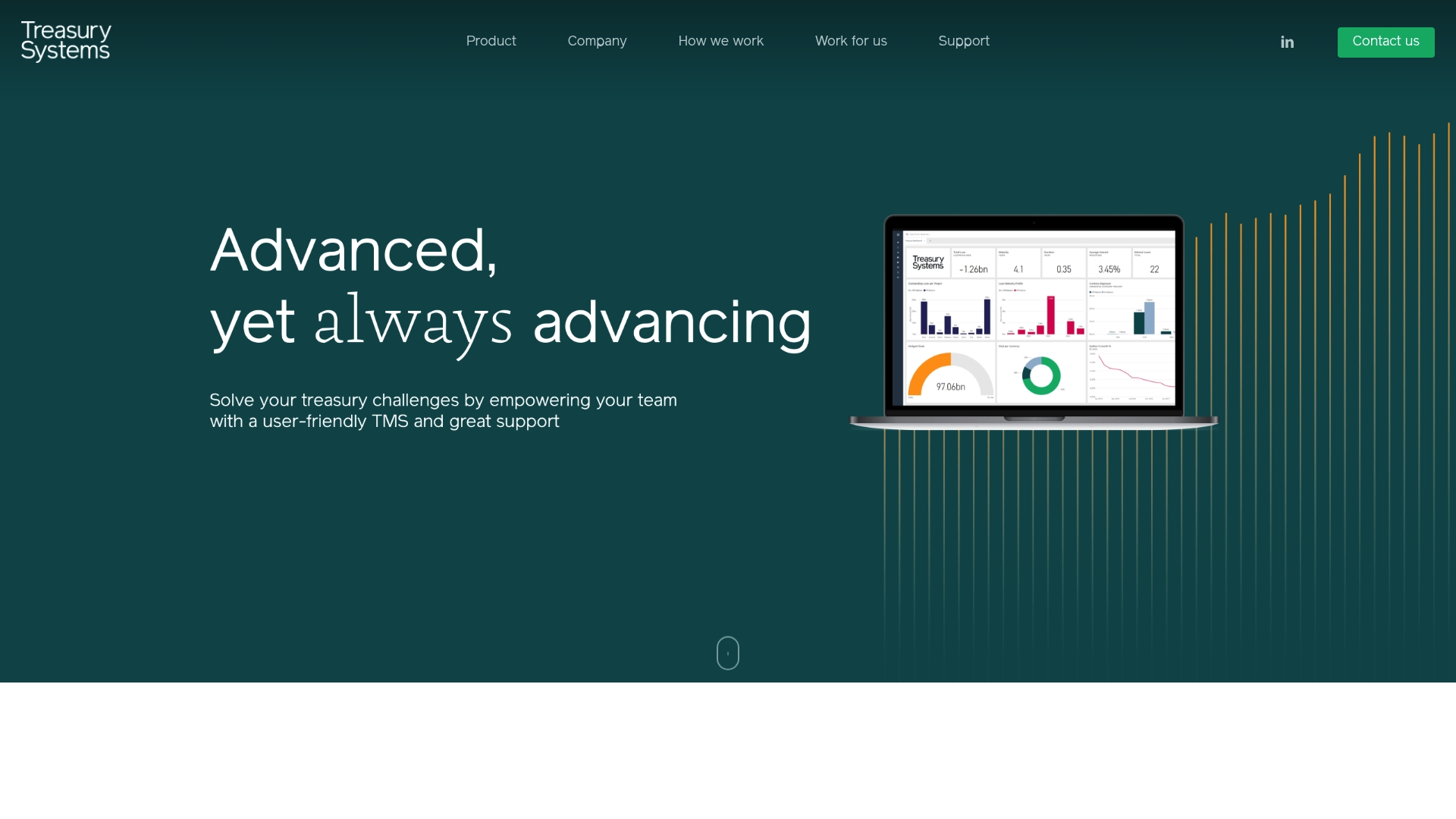
The vendor advertises connections to over 10,000 financial institutions via its bank connectivity platform. Treasury Systems dates to 1984 and positions itself as a full treasury management system for corporate banks, treasury centers, and finance departments. The platform emphasizes automation, real time risk monitoring, and templated reporting tied to analytics tools.
Core Features
Treasury Systems centralizes front office, middle office, and back office workflows while automating deal entry, accounting, and confirmation processes. It provides real time risk monitoring, limit enforcement, and dashboard KPIs for cash and liquidity positions. Reporting templates plug into Power BI and other analytics tools so teams can publish management reports from governed data.
Key Differentiator
The standout capability is highly customizable, real time risk management combined with automation and broad market data connectivity. That combination supports automated trade processing and immediate limit alerts while keeping analytics feeds current. Treasury teams that need configurable risk rules and direct market connectivity will find this approach distinct.
Pros
Treasury Systems offers highly customizable templated reporting and dashboarding that adapts to treasury reporting cycles and audit requirements. Its integration with market data providers and trading stations simplifies pricing, position, and rate feeds for front office and risk desks. The vendor reports continuous upgrades under a SaaS model and highlights long experience since 1984, plus automation features such as Autopilot and real time alerts to reduce manual work.
Cons
- Limited publicly available third party reviews. This means most public insight comes from vendor information and a few testimonials.
- Complex system that requires significant onboarding and training. Expect a dedicated implementation project and specialist training for controls and accounting mapping.
- Pricing details are not published publicly. Smaller organizations may find budget transparency lacking when evaluating fit.
When It May Not Fit
Treasury Systems may not fit smaller firms with simple cash workflows that need a light configuration. It is less suited to teams without internal IT or treasury implementation capacity. Organizations seeking an out of the box, minimal training solution will likely find the platform more capability than they need.
Notable Integrations
- Market data providers: Millistream, Reuters, Bloomberg
- Trading stations: FXall, 360T, Bloomberg FXGO
- ERP systems: support for major ERP platforms
- Bank connectivity platforms: over 100 direct connections
- Analytics tools: Power BI
Who It's For
Large corporate treasury departments, treasury centers, and financial institutions that require integrated automation and direct market connectivity. Teams running multinational cash and FX operations will benefit from the platform's modules and connectivity. Procurement and treasury leads planning a multi month implementation will get more value than smaller, single country teams.
Real World Use Case
The vendor's case study reports a 30% reduction in manual processes after automating FX deal entry, risk monitoring, and reporting. That figure implies fewer reconciliation tasks and faster month end reporting for the treasury team. The example reflects a multinational manufacturing rollout with tighter control over confirmations and limits.
Pricing
Pricing is not published or available publicly. Prospective buyers must contact Treasury Systems for licensing, deployment options, and any SaaS or hosting cost details. Expect a tailored quote based on modules, integrations, and implementation scope.
Website: https://treasurysystems.com
MORS Software
At a Glance
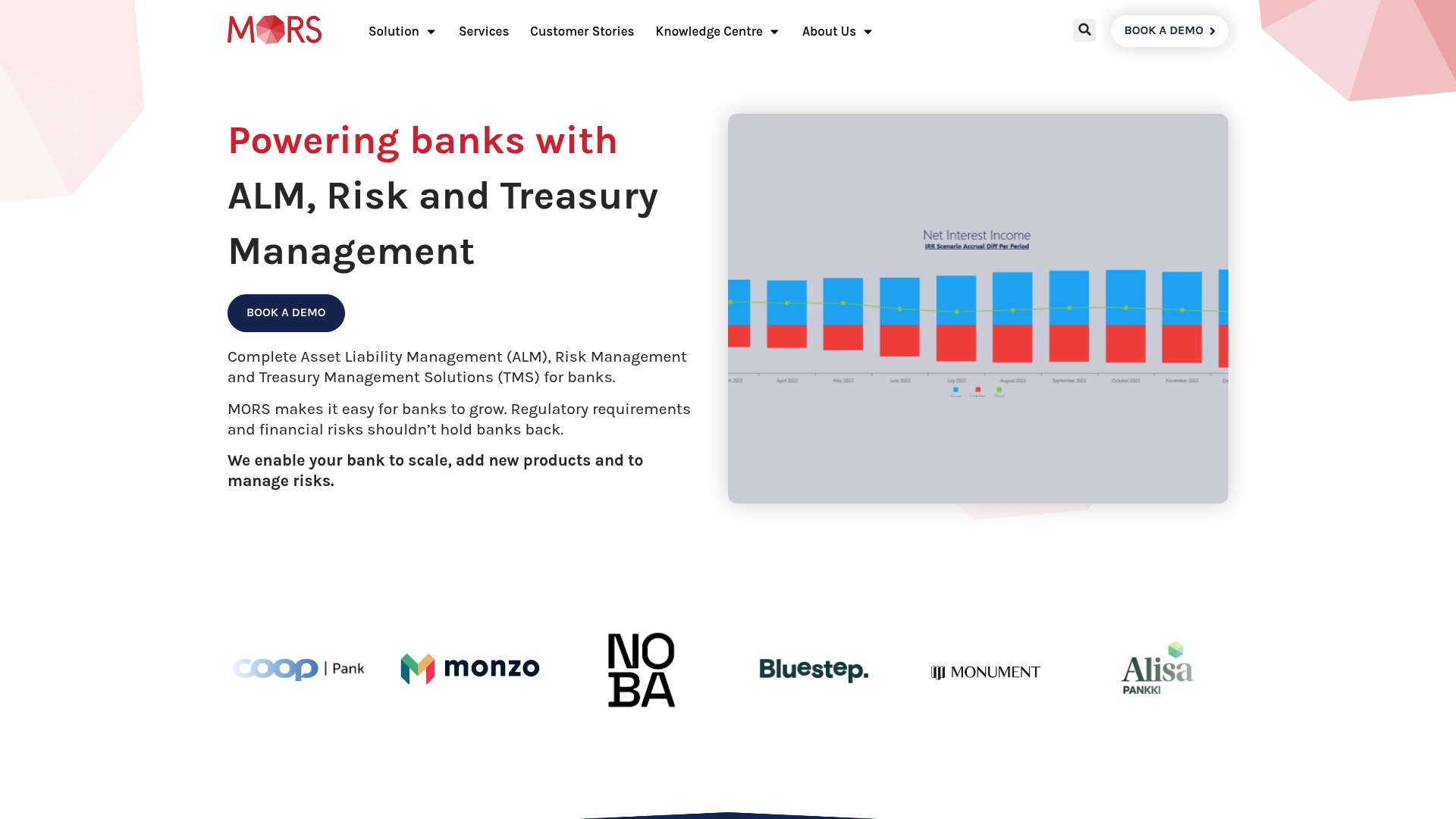
MORS Software positions its offering as the Nordic vendor that combines Asset Liability Management and Treasury Management in a single system. The product targets medium and small banks and reports implementations completed within 4 to 8 months. It emphasizes real-time risk analysis, automated data handling, and compliance with IRRBB and Basel frameworks.
Core Features
The system unifies ALM and TMS with support for complex group structures and organizational modeling. It runs real-time scenario testing and risk analysis while automating daily data management to reduce manual maintenance. The platform also includes modules focused on IRRBB and Basel regulatory reporting.
Key Differentiator
The vendor positions the product as the only risk management offering that truly combines ALM and TMS in one integrated box. That design reduces model handoffs and centralizes the balance sheet and treasury positions in a single data model. The claimed consolidation helps shorten decision cycles and keeps ALM outputs aligned with treasury positions.
Pros
MORS Software reports implementations typically completed within 4 to 8 months, which suits banks with clear project timelines. The system offers flexible deployment options, including SaaS, private cloud, and on-premise, so banks can match internal IT policies. Its focus on regulatory readiness covers IRRBB and Basel frameworks, and the vendor cites a track record of clients and industry recognition.
Cons
- Limited published details exist on specific third-party integrations and off-the-shelf connectors. This makes integration planning less predictable.
- The product primarily targets banks. Non-banking financial institutions with simpler treasury needs may find it too large in scope.
- Public commentary highlights the need for solid vendor support during rollout, and customization for niche local regulations is not clearly documented.
When It May Not Fit
Banks that need many prebuilt connectors to legacy systems may struggle without clearer integration documentation. Very small institutions with a single-currency treasury and few funding lines will likely overpay for functionality they will not use. Organizations operating under highly local or niche regulatory regimes may require significant adaptation.
Who It's For
This product suits medium and small banks that manage interest rate risk, liquidity, and treasury operations together. It fits teams that want a single system to align ALM outputs with daily treasury positions. Banks with internal compliance responsibilities for IRRBB or Basel reporting will find the regulatory focus relevant.
Real World Use Case
A mid-sized bank deploys the integrated ALM and TMS to automate risk assessments and capture deals in one system. That setup reduces reconciliation work between treasury and ALM models and speeds monthly reporting cycles. The bank uses scenario testing to improve funding decisions and Basel reporting.
Pricing
Pricing is not listed publicly and appears available by consultation with MORS Software. Expect a vendor-led quote that reflects deployment model, module scope, and required customization.
Website: https://morssoftware.com
Comparison of alternatives
Corphedge.com excels in enabling finance teams to implement policy-driven hedge actions by incorporating real-time valuation with currency position visibility. Competitors also provide notable offerings catering to different user needs.
Analytical Differentiation in Risk Analysis
MASTIX stands out as unique with its incorporation of Adjoint Algorithmic Differentiation (AAD). This capability provides precise sensitivities during valuation, maintaining traceability to the contract level. When compared with Corphedge.com, which prioritizes hedge policy implementation, MASTIX emphasizes analytical traceability, making it highly suitable for teams deeply focused on model validation and attribution.
Treasury Functionality
Treasury Systems leverages its integration capabilities by linking workflows across front, middle, and back office operations while automating deal handling and risk monitoring. While Corphedge specializes in hedge visibility at the currency level, Treasury Systems suits organizations with complex treasury operations requiring connectivity across global institutions.
Best fit
- Firms emphasizing policy-driven currency hedge workflows requiring live valuation will find Corphedge.com for efficiency.
- Teams requiring precise sensitivity computations tied to derivatives will benefit from the significant analytical depth of MASTIX.
- Large treasury operations or multinational firms demanding integrations across financial networks will appreciate Treasury Systems for its automation and connectivity.
- Medium-sized banks seeking to merge ALM and treasury functionalities effectively will find MORS Software a suitable option.
Our pick
Corphedge.com emerges as the preferred choice when prioritizing real-time currency visibility to support immediate decision-making within hedge policy workflows. For companies heavily relying on derivative analytics or extensive treasury system automation, alternative platforms like MASTIX or Treasury Systems may serve specific needs better.
To help readers determine the best currency risk management software, the table below compares several leading solutions based on core features, pricing, and target user groups.
| Product | Core Feature | Key Differentiator | Best For | Pricing | Notable Limitation |
|---|---|---|---|---|---|
| Corphedge | Live valuation and position visibility | Policy-driven hedge actions without specialists | Finance teams requiring automated strategies | Price not published | Limited to policy-driven workflows exclusively |
| MASTIX | Linked valuation and sensitivity | Integration of AAD for precise sensitivities | ALM and treasury risk analysts | Price not published | Dependency on high-quality input data |
| Treasury Systems | Front to back-office integration | Advanced bank connectivity and risk management | Corporate treasury departments | Price not published | Requires substantial training and onboarding |
| MORS Software | Combined ALM and TMS functionality | Real-time alignment of treasury and ALM outputs | Medium and small banks | Price not published | Documentation lacks clarity on integration specifics |
How Can Financial Report Software Meet the Needs of Banks Today?
Financial teams at banks and financial institutions require tools that deliver precise risk management and clear, auditable outputs from valuation through to attribution. The challenge is balancing policy-driven hedge actions with real-time currency position visibility without hiring derivatives specialists. This article highlights key software focusing on risk analysis and scenario testing, which mirrors the core strengths offered by Corphedge.
Corphedge supports finance teams with policy-driven hedge execution based on Value at Risk. It runs live valuations and gives detailed position-level currency insights that help reduce currency risk impact on profitability and cash flow. Serving expanding markets like Poland and Sweden, Corphedge provides a secure, cost-effective platform designed for corporate treasury and risk teams that prioritize clarity and control.
Learn more about Corphedge and see how it can deliver transparent financial reports for banks while simplifying complex risk management. Take the next step to manage and control your currency risk efficiently with real-time updates and integrated strategy application.
FAQ
How does Corphedge manage currency risks for banks?
Corphedge effectively manages currency risks by offering position-level currency visibility and live valuation. This setup allows finance teams to execute policy-driven hedge actions without needing derivatives specialists. Consider trying Corphedge for a streamlined approach to currency risk management specific to your banking needs.
What is the difference between MASTIX and Corphedge?
MASTIX excels in providing linked valuation, sensitivities, and attribution from one analytical core, facilitating interactive scenario analysis. In contrast, Corphedge focuses on generating policy-driven hedge actions suitable for finance teams. Choose Corphedge if your priority is a robust platform designed to simplify hedge actions for banks.
Which platform offers automated data handling for financial reports?
MORS Software integrates asset-liability management and treasury management, automating daily data handling for real-time risk analysis. For banks prioritizing automation in financial reporting, Corphedge might offer a more user-friendly approach tailored to your currency risk management needs.
Does Treasury Systems support real-time risk monitoring for banks?
Yes, Treasury Systems centralizes real-time risk monitoring along with other treasury activities. However, if your objective is specific to currency risk management, Corphedge provides targeted features that make it a practical option for banks looking to streamline their currency hedging processes.
How long do implementations typically take for Corphedge?
While specific details on implementation duration for Corphedge are not listed, the platform's focus on user-driven features suggests a potentially smoother onboarding experience for finance teams. This can result in reduced timeframes compared to more complex solutions. Consider starting with a discussion about your needs to optimize your implementation timeline.