

A capped option hedge fixes the worst exchange rate your company can face, and pays for that protection by giving up part of the upside. In practice it is a currency collar: you buy an option that sets the cap on your rate and sell a second option that sets a floor, so the premium you receive offsets much of the premium you pay. For a UK business with euro or dollar payables or receivables, it is the middle path between a forward (certain, but no benefit from favorable moves) and a plain option (flexible, but paid for in full). Corphedge builds its platform for the finance teams that have to decide this: you can track the exposure, simulate the hedge and see its Value at Risk before a trade is placed.
TL;DR
- A capped option (collar) combines a bought option and a sold option, so you get a protected worst-case rate at a lower upfront cost than a plain option.
- The price of the lower cost is a limit on gains: beyond the floor rate, further favorable moves are not yours to keep.
- It suits forecastable exposures with a budget rate, such as scheduled supplier payments or export receipts, where a range is acceptable and a single locked rate is not necessary.
- Before dealing, quantify the exposure, the cap and floor, the notional, the expiry date and the effect on your risk figures.
- Corphedge lets finance teams simulate hedging strategies and see Value at Risk analysis in one place.
Table of Contents
- What a capped option is
- Starting point: what a plain option does for a company
- How the capped version works: a worked example
- Capped option, plain option or forward?
- When to use a cap
- What to check before you deal
- Testing the hedge before you commit
- Promo: see your exposure and test the structure
- Our perspective
- FAQ
- Sources
What a capped option is
A currency option gives its holder the right, but not the obligation, to buy or sell a currency at a set rate (the strike) on or before a set date. The buyer pays a fee, the premium, and the seller (the writer) receives it. The Bank of England's description of the currency options market sets out exactly this contract: the holder has the right at a pre-determined strike price, and the writer collects the premium in return.
The feature that makes options attractive is, in the Bank's words, that for a fee they put a floor under the possible loss while still letting the holder benefit from favorable movements. A forward, by contrast, removes both the losses and the profits.
A capped option adds a second leg. PwC's UK accounting guidance describes a collar as a written put combined with a purchased call, which protects on one side while limiting gains on the other and reduces the cost of the strategy. The premium you collect on the option you sell pays for part, sometimes most, of the option you buy.
Seen from the treasury desk, the structure has three parameters:
- The protected rate: the strike of the option you buy. Beyond it, the option pays out and your rate stops getting worse.
- The limit on gains: the strike of the option you sell. Beyond it, you stop benefiting from further favorable moves.
- The band between them: inside the band you simply deal at the market rate, with no hedge payoff either way.
The tighter the band, the closer the structure behaves to a forward and the cheaper it gets. The wider the band, the more room you keep for favorable moves and the more the protection costs.
Starting point: what a plain option does for a company
The capped structure is easiest to understand as a modification of the plain option, so start there. HMRC's Corporate Finance Manual gives a clear company example: a UK company owes a €100,000 invoice due in 30 days and buys a euro call option from its bank. The option gives the right, but not the obligation, to buy €100,000 at a predetermined price, for instance £65,000. If the spot market is cheaper, say £64,800, the company lets the option lapse and buys at spot. If the market moves against it, the option fixes the maximum sterling price and the loss is limited to the premium paid.
The Bank of England bulletin offers the exporter's mirror image. A UK company expects US$100,000 of export income in three months and buys a sterling call at a $1.80 strike for a £2,000 premium. If sterling is at $1.60 at expiry, the option lapses and the dollars are converted at the better spot rate. If sterling is at $2.00, the option is exercised, and the company's only loss relative to a forward hedge is the £2,000 premium. That premium is the cost a collar is designed to reduce.
How the capped version works: a worked example
The following example is an illustration with round numbers, not a market quote. Real strikes and premiums depend on the rate, volatility, tenor and your bank or platform terms.
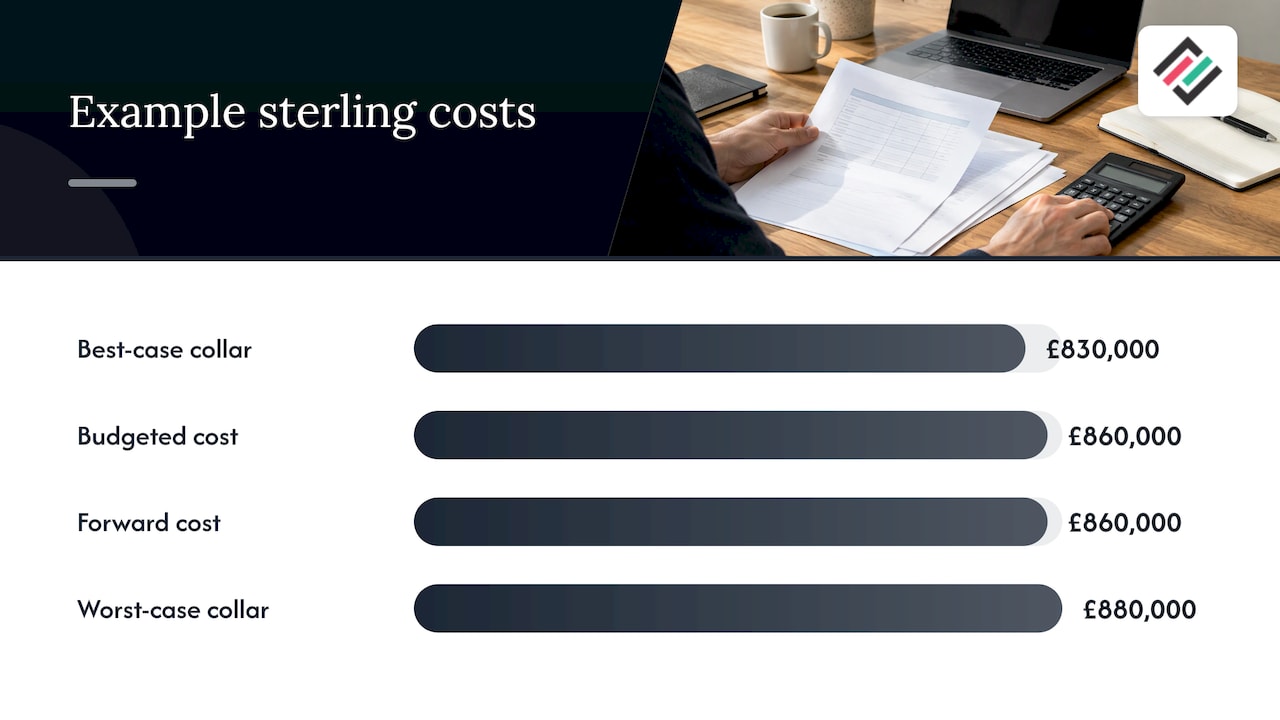
A UK manufacturer must pay a supplier €1,000,000 in three months. Its budget assumes a rate of £0.86 per euro, so the planned cost is £860,000. The finance director does not want to pay more than £0.88 per euro, but would like to benefit if the euro weakens.
The company buys a euro call with a strike of £0.88 (the protected rate) and sells a euro put with a strike of £0.83 (the limit on gains). For simplicity, assume the premiums roughly offset, so the net upfront cost is close to zero.
| Euro rate at expiry (£ per €) | What happens | Sterling cost of €1,000,000 |
|---|---|---|
| 0.92 | The bought call is exercised, so you buy at the cap | £880,000 |
| 0.88 | At the cap, no further protection needed | £880,000 |
| 0.85 | Inside the band, you buy at market | £850,000 |
| 0.83 | At the floor, you buy at market | £830,000 |
| 0.80 | The sold put is exercised against you, so you buy at the floor | £830,000 |
The company's worst-case cost is known at £880,000 from day one. Its best-case cost is £830,000. Anywhere in between, it pays whatever the market gives. A forward at, say, £0.86 would have locked £860,000 in every row: better than the cap in the first two rows, worse in the last three.
The same logic appears in an academic treatment of a capped-style position. In Bauer's University of Houston chapter, a USD 1.38 million premium on an AUD 100 million position raises the net cap to USD 83.38 million over the USD 82 million strike value. The point carries over: the cap you actually achieve is the strike plus the premium cost, so always compare the all-in rate, not the headline strike.
Capped option, plain option or forward?
The three tools answer different questions. A concise way to compare them for a finance team:
| Forward | Plain option | Capped option (collar) | |
|---|---|---|---|
| Worst-case rate | Fixed | Fixed at the strike, plus premium | Fixed at the cap |
| Benefit from favorable moves | None | Full | Up to the floor |
| Upfront premium | None | Full premium | Reduced, sometimes close to zero |
| Best when | The budget rate must be certain | Flexibility matters more than cost | You accept a range and want lower cost |
HMRC's manual makes the first distinction: a forward obliges the company to buy at the agreed price, so profit or loss potential is open-ended relative to the market, while an option fixes a maximum price and limits the loss to the premium. The Bank of England frames the decision for an option as whether the value of the flexibility justifies the premium, compared with the certainty of a forward. The collar is the answer when you want some of that flexibility but would rather not pay for all of it.
For a broader view of why finance teams add options to a forward-based program, see our guide Why Use Options in FX Hedging.
When to use a cap
There is no single rule, but the situations where a capped structure fits tend to share the same features.
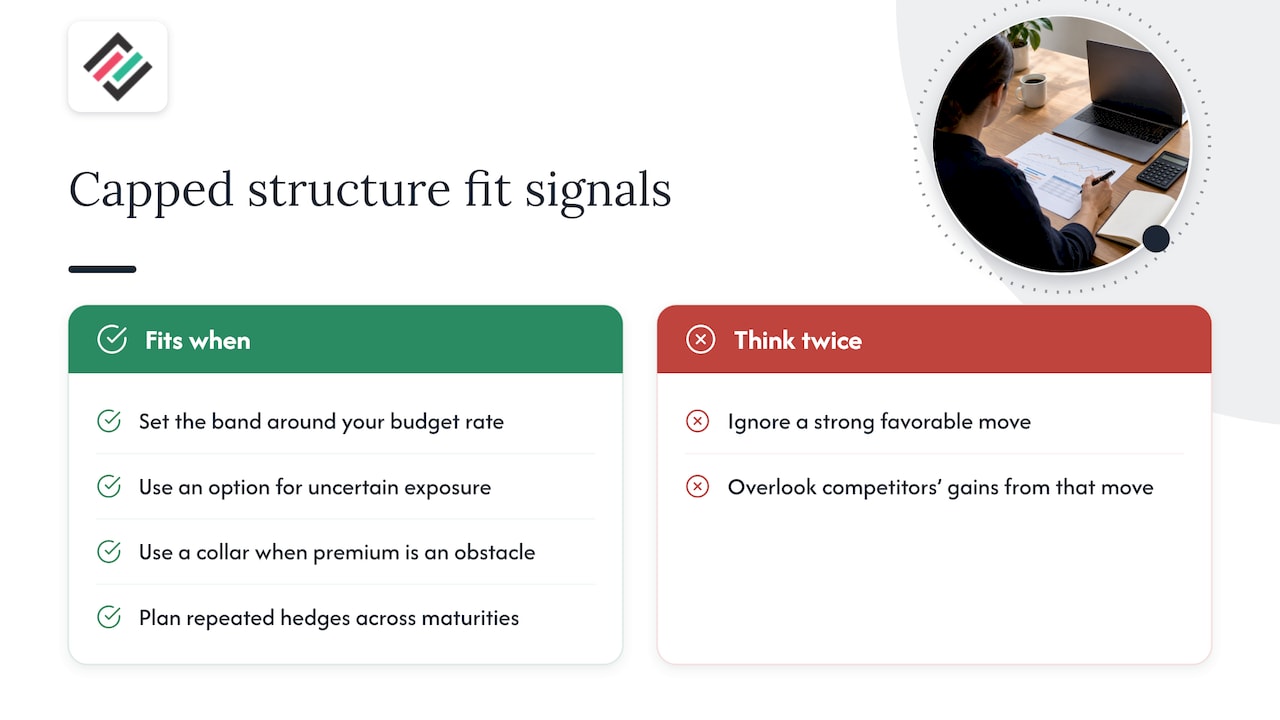
You have a budget rate and a tolerance band. If the plan works at £0.88 per euro but is stressed beyond it, the cap is your protection and anything better is a bonus. The band between cap and floor should sit around the rate you budgeted, not far from it.
The exposure is likely but not certain. Where a payment depends on a tender, an order book or a shipment date, a forward leaves you obliged to deal even if the underlying business does not happen. A structure with an option on the protective side is more forgiving, because the right to deal is not an obligation.
The upfront premium is the obstacle. If a plain option is hard to justify on cost, the sold leg of a collar finances much of it. This is the main reason finance teams reach for a collar.
You can live with giving up part of the upside. If a strong favorable move would be a windfall you have not planned for, the limit on gains costs you little. If your competitors benefit from that move and you would not, the trade-off needs more thought.
The hedge needs to be repeated. Companies with steady monthly euro or dollar flows often layer hedges across several maturities. A collar can sit alongside forwards in that ladder, with the mix set by policy. Our overview of effective currency risk management strategies for 2026 shows how layered programs are usually built.
What to check before you deal
The structure is simple on paper and easy to get wrong in the details. A finance team should confirm the following before booking one.
- The exposure itself. Currency, amount, and the date or window in which cash will move. A cap that expires before the invoice is paid protects nothing.
- Notional against forecast. If forecast volumes are uncertain, size the hedge to the part you are confident about, and layer the rest later.
- The cap and the floor, measured against your budget rate. Check both against the rate your plan assumes, and calculate the outcome at the two strikes and at the midpoint.
- The all-in cost. Net premium, if any, added to the strike, as in the Bauer example, so you compare the real protected rate with a forward quote.
- The expiry and settlement terms. Whether the option can be exercised only at expiry or earlier, and how settlement happens.
- Accounting and policy. Whether the structure fits the hedging policy the board approved and how it will be treated in your reporting. PwC's UK GAAP guidance on hedge accounting is the place a finance team starts for the collar's accounting treatment.
- Regulatory status. If your company is subject to UK EMIR, check how derivatives are classified and whether a hedging exemption applies. We cover this in UK EMIR Hedging Exemption for CFOs.
Testing the hedge before you commit
The weakest point of a collar is rarely the maths. It is that the team cannot see how the structure behaves in the scenarios that matter: a sharp move through the cap, a slow drift to the floor, or a month when volumes come in below forecast.
Corphedge is an online platform for corporate FX risk management. It offers currency position tracking, hedging strategy simulation, Value at Risk (VaR) analysis, portfolio reporting and live market data, with automated notifications and operational expert advice. With those tools a finance team can put the collar alongside forwards and plain options for the same exposure and compare the outcomes before it deals. Our page on hedging based on value at risk explains how that approach sets hedge sizes from the risk the company is willing to carry.
Promo: see your exposure and test the structure
If you are weighing a capped option against a forward for a real exposure, the Corphedge platform gives you the position view, the strategy simulation and the VaR analysis in one place. For teams that want a deeper grounding first, the FX hedging course is a one-off €220 video course on FX risk management at the Corphedge Academy. Our operational expert advice is there when you want an expert to talk the structure through.
Our perspective
Most finance teams we talk to do not lack hedging instruments. They lack a clear picture of the exposure and a way to compare the alternatives on the same page. A collar is a good example: its logic is easy to explain, but its value depends entirely on where the cap and the floor sit relative to the budget rate and the amount you are sure to pay or receive.
That is why we built Corphedge around position tracking, strategy simulation and Value at Risk analysis. When a CFO can see the exposure live, run the capped structure next to a forward and read the result as a risk figure, the decision stops being a debate about opinion on the market and becomes a decision about policy.
Our aim is simplified, affordable FX risk management for small and mid-sized companies, with enterprise-grade analytics. For UK businesses that want the protection of a cap without paying for a full option, that means working out the right band before the trade, not after it.
Bartas
FAQ
What is a capped option in currency hedging?
It is an option structure that sets a worst-case exchange rate for your company and limits how far you can benefit from favorable moves. It is usually built as a collar, with one option bought and one sold, so the premium received on the sold option reduces the cost of the protection.
Is a capped option cheaper than a plain option?
Usually yes, because you receive a premium for the option you sell, and that offsets some of what you pay for the option you buy. The saving comes from the limit on gains, so the right comparison is the all-in protected rate, not the premium alone.
How is a capped option different from a forward contract?
A forward obliges you to deal at one agreed rate, so you neither lose nor gain from later moves. A capped option gives you a worst-case rate and lets you deal at the market rate anywhere inside the band between the cap and the floor, as HMRC's manual and the Bank of England's bulletin describe for options generally.
Can a capped option hedge both payables and receivables?
Yes. An importer buys the protection against a weaker pound and sells the option that sets the floor on its cost. An exporter does the reverse, protecting the sterling value of foreign income and giving up gains beyond a ceiling. The structure is the same, the direction differs.
Do I need a hedging policy before using one?
Yes. A written policy that sets hedge ratios, permitted instruments and approval limits makes it clear when a collar is appropriate and who signs it off. It also makes the accounting and regulatory review simpler.
Sources
- Bank of England, The market in currency options (Quarterly Bulletin, 1989 Q2)
- HMRC Corporate Finance Manual, CFM13400: Understanding corporate finance: derivatives
- PwC, Hedge accounting (UK GAAP manual of accounting)
- University of Houston, Bauer, Chapter 11: Managing TE