

For most enterprises managing multi-currency exposure, the right default is buy + extend: license a vendor platform for the plumbing (rate feeds, position tracking, VaR analytics), then customize only the workflows that create real competitive edge. Pure build makes sense when your hedging logic is genuinely proprietary and you have engineering capacity to spare. Pure buy fits narrow, low-complexity needs. Every decision hinges on three axes: how much strategic differentiation you actually need, how fast you need to launch, and what the total cost of ownership looks like over five years, not year one.
TL;DR:
- Most enterprises should choose the buy or buy plus extend approach due to faster deployment, lower five-year costs, and established security standards.
- Building in-house is costlier, taking 12 to 24 months and requiring a dedicated team of at least five specialists to develop proprietary hedging logic and infrastructure.
- Vendor platforms offer mature features, high uptime SLAs, and reliable currency data, with the ability to extend core workflows for unique business needs.
- Buy plus extend enables firms to customize specific modules like proprietary algorithms or reporting layers while leveraging vendor-provided core capabilities.
- The decision should primarily rely on strategic differentiation, speed needs, regulatory complexity, engineering capacity, and total cost of ownership.
Table of Contents
- Build vs Buy FX Software: Defining Your Three Real Options
- Should You Build Custom FX Software In House?
- Is It Cheaper to Buy Off-the-Shelf FX Software?
- What Does Buy + Extend Look Like for FX Platforms?
- How Much Does Build vs Buy Actually Cost?
- What Are the Regulatory and Security Risks in FX Systems?
- How Do You Decide Between Build, Buy, and Buy + Extend?
- How CorpHedge Meets Enterprise Build vs Buy Requirements
- Which Path Fits Your Enterprise Profile?
- How Finance Leaders Should Frame This Decision Going Forward
- See How Corphedge Fits Your FX Software Decision
- Sources
- FAQ
Build vs Buy FX Software: Defining Your Three Real Options
"Build vs buy" sounds like a binary. In FX software, it almost never is. Enterprises evaluating custom fx software vs purchase decisions typically land on one of three structural paths, and each one plays out differently across rate feeds, execution, settlement, hedging logic, and reporting.
Build means your engineering team owns the full stack: sourcing currency rate data, writing execution and settlement logic, building your own Value at Risk models, and maintaining every reporting pipeline. You control the roadmap entirely. You also own every bug, every outage, and every regulatory update from day one forward.
Buy means licensing a vendor platform that already handles the core FX workflow: real-time position tracking, hedging strategy simulation, VaR analysis, and compliance reporting, delivered as SaaS with a support contract and SLA attached. You adapt your process to the platform, not the other way around.
Buy + extend sits in between. You license the vendor's core capabilities, then build thin, targeted extensions where you actually differentiate: a proprietary hedging algorithm, a custom risk dashboard for the board, or an integration with a legacy treasury system nobody else uses. Analyst commentary increasingly frames this as the dominant enterprise pattern, since modern software decisions often include this third option rather than treating build and buy as opposites.
Here's how the three models typically play out on core FX components:
- Rate feeds: Build means scraping or contracting raw data sources yourself; buy means a managed feed with historical depth and SLA-backed uptime; buy + extend means using the vendor feed but layering your own alerting logic on top.
- Execution and settlement: Build gives full control over routing logic; buy hands you a tested, audited settlement pipeline; buy + extend lets you plug a custom execution rule into an otherwise standard settlement flow.
- Hedging and VaR: Build lets you encode a truly proprietary risk model; buy gives you proven VaR methodology out of the box; buy + extend lets you keep the vendor's VaR engine and bolt on a custom hedge ratio calculator.
- Reporting: Build requires you to track every regulatory change yourself; buy usually bundles compliance-ready templates; buy + extend lets you keep vendor reporting and add board-specific dashboards.
Most enterprises choosing pure build are companies whose FX exposure is itself the product, like a payments firm building rate arbitrage into its core margin. Most choosing pure buy are treasury teams with straightforward hedging needs and no appetite to run software infrastructure. Buy + extend serves everyone in between, which in practice is the majority of internationally active corporates.
Should You Build Custom FX Software In House?
Building gives you something no vendor contract can: complete ownership of the intellectual property behind your hedging logic. If your competitive edge genuinely lives inside a proprietary risk model, build is the only path that lets you keep that model entirely private, unreplicated in a vendor's shared codebase, and free from any third-party roadmap decisions.
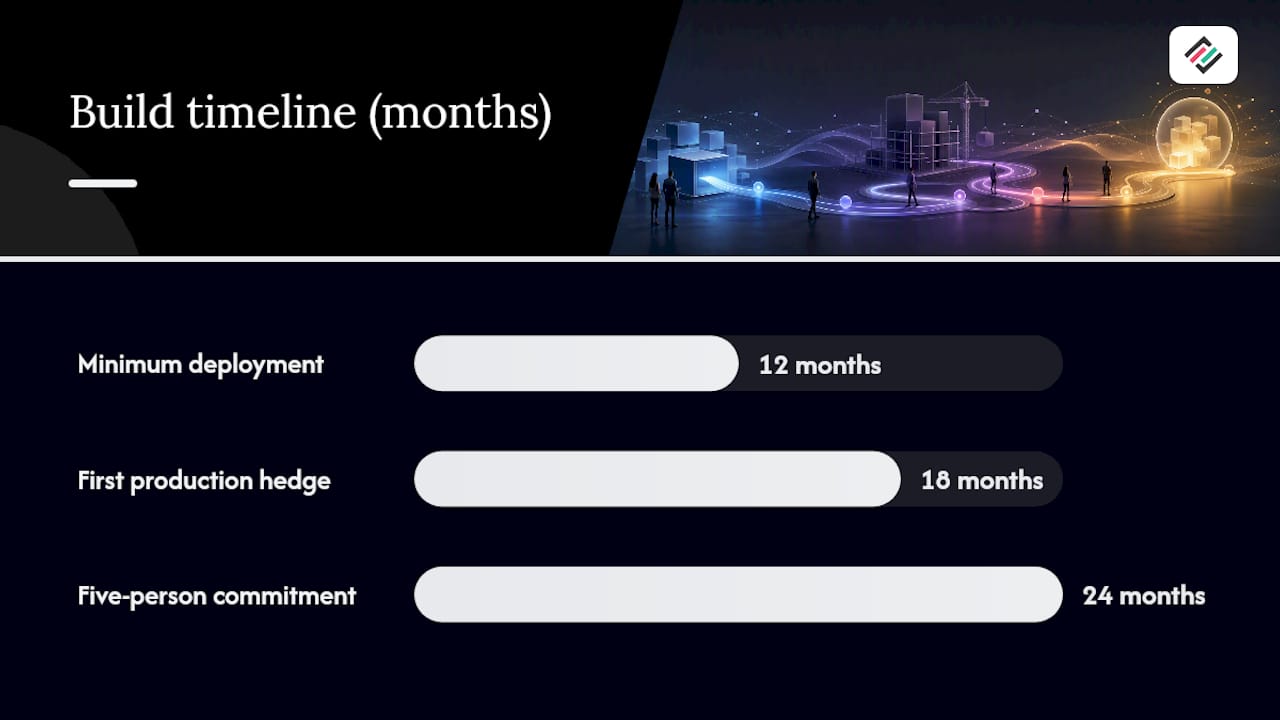
That control comes at a real cost in time and headcount. Building a client-facing FX hedging solution in house typically runs 12 to 24 months from concept to full deployment, and that estimate assumes you already have a team that understands both FX market structure and software engineering. Most enterprises underestimate this by treating it as a coding project instead of a discipline that spans quant modeling, compliance, and infrastructure operations.
A realistic build team for an enterprise-grade FX platform includes:
- A quant or risk analyst who translates hedging strategy into testable logic.
- Two to four backend engineers for rate ingestion, execution, and settlement pipelines.
- A dedicated DevOps or infrastructure engineer for uptime, disaster recovery, and monitoring.
- A compliance liaison who tracks regulatory reporting requirements as they change.
- A product owner who prioritizes the backlog against actual treasury needs, not engineering preference.
That's a five-person minimum commitment sustained for two years before you even reach parity with an off-the-shelf platform's baseline feature set.
Pro Tip: Before greenlighting a build, price out the first 24 months of headcount alone, excluding infrastructure and licensing costs for third-party data. If that number alone exceeds three years of a comparable vendor subscription, buy or buy + extend usually wins on cost even before you factor in opportunity cost.
Hidden costs tend to surface later: regulatory reporting changes that require emergency patches, a key engineer leaving with undocumented institutional knowledge, or a currency rate provider changing its API without warning. None of these show up in a build estimate, and all of them show up in year two.
Build makes sense when your hedging strategy is a genuine trade secret, your engineering org already has FX domain expertise, and you can tolerate an 18-month runway before your first production hedge executes through the new system.
Is It Cheaper to Buy Off-the-Shelf FX Software?
For most enterprises, yes, and by a wide margin over a five-year horizon. Buying trades some customization for speed, and speed compounds. A vendor platform ships with the currency risk workflows already built, tested against edge cases you haven't hit yet, and refined by feedback from every other client running the same system.
Advantages of buying vendor or SaaS FX software show up fastest in three places:
- Time to market: vendors can deliver a working, white-labeled solution in a matter of weeks rather than years, since white-label deployment can shrink launch windows to 4 to 12 weeks compared with a build timeline measured in months of engineering sprints.
- Security and reliability baked in: enterprise vendors typically maintain high uptime SLAs, documented disaster recovery protocols, monitoring, and third-party security validation as a baseline, not an aspiration.
- Data quality without the maintenance burden: a managed currency rate feed typically covers 170-plus currencies with real-time updates and historical storage, a level of breadth and SLA-backed reliability that most in-house prototypes never reach because nobody wants to maintain that infrastructure internally.
- Feature maturity from shared learning: because vendor platforms serve multiple enterprise clients, features and analytics mature faster than anything a single internal team could iterate toward alone.
The headline subscription price is rarely the full cost. Vendor contracts often carry extra fees for custom connectors to your ERP or treasury management system, additional user seats beyond a base tier, one-time migration or onboarding work, and professional-services charges for anything outside the standard configuration. SaaS pricing tends to hide recurring cost growth in exactly these places: licence tier increases, connector fees, and change requests that never appear in the initial sales quote. Ask for a three-year cost projection at your expected seat count and transaction volume before signing anything, not just the year-one number.
Buying is the prudent choice when your treasury team needs to be live within a quarter, when your FX exposure follows fairly standard hedging patterns, and when you'd rather pay a predictable subscription than staff a permanent engineering function around currency risk.
What Does Buy + Extend Look Like for FX Platforms?
Buy + extend works because it separates the parts of FX software that are genuinely commoditized from the parts that actually carry your competitive edge. You buy the rate feeds, the execution rails, the compliance reporting, and the base VaR engine, all things a vendor has already refined across dozens of clients. Then you extend only the specific workflow where your business does something nobody else does.
This pattern shortens time to launch dramatically compared with a ground-up build, while still letting you differentiate where it counts. A common hybrid approach among enterprise FX teams is to buy the core data and settlement layer while selectively building modules for proprietary algorithms or unique execution paths, rather than trying to replicate the entire stack internally.
Typical extension points enterprises build on top of a vendor FX platform include:
- Custom API integrations connecting the platform to an internal ERP, treasury workstation, or legacy accounting system.
- Bespoke hedging rule plugins that encode a proprietary trigger logic on top of the vendor's core VaR engine.
- Board-level reporting layers that reformat vendor data into internal governance templates.
- Alerting workflows tuned to internal risk thresholds rather than generic vendor defaults.
Buy + extend also gives you an exit ramp that pure build doesn't: white-label and vendor approaches let firms launch fast, then progressively replace or augment specific modules over time rather than committing to a multi-year rebuild upfront, a staged migration path from buy toward custom that many treasury teams use as they mature.
The failure modes are specific and worth naming before you sign a contract. API rate limits or webhook restrictions can quietly cap how far you extend a platform before hitting a wall. A vendor roadmap that drifts away from your extension plans can leave your custom module orphaned against an incompatible new core version. And integration debt piles up fast when every extension is built against undocumented vendor behavior instead of a stable, published interface.
Pro Tip: Before building any extension, ask the vendor for their public API rate limits and their policy on breaking changes between major versions in writing. If they can't produce either document, treat that as a signal your extension is at risk the next time they ship a platform update.
How Much Does Build vs Buy Actually Cost?
Cost comparison fx software development debates usually fail because they compare a build's sticker price against a vendor's headline subscription fee, ignoring the five-year picture entirely. The real comparison needs three horizons: time to launch, direct spend, and the ongoing burden each option places on your team.
On timeline, the gap is stark. A custom build for a client-facing FX hedging solution typically takes 12 to 24 months from concept to production, while white-label or vendor-managed platforms can go live in 4 to 12 weeks for comparable core functionality.
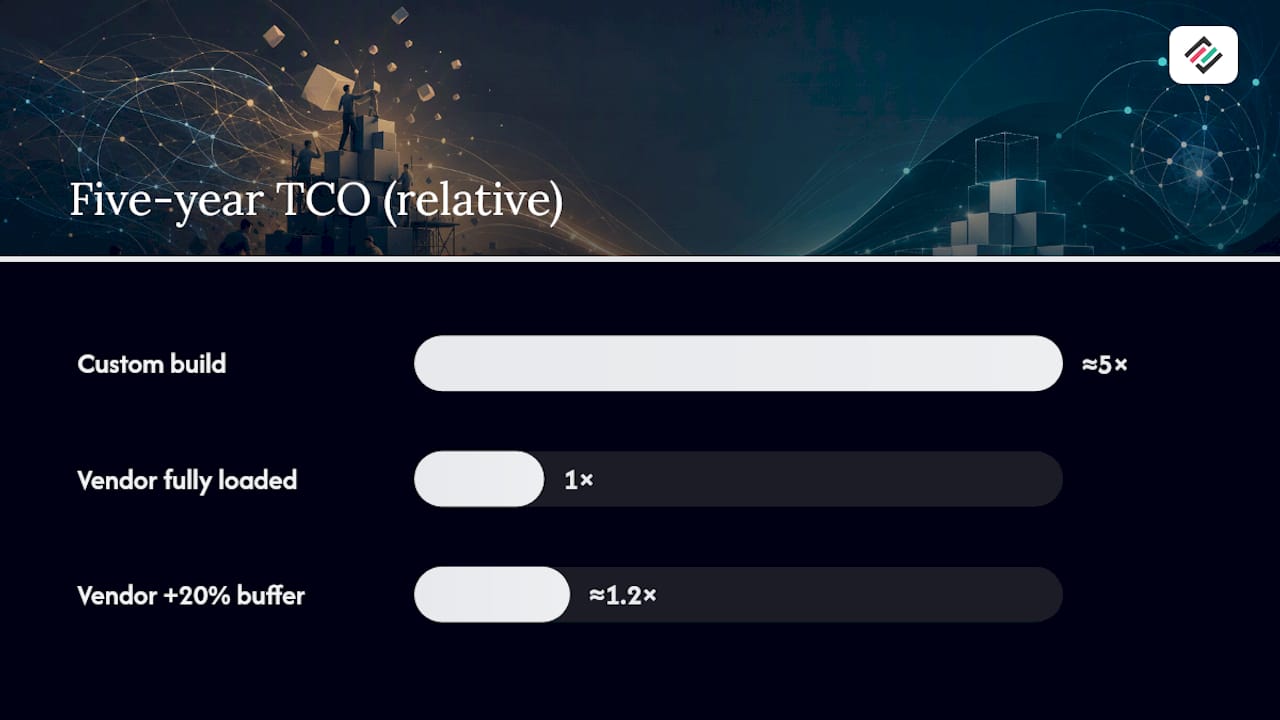
By the numbers: White-label and vendor-managed FX platforms can reduce five-year total cost of ownership by roughly three to five times compared with an equivalent custom build, according to industry analysis of broker technology stacks.
Break your TCO model into these buckets before you compare a single number across build and buy:
- Licensing or subscription fees, scaled against your projected seat count and transaction volume for at least three years, not one.
- Infrastructure costs, which build carries directly (hosting, scaling, redundancy) and buy typically bundles into the subscription.
- Maintenance and support, running 15 to 25% of original build cost annually for custom software, versus a vendor's included SLA for bought platforms.
- Integration and connector fees, often the largest hidden line item in vendor contracts once you connect ERP, treasury, or accounting systems.
- Vendor change or migration fees, charged when you outgrow a tier or need custom configuration outside the standard package.
- Opportunity cost, the value of engineering time spent on FX infrastructure instead of your actual product.
A quick breakeven check takes fifteen minutes and clarifies more than most procurement decks: take your estimated five-year build cost (headcount plus infrastructure plus maintenance), divide by 60 months, and compare that monthly figure against the vendor's fully loaded monthly cost, including connectors and seats at your expected scale. If the vendor number stays lower even after adding a 20% buffer for scope creep, buy or buy + extend wins on pure economics before you've even weighed the time-to-market gap. Run this sensitivity check again at double your current transaction volume. Vendor seat-based pricing sometimes scales worse than a fixed-cost build at very high volume, which is one of the few scenarios where the math can flip.
Tools like a quantitative FX assessment framework can help you model exposure inputs accurately enough that this comparison reflects your actual risk profile, not a generic estimate.
What Are the Regulatory and Security Risks in FX Systems?
FX software carries operational risks that generic enterprise software doesn't, because currency positions touch settlement finality, cross-border data residency, and regulatory transaction reporting simultaneously. A gap in any one of these can turn a software bug into a compliance incident.
Watch specifically for these FX-specific exposure points:
- Data residency requirements, especially where currency positions or client data must stay within specific jurisdictions depending on where your entities are incorporated.
- Transaction reporting obligations, which vary by regulatory regime and change more often than most software roadmaps account for.
- Reconciliation and settlement risk, where a timing mismatch between trade execution and settlement confirmation can create exposure that goes unnoticed until month-end close.
- Third-party dependency risk, when a rate feed or settlement partner has an outage during a volatile market window.
Security and operational expectations for any FX platform, whether built or bought, should include recognized certifications like ISO 27001, documented service-level agreements for uptime, disaster recovery and business continuity plans with defined recovery time objectives, and independent monitoring. Enterprises evaluating a vendor should specifically expect high uptime SLAs, disaster recovery protocols, active monitoring, and third-party security validation as baseline, non-negotiable requirements rather than premium add-ons.
Vendor governance deserves the same scrutiny you'd apply to an internal build. Ask how change control works when the vendor ships a new release, what the incident response process looks like when something breaks during market hours, and, critically, what your exit plan is if you need to migrate off the platform. A vendor selection checklist worth applying rigorously includes proven track record, seamless integration with your existing FX infrastructure, ISO 27001 or equivalent security certification, a documented pattern of regular updates, and demonstrated scalability as your transaction volume grows. Skipping this step is how enterprises end up locked into a platform they can't safely leave.
How Do You Decide Between Build, Buy, and Buy + Extend?
A clear decision framework beats gut instinct, especially when finance and engineering stakeholders start the conversation from different priorities. Score your organization against six axes, and let the pattern of scores point you toward a path rather than defaulting to whichever team argues loudest.
- Strategic differentiation. Does your hedging logic or execution strategy create a real competitive advantage, or is it a standard workflow every treasury team needs? Low differentiation points strongly toward buy.
- Speed requirement. Do you need to be live this quarter, or do you have 18 months to spare? Urgent timelines rule out pure build almost automatically.
- Workflow complexity. Is your FX exposure straightforward (a handful of currency pairs, standard hedge ratios) or genuinely complex (dozens of entities, layered hedging strategies, bespoke reporting)? Complexity without differentiation still often favors buy + extend over build.
- Regulatory exposure. How many jurisdictions and reporting regimes touch your FX activity? Higher regulatory complexity favors a vendor with existing compliance infrastructure over building that expertise from scratch.
- Engineering capacity. Do you have five-plus engineers with FX domain knowledge who can be dedicated for two years? If not, build is off the table regardless of other scores.
- Total cost of ownership tolerance. Can your finance function absorb a large upfront capital cost for a build, or does a predictable operating expense model fit your budgeting process better?
If three or more axes point toward speed, low differentiation, or limited engineering capacity, that's a red flag against pure build. Ask any vendor you're evaluating these direct questions: What's your published uptime SLA over the last 12 months? What does your API rate limit and versioning policy look like? Which certifications do you hold, and can you produce a recent audit report? Ask your internal team the mirror question: if we build this, who owns it in three years when the original engineers have moved on?
How CorpHedge Meets Enterprise Build vs Buy Requirements
Corphedge was built around exactly this checklist, not around generic FX news or spreadsheet replacement. The platform gives finance and risk teams real-time currency position tracking, hedging strategy simulation, and Value at Risk analysis without the 12 to 24 month build runway a custom system demands.
Mapped against the decision axes above, Corphedge addresses the parts of the stack that rarely justify a custom build: live market data feeds, automated notifications on exposure thresholds, and portfolio reporting that satisfies board and compliance stakeholders without a dedicated internal reporting team. The platform's VaR-based hedging approach gives enterprises a tested risk framework rather than one built and validated from scratch. Integrations with platforms like Corpay reduce the connector risk that typically hides inside vendor contracts, since the compatibility work is already done rather than billed as custom professional services.
Security posture matters just as much as feature coverage. Corphedge documents its security policy publicly, addressing the ISO 27001 and SLA expectations enterprise procurement teams are right to demand before committing budget to any vendor relationship.
For enterprises weighing whether their FX exposure justifies a custom build, the honest answer is usually no: unless your hedging strategy is genuinely proprietary, a platform like Corphedge covers the checklist items that consume the most build time (rate feeds, VaR modeling, reporting) while leaving room to extend around whatever workflow actually differentiates your treasury operation. As Corphedge expands into the Poland and Sweden markets, that same buy-plus-extend logic applies to enterprises in those regions evaluating their own build vs buy decision for the first time.
Which Path Fits Your Enterprise Profile?
A fast mover launching FX hedging capability under quarterly pressure should default to buy, full stop, and revisit build only after the vendor relationship proves the workflow at scale. A strategic differentiator with genuinely proprietary hedging algorithms and five-plus engineers to spare can justify build, but should still buy the data and settlement layer rather than reinventing rate feeds. A regulated heavy-lift enterprise juggling multiple jurisdictions almost always does best with buy + extend, leaning on vendor compliance infrastructure while extending only the reporting layer specific to internal governance.
Whichever profile fits, the next steps are the same: run the six-axis scoring checklist against your own organization, scope a narrow pilot before committing to a full rollout, and request a vendor demo to see how quickly a platform like Corphedge's product tour can get you from evaluation to a working pilot. Most enterprises that skip the pilot stage end up re-litigating the build vs buy decision eighteen months later, after sinking cost has already clouded the analysis.
How Finance Leaders Should Frame This Decision Going Forward
The build vs buy conversation gets framed as an engineering decision far too often. It's a finance decision first. The team that should own the final call is whoever owns the P&L impact of a hedging failure, not whoever wants to write the code.
My stance, based on how this plays out across enterprise FX operations: default to buy + extend, and treat pure build as an exception you have to justify with a specific, defensible answer to "what proprietary edge does this protect?" If nobody in the room can answer that in one sentence, you're building infrastructure, not IP, and infrastructure is exactly what vendors already do better and cheaper.
The one alignment tip worth stealing from procurement teams that get this right: put a finance stakeholder and an engineering lead in the same room before you write a single requirements doc, not after. Engineering will underestimate timeline. Finance will underestimate maintenance cost. The overlap between their two blind spots is where most failed builds actually originate.
— Bartas
See How Corphedge Fits Your FX Software Decision
If the checklist above points you toward buy or buy + extend, Corphedge gives you a faster starting line than building from a blank page: real-time position tracking, VaR-based hedging simulation, and compliance-ready reporting live inside one platform, without the 12 to 24 month engineering commitment a custom build demands.
The platform fits enterprises that scored heavy on speed and regulatory complexity in the framework above: finance teams that need currency exposure visibility now, not after a two-year build cycle. Integrations with Corpay and other treasury tools cut the connector work that usually inflates vendor timelines, and the security policy behind the platform is published, not promised. For teams that want to build internal hedging expertise alongside the software itself, the FX hedging course and learning academy gives finance leaders a structured path to sharpen their own risk judgment while the platform handles execution. Corphedge is also extending its coverage into the Poland and Sweden markets, giving enterprises in those regions the same vendor-led path already proven elsewhere. Walk through the Corphedge product tour to see how quickly your team could move from evaluation to a live pilot.
Sources
The benchmarks and framework in this article draw on a mix of FX industry analysis and engineering cost breakdowns worth reading in full if you're building a procurement case internally.
- Build versus Buy: Key considerations for delivering e-FX and digital transformation
- White Label vs Custom Development: The 2026 Broker's Guide
- Forex CRM Cost: Build vs Buy From an Engineering Budget Perspective
- Gartner research on build vs buy trends (preview)
FAQ
What Is the Difference Between Building and Buying Software?
Building means your team designs, develops, and maintains the software entirely in-house, owning both the IP and every ongoing maintenance obligation. Buying means licensing a vendor's existing platform under a subscription, trading full customization for speed, support, and shared feature development.
Is It Cheaper to Build or Buy FX Software?
For most enterprises, buying is cheaper over a five-year horizon: white-label and vendor platforms can cut ownership costs by three to five times compared with a custom build, once you account for maintenance, infrastructure, and engineering opportunity cost. Building only wins on cost when your engineering team already has FX expertise and your differentiation is high enough to justify a longer runway.
How Do You Decide Between Build vs Buy?
Score your organization against strategic differentiation, speed requirements, workflow complexity, regulatory exposure, engineering capacity, and TCO tolerance. If most of those point toward speed and limited engineering bandwidth, buy or buy + extend, like the approach Corphedge offers, is almost always the safer path.
What Are the Three Ways to Approach FX Software Procurement?
The three paths are build (full in-house development), buy (vendor SaaS subscription), and buy + extend (licensing core vendor capabilities while building targeted custom modules). Buy + extend has become the dominant enterprise pattern because it balances speed against selective differentiation.
How Long Does It Take to Build FX Software In-House?
Building a client-facing FX hedging solution typically takes 12 to 24 months from concept to full deployment, compared with 4 to 12 weeks for a white-label or vendor-managed platform covering similar core functionality.