

Managing foreign exchange risk across entities is confusing when treasury and accounting workflows do not share data or automate hedging steps. Most existing tools gate critical integrations and automation behind custom plans or require direct vendor negotiation with no listed pricing. This comparison covers pricing, integration depth, and automation across five platforms so finance and treasury teams can select a fit for their operations without vendor lock-in.
Table of Contents
- CorpHedge
- ZenTreasury
- Tulyp
- Fyorin
- Datasoft FxOffice Financials and FX Dealing Platform
- Comparison of alternatives
CorpHedge

At a Glance
CorpHedge's marketing materials state it received the Top Risk Management Solution Award 2023 from CIO Applications Europe. The platform runs in the cloud and targets SMEs and mid-sized corporate treasuries. It focuses on reducing FX volatility impact on margins and cash flow through continuous monitoring and professional support.
Core Features
CorpHedge delivers real-time FX risk analysis and monitoring alongside portfolio tracking and risk valuation. The platform includes tools for hedging policy creation and automated trading plan generation, plus notifications for market levels and risks. Integration options connect to banking and trading systems so treasury teams can act from a single workflow.
Key Differentiator
CorpHedge simplifies complex FX risk tasks for smaller corporate teams while pairing software with expert FX risk support. That combination shortens the learning curve for treasuries without dedicated quant teams. The result is a practical way for SMEs to apply structured hedging policies.
Pros
Non-expert finance teams gain from a user-friendly interface and real-time analytics that make daily monitoring tractable. The platform pairs software tools with support from FX risk professionals, which helps craft hedging policies and interpret risk signals. Integration with banking and brokerage platforms enables execution and reconciles positions with reporting.
Cons
- Public pricing is not listed, so procurement requires direct contact and a guided commercial discussion.
Notable Integrations
- Banking and brokerage platforms
- FX trading systems
Who It's For
CorpHedge fits business owners, CFOs, and treasury managers at SMEs and mid-sized companies who manage foreign currency exposures. It suits teams that need structured hedging without hiring in-house quant staff. It is less suited to individual traders or very large enterprises that require bespoke risk engines.
Unique Value Proposition
Automated trading plan generation combined with expert FX risk support removes much of the manual work in hedging. That pairing reduces the time your treasury spends translating forecasts into executable plans. For a small treasury, this lowers operational load and helps protect profit margins.
Real World Use Case
A manufacturing SME uses CorpHedge to build a hedging strategy from its cash flow forecast. The company automates trading plans and receives market risk alerts to adjust coverage. This approach helped stabilize margins while foreign exchange moved unpredictably.
Pricing
Pricing is not published and listed as not applicable for informational content. Expect vendor discussion to determine scope, licence model, and any integration work. Contact the vendor for a tailored commercial proposal.
Website: https://corphedge.com
ZenTreasury
At a Glance
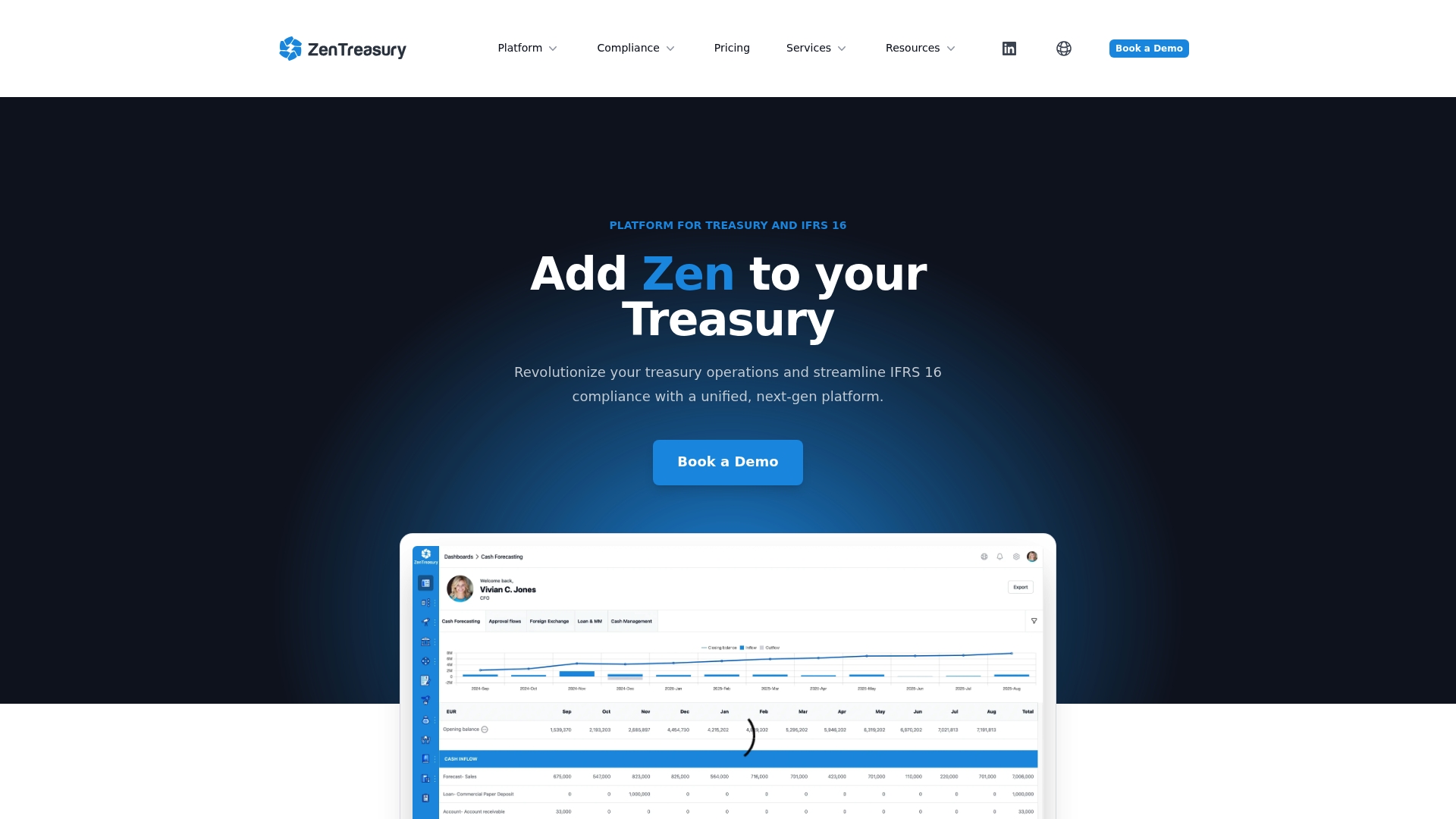
€399/month is the listed Premium starting price. ZenTreasury combines IFRS 16 lease accounting with foreign exchange, loans, trade finance, and cash flow forecasting. The product targets corporate treasury teams and scales from small contracts to enterprise deployments.
Core Features
The platform includes IFRS 16 lease accounting with reporting tools for balance sheet and lease disclosures. It manages foreign exchange with hedging workflows and accepts crypto transactions alongside loans and money market tracking. Cash flow forecasting and group wide liquidity views let treasurers consolidate positions across subsidiaries.
Key Differentiator
ZenTreasury links lease accounting, FX, loans, and liquidity into a single ledger for treasury teams. That integration targets organizations that must close books to IFRS 16 while running complex hedging programs. Client logos on the vendor site indicate adoption by major global companies.
Pros
Full module coverage spans IFRS 16, FX, loans, trade finance, and cash forecasting in one system. Plans cover small contracts up to enterprise deployments, which helps teams scale without switching vendors. The vendor emphasizes IFRS 16 compliance and detailed reporting, and the product advertises architecture able to handle larger volumes for complex operations.
Cons
-
Pricing details may vary and require direct contact for custom enterprise plans.
-
Complex feature set may require dedicated training or vendor support for new treasury teams.
-
Limited public details on third party integrations and API capabilities increase onboarding uncertainty.
Who It's For
Large to enterprise organizations with central treasury teams and multi currency operations will get the most value. Financial controllers who must apply IFRS 16 across subsidiaries and run group wide hedging should consider it. Smaller firms with simple FX needs may find the feature set more than required.
Real World Use Case
A multinational treasury used ZenTreasury to centralize FX hedging, lease accounting, and cash forecasts across three continents. Teams reconciled hedges to forecast lines and delivered IFRS 16 reports to auditors faster. That setup reduced manual spreadsheets and created a single source of treasury truth for board reporting.
Pricing
The Premium plan lists €399/month as the entry price. The vendor states higher tiers and add on modules for larger organizations with custom pricing available on request. Billing appears to use monthly subscription billing for the Premium tier and bespoke contracts for enterprise clients.
Website: https://zentreasury.com
Tulyp
At a Glance
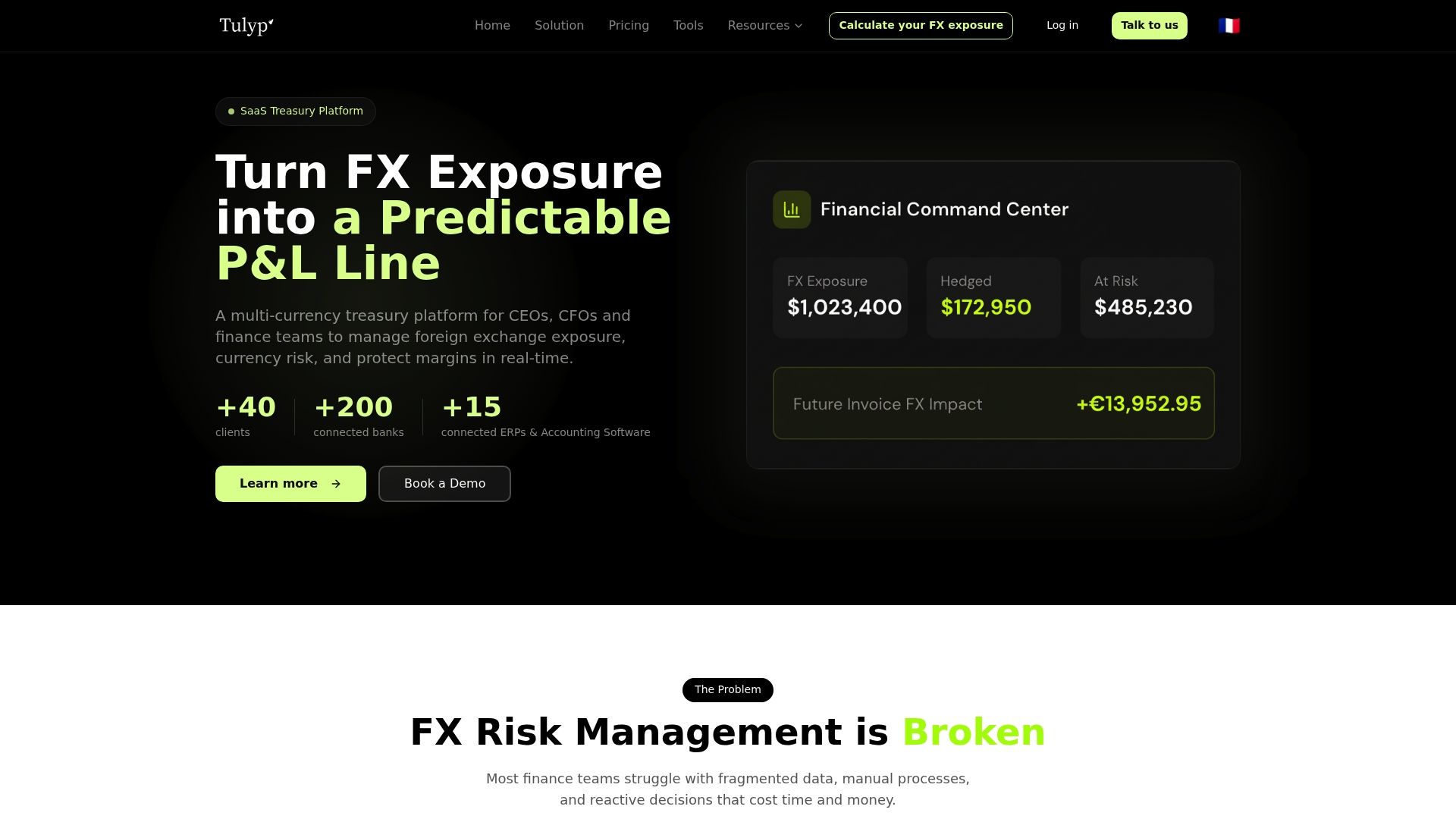
Starts at 129 €/month with a 14 day free trial, making entry easier for smaller finance teams. The platform centralizes data from ERPs, bank connections, and trading platforms to produce consolidated FX exposure views. That approach intends to let finance teams manage currency risk without hiring a dedicated treasury staff.
Core Features
Tulyp pulls feeds from ERP systems, banks, and trading platforms and computes net exposure by currency and by time bucket. It runs market move simulations and turns those scenarios into impact reports that show potential effects on profit and loss. The platform also supports real time FX hedging management and sends alerts for scenario outcomes.
Key Differentiator
Tulyp focuses on delivering integrated, real time exposure visibility and automation that reduces the need for a full treasury team. The product lets a small finance team run hedging scenarios, set alerts, and execute hedging actions from a single consolidated data set. That single source view reduces reconciliation work and speeds decision cycles across entities.
Pros
Tulyp helps protect margins from currency volatility by showing aggregated exposure across systems and subsidiaries. Its automation of data collection removes repetitive reconciliation tasks and cuts manual spreadsheet work. The scenario simulation feature lets you stress test rate moves and produce impact reports for leadership. Customizable plans match different company sizes and FX volumes, which helps teams scale without replacing their toolset.
Cons
- Heavy reliance on external data feeds. If ERP or bank feeds are incomplete, exposure numbers require manual checking.
- Complex integration for organizations with many entities. Setup may need vendor or third party configuration work.
- Some advanced capabilities such as net hedging appear reserved for higher tier plans, according to buyer feedback.
When It May Not Fit
If your organization lacks stable bank feeds and clean ERP mappings, Tulyp will surface data quality issues that increase setup time. Companies with a highly bespoke treasury workflow may find core workflows require customization. If you need advanced net hedging immediately, expect to budget for a higher tier or custom enterprise plan.
Notable Integrations
Tulyp connects directly to ERP systems, bank connections, and trading platforms. Those links let it consolidate positions and transaction data across sources. The integrations reduce manual imports and help produce timely exposure reports.
Who It's For
Finance teams in mid sized and growing companies that manage cross border cash flows and want day to day FX visibility. CEOs and CFOs who need consolidated exposure reporting without hiring a treasury function will benefit most. Companies with multiple subsidiaries that already use ERP and bank feeds will implement faster.
Real World Use Case
A group with multiple subsidiaries centralizes currency data via ERP and bank feeds into Tulyp. The finance team runs scenario simulations ahead of budgeting cycles and sets alerts for large exposure moves. That process reduced manual reconciliation and helped the team make hedging decisions faster.
Pricing
Pricing starts from 129 €/month for the Starter plan and scales to custom enterprise pricing for larger deployments. The vendor offers a 14 day free trial to test data connections and core workflows. Higher tier plans include advanced features such as net hedging and custom integrations.
Website: https://tulyp.io
Fyorin
At a Glance
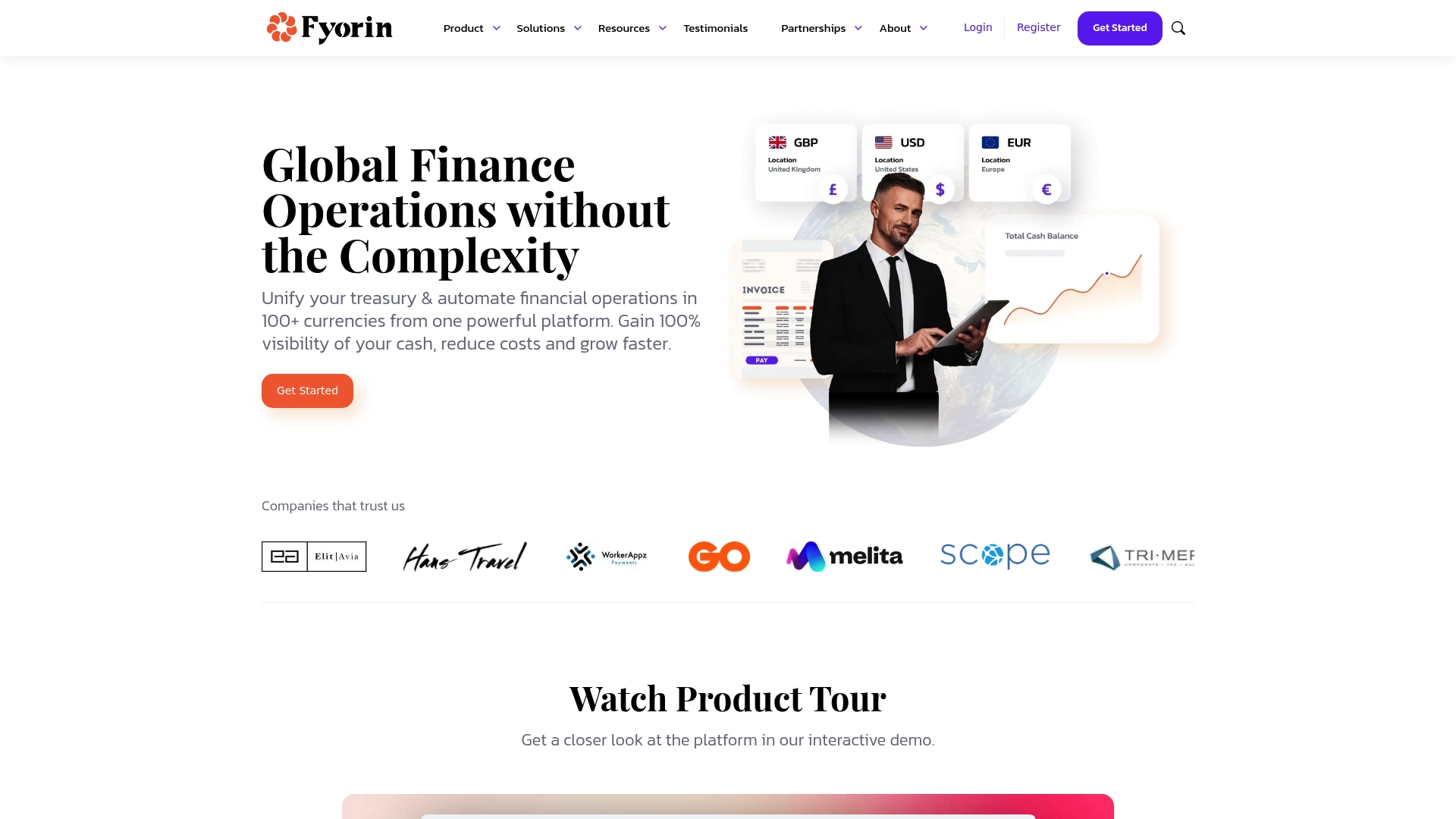
According to the company, Fyorin supports over 100 currencies and operations in 200+ countries. That scope targets mid-market treasury teams running multi-entity, cross-border operations. The platform emphasizes cash visibility, automation, and multi-bank diversification to reduce manual reconciling and settlement friction.
Core Features
Fyorin centralizes cash and treasury management across multiple currencies and legal entities while offering automation for payments, collections, and reconciliation to cut manual work. It includes FX risk management and hedging tools alongside multi-bank connectivity and virtual accounts for faster settlement and liquidity diversification. Native ERP integrations sync invoices, bills, vendor records, account balances, and transactions in near real time.
Key Differentiator
Fyorin pairs broad multi-currency banking connectivity with native ERP links. That combination shortens reconciliation loops and lets treasury teams act on live ERP data rather than stale exports. The platform therefore aims to collapse operational handoffs between banking, treasury, and accounting systems.
Pros
Fyorin unifies global cash controls into a single operational plane, which reduces process complexity and lowers operating costs for teams juggling many entities. Automation of receivables and payables cuts repetitive work and reduces posting errors across ledgers. Deep ERP integrations keep accounting records aligned with bank activity, and the multi-bank model helps diversify settlement risk while improving local payment speed.
Cons
- Platform complexity. Small companies with simple domestic workflows may find the feature set more than they need.
- ERP setup effort. Initial configuration and mapping require time and coordination with finance and IT teams.
- Steeper learning curve. Advanced treasury features assume familiarity with FX and hedging concepts.
When It May Not Fit
Fyorin may not fit very small companies that process few cross-border payments or lack an ERP. Organizations with single-entity, single-currency operations will not benefit from multi-bank connectivity. Teams without treasury expertise will need training before using advanced FX or hedging modules.
Notable Integrations
- Netsuite
- Microsoft Dynamics
- Xero
- QuickBooks
- Zoho
- Sage
Who It's For
Fyorin fits mid-market finance and treasury teams managing multi-entity, multi-currency operations and needing tighter ERP to bank workflows. It suits companies expanding into new corridors that need local rails and virtual accounts for settlement. Treasury managers who run hedging programs will find the platform aligned with their operational needs.
Real World Use Case
A rapidly expanding e-commerce company centralizes cash with Fyorin to reduce banking fragmentation and idle balances. The team automates cross-border payouts and reconciles them directly to its ERP to shorten month end close. That configuration improves cash flow visibility and lowers FX execution friction.
Pricing
Pricing is not publicly listed. Fyorin typically sells as enterprise SaaS with custom quotes based on company scale, number of entities, and modules chosen. Expect vendor engagement to produce a tailored commercial proposal.
Website: https://fyorin.com
Datasoft FxOffice Financials and FX Dealing Platform
At a Glance
Full lifecycle management of FX deals covers pre trade, execution, post trade, risk, and reporting. The platform ties trading, treasury, accounting, payments, and compliance to the same data model. That design aims to shorten reconciliation cycles and keep valuations current across entities.
Core Features
Datasoft FxOffice integrates real time market feeds with multi currency general ledger and sub ledger support. It automates mark to market revaluation, profit and loss recognition, and reconciliation for FX and cross border payments. Modules include liquidity and cash position reporting, AML and regulatory reporting, payments through SWIFT, BACS, and EFT, and deal lifecycle processing.
Key Differentiator
The platform's one distinct strength is the way trading, treasury, payments, and compliance use a single data model. That deep integration drives automation of pre trade and post trade tasks across accounting and settlement. It keeps valuations and cash positions current with real time data for multi entity operations.
Pros
Integration reduces manual handoffs by linking FX trading to accounting entries and payments. Real time market feeds improve valuation accuracy and let treasury see profit and loss as deals move. Automation handles reconciliation, mark to market adjustments, and regulatory reporting, which lowers repetitive work and reduces error rates.
Cons
-
Complex platform. New teams will need substantial training and professional services to reach full productivity.
-
Implementation requires heavy setup and technical expertise, increasing project duration for large firms.
-
Cost profile favors larger institutions; smaller firms or startups may find licensing and implementation costs high.
When It May Not Fit
Not a fit for small finance teams without an IT implementation partner. Institutions with light FX volumes or single currency operations will not use most modules. Expect a multi phase rollout and steady technical support during the first months of deployment.
Who It's For
Banks, broker dealers, and corporate treasury departments with multi entity, multi currency flows will benefit most. Compliance teams that must automate AML checks and produce regulatory reports will find the modules useful. Do not recommend for small exporters or single office finance teams with limited budgets.
Real World Use Case
A multinational bank used Datasoft FxOffice to centralize FX deal capture, hedge accounting, and settlement across multiple entities. That setup cut manual reconciliation steps and made profit reporting available shortly after deals settled. Compliance workflows produced automated AML reports that reduced time spent on regulatory filings.
Pricing
Vendor does not publish standard pricing. Plans and licensing are sold through direct sales and tailored to institutional deployments. Contact the vendor for a custom quote and implementation estimate.
Website: https://datasoft.global/platform/accounting-financials
Comparison of alternatives
FX risk management services display a nuanced selection of capabilities, catering to businesses with varying operational needs, team capacities, and financial scale.
Regulatory compliance benefits
ZenTreasury excels among competitors by providing direct IFRS 16 compliance support, incorporating lease accounting within its toolset. For corporate finance controllers overseeing multi-subsidiary operations, ZenTreasury presents a solution that simplifies regulatory adherence. This capability can significantly reduce processing effort during financial audits, showcasing ZenTreasury as a strong candidate for large portfolios requiring transparent accounting practices.
Integration and operational simplicity
Fyorin achieves notable unification across bank reconciliation, ERP data syncing, and diversified cash management. Its automation streamlines tasks for finance teams managing global operations, offering substantial value to organizations with wide-reaching transactional infrastructures lacking direct banking connectivity centralization.
Best fit
- SMEs requiring professional FX risk support without hiring quant teams select CorpHedge for its integrated, user-friendly analytics and qualified guidance.
- Large organizations implementing IFRS lease accounting integration benefit from ZenTreasury, which consolidates compliance and reporting frameworks within a scalable system.
- Mid-market teams requiring multi-bank connectivity and centralized treasury workflows improve operational efficiency with Fyorin, leveraging its real-time reconciliation tools.
- Startups needing simplified FX exposure insights choose Tulyp for its accessible entry-level offerings, easing integration with ERP and banking data sources.
Our pick
CorpHedge remains the recommended choice for SMEs and mid-sized finance teams balancing complex FX exposure challenges with limited internal resources. Its ability to simplify structured hedging policies and provide insights through professional support positions the platform uniquely within the industry. However, larger entities might explore ZenTreasury for broader accounting capabilities or Fyorin for multi-entity reconciliation efficiency.
Making a decision about foreign exchange risk management software depends on aligning key capabilities with specific business needs.
| Product | Primary Use Case | Key Differentiator | Pricing | Limitation |
|---|---|---|---|---|
| CorpHedge | FX risk management and hedging for mid-sized corporate treasuries | Expert FX risk support paired with user-friendly hedging tools | Price not published | Contact required for pricing details |
| ZenTreasury | Comprehensive treasury software including IFRS 16 accounting | Integration of multi-financial systems, including lease accounting | €399/month | Complexity may require vendor training |
| Tulyp | Real-time FX exposure visibility for smaller finance teams | Automated exposure computation and market simulations | 129 €/month | Reliance on accurate external data feeds |
| Fyorin | Mid-market multi-currency treasury management | ERP integration with multi-entity banking | Price not published | Advanced features assume FX and hedging expertise |
| Datasoft FxOffice | Full lifecycle FX deal management for large institutions | Unified trading, accounting, and compliance under one platform | Price not published | Implementation complexity with high training requirements |
Challenges Companies Face With Exchange Office Accounting Services Alternatives
Many companies managing foreign exchange risk through exchange office accounting services struggle with real-time monitoring and integrating complex data from multiple banking and trading platforms. This challenge slows hedging decisions and increases the risk from currency fluctuations. Finance teams at SMEs and mid-sized companies need tools that simplify FX risk analysis and trading plan execution without hiring costly specialists.
Corphedge offers a cloud-based platform designed to help companies handle such currency risk efficiently. With features like real-time FX position tracking and automated hedging plan generation supported by expert FX risk guidance, Corphedge reduces manual effort and enhances control over margins and cash flow. Serving growing markets in Poland and Sweden, Corphedge provides scaled solutions for teams managing cross-border cash flows.
Learn more about how Corphedge can improve your FX risk management and begin tailoring your hedging policy with expert-backed automation today.
FAQ
How does Corphedge help finance teams manage FX volatility?
Corphedge assists finance teams by providing real-time FX risk analysis and monitoring. It connects to banking and trading systems for a streamlined workflow, enabling treasury teams to efficiently monitor their foreign exchange exposure. This allows users to react promptly to market changes, protecting margins and cash flow.
What is the difference between Corphedge and ZenTreasury?
ZenTreasury offers comprehensive lease accounting integration alongside FX management, making it a suitable choice for organizations needing IFRS 16 compliance. In contrast, Corphedge focuses on simplifying FX risk tasks for corporate teams without dedicated quant staff, providing expert support to guide users. Choose ZenTreasury for detailed lease accounting needs, while Corphedge is ideal for simpler FX management.
Which platform provides automated trading plan generation?
Corphedge offers automated trading plan generation, helping finance teams easily execute hedging strategies based on their real-time exposure. This functionality supports day-to-day risk management and reduces the operational burden on smaller teams. Users can expect a practical way to craft and execute structured hedging policies without extensive quant expertise.
Can I integrate Corphedge with my existing banking systems?
Yes, Corphedge integrates with banking and trading systems, allowing finance teams to act from a single workflow. This integration simplifies data management and ensures that teams can handle their foreign exchange risks efficiently. Expect to enhance your treasury operations by connecting existing systems to Corphedge.
What should I know about Corphedge’s pricing?
Pricing details for Corphedge are not publicly listed, requiring potential users to engage directly for a tailored proposal. This approach allows the vendor to tailor the scope and licensing model to individual needs, which may vary based on specific integrations or features required for your organization.