

What is competitive hedging, and why does it go beyond risk reduction?
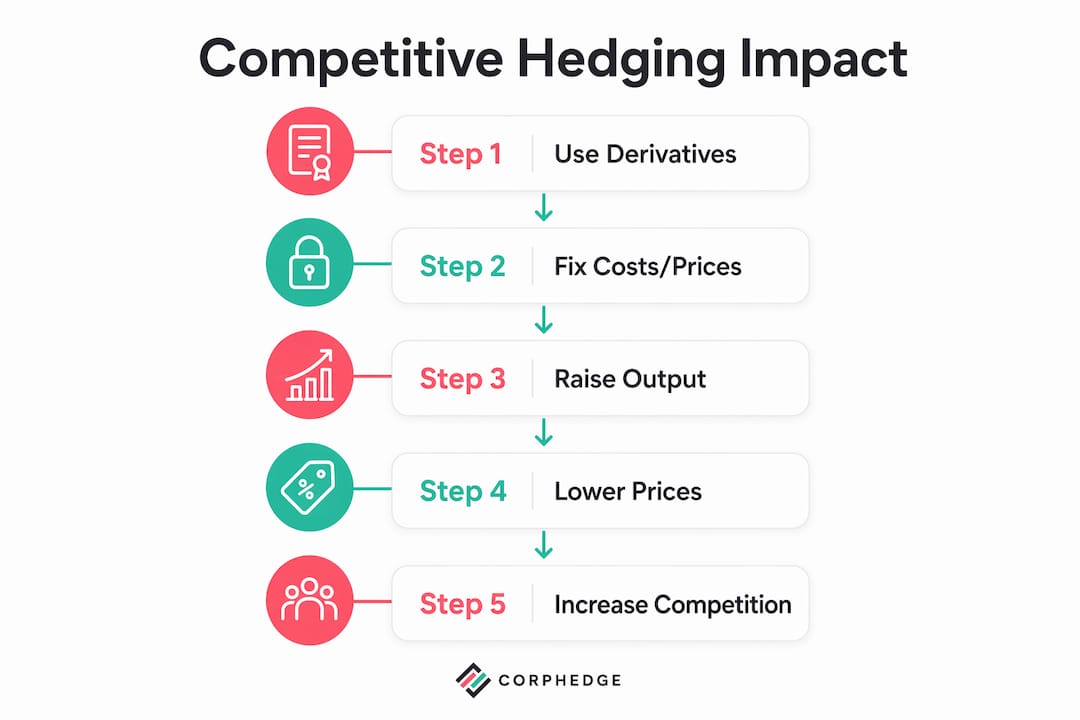
Competitive hedging is the deliberate use of financial instruments, primarily derivatives such as forwards and options, to reduce a firm's exposure to price risk while simultaneously gaining operational leverage over rivals. The distinction from standard defensive hedging is not subtle. Defensive hedging stabilizes cash flows. Competitive hedging uses market positions to fix input costs or lock in sales prices so that a firm can undercut competitors, absorb demand shocks, or expand output when rivals cannot.
The core logic works like this: when a manufacturer in Warsaw locks in its euro-denominated raw material costs six months forward, it removes the uncertainty that forces competitors to price conservatively. That firm can then commit to lower prices or higher production volumes, knowing its margin is protected. Rivals who did not hedge face the same cost shock but without the buffer.
Key benefits of competitive hedging include:
- Cash flow stability that allows confident capital allocation and investment
- Price flexibility to undercut competitors during commodity or currency spikes
- Reduced probability of financial distress, which lowers the cost of external financing
- Improved market share when rivals are constrained by unhedged risk exposure
- Stronger negotiating position with suppliers and customers due to predictable cost structures
The critical insight is that hedging is not just a treasury function. When used with competitive intent, it becomes a tool that shapes market outcomes.
How do theoretical models explain competitive hedging's impact on firm competition?
The academic foundation for competitive hedging rests on equilibrium models that treat hedging as a strategic variable, not just a financial one. The most influential framework comes from Adam, Dasgupta, and Titman, whose 2007 Journal of Finance study showed that a firm's incentive to hedge depends directly on what its competitors choose to do. When more rivals hedge, the marginal benefit of hedging for any individual firm actually falls, because the competitive advantage of being hedged diminishes. When fewer rivals hedge, the incentive to hedge rises.

This creates a classic strategic interdependence. Firms are essentially playing a coordination game where the equilibrium is not full hedging by everyone, but a heterogeneous mix of hedgers and non-hedgers within the same industry.
The Allaz-Vila framework, extended in subsequent research on simultaneous hedging settings, adds another layer. Forward markets increase competition in oligopolistic markets through two channels:
- Hedging under uncertainty raises total industry supply to the level it would reach under certainty.
- The strategic impact of forward contracts, where forward prices do not react to increased spot supply, pushes competition even further.
The result is that forward markets increase competition by raising industry output and lowering equilibrium prices, which compresses profits across the board. This is the strategic dilemma at the heart of competitive hedging: firms that hedge aggressively improve their own risk position but also intensify market competition, potentially eroding the profits of the entire industry.
Underhedging as a strategic response is one of the most counterintuitive predictions of these models. Firms in imperfectly competitive markets often hedge less than the theoretically optimal amount, not because of ignorance, but because full hedging would commit them to high output levels that drive down prices. Empirical studies in gold mining and oil and gas confirm this pattern, with observed hedge ratios consistently below one.
Industry characteristics that drive hedging heterogeneity include:
- Number of firms (more competitors, more heterogeneity in hedging choices)
- Elasticity of demand (steeper demand curves increase heterogeneity)
- Convexity of production costs (flatter marginal cost curves increase heterogeneity)
- Financial constraints (tighter constraints push more firms toward hedging)
What equilibrium outcomes does competitive hedging produce across an industry?
At the industry level, competitive hedging produces a stable but uneven equilibrium. Research finds that approximately half of firms use derivatives in any given industry while the other half do not, even when all firms face identical conditions at the outset. This is not a failure of rationality. It reflects the equilibrium logic: in the most competitive industries, the fraction of hedgers converges toward 50%, the point of maximum heterogeneity.
| Condition | Effect on hedging equilibrium | Effect on market |
|---|---|---|
| More firms in industry | Higher heterogeneity in hedging | Greater price sensitivity to cost shocks |
| Inelastic demand | More heterogeneity | Larger output swings when costs shift |
| Tight financial constraints | More firms hedge | Lower risk, fewer distress events |
| Larger market size | Larger fraction of firms hedge | More stable aggregate supply |
| Lower hedging costs (post-reform) | More firms hedge aggressively | Increased market rivalry, lower prices |
The welfare implications are genuinely complex. When hedging costs fall, such as after legal reforms that grant derivatives superpriority in insolvency proceedings, firms facing costly external finance increase hedging, lower prices, and gain market share. This is good for consumers and for competitive efficiency. But it also intensifies rivalry, which can reduce industry-wide profits and push weaker, unhedged firms toward distress.
Financial constraints play a pivotal role. A financially constrained firm may actually face a convex profit function with respect to investment, which means it has an incentive to speculate rather than hedge. This is one of the more surprising predictions of the equilibrium literature: the firms most in need of risk protection are sometimes the least likely to adopt it, because the upside of an unhedged position is worth more to them than the downside protection.
Pro Tip: When assessing whether to hedge competitively, model the equilibrium fraction of hedgers in your specific industry before committing to a position. In highly competitive sectors with inelastic demand, the strategic cost of full hedging may outweigh the risk benefit.
What practical challenges do firms face with competitive hedging in Central European markets?
Central European markets, particularly Poland and Sweden, present a distinct set of conditions for firms attempting to implement competitive hedging strategies. Both markets have well-developed capital markets and sophisticated corporate treasuries, but several structural factors complicate execution.
Regulatory and legal constraints are the most immediate barrier. Derivatives contracts in Poland operate under the framework of the Polish Financial Supervision Authority (KNF) and EU regulations including EMIR, which requires central clearing for standardized over-the-counter derivatives and mandatory reporting. Swedish firms operate under Finansinspektionen oversight with similar EMIR obligations. Compliance costs are non-trivial for mid-sized firms, and the documentation requirements for hedge accounting under IFRS 9 add further operational burden.
Market maturity and liquidity vary significantly by instrument. PLN-denominated forward contracts and FX options are liquid and widely available through Polish commercial banks and international dealers. SEK instruments are similarly accessible. However, commodity derivatives for Central European firms, particularly those in manufacturing or agriculture, may require access to international exchanges such as the ICE or CME, adding basis risk when the hedge instrument does not perfectly match the underlying exposure.
Key practical challenges for Central European firms include:
- Skill gaps in treasury teams, particularly in smaller firms that lack dedicated risk management staff
- Limited internal models for quantifying competitive impact of hedging versus pure risk reduction
- Currency mismatch between PLN or SEK revenues and EUR or USD input costs, which creates layered hedging requirements
- Corporate risk culture that treats hedging as a cost center rather than a competitive tool
- Counterparty credit requirements that restrict access to OTC derivatives for firms without strong credit ratings
Best practices for the region center on a few concrete steps. Firms should start with a clear cash flow forecast before designing any hedging program, since the hedge ratio should reflect actual exposure, not theoretical optima. Integrating Value at Risk (VaR) modeling into the hedging decision process allows firms to quantify the competitive benefit of a given hedge position, not just its risk reduction effect. Firms expanding across the region should also account for the fact that hedging costs act as barriers to entry; when policy reforms lower these costs, previously constrained firms can become more competitive, increasing market rivalry.
How does Corphedge support competitive hedging for firms in Poland and Sweden?
Corphedge is a corporate foreign exchange risk management platform built specifically for firms that need to move beyond spreadsheet-based hedging and into structured, data-driven risk management. As Corphedge expands into Poland and Sweden, its platform addresses the exact gap that most Central European mid-market firms face: the distance between knowing they should hedge competitively and having the tools to do it properly.
The platform's core capabilities include:
- Value at Risk-based hedging strategies that quantify exposure and set hedge ratios grounded in statistical risk modeling, accessible at Corphedge's VaR hedging module
- Real-time FX position monitoring that lets treasury teams see live exposure across currencies, including PLN and SEK pairs
- Integration with Corpay for execution, reducing the friction between analysis and actual hedge placement
- Security and cost efficiency as core design principles, with continuous platform availability for teams operating across time zones
For corporate strategists, the most relevant feature is the alignment between Corphedge's VaR framework and the competitive hedging logic described in the academic literature. A firm that can model its risk exposure in real time, set hedge ratios that reflect both risk reduction and competitive positioning, and execute efficiently has a structural advantage over rivals still managing FX risk manually. Corphedge's FX risk management use cases illustrate how firms across industries apply these tools to protect margins and maintain pricing flexibility.
Corphedge was recognized as one of the best risk management services in 2023, and its expansion into Poland and Sweden reflects the growing demand for institutional-grade hedging tools among mid-market firms in Central Europe.
How did competitive hedging theory develop over time?
The theoretical roots of competitive hedging trace back to the early 1990s, when Allaz (1992) and Allaz and Vila (1993) first formalized the idea that forward contracting in oligopolistic markets is not just a risk management tool but a commitment device. By selling forward, a firm commits to higher output, which shifts the competitive equilibrium in its favor. This was a departure from the earlier Modigliani-Miller tradition, which held that hedging was irrelevant to firm value in perfect capital markets.
The 1990s and early 2000s saw a wave of empirical work documenting that firms hedge far less than theory predicts. Tufano's 1996 study of gold mining firms and Haushalter's 2000 analysis of oil and gas producers both found hedge ratios well below one, which the standard risk-reduction models could not explain. This anomaly pushed theorists toward strategic explanations.
Adam, Dasgupta, and Titman's 2007 equilibrium model was a turning point. By embedding hedging decisions within a Cournot competition framework, they showed that underhedging is a rational equilibrium outcome, not a behavioral failure. The 2017 strategic corporate hedging research extended this to simultaneous hedging settings and provided laboratory experimental evidence that decision-makers do account for the competitive impact of their own hedging choices.
More recently, research on hedging and market-wide shocks has introduced firm heterogeneity and sunk entry costs into the picture. When hedging is voluntary, only the most efficient firms hedge, which strengthens competitive selection. Mandatory hedging regimes produce stronger competition than voluntary ones, a finding with direct implications for regulatory design in markets like the EU. The study of optimal hedging strategies in contexts of financial constraints and imperfect competition further refined the picture, showing that strategic complements and substitutes in investment produce opposite hedging incentives, a result that connects strategic finance principles directly to hedging program design.
Key Takeaways
Competitive hedging creates operational leverage against rivals by fixing costs or prices, not just by reducing volatility.
| Point | Details |
|---|---|
| Strategic vs. defensive hedging | Competitive hedging uses market positions to outperform rivals; defensive hedging only stabilizes cash flows. |
| Equilibrium heterogeneity | There is often a mix of firms hedging and not hedging in an industry, even when firms start under similar conditions. |
| Underhedging is rational | Firms in imperfectly competitive markets often hedge below the optimal level to avoid intensifying market competition. |
| Hedging costs shape rivalry | When policy reforms lower hedging costs, financially constrained firms hedge more and gain market share from rivals. |
| Central European context | EMIR compliance, skill gaps, and currency mismatch are the primary barriers to competitive hedging in Poland and Sweden. |
FAQ
What does competitive hedging mean in simple terms?
Competitive hedging means using financial contracts, such as forwards or options, to lock in costs or prices so your firm can compete more aggressively than rivals who face the same market uncertainty without protection.
What are the three main types of hedging?
The three main types are defensive hedging (stabilizing cash flows against price risk), speculative hedging (taking positions to profit from price moves), and competitive hedging (using hedge positions to gain operational or pricing advantages over rivals).
What is an example of competitive hedging in practice?
A Polish manufacturer that buys EUR/PLN forward contracts to fix its euro-denominated input costs can commit to stable or lower product prices during a currency spike, capturing market share while unhedged competitors are forced to raise prices or absorb losses.
How does competitive hedging affect market competition?
Forward contracts increase total industry supply toward the level it would reach under certainty, which lowers equilibrium prices and intensifies rivalry. Firms that hedge aggressively commit to higher output, which puts competitive pressure on all market participants.
What is underhedging, and why do firms do it?
Underhedging means holding a hedge ratio below the theoretically optimal level. Firms do it deliberately in competitive markets because full hedging commits them to high output volumes that drive down prices and reduce industry-wide profits.