

TL;DR:
- Hedge academies now provide practical, institution-style training in risk management strategies for finance professionals and corporations. They emphasize live execution, quantitative methods, and governance integration to develop cost-effective, deliberate hedging approaches. These programs empower firms to translate theory into operational processes that protect earnings and manage multi-currency exposures effectively.
Institutional-grade hedge risk management used to be the exclusive domain of large fund managers with proprietary desks and decades of internal training. That perception is outdated. A hedge academy today offers financial professionals and corporate decision-makers access to structured, practical education covering everything from portfolio construction to currency exposure mitigation. Whether you manage treasury operations for a multinational or oversee investment strategies for a fund, understanding what these programs deliver, and how to apply that knowledge, is what separates reactive risk management from deliberate, cost-effective protection.
Table of Contents
- Key takeaways
- What a hedge academy actually covers
- Core financial hedge strategies you will learn
- Technology and quantitative methods in modern hedge training
- Implementing hedge academy training in corporate risk management
- My honest take on what hedge academies get right and wrong
- Put your hedge training to work with Corphedge
- FAQ
Key takeaways
| Point | Details |
|---|---|
| Hedge academies teach live execution | Programs combine theory with real capital management and market simulation to produce desk-ready professionals. |
| Three core currency strategies exist | Budget, layering, and year-over-year hedges serve different corporate treasury objectives and timelines. |
| Cost discipline is non-negotiable | Hedge costs should not exceed 1%–2% of portfolio value per quarter to maintain long-term viability. |
| Python skills accelerate practice | Quantitative programming lets professionals build backtesting frameworks and data pipelines for strategy refinement. |
| Implementation requires governance | Documenting exposures, automating execution, and managing counterparty risk are critical steps after any hedge training. |
What a hedge academy actually covers
Most professionals searching for hedge fund courses expect a theory-heavy curriculum built around academic models. What the better programs actually deliver is something far more practical. Trading Academy® launched an Advanced Hedge Fund Strategies and Tactics program designed to simulate institutional hedge fund environments with hands-on strategy application, including top-down dual-momentum and long/short equity approaches. That is a meaningful departure from a lecture series.
A well-structured investing academy or portfolio management academy program typically covers:
- Portfolio construction: Building diversified, risk-adjusted books with defined drawdown parameters
- Currency risk management: Forward contracts, options structures, and layered approaches for corporate FX exposure
- Quantitative methods: Statistical modeling, factor analysis, and performance attribution
- Risk frameworks: Value at Risk calculations, scenario analysis, and stress testing
- Strategy execution: Live trade placement, order management, and post-trade review
What separates a genuine hedge academy from a weekend seminar is the live capital component. Hands-on strategy application through weekly sessions, Python workshops, portfolio reviews, and trade execution creates the kind of muscle memory that case studies never can. Small cohort sizes and experienced instructors who have managed real books also matter more than program branding.
For corporate decision-makers, the most relevant alternative investment training within these programs is the currency and treasury risk curriculum. Understanding how to size, time, and govern a hedge position is not just useful knowledge. It directly affects how you defend earnings against FX volatility each quarter.
Core financial hedge strategies you will learn
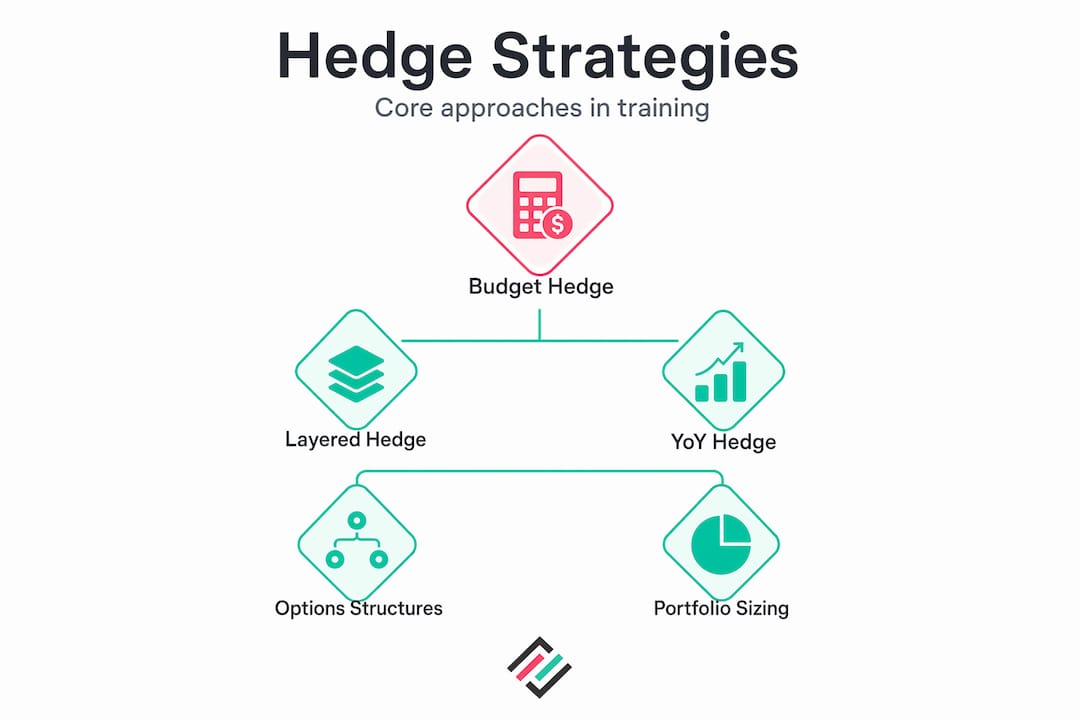
The hedge strategy selection process is where theory collides with corporate reality. Three primary approaches define most corporate currency hedging: budget hedges, layering strategies, and year-over-year hedges. Each solves a different problem.
| Strategy | Primary purpose | Typical coverage | Best suited for |
|---|---|---|---|
| Budget hedge | Lock in a rate for planning | 100% of forecasted exposure | Firms with fixed pricing cycles |
| Layering strategy | Smooth impact over time | Graduated, 20%–80% over months | Treasury teams managing rolling exposure |
| Year-over-year (YoY) | Protect prior-year FX rate | 50% of forecasted revenue | Companies reporting against prior-period benchmarks |
The YoY approach is underused by mid-market companies. Treasury teams often hedge 50% of forecasted foreign revenue in these strategies specifically to protect prior-year rates and smooth currency impact through the income statement. That number is not arbitrary. It balances cost against volatility absorption without over-hedging liquid positions.
On the portfolio side, advanced trading techniques taught in hedge academies focus heavily on options structures. Protective puts offer straightforward downside coverage, but collars create zero-cost protections by selling calls to finance puts, balancing cost and risk in volatile markets. In elevated volatility environments, collars are often superior to protective puts for return-focused investors because meaningful downside protection comes at a significantly reduced premium.

Sizing deserves its own conversation. Beta-weighted dollar exposure to the hedging index should drive how many contracts you buy, not a round percentage of the book. Targeting 50% to 100% coverage based on your actual downside conviction keeps costs manageable while protecting where it genuinely matters.
Pro Tip: Hedge costs exceeding 1%–2% per quarter of portfolio value signal a structurally expensive program. Before adding more protection, recalibrate sizing or switch to a collar structure to reduce premium outflow.
For companies operating in Polish zloty or Swedish krona exposures, specifically relevant given Corphedge's active expansion into Poland and Sweden, these three corporate hedge strategies map directly to currency risk strategies that treasury teams can implement within existing governance frameworks without requiring complete process overhauls.
Technology and quantitative methods in modern hedge training
The best hedge fund workshops and alternative investment training programs no longer treat quantitative skills as optional electives. They treat them as the foundation. Hedge academies build Python-based trading frameworks including data ingestion, signal generation, backtests, and live portfolio execution as a core part of the curriculum.
Here is what that looks like in practice:
- Data pipelines: Students build automated processes to pull and clean market data from multiple sources, creating the infrastructure for any systematic strategy
- Signal generation: Using statistical models to identify entry and exit conditions based on price, volume, or macro indicators
- Backtesting frameworks: Running strategies against historical data to measure expected performance, drawdown, and risk-adjusted returns before risking capital
- Live execution tools: Connecting strategies to brokerage APIs for real trade placement, position monitoring, and performance tracking
The value of this technical stack goes beyond getting a trade done. Performance attribution analysis, which isolates which parts of a strategy generated returns and which introduced drag, is what refines a hedge program over time. Without it, you are flying blind.
Ongoing hedge fund workshops within these programs serve a specific function. Weekly strategy meetings where participants review actual positions, debate sizing decisions, and pressure-test assumptions create the critical thinking environment that classrooms cannot replicate. For corporate treasury professionals, connecting with practitioners who build scalable equity research and quantitative processes provides a useful cross-disciplinary perspective on systematic risk management.
Pro Tip: If your hedge academy program does not include a live paper trading phase before you commit real capital or real corporate budget to a strategy, ask why. Simulation with immediate feedback is what converts academic understanding into consistent execution.
Implementing hedge academy training in corporate risk management
Knowledge from an investing academy or hedge fund workshops only generates value when translated into a repeatable, governed process. Here is how to structure that translation.
-
Document your full FX exposure map. List every currency pair, the size of each exposure, its time horizon, and whether it is a firm commitment or a forecasted transaction. This baseline determines which hedge strategy fits. Without it, you are selecting instruments before you understand the problem.
-
Match strategy to management objective. Budget hedges suit firms that need rate certainty for pricing models. Layering suits companies with rolling, forecast-dependent exposure. YoY strategies suit companies reporting performance against prior-period FX benchmarks. Misaligning strategy to objective is the most common treasury hedging error.
-
Calculate beta-weighted exposure before sizing. For portfolio managers, beta-weighted sizing targeting 50% to 100% coverage based on downside conviction produces more cost-efficient programs than blanket percentage rules. Apply the same logic to FX: size your forward book or options position to the actual exposure you want to neutralize, not to a round number that looks tidy on a report.
-
Govern counterparty and instrument selection. Hedge academy training emphasizes that the instrument choice, forwards, options, cross-currency swaps, affects both cost and counterparty exposure. Document approved instruments, approved counterparties, and concentration limits before any position is opened.
-
Automate monitoring and rebalancing triggers. A hedge that was correctly sized at inception will drift as exposures change. Automating alerts when your hedge ratio falls outside a defined band prevents the silent accumulation of unhedged risk that typically shows up in quarterly earnings reviews, not in treasury reports.
For enterprise-level guidance on reducing currency exposure, aligning these steps with formal risk policy documentation turns individual training into institutional capability.
My honest take on what hedge academies get right and wrong
I have watched professionals spend significant time and money on financial education that was technically accurate but operationally useless. The content was sound. The gap was context.
What translating theory into live execution actually does for you is force you to confront the cost-versus-protection trade-off in real time, not in a spreadsheet model. When I have seen treasury teams or portfolio managers implement hedge programs after genuine academy-style training, their first instinct shifts from "am I protected?" to "am I protected at a cost that makes business sense?" That reframe is worth more than most textbooks.
The area where even strong programs fall short is governance integration. Programs teach you how to build and size a hedge. They rarely teach you how to get a hedge policy approved, documented, and audited within a corporate structure. That institutional layer matters enormously in practice. It is the difference between a brilliant strategy that sits unused because legal or finance never signed off, and a functioning risk program that actually protects quarterly earnings.
My view is that hedge academies are most valuable for professionals who combine program training with a live software environment that tracks exposures and automates reporting. The training sharpens your judgment. The platform makes that judgment operational. Without both, you are halfway there.
— Bartas
Put your hedge training to work with Corphedge
Understanding hedge strategy design is the first step. The second is having the infrastructure to execute it without manual tracking errors, reporting gaps, or counterparty blind spots. Corphedge is built specifically for companies that need to move from hedge theory to governed, automated currency risk management at enterprise scale. The platform supports Value at Risk-based hedging, real-time FX position monitoring, and layered strategy execution for companies with complex multi-currency exposure, including firms operating in Poland and Sweden.
You can explore the full feature set for FX exposure management or take a self-guided walk through Corphedge's currency risk product tour to see how budget, layering, and YoY hedge strategies translate into an automated, auditable workflow. For teams working through value at risk-based hedging, Corphedge provides the quantitative framework that turns academy-level knowledge into daily operational practice.
FAQ
What is a hedge academy?
A hedge academy is a structured training program that teaches financial professionals how to design, size, and execute hedge strategies using institutional methods, including live capital management, quantitative tools, and performance attribution analysis.
What financial hedge strategies are covered in hedge academy programs?
Most programs cover protective puts, collars, put spreads, and corporate currency approaches including budget hedges, layering strategies, and year-over-year hedges targeting 50% coverage of forecasted revenue.
How do hedge academies differ from traditional finance courses?
Hedge academies emphasize live execution and real capital management rather than pure theory, producing desk-ready professionals who can implement risk management strategies immediately in institutional or corporate treasury settings.
How much should a corporate hedge program cost?
Sustainable hedge program costs should not exceed 1% to 2% of portfolio value per quarter. Costs above that threshold signal over-protection or inefficient instrument selection that should be restructured using collars or tighter sizing.
Are hedge academy skills applicable in corporate treasury roles?
Yes. Budget hedges, layering, and YoY currency strategies covered in advanced hedge training map directly to corporate treasury objectives, particularly for multinationals managing earnings against prior-period FX benchmarks.