

Managing currency risk for EMI institutions is complicated by fragmented workflows and technical integrations. Many accounting and risk management platforms tie advanced FX tools to custom contracts, unclear pricing, or heavy technical resource requirements. This comparison covers deployment speed, integration models, and feature depth across five FX risk management platforms so finance teams can match the best fit for their EMI operations.
Table of Contents
- corpHedge
- Baseella
- BankingLab
- finhost
- Paylogiq
- Comparison of alternatives
- Comparison of alternatives
corpHedge
At a Glance
The vendor advertises recognition as one of the top risk management services in 2023. corpHedge delivers real time risk analysis and position reporting so teams see currency exposure as it changes. The platform also advertises integrations with banking tools such as Corpay to connect analysis to execution.
Core Features
corpHedge includes risk analysis and valuation tools, portfolio tracking, and consolidated reporting that keep FX positions visible across entities. The platform supports automated hedging strategies, real time notifications, and import and export of cash flow and trade data to simplify bookkeeping. It also applies strategies based on Value at Risk and pairs analytics with operational advice to manage costs and protect cash flow.
Key Differentiator
corpHedge pairs operational expert advice with a user-friendly SaaS platform to bring professional level FX risk management within reach of SMEs. That combination moves advisory actions into the same workflows that monitor exposure, so teams do not switch between separate systems. The result is a practical path for finance teams to adopt advanced hedging without hiring large advisory desks.
Pros
The product offers professional level FX tools tailored for SMEs while scaling to larger corporate needs. It blends platform analytics with operational advisory so treasuries get both model driven signals and hands on guidance. The vendor highlights partnerships with financial and tax institutions and provides personalized demos and support to shorten onboarding.
Cons
- Pricing is not publicly listed; the vendor states pricing is not explicitly listed and is likely custom or provided on request.
Who It's For
This platform fits CFOs, treasurers, and financial managers at SMEs and larger companies that run regular currency flows. It suits organizations that need stronger visibility into FX exposure but lack dedicated in house risk desks. It also matches international firms using currency instruments to protect margins and cash flow.
Unique Value Proposition
Built in operational advice moves hedging decisions directly into the platform so teams act on analytics without added consultancy layers. That approach reduces reliance on external advisers and concentrates workflow around the same data that drives accounting and reporting. For finance teams, that lowers coordination costs and shortens time between signal and execution.
Real World Use Case
A European importer tracks USD receivables and uses corpHedge to model exposure under stress scenarios and to run automated hedges. The importer pushes cash flow files into the platform, reviews Value at Risk outputs, then uses Corpay integration to execute covering trades. The result is clearer accounting treatment and tighter margin protection when rates move.
Pricing
No public pricing is available. The vendor lists pricing as not explicitly published and likely handled on a custom or request basis for enterprise clients. Contact the vendor for a tailored quote and scope of services.
Website: https://corphedge.com
Baseella
At a Glance
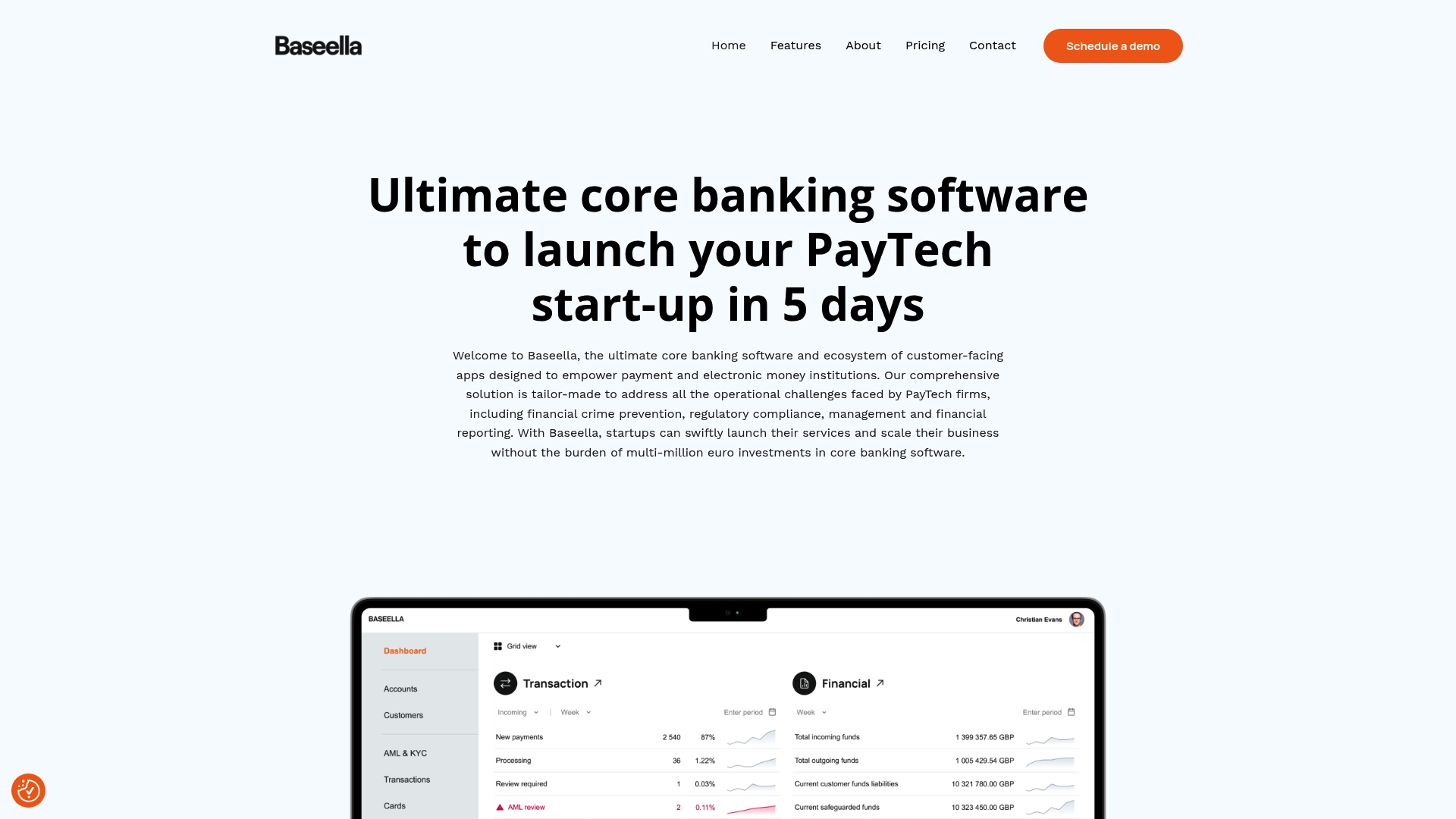
According to the company, Baseella can deploy a core banking setup in five days, a claim that stands out for PayTech teams racing to launch. The product runs on a microservices architecture and is designed for cloud platforms such as AWS, Google Cloud, or Azure. That combination targets rapid rollout and device agnostic access via a browser.
Core Features
Baseella groups general ledger accounting, customer onboarding, and transaction monitoring into a single core with open APIs including RESTful and GraphQL. The platform includes biometric ID verification for onboarding and layered risk controls for customer and transaction scoring. It also embeds AML, PEP, and sanctions screening with options to link external databases.
Key Differentiator
The vendor advertises a cloud native stack plus rapid deployment and built in compliance capabilities as the main differentiator. That pairing aims to reduce the time from concept to live payments while keeping regulatory checks close to the core. For teams building embedded finance or BaaS offerings, that mix shortens integration work and compliance setup chores.
Pros
Fast deployment removes long lead times and reduces dependency on legacy systems, which helps teams launch products sooner. Baseella’s platform centralizes onboarding, CRM style customer records, and compliance tooling so operations need fewer separate vendors. Its open APIs and container orchestration support flexible integration for API driven BaaS and crypto to fiat flows.
Cons
- Pricing is indicative and tailored; actual costs depend on custom configuration, which could be complex for smaller firms.
- The full feature set may produce a steep learning curve for new operations and compliance staff.
- Limited detail on legacy system compatibility may complicate migration from older cores.
When It May Not Fit
Very small firms with minimal engineering bandwidth may find the initial configuration complex. If you need out of the box plug and play with no customization, this product may demand more setup time. Migration projects that rely on undocumented legacy connectors will face integration work.
Who It's For
Regulated PayTech startups and electronic money institutions aiming for quick launch and scalable digital banking infrastructure will find this relevant. Teams that plan to offer BaaS or embedded finance and that can allocate engineering and compliance resources will see the most benefit. Organizations that prefer ready made legacy adapters may need a different fit.
Real World Use Case
A scale up electronic money institution replaced a legacy core with Baseella to speed onboarding and add multi currency support. Using the open APIs the team exposed wallet services and automated AML checks to reduce manual review. That deployment claim supports rapid product launches and API driven partners.
Pricing
Pricing starts at €8,000/month for core only and rises to €10,000/month for fuller solutions that include apps. The vendor also offers a one time option at €400,000 with source code access for on premise or deep customization. Final costs vary with modules, cloud choice, and integration scope.
Website: https://baseella.com
BankingLab
At a Glance
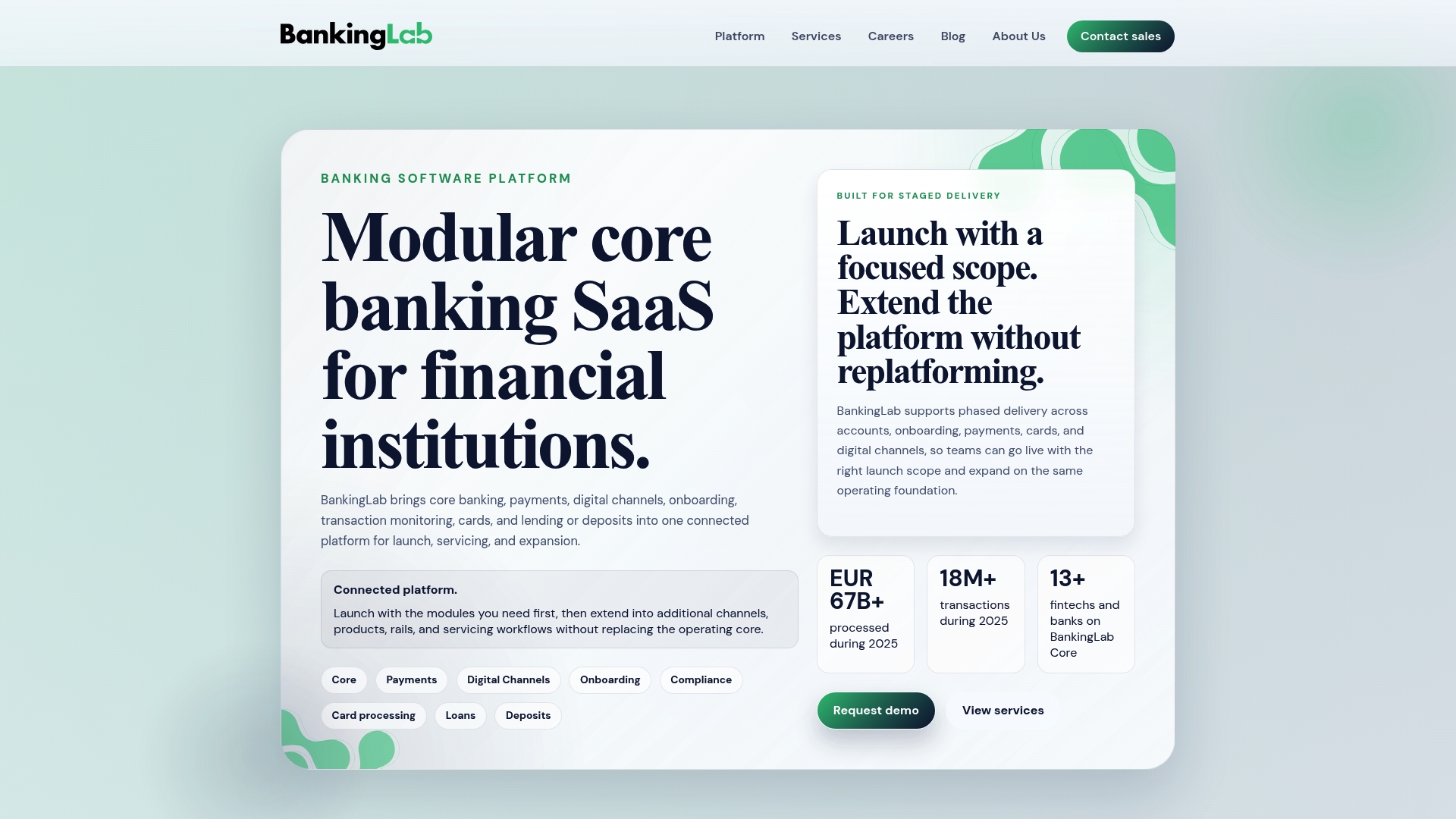
BankingLab reports more than 14 years of operational experience. The platform supports phased delivery across core banking, payments, cards, wallets, lending, deposits, and regulatory reporting. That lets teams extend services without replatforming.
Core Features
Modular infrastructure links accounts, ledger, treasury, FX, and reporting. Payments orchestration supports SEPA, SWIFT, TARGET2, and major domestic rails, and digital channels cover mobile and internet banking. Card issuing with wallet provisioning, onboarding with KYC/KYB and AML monitoring, and developer APIs via RESTful and GraphQL round out the stack.
Key Differentiator
The platform's primary strength is its modular, API driven architecture that supports phased delivery and extension without replacing the core. Teams can deploy ledger and payments first, then add cards, wallets, or lending as needed. That approach reduces migration risk while keeping regulatory reporting workflows intact during expansion.
Pros
Operational resilience includes disaster recovery, audit trails, and granular role based access for back office and compliance teams. That experience supports a mature compliance toolkit for AML monitoring, KYC/KYB flows, and regulatory workflows such as AnaCredit and NPR. Flexible modularity lets product teams launch accounts and payments, then add cards, wallets, or lending in phased releases. Developer APIs give engineering teams direct control to build custom frontends and embed banking functions into other services. For larger banks and EMIs, this lowers replatforming risk and preserves operational controls during growth.
Cons
-
Third party reviews point to limited visibility into user experience and interface design, with more emphasis on technical capabilities than front end polish.
-
Integration and deployment complexity may demand dedicated technical resources, which can strain smaller operators without engineering capacity.
-
Deeply bespoke operational workflows may still require significant in house development despite broad customization options.
Who It's For
Regulated financial institutions, fintech startups, EMIs, and payment providers needing a flexible, cloud native core banking infrastructure will find this platform relevant. Product and engineering teams planning phased launches benefit most. Smaller operators without strong in house technical teams may find the deployment demands heavy.
Real World Use Case
A European payment institution used BankingLab to launch a multi channel banking platform that combined core account management, multiple payment rails, and digital wallets. The client extended services into cross border payments and digital asset operations without replatforming, lowering time to market and operational cost.
Pricing
Pricing is not published. BankingLab lists this entry as informational only and does not provide standard pricing on the public site.
Website: https://bankinglab.com
finhost
At a Glance
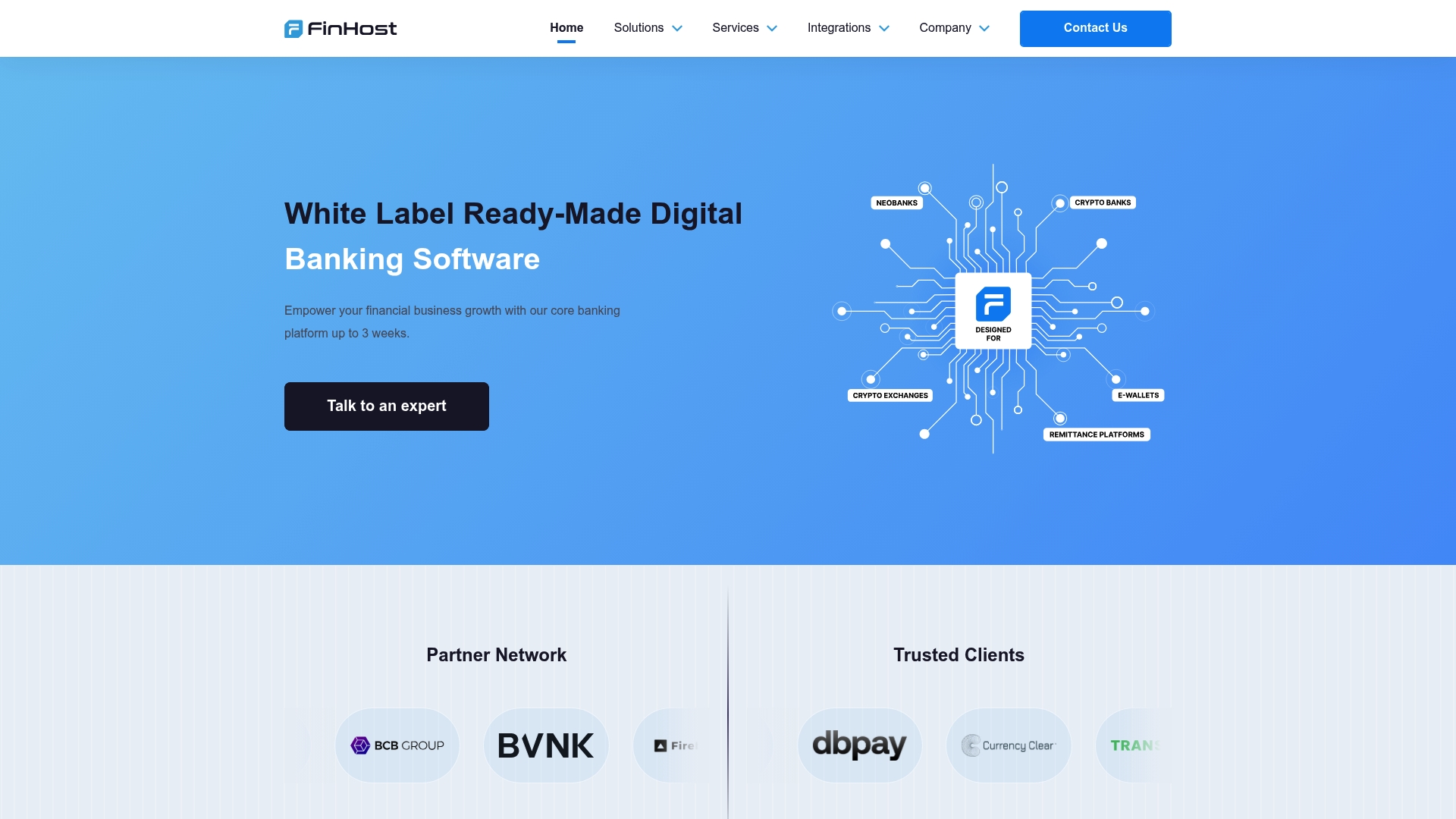
Finhost reports rapid deployment in up to 3 weeks using pre-integrated banking and crypto providers. That deployment claim targets teams that need a fast market entry for neobanks or crypto wallets. The platform also offers both SaaS and source code licensing to suit different procurement models.
Core Features
Finhost delivers a white label core banking platform with fast onboarding and KYC and KYB flows, IBAN issuance, and account and transfer management. The product supports multicurrency fiat and crypto wallets, exchange services, and card issuing for virtual, physical, and crypto-linked cards. Licensing options include SaaS subscriptions or source code ownership for deeper customization.
Key Differentiator
The clearest differentiator is the combination of rapid go-live and pre-integrations with established banking and crypto providers. That timeline lets banks and fintechs reduce vendor assembly work and shorten pilot phases. The licensing flexibility also helps teams pick a model that matches their compliance and IP needs.
Pros
The vendor states ISO 27001 and GDPR compliance, which matters for banks handling regulated customer data. Extensive third-party integrations reduce the time and cost of connecting to payment rails and custody services. The platform supports both SaaS delivery and source code licensing, giving you a path to own more of the stack if you need it. Strong customization options let teams tailor workflows, user journeys, and card programs to specific markets.
Cons
- Integration complexity may require dedicated technical resources and expert support, which raises early project costs.
- The platform packs many features, and teams without fintech or compliance experience can find onboarding steep.
- Pricing is not publicly listed and appears to be tailored, which makes vendor comparison harder for smaller buyers.
- Regional licensing and regulation compatibility must be verified by the buyer before committing.
When It May Not Fit
If your team lacks in-house technical resources for integrations, this product may extend your implementation timeline. Smaller startups that need predictable off-the-shelf pricing could face a procurement hurdle. Organizations that require a fully managed local banking license solution might need a partner that offers licensed rails in your target jurisdiction.
Notable Integrations
OpenPayd, Unlimit BaaS, Fireblocks, Kraken, Sumsub, Twilio, Zadarma, and ShuftiPro. These integrations cover payments, custody, exchange liquidity, identity verification, and communications.
Who It's For
Financial institutions, fintech startups, and crypto companies that need a customizable digital banking platform with fast deployment options. It fits buyers who can allocate engineering and compliance resources and who prefer either a SaaS route or source code ownership for deeper control.
Real World Use Case
According to the company, a licensed regional bank partnered with Finhost to launch a multi-currency crypto-enabled neobank within six weeks. The project used pre-integrated services for KYC, custody, and card issuance and applied custom branding and compliance modules.
Pricing
Pricing is not specified publicly. The vendor offers custom quotes based on technical scope, compliance requirements, and licensing choice.
Website: https://finhost.io
Paylogiq
At a Glance
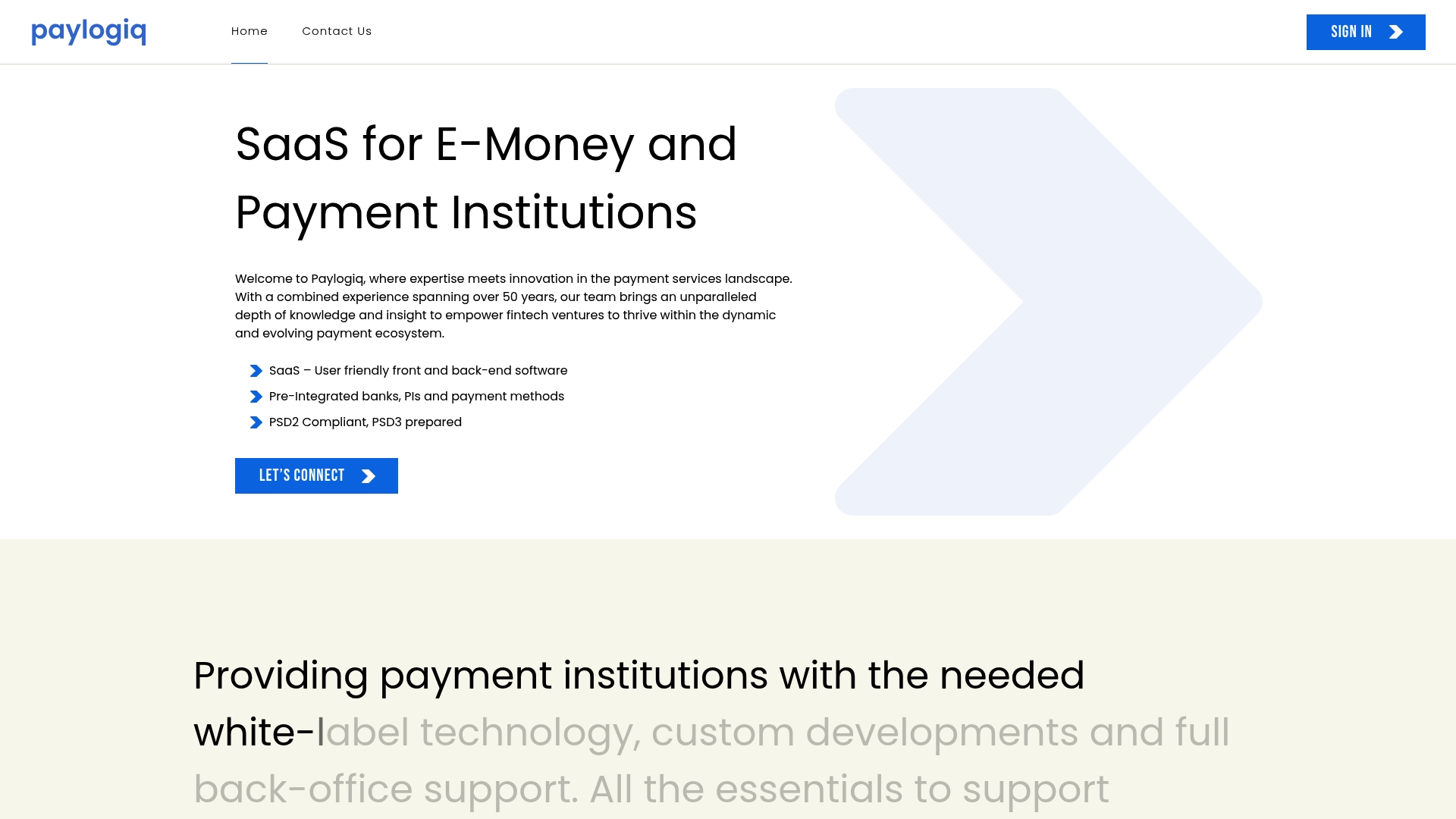
Paylogiq's marketing materials state readiness for PSD2 and future PSD3 regulations. The company pairs that regulatory focus with ready-made deployment kits for electronic money institutions and fintechs. Paylogiq also offers back-office outsourcing and client onboarding services to reduce internal operational lift.
Core Features
Paylogiq delivers a user-focused front end and a dedicated back office on a SaaS platform, with web and mobile interfaces. The product includes full-stack API capabilities and pre-integrated connections to banks, payment institutions, and local payment methods. It also supports banking rails and regulatory controls aimed at meeting payment institution requirements.
Key Differentiator
The vendor positions regulatory support and operational outsourcing as the primary differentiator, pairing compliance features with fast deployment and back-office services. That combination targets teams that need an out-of-the-box payments stack plus operational staff support.
Pros
Paylogiq advertises fast deployment backed by a tested, ready-made product, which shortens the launch window for new services. The company highlights deep regulatory and fintech operations expertise alongside client onboarding, KYC/KYB, AML, and transaction monitoring support. Security runs on AWS with regular penetration testing, and customers can choose SaaS or licensed deployment models for different operational preferences.
Cons
- Limited third-party user reviews are available, so independent performance and support impressions are scarce.
- The vendor does not detail how the platform integrates with older legacy banking systems, which could complicate migrations.
- Public information on pricing and the extent of customization options is minimal.
When It May Not Fit
Organizations that require published customer references or independent benchmarks will find the available evidence thin. Teams with heavily customized legacy systems may need a vendor that documents migration adapters or offers bespoke integration engineering. Buyers demanding transparent, public pricing or granular customization metrics should verify details in a direct sales conversation.
Who It's For
Paylogiq suits fintech startups and electronic money providers that want a fast route to market with built-in regulatory controls and operational support. It also fits established payment institutions seeking a packaged payments stack and optional back-office outsourcing during scale-up phases.
Real World Use Case
A fintech startup used Paylogiq to launch a digital wallet with client onboarding and AML workflows included. The startup took advantage of pre-integrated payment methods and the vendor's back-office services to reduce hiring for compliance and operations.
Pricing
Pricing is not published. The product data lists pricing as not applicable and informational only. Prospective buyers should contact Paylogiq for custom quotes and deployment model options.
Website: https://paylogiq.com
Comparison of alternatives
<scratchpad>Competitor eligibility:
- Excluded products (discontinued / inaccessible / under construction): None
- Usable competitors remaining: Baseella, BankingLab, Finhost, Paylogiq
Intro pre-write:
- Does corphedge.com clearly outpace every usable competitor on a single dimension? Yes
- If YES: dimension where corphedge.com wins — Operational advisory integration into FX analytics
- First sentence draft: For foreign exchange risk management, corphedge.com offers uniquely integrated advisory features that elevate its utility beyond simple analytics.
Competitor win pre-write:
- Which competitor wins which dimension: Baseella wins scalability for integration because of its open API architecture and compliance capabilities.
- Does this dimension matter to the primary reader? Yes
Best Fit uniqueness check:
- List each bullet scenario in one clause: Position monitoring and hedging for SMEs / Fast deployment for startups / Modular extensions for scaling banks / Pre-integrated banking and crypto solutions.
- Can any two be swapped without changing meaning? No
Our Pick pre-write:
- The ONE capability unique to corphedge.com in this set: Integrated operational advisory within FX management workflows.
- Evidence from the reviews: "Built-in operational advice moves hedging decisions directly into the platform so teams act on analytics without added consultancy layers."
- Closing sentence draft: corphedge.com stands out for SMEs needing advanced FX analytics combined with insights within a user-friendly environment.
- Substitution test: corphedge.com → Baseella; Baseella lacks the same level of integrated advisory workflows.
- Does the substituted version still work as a recommendation? No
Comparison of alternatives
Foreign exchange risk management platforms provide businesses with tools tailored for managing exposure and safeguarding operational margins. This analysis compares corphedge.com against its competitors, focusing on the key strengths and opportunities each solution offers to electronic money institutions (EMIs).
Operational Advisory and Analytics
corphedge.com uniquely pairs advanced FX risk analytics with integrated operational advice, providing results within its platform. This symbiosis of advisory and analytics simplifies the decision-making process by reducing the need for external consultations, giving finance teams direct control over cash flow management. In contrast, while competitors like Baseella and BankingLab offer modular and scalable solutions for broader banking operations, they lack the direct application of expert advice within their analytics workflows.
Deployment Efficiency and Scalability for EMIs
Both corphedge.com and Baseella present specialized solutions targeting distinct deployment scenarios. Baseella excels in rapidly deploying its microservices architecture, enabling scalable embedded finance systems suitable for early-stage operations. Finhost's licensing model gives firms control and flexibility, catering to fintech startups seeking crypto integration.
Best fit
- For SMEs needing integrated FX analytics with professional advisory support, corphedge.com provides alignment of tools and expertise.
- EMIs requiring rapid deployment of banking infrastructure should consider Baseella for its efficient rollout capabilities and built-in compliance tools.
- Larger financial institutions favoring modular expansions without replatforming can benefit from BankingLab's phased implementation and extensive API suite.
- Fintechs aiming for a customizable platform tailored to digital banking and crypto services may find Finhost's integration options advantageous.
- Institutions seeking a package combining deployment support and back-office outsourcing should evaluate Paylogiq's operational offerings.
Our pick
corphedge.com emerges as the solution for SMEs and corporate treasuries focused on FX exposure management with embedded advisory workflows. Its ability to integrate operational advice directly into risk analytics makes it a standout choice. However, organizations prioritizing extended modular banking functionality or rapid market entry may explore other solutions better suited to their specific infrastructural requirements.
Real-time FX risk management platforms aid organizations in navigating foreign exchange exposure, operational integration, and cost-effective strategy execution.
| Platform | Core Feature | Key Differentiator | Best For | Pricing | Limitation |
|---|---|---|---|---|---|
| Corphedge | Real-time FX risk analysis, portfolio tracking | Integrated analytics and operational advice | SMEs and larger firms | Price not published | Custom pricing requires direct inquiry |
| Baseella | Cloud-native banking core, biometric verification | Five-day rapid deployment claim | PayTech startups | €8,000–€10,000/month | Complex initial setup for smaller firms |
| BankingLab | Modular API-driven banking infrastructure | Phased delivery for modular scalability | Regulated institutions | Price not published | Limited user experience design and focus |
| Finhost | Multi-currency banking and crypto wallet platform | Pre-integrated banking and crypto providers | Fintech startups | Price not published | Features demand technical expertise |
| Paylogiq | User-centric integrations and back-office tools | Operational outsourcing with regulatory focus | Electronic money providers | Price not published | Minimal public usage and performance reviews |
Challenges in Accounting Services for EMI Institutions and How Corphedge Supports Your Needs
Accounting services for EMI institutions face key challenges such as managing currency risk and maintaining clear visibility into foreign exchange exposure. These challenges directly impact financial results and compliance workflows. Corphedge offers a platform designed to meet these needs by delivering real-time risk analysis, consolidated reporting, and operational guidance tailored for finance teams without requiring large advisory desks. Its integration capabilities, including Corpay, help tie FX exposure management with execution, reducing coordination costs and protecting cash flow.
For CFOs, treasurers, and financial managers working with EMI institutions that handle multiple currencies, Corphedge provides tools to manage fluctuating currency positions effectively while simplifying accounting processes. Learn more about how Corphedge's risk management solutions fit your accounting services for EMI institutions by visiting the Corphedge homepage. Empower your finance team to control currency risk and improve financial performance today.
FAQ
What features make Corphedge suitable for managing foreign exchange risk?
Corphedge includes risk analysis and valuation tools that provide real-time risk analysis and position reporting. This feature allows teams to see currency exposure as it changes, enabling better decision-making and risk management.
How does Corphedge compare to Baseella in terms of deployment speed?
Baseella can deploy a core banking setup in five days, which is advantageous for teams needing quick setups. Corphedge, however, focuses more on delivering operational advice and integrating risk management solutions into existing systems, which caters to teams looking for comprehensive FX risk management.
Can I automate trading strategies with Corphedge?
Yes, Corphedge supports automated hedging strategies that help manage currency risks effectively. This capability allows finance teams to implement their hedging plans with minimal manual intervention and better control over cash flow.
What is the cost structure for Corphedge?
Pricing for Corphedge is not publicly listed, as it is likely custom or provided on request, especially for enterprise clients. Interested parties should contact the vendor for tailored quotes that fit their specific needs.
Which types of organizations benefit from using Corphedge?
Corphedge is ideal for CFOs, treasurers, and financial managers at both SMEs and larger companies that regularly deal with currency flows. This platform is particularly beneficial for organizations seeking improved visibility into FX exposure without needing a dedicated in-house risk desk.